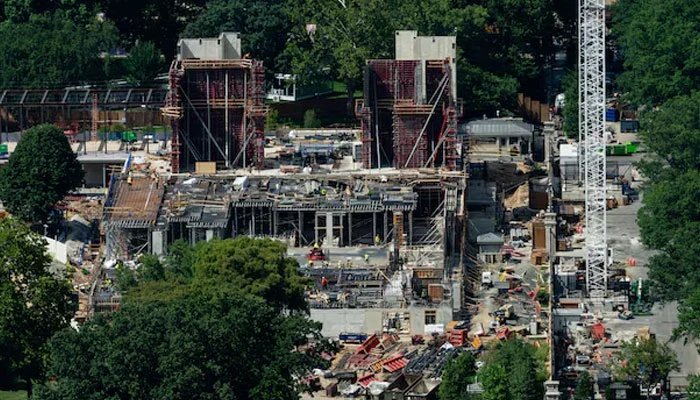
A federal appeals court in the United States has ordered the Trump administration to halt construction on a $400 million ballroom at the White House, built on the site of the former East Wing. The ruling presents a significant setback for former President Donald Trump as it tests the extent of executive authority over presidential property.
The Court of Appeals for the District of Columbia Circuit, in a 2-1 decision, emphasized that “each president is a temporary tenant, not the owner, of the White House,” and cannot make major alterations without congressional approval. This decision upholds an injunction granted to the National Trust for Historic Preservation, which challenged the administration last year after demolition of the East Wing and the start of the ballroom’s construction—an 88,360-square-foot project—without congressional approval.
The majority argued that the decision on whether to build a large ballroom is a matter for Congress, not executive self-help, and temporarily paused the project while allowing the Trump administration to pursue further appeals, including to the Supreme Court.
Trump, who has defended the project by claiming it’s essential for national security, posted on Truth Social that the court’s ruling was “horrendous” and politically motivated. He asserted the structure would include bomb shelters, medical facilities, and defenses against drones and missiles—integrated into a complex security system. Trump also called for the decision to be overturned, stating that the project is a major security upgrade.
Brent Leggs, president of the National Trust, praised the ruling as a victory for the country’s historic sites and the public’s right to voice their opinions about treasured landmarks, including the White House.
The dispute arose after lower courts, including a judge appointed by former President George W. Bush, repeatedly blocked surface construction while allowing underground work. The administration argued the project was necessary for hosting large events and ensuring White House safety—an effort that fits within a broader pattern of Trump’s attempts to reshape Washington’s iconic government architecture.
In a related case, a judge recently ordered the removal of Trump’s name from the exterior of the Kennedy Center, citing illegal placement.
During the appeals process, the Justice Department’s attorney contended that the courts shouldn’t intervene in a privately funded project and that national security concerns should take precedence over the National Trust’s aesthetic preferences. The appellate judges clarified that, while their ruling delays ground-level work, it doesn’t permanently block the project, emphasizing the importance of congressional approval for significant alterations.
One dissenting judge, Neomi Rao—appointed by Trump—criticized the court’s decision and argued that the project should be able to proceed, asserting the injunction was an overreach of judicial authority. Rao contended that the administration’s security features—costing more than initially projected and now doubled in price—should not be hindered by judicial rulings.
Overall, the case underscores ongoing tensions over presidential power, historic preservation, and national security considerations at one of America’s most symbolic sites.