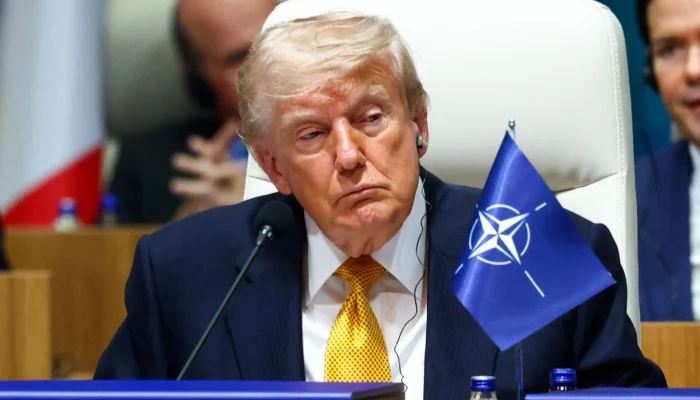
- Trump states, “No intention to negotiate” with Iranians.
- Iran’s lead negotiator claims the era of U.S. “bullying” is over.
- More than 60 IRGC boats targeted, according to Central Command.
On Wednesday, U.S. President Donald Trump declared that a temporary agreement aimed at ending hostilities with Iran has been terminated after Iran launched new attacks on U.S. military bases in the Gulf region.
The recent escalation worsened a fragile ceasefire, causing oil prices to spike sharply. Iran confirmed striking U.S. military installations in Bahrain and Kuwait, following U.S. retaliations against Iranian sites after strikes on commercial ships in the Strait of Hormuz.
This flare-up further disrupted hopes of formalizing the June 17 memorandum into a lasting peace treaty to end the ongoing conflict, which originated with U.S.-Israeli airstrikes on Iran on February 28.
Rising Oil Prices and Falling Stocks
Before attending a NATO summit in Turkey, Trump was asked if the agreement was over. He responded, “That’s a very interesting question. To me, I believe it’s over. I don’t want to deal with them.”
“They are sick people. They are led by sick people,” he added. “As far as I’m concerned, negotiating is pointless.”
Despite Trump’s occasional backing off from aggressive rhetoric, markets reacted with an immediate jump in oil prices and a decline in equities following his comments.
A source familiar with the Ankara discussions said Trump’s later remarks at the NATO summit did not echo his initial statement about ending the interim deal.
The renewed violence has also heightened security concerns in the Strait of Hormuz, with shipping data indicating that at least four oil and gas tankers have turned back rather than attempt to traverse the vital waterway.
Oil prices surged and global bond markets experienced declines. Brent crude jumped over 5% to $78.48 per barrel, marking the largest single-day increase since late May, adding inflationary pressures amid depleted global oil inventories.
Blame Game: Iran and U.S. Accuse Each Other
Iran’s Islamic Revolutionary Guard Corps (IRGC) claimed responsibility for targeting U.S. military sites in Bahrain and Kuwait and also reported shooting down a U.S. MQ-9 drone attempting to interfere with operations.
Bahrain’s armed forces later said they had thwarted Iranian attacks.
The U.S. responded with new military strikes and revoked an oil sales license for Iran following attacks on three vessels in the Strait of Hormuz.
According to Central Command, over 60 small boats operated by the IRGC were among the targets struck in an operation intended to impose heavy costs on Iran for violations of the ceasefire, especially regarding attacks on maritime shipping.
“Iranian forces’ unwarranted aggression is a serious violation of the ceasefire and threatens navigation freedom,” said Centcom in a statement.
NATO Secretary General Mark Rutte expressed that the recent U.S. strikes against Iran were “absolutely necessary” prior to the NATO summit. Meanwhile, EU foreign policy chief Kaja Kallas issued a statement on X (formerly Twitter), condemning the escalation: “The exchanges of fire between the U.S. and Iran complicate already delicate negotiations to end the conflict. Iran’s attacks on Bahrain and Kuwait are unacceptable.”
Iran’s top military command, Khatam al-Anbiya Central Headquarters, condemned the U.S. strikes as “a blatant act of aggression” and warned of a “crushing response,” asserting Iran would defend its interests and territorial waters against U.S. interference.
Parliament Speaker Mohammad Bagher Ghalibaf accused the U.S. of breaching the ceasefire agreements, citing recent military actions, renewed sanctions, violations of Iran’s “adjustments” in the Strait, and Israeli attacks on Lebanon as evidence of American violations.
Ghalibaf declared, “The era of bullying and extortion is over. We will not succumb.”
Iranian media also reported explosions at key oil hubs—Kharg Island, Qeshm Island, and the southern port cities of Sirik and Bandar Abbas—though the U.S. Central Command did not mention Kharg Island, which is responsible for exporting 90% of Iran’s crude oil.
A U.S. official noted that targets included Iranian air defense batteries, coastal surveillance systems, surface-to-air missile launchers, anti-ship cruise missiles, and drone launch sites.
So far, no civilian casualties have been reported in Iran.
Strategic Importance of the Strait of Hormuz
Controlling the Strait of Hormuz grants Iran significant leverage, effectively allowing it to stymie the military power of the world’s most advanced forces. Analysts often see Iran’s attacks on shipping as a bargaining tool in negotiations for a broader peace agreement with the U.S.
Under the temporary U.S.-Iran agreement, the U.S. Treasury issued a license on June 22 permitting Iran to sell crude oil and related products through August 21. With the license revoked Tuesday, Iran has until July 17 to wind down all transactions.
Iran’s foreign ministry called this move a breach of the peace framework, warning that Washington will bear full responsibility for any consequences and stating that Iran could take any measures necessary to defend its interests and security.