Tag: United States

  • Trump’s Misguided Assault on Overseas Voters Poses Risks

    Trump’s Misguided Assault on Overseas Voters Poses Risks

    I focus my research on racist and xenophobic rhetoric. As an American citizen who has been voting from abroad since 1996—first in the U.K. and currently in Canada—I bring a personal perspective to these issues.

    This background allows me to provide insight into Donald Trump’s recent post on Truth Social regarding overseas voters and the Republican party’s attempts to undermine them. Such statements are factually incorrect and politically perilous.

    The existing legislation that governs voting rights for Americans living overseas is the Uniformed and Overseas Citizens Absentee Voting Act, a law enacted by Republican President Ronald Reagan.

    The Department of Defense manages the federal program that helps U.S. citizens vote while living abroad—a fitting responsibility since many overseas voters are military personnel. This context should dispel any notions that facilitating overseas voting is somehow a liberal plot.

    Voting Complications

    Voting from overseas is far from straightforward. Each state has its own specific procedures for confirming citizenship after they receive the registration and ballot request, and these rules vary significantly from one state to another.

    For instance, my home state of New Jersey allows me to email my registration request, receive my ballot via email, and then send it back, but I must also mail the paper version of my ballot to ensure my vote counts.

    While this process is manageable for me from Canada or the U.K., it becomes much more challenging for Americans in regions with unreliable mail services, often forcing them to resort to costly courier options to fulfill their civic duties.

    Take my husband’s state, New York, for example. He can email his ballot request, but he is also required to send a mailed paper version of that request. The ballot itself comes with complex envelope templates that necessitate precise folding, and they must adhere to strict deadlines, regardless of their origin.

    The author’s husband and son complete their mail-in ballots.
    (Jennifer Saul), Author provided (no reuse)

    My husband, a former graphic designer, manages these requirements without much difficulty. However, picture someone with arthritis or vision problems attempting to navigate this process—especially with home-printed ballots containing small text. Voting from abroad is no small feat.

    Why, then, use provocative language to imply that generating numerous fraudulent overseas votes is straightforward? One possible motive is to create doubts about the election results. Any tactic that introduces uncertainty or hinders ballot counting could be exploited to allow Trump and his allies to falsely declare victory on November 5.

    Trump’s campaign has been explicit about its intent to follow this course of action.

    Portraying American citizens living abroad as less legitimate fits into a broader strategy of fostering division while defining stricter boundaries of who counts as a “real” American. This is a classic tactic associated with fascist ideologies, establishing a narrow “us” deserving of moral consideration against a broader “them” who are not.

    Marginalizing Citizens Abroad

    Critically, the movement against overseas voters extends beyond social media attacks. There are ongoing lawsuits across several states aimed at disenfranchising American citizens living abroad. These individuals often endure significant hurdles to fulfill their voting obligations, frequently incurring substantial personal costs in the process.

    Efforts from Trump and his allies aim to hinder the basic rights of citizenship for Americans overseas. When he or others claim that overseas voters engage in fraud or foreign meddling, it implies that those citizens are somehow not true Americans.

    This presents a serious issue, particularly since many Americans abroad are members of the military. Actions to disenfranchise these citizens also jeopardize the voting rights of our armed forces. Disenfranchising Americans overseas puts military personnel at risk of disenfranchisement as well.
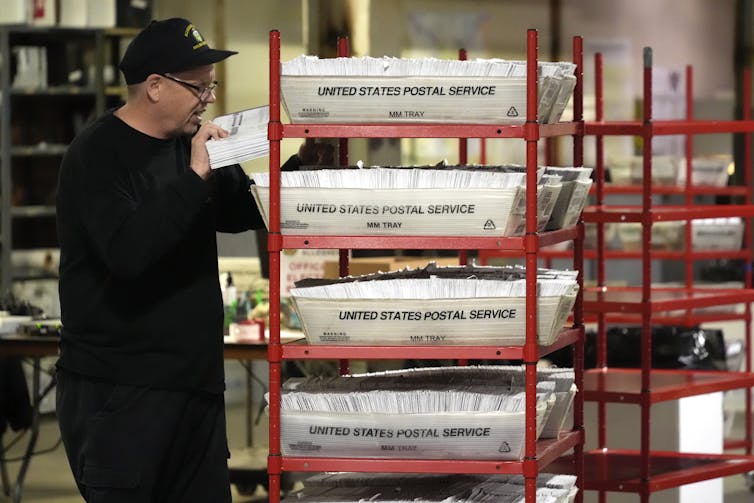
    A worker processes mail-in ballots in Pittsburgh.
    A worker processes mail-in ballots in Allegheny County, Pittsburgh.
    (AP Photo/Gene J. Puskar)

    Deceptive Narratives

    Trump’s claim on Truth Social that Democrats “want to dilute the TRUE vote of our beautiful military” is perplexing. This accusation becomes even more absurd when considering he is targeting the very legislation that enables military members to vote from abroad, ballots for which may include his own votes if they choose.

    I refer to this kind of rhetoric as a figleaf—a superficial statement that allows the speaker to veil a more controversial message. This particular accusation implies support for the military while intentionally obscuring its context.

    Moreover, Trump’s “diluting the vote” narrative aligns with the profoundly racist Great Replacement Theory. This theory asserts that Democrats and other shadowy forces (often anti-Semitically portrayed) are conspiring to replace white Americans with immigrants, as a means to secure electoral advantages.

    While overseas voting may seem a niche concern, the votes of these citizens could potentially influence close elections. Attacks on overseas voting are part of a much larger and troubling narrative from Trump regarding the identity of “real” Americans.

  • Is Kamala Harris’s Pro-Work Message Resonating in Anti-Ambition Era?

    Is Kamala Harris’s Pro-Work Message Resonating in Anti-Ambition Era?

    “Our ambitions and aspirations should be our baseline; we should not only aim to get by but strive to get ahead,” stated Vice President Kamala Harris as she unveiled her vision for an “opportunity economy” in a recent address.

    As a sociologist exploring how people perceive ambition and success, I’m intrigued by the wave of anti-ambition sentiment that has emerged recently, which stands in contrast to Harris’s optimistic viewpoint.

    A notable article in The New York Times Magazine from 2022 highlighted what it called a new “Age of Anti-Ambition.”

    While many embraced the notion that “ambition is out,” some suggested that ambition had merely transitioned to a more subdued version, as Fortune magazine noted that people seemed to be “less concerned with achievement for its own sake.”

    This raises an important question: Is Harris’s focus on ambition resonating with voters as the presidential election approaches? Do people still value ambition as a key to success?

    Changing Perspectives

    To understand this, let’s examine some data. The General Social Survey (GSS), which has been monitoring American attitudes and beliefs since the 1970s, poses a series of questions regarding the significance of various paths to success.

    This includes categories like “ambition,” “hard work,” “a good education,” “background privilege,” and “networking.” Respondents classify each factor as “essential,” “very important,” “fairly important,” “not very important,” or “not important at all.”

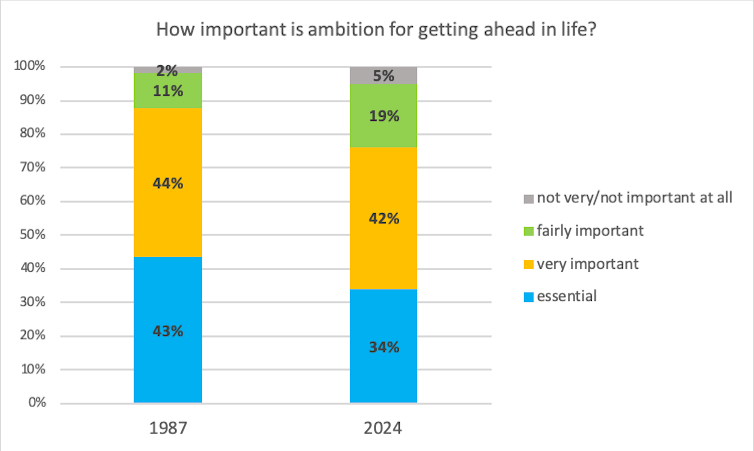
    In 1987, during the GSS’s inaugural survey on this topic, 43% of American workers considered ambition “essential” for success, while 44% deemed it “very important,” 11% said it was “fairly important,” and only 2% indicated it was “not very/not at all important.”

    The majority of survey respondents believe ambition is significant or very significant for achieving success, both in the past and present.
    (Mimi Thian/Unsplash)

    While I had my suspicions that ambition hasn’t waned among Americans, I wanted to substantiate my theory. Therefore, I enlisted YouGov to conduct two national surveys of 7,500 American workers in 2023 and 2024 for my research titled the MESSI (Measuring Employment Sentiments and Social Inequality) study.

    My 2024 findings reveal that while many American workers still acknowledge ambition’s importance, there are indications that attitudes have shifted somewhat.

    Specifically, the percentage of respondents who consider ambition “essential” has fallen by nine points since 1987, landing at 34%. Meanwhile, those who view ambition as “very important” decreased by two points (now at 42%), while those who perceive ambition as “fairly important” or “unimportant” surged by 11 points.

    This softening of views is noteworthy. However, if we are indeed in an anti-ambition era, why do three-quarters of American workers still regard ambition as very significant or essential?

    A bar graph represents survey findings about ambition.
    Survey results on ambition and professional achievement.
    (General Social Survey, 1987; Measuring Employment Sentiments and Social Inequality Study (MESSI), 2024, Scott Schieman, Principal Investigator)

    Catching Attention?

    Harris often underscores the “dignity of work” and the virtues of “hard work” in her speeches. However, in a landscape where anti-work narratives have surged, alongside newer phrases like “quiet quitting,” her celebrations of hard work may not speak to everyone.


    Read more:
    To combat quiet quitting, companies must take employee burnout seriously


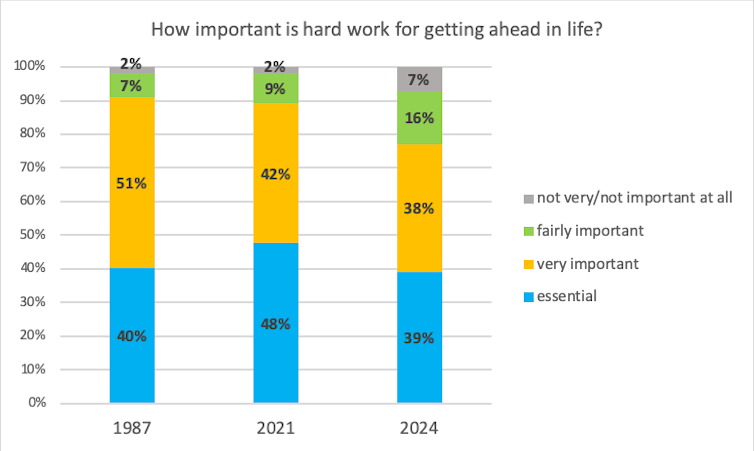
    Reflecting on the 1987 GSS, a remarkable 91% of working Americans believed that hard work was “very important” or “essential” for success. However, this figure dropped slightly to 89% in 2021 and fell to 77% by 2024.

    A bar graph displays the survey results on hard work and success across different years.
    Survey findings on hard work and professional success.
    (General Social Survey, 1987 and 2021; 2024 data from the Measuring Employment Sentiments and Social Inequality Study (MESSI); Scott Schieman, Principal Investigator)

    This 11-point decline might raise concerns. Yet, it’s worth noting that nearly 80% of American workers still value hard work, demonstrating its staying power — especially in light of ongoing narratives depicting employees as unhappy in their jobs since 2021.


    Read more:
    New research challenges the ‘unhappy worker’ narrative but indicates widespread belief in it


    Will to Work Harder

    A viral TikTok video explains that quiet quitting means you “quit the notion of going above and beyond.”

    Given the frequency of quiet quitting in discussions about anti-ambition, I was curious how Americans would respond to a GSS question about their willingness to work harder for their organization’s success.

    If quiet quitting has truly become prevalent, would it not be reasonable to assume that most Americans would strongly oppose the idea of going the extra mile?

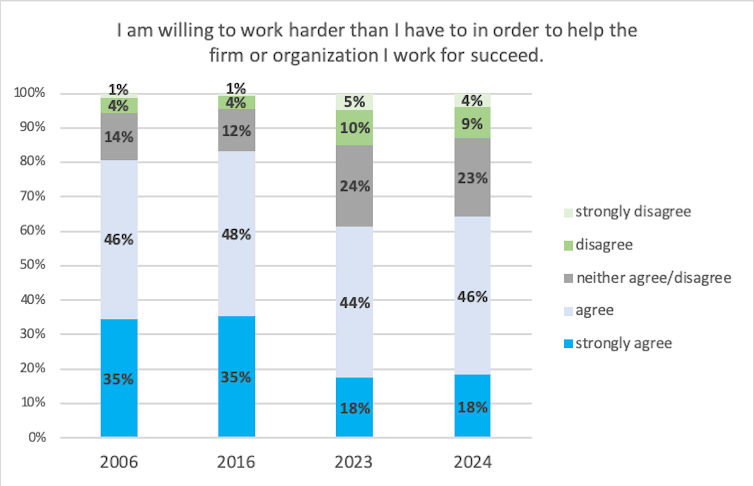
    In 2006 and 2016, eight in ten Americans expressed a willingness to put in extra effort. However, this number fell to 60% in my 2023 and 2024 MESSI surveys, suggesting an increase in ambivalence about giving that extra effort.

    A bar graph presents survey results regarding willingness to work harder for organizational success.
    Survey findings on willingness to work harder for organizational success.
    (General Social Survey, 2006 and 2016; Measuring Employment Sentiments and Social Inequality Study (MESSI), 2023 and 2024, Scott Schieman, Principal Investigator)

    ‘Hard Work Pays Off’

    So, what can we conclude? Broad claims that we are currently experiencing an era of anti-ambition, along with assertions that a majority are engaging in quiet quitting, lack strong foundation.

    While it is true that perspectives about ambition, hard work, and going the extra mile have evolved, the reality is more nuanced than media narratives suggest. Despite pervasive economic pessimism, a significant portion of the workforce still values hard work despite ongoing negative portrayals of job satisfaction since 2021.

    As election day approaches, Harris may face challenges in promoting her vision of an “opportunity economy.” However, her assertion remains steadfast: “Hard work is good work.”

  • Trump vs. Harris: Stark Disparities in Crime and Justice Records

    Trump vs. Harris: Stark Disparities in Crime and Justice Records

    While crime and criminal justice policy often take center stage in election discussions, they don’t seem to be major concerns for voters in 2024. Polls indicate that only a small number of American citizens view crime as their top priority.

    Nonetheless, both former President Donald Trump and Vice President Kamala Harris express a strong commitment to addressing these issues. Trump and the Republican Party have highlighted concerns around illegal immigration, including claims about the crimes associated with immigrants.

    On the other hand, Harris, as The Economist pointed out, is leveraging her background as a prosecutor in San Francisco to enhance her “tough-on-crime” credentials. She has connected her prosecutorial experience to topics like immigration, drug policy, and corporate misconduct.

    As a scholar of crime and justice in the U.S., I recognize significant contrasts between the two candidates, each of whom has a complex and intriguing history related to these issues.

    Kamala Harris: The Prosecutor

    Harris has a long history in the criminal justice system, beginning her career in the Alameda County District Attorney’s Office in California in 1990, focusing on child sexual assault cases. She later served as the District Attorney of San Francisco from 2004 to 2010 and as California’s Attorney General from 2010 to 2017 before her election to the U.S. Senate.

    According to Axios, during her tenure as District Attorney, violent crime in San Francisco initially increased steadily before declining by 15% in her final two years. As Attorney General, the violent crime rate in California dropped from 439.6 per 100,000 residents the year before she took office to 396.4 by 2014. However, it rose again to a high of 444.8 in 2016.

    Throughout her time in both roles, Harris implemented several reforms in criminal justice policy. One notable initiative was “Back on Track,” which aimed to assist nonviolent drug offenders aged 18 to 30. The program promised that participants would have their charges expunged after meeting certain conditions, like a year of consistent employment and community service. It received positive feedback, especially from progressive circles.

    Under her leadership, California’s approach to school truancy shifted focus to parents, threatening fines or imprisonment if they failed to ensure their children attended school. FactCheck.org noted that this led to a modest number of prosecutions, averaging three to six cases annually.

    The Desert Sun in Palm Springs remarked that Harris gained a reputation for being tough on sexual abuse, human trafficking, and organized crime, showing no hesitation in pursuing incarceration when necessary.

    Throughout her career, Harris has opposed the death penalty, pledging during her initial campaign for District Attorney that she would never seek a death sentence, regardless of the crime’s severity. While she upheld that commitment, she did defend death sentences issued by prior administrations while serving as Attorney General. The Los Angeles Times stated that her actions reflected the appropriate responsibilities of an attorney general, prioritizing her professional obligations over personal beliefs.

    CNN characterized her stance on capital punishment as having “broken hearts on both sides.”

    Donald Trump’s Presidency and Record

    In contrast, Trump was a staunch supporter of the death penalty during his presidency. In March 2018, he instructed the Department of Justice to pursue capital punishment for drug traffickers and actively defended death sentences in court.

    After an extended hiatus from federal executions, his administration carried out 13 in the last seven months of his term, according to ProPublica, marking the highest number of federal executions since Franklin D. Roosevelt and more than the previous ten presidents combined.

    Trump’s administration also limited some criminal justice reform initiatives. For example, his first attorney general, Jeff Sessions, halted efforts initiated by former President Barack Obama to end prison privatization and began issuing contracts for new private detention facilities.

    Despite advocating for tough-on-crime measures, Trump showed inconsistencies during his time in office. In March 2018, he established the Federal Interagency Crime Prevention and Improving Reentry Council to explore how to provide better opportunities for former offenders, aiming to develop a comprehensive strategy addressing mental health, vocational training, job creation, and more.

    The Biden administration later expanded on these initiatives.

    Additionally, in December 2018, Trump endorsed the “First Step Act,” which garnered bipartisan support in Congress. This legislation funded programs to reduce recidivism among released prisoners through features like addiction treatment and job training.

    During his presidency, Trump also commuted sentences for over 90 individuals and granted pardons to more than 140 others, a controversial use of clemency that included some of his associates, such as Steve Bannon and Paul Manafort.

    Regarding crime rates during Trump’s presidency, the Dallas Morning News noted that violent crime per 100,000 residents decreased annually during his first three years. However, it spiked in 2020, albeit slightly lower than its peak year under President Obama.

    Future of Crime and Justice Policies

    The next president will face critical decisions regarding federal crime and justice policies, particularly concerning whether to favor reform or impose stricter penalties. They will also need to determine how to allocate federal funding and resources to support their objectives.

    The contrasting records of Harris and Trump suggest they would approach crime and criminal justice issues with notably different philosophies and strategies.

  • FEMA Disaster Relief: The Politics of Hurricanes and Elections

    FEMA Disaster Relief: The Politics of Hurricanes and Elections

    Concerns and misinformation regarding government actions during natural disasters aren’t anything new. The interplay of politics, false information, and the tendency to deflect responsibility has long clouded responses to emergencies.

    Take, for instance, Hurricane Harvey, which battered Houston in 2017. During and after the hurricane, misleading information arose from various sources, including government officials, news outlets, and social media users. Following Hurricane Sandy in 2012, the spread of rumors was so extensive that it affected the accuracy of CNN’s live reporting.

    Typically, these rumors don’t originate from former presidents. However, in the aftermath of hurricanes Helene and Milton, former President Donald Trump made false statements regarding the federal government’s response efforts. The misinformation escalated to such an extent that the Federal Emergency Management Agency (FEMA) had to create a dedicated page to refute it.

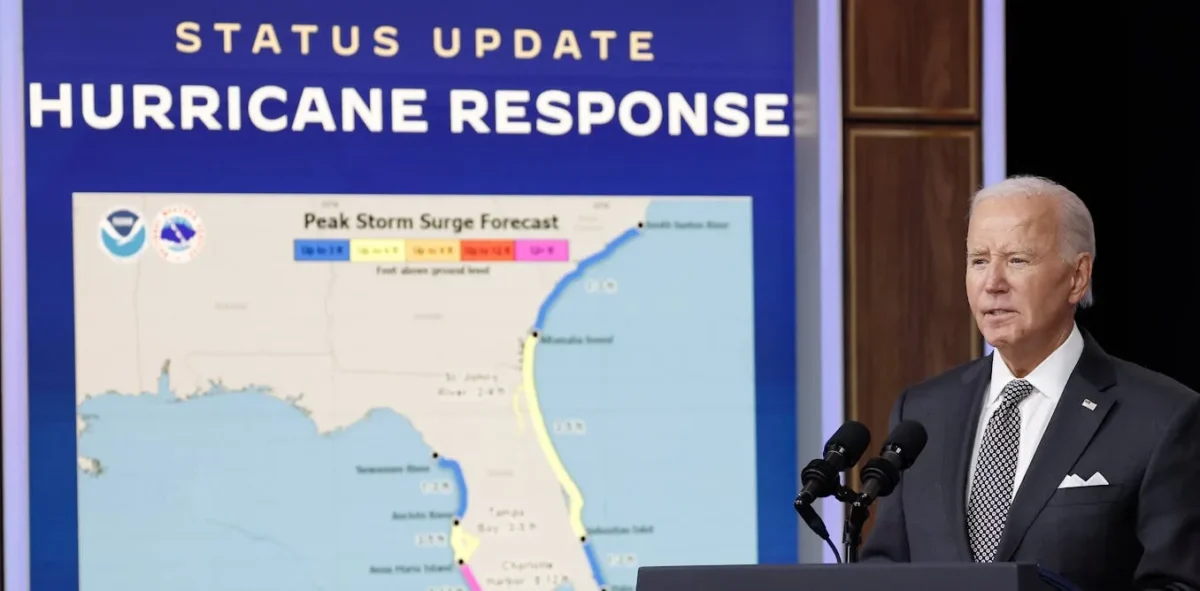
    President Joe Biden expressed his frustration, labeling Trump’s and his supporters’ claims as “reckless, irresponsible and disturbing.” He emphasized that these falsehoods could jeopardize the rescue and recovery efforts being executed by local, state, and federal agencies.

    Disaster relief often becomes a political issue due to the vast number of individuals affected and the extensive media coverage surrounding catastrophic events such as hurricanes and floods. Moreover, such relief efforts necessitate substantial financial resources and coordination among prominent elected officials.

    The complex nature of federal emergency management is further complicated by the fact that many people are not well-versed in the federal laws that dictate disaster relief procedures. Notably, even state and local leaders often struggle to fully grasp the intricacies of the law and its regulations.

    Additionally, the structure of the law, combined with the timing of hurricane season, can lead to heightened political tensions. Elected officials play pivotal roles in orchestrating government responses, which introduces a political element to disaster relief efforts. The overlap of hurricane and election seasons amplifies the politicization of these situations.

    Former President Donald Trump falsely claimed that the Biden administration “stole a billion dollars” meant for disaster relief to assist immigrants.

    Understanding Government Responses to Natural Disasters

    The law governing federal responses to natural disasters is the Disaster Relief Act of 1974, commonly referred to as the Stafford Act.

    However, this act does not ensure that federal assistance will be provided to communities impacted by hurricanes or other disasters.

    Instead, it requires the governor of the affected state or the head of an affected tribal government to request a disaster declaration from the president. This request can be made prior to or after a storm, but it must demonstrate that the disaster’s severity and magnitude exceed the responses that state, local, or tribal governments can manage independently.

    In response to such requests, President Biden has issued disaster declarations for eight states in connection with Helene. He also declared emergencies for the Seminole Tribe and the state of Florida regarding Milton.

    Once the president issues a declaration, the federal government can commence assistance to state, local, and tribal governments. This support encompasses coordinating disaster relief efforts—ranging from evacuations to recovery initiatives—afforded by federal agencies, organizations like the Red Cross, and local and state authorities.

    Federal assistance can take various forms, including financial and logistical support. It includes aid for restoring roads and utility services as well as providing essential services such as temporary housing, legal assistance, and crisis counseling for the disaster’s victims.

    The degree of involvement from federal agencies and personnel in disaster relief efforts is remarkable. For example, thousands of federal workers, spanning FEMA, the Coast Guard, the Army Corps of Engineers, the Environmental Protection Agency, and the Departments of Defense, Energy, Health and Human Services, Housing and Urban Development, and Transportation, are currently assisting with responses to Helene and Milton.

    Local and state officials also play critical roles once a disaster declaration is made. The governor of each impacted state or the tribal leader oversees coordination between state and federal efforts. They designate a point person to act as a link between state or tribal leadership and federal authorities. In each affected locality, an elected official, often a mayor, leads the on-ground response.

    The Practical Application of Federalism

    The effective execution of the Stafford Act requires collaboration among the president, federal agencies, and state, local, and tribal governments.

    When properly implemented, government disaster response exemplifies “federalism” in practice. This system shares power between national and state entities. The Founding Fathers established this framework to allow the national government to manage coordination issues among states while enabling state governments to address local-specific challenges.

    For instance, in response to state requests following Hurricane Helene, President Biden guided federal efforts to assist those in greatest need. The federal response has involved collaboration with over 450 state and local officials to ensure the provision of housing support and financial aid for medical and funeral expenses to affected individuals.

    The Element of Politics

    However, the federalist system envisioned by the Founding Fathers can lead to political manipulation. The Stafford Act’s framework for emergency management is designed to be decentralized and responsive to local feedback.

    Despite this intent, differing priorities among officials can lead to conflict. For example, during Hurricane Helene’s aftermath, various response leaders pushed for federal resources focused on restoring utilities, public safety, health services, communications, and transportation. With so many necessary services at play, how does the national government decide which deserves funding?

    This challenge is increasingly compounded by findings that elected officials and their appointees—who typically oversee these critical decisions—often lack the experience of career civil servants who regularly interact with affected communities.

    The outcome is that the Stafford Act’s choice to place elected officials and their appointees in charge of emergency management may compromise the efficacy of governmental responses.

    FEMA Urban Search and Rescue team members search a flood-affected area in Asheville, North Carolina, on October 4, 2024, after Hurricane Helene.
    Mario Tama/Getty Images

    Contemplating Government Size and Function

    The varying political affinities of elected officials introduce another layer of complexity. The discourse surrounding disaster response frequently mirrors broader political debates concerning the size and role of government.

    A historical overview of the Stafford Act reveals its evolution. In the past, managing disaster relief was primarily the responsibility of state and local authorities. However, significant disasters—such as the Alaska earthquake in 1964 and hurricanes Betsy in 1965 and Camille in 1969—necessitated federal intervention due to their vast scale.

    In the wake of Camille, accusations of racial bias in relief processes and partisan conflicts over accountability for ineffective government action emerged. Scrutiny from the media and Congress regarding the mishandling of these relief efforts opened avenues for the federal government’s increased involvement, leading to the initial passage of the Stafford Act.

    Fast forward 35 years, and many of the same issues—racial discrimination, government mismanagement, and the politicization of relief—resurfaced after Hurricane Katrina in New Orleans in 2005. Increased media and congressional focus resulted in legislation that updated the Stafford Act and altered FEMA’s role and the federal government’s approach to requests from states and tribes.

    Trump’s falsehoods rely on similar tactics—without evidence, he claimed that funds meant for disaster relief were misallocated to assist migrants and accused officials of only helping Democrat-leaning regions.

    Nevertheless, the destruction left in the wake of Helene and Milton raises significant questions about coordination between local and federal authorities in the forecasting and management of natural disasters. This has prompted renewed calls for Congress to implement reforms aimed at enhancing equity, efficiency, and effectiveness in governmental disaster responses. Whether such reforms can be enacted within the current politically charged environment remains uncertain.

  • Candidates Turn to Celebrities for a Change in Voter Tunes

    Candidates Turn to Celebrities for a Change in Voter Tunes

    It feels like we’re revisiting 2016, and to a certain extent, even 2020. Democrats are facing what appears to be yet another nail-biter election, with their nominee going up against Donald Trump.

    In a contest that may hinge on a few hundred thousand votes in just a handful of states, every voter is crucial—regardless of how you connect with them. With this in mind, Democrats are not only focusing on policy but also tapping into pop culture.

    In particular, Democrats are embracing football and Taylor Swift. The Harris-Walz campaign has showcased endorsements from 15 Hall of Famers in the NFL and is even selling Swiftie-style friendship bracelets on their campaign site, among other engaging initiatives. Notably, Taylor Swift herself has endorsed Kamala Harris.

    Tim Walz has pointed to his experience as a football coach and even mentioned Taylor Swift during the vice presidential debate.

    Democratic challenger and former NFL player Colin Allred, who is seeking to unseat GOP Senator Ted Cruz of Texas, has released ads that portray him as a gridiron hero.

    But how significant is this pop culture campaigning? Does associating a campaign with a sport, a cultural phenomenon, or a musical style genuinely sway voters? A look back at five different campaigns from history can shed light on whether this approach is effective.

    An advertisement for Texas Democrat Rep. Colin Allred, highlighting his background in football as he vies to unseat GOP Senator Ted Cruz.

    Reagan and Springsteen

    When discussing how candidates have engaged with pop culture, it’s essential to start with Ronald Reagan’s connection to Bruce Springsteen during the 1980s.

    Regan, aiming to broaden his appeal, perceived the 1984 election as a campaign defined by vibes, citing Springsteen as a representation of the optimism his campaign sought to evoke. However, Springsteen declined Reagan’s request to use his iconic song “Born in the U.S.A.” on the campaign trail. Although the melody might sound patriotic, the lyrics recount the struggles of a disenfranchised Vietnam War veteran.

    Reagan ultimately won 49 states in that election, but one lasting outcome of his outreach to Springsteen’s fanbase was transforming the artist from a largely apolitical figure to a strong Democratic advocate.

    This evolution echoes Taylor Swift’s journey, particularly with Marsha Blackburn, the Tennessee Republican senator who served as her Reagan—prompting her into political engagement after years of remaining neutral.

    Springsteen and Kerry

    Springsteen’s political involvement continued as he supported Democratic presidential candidate John Kerry in 2004 through a series of concerts known as the “Vote for Change” tour.

    Democratic presidential candidate John Kerry campaigns alongside musician Bruce Springsteen in Columbus, Ohio, on October 28, 2004.
    AP Photo/Laura Rauch

    Meanwhile, Kerry tried to demonstrate his connection to the common man through sports, but his outreach often went astray. At one point, he mistakenly named “Lambeau Field,” home of the Green Bay Packers, and referred to a fictional Boston Red Sox player, “Manny Ortez.” While these missteps didn’t seem to hurt his campaign in states like Wisconsin and Massachusetts, he experienced ridicule for a hunting photo-op late in the election, which severely impacted his standing with rural Midwestern voters and ultimately contributed to his loss.

    Kerry’s attempt to capitalize on hunting imagery was likely an effort to counter President George W. Bush’s image, which was bolstered by his portrayal as a strong leader, exemplified by his cowboy persona.

    Harding, Jolson, and the Cubs

    Though Reagan’s attempt to attract 1980s rock fans is one of the most famous examples of leveraging pop culture in campaigns, it wasn’t the first instance.

    Senator Warren Harding’s 1920 front porch campaign gained an infusion of excitement thanks to a visit from singer and actor Al Jolson. Harding also welcomed a host of celebrities and even the Chicago Cubs to his hometown of Marion, Ohio.

    Harding’s strategy is perhaps better viewed as a precursor to future campaigning styles rather than a decisive factor in the 1920 election, as his overwhelming win with over 60% of the popular vote indicates that no celebrity could have saved his opponent, Democrat James Cox.

    Bill Clinton and MTV

    As the Harris-Walz campaign seeks to engage Taylor Swift’s younger fans, we can draw comparisons to Democratic Arkansas Governor Bill Clinton’s efforts to connect with youth culture during the 1992 presidential election. Clinton made appearances where he took questions from young voters on MTV and even played saxophone on “The Arsenio Hall Show.”

    While it’s difficult to quantify the direct impact of Clinton’s youthful outreach, he did experience a notable uptick in support among young voters in comparison to Michael Dukakis’s campaign in 1988.

    In his 1992 campaign, Bill Clinton engaged with young voters on MTV, addressing questions that included, ‘If you had it to do over again, would you inhale?’

    Ford and Football

    No conversation about politicians tapping into football culture would be complete without mentioning Gerald Ford, known for his athleticism. Ford served as vice president before becoming the 38th President of the United States in 1974, following Richard Nixon’s resignation during the Watergate scandal.

    Ford played center for two national championship teams at the University of Michigan. While he didn’t emphasize his football background to the extent that Walz did during the Democratic National Convention, Ford did reference his athletic accomplishments on the campaign trail in 1976, often appearing alongside legendary Alabama football coach Paul “Bear” Bryant.

    However, it seems that a connection to football fans wasn’t enough to secure Ford’s place in the White House for long, as he lost the 1976 election to Democrat Jimmy Carter.

    Potential Gains

    Will the Harris-Walz strategy of leveraging pop culture resonate with voters? Swift’s audience consists mainly of younger, suburban women, while NFL fans are politically diverse. This suggests there may be valuable gains to be made with both demographics. The candidates believe it matters, as Walz stated that he “took football back” from Republicans, a claim Trump has challenged.

    Emphasizing pop culture credentials might also draw media attention to a campaign, regardless of whether voters feel connected to a candidate based on shared interests in football or music. Clinton’s forays into pop culture garnered significant media coverage beyond just the events themselves, proving to be cost-effective for a campaign with limited funds.

    This style of pop culture campaigning generates attention, even if voters aren’t swayed by the idea that a candidate shares their interest in football or popular music.

  • Can Trump’s hurricane claims overshadow Harris’s media push?

    Can Trump’s hurricane claims overshadow Harris’s media push?

    The next stage of the US election campaign is fast approaching, and it’s shaping up to be even more contentious than before. As hurricanes Milton and Helene made their way toward Florida and North Carolina, impacting at least four other states with tornadoes, storm surges, and widespread destruction, Donald Trump’s campaign team unleashed a slew of attacks targeting the government (i.e., the Democrats) for the poor weather and their response to the crisis.

    In a flood of misinformation, Trump falsely asserted that Vice President Kamala Harris was “wining and dining” in San Francisco while “everyone in North Carolina had no helicopters.” In contrast, facts revealed that the National Guard had already conducted 146 flight missions, rescuing 538 individuals and 150 pets.

    Trump’s allegations poured in, claiming that the national disaster fund had been allocated to illegal immigrants rather than to those affected by the storms. The Federal Emergency Management Agency (FEMA) felt compelled to clarify the situation and established a fact-checking section on its website. Meanwhile, Georgia Republican Congresswoman Marjorie Taylor Greene, notorious for her unconventional views on national emergencies, claimed, “they could control the weather.”

    Colleen Murrell, a former journalist and current professor at Dublin City University, believes that the spread of misinformation and disinformation will escalate on social media as the campaign enters its final stretch. She also noted that Kamala Harris has stepped up her media strategy this week by conducting interviews with influential news outlets.


    iliya Mitskovets / Alamy

    The world is closely observing the unfolding US election campaign. Join us for a special Conversation event on October 17, where expert panelists will engage with the audience about the upcoming election and its implications.


    With just under a month until election day, there’s everything to play for. Trump and Harris are virtually tied in the polls, and only the most daring are willing to wager on the outcome. The election is likely to hinge on a small number of voters in swing states who remain undecided, prompting both campaigns to ramp up their efforts, innovate strategies, and spend heavily.

    Hurricane Milton left three million people without power.

    Harris, who had initially shied away from collaborating with mainstream news outlets, is now rebranding her media approach. In a highlight interview with CBS, she spoke with seasoned journalist Bill Whitaker, tackling challenging topics such as the economy, immigration, and gun control (including her ownership of a Glock).

    As an editor with a global perspective on the US election, I’ve noticed Harris become significantly more at ease with her leadership responsibilities in recent months, even if she hasn’t always excelled in major speeches or quick media responses. However, her appearance on CBS showed noticeable improvement; she appeared more relaxed on camera and at times more succinct in her replies. Observers have noted her progress in handling such interviews compared to earlier in the year.

    In this highly competitive race, Harris needs to excel in every aspect. Her campaign has shifted gears after a summer focused on building her presence on social media—a strategy that helped her resonate with younger voters. Engaging with an established audience like 60 Minutes, with its 8.4 million viewers, presents a risk but one deemed necessary.

    During a recent media blitz, she appeared on various platforms, including The Howard Stern Show and The Late Show with Stephen Colbert, as well as multiple podcasts. While she seems more compelling in those informal settings, she is stepping up her performance in traditional interviews as well.

    Throughout the summer, the Harris team opted to avoid most conventional media appearances and focused instead on social media, which saw her adopting a more laid-back persona with a “brat summer” theme to attract younger votes, who are essential for turning out on November 5. Her campaign’s meme-driven success helped frame her as more approachable and relatable.

    However, social media only reaches a segment of the electorate. Those who rarely engage with platforms like Instagram and Twitter are more likely to tune into CBS instead of keeping an eye on TikTok trends. If viewers are not watching television, campaigns will need to take to the streets to engage them directly.


    In these times, staying informed about critical issues affecting global stability is essential. Subscribe to our weekly World Update newsletter, where every Thursday we’ll provide expert analysis on major international headlines.


    Seeking Every Last Vote

    Our regular correspondent covering the US election, Thomas Gift, has spent the last few weeks in Pennsylvania, sharing insights about the campaign landscape in this pivotal state. Recently, he described large Trump banners that have become a notable presence in the streets of Chambersburg, located centrally between Pittsburgh and Philadelphia.

    While Harris is expected to perform well in urban areas, Trump is likely to dominate the rural parts of Pennsylvania, which holds significant weight with its 19 Electoral College votes and fifth-largest population in the US. The real battleground will be in the suburbs, where both candidates are vying for votes. Suburban demographics have shifted in recent years, with a growing number of Democrats moving in, and the suburban population is increasing rapidly.

    Additionally, demographic changes are occurring in formerly industrial towns in Pennsylvania, where an influx of Latino voters has risen, attracted by new jobs in call centers, as noted by A. K. Sandoval-Strausz, a professor of history at Penn State University. Latino voters played a crucial role in Biden’s 2020 win, and according to recent Census data, Allentown now has a 54% Latino population. Notably, 53% of Pennsylvania’s Hispanic community is of Puerto Rican descent, traditionally leaning Democratic. Both campaigns are keenly aware of these opportunities.

    With Trump launching a massive campaign in the state, Harris is also significantly increasing her spending. Having attended high school in Pittsburgh, I am especially interested in Pennsylvania’s political dynamics, which are rapidly becoming a focal point in the race. Given that the winner of Pennsylvania is often seen as the potential president, this state will be crucial. In the last ten elections, Pennsylvania has voted for the eventual president eight times, as Gift pointed out in his recent commentary.

    Consequently, it is unsurprising that Harris and her allies have spent a staggering $21.2 million on political advertising in Pennsylvania—three times what they’ve spent in Georgia, twice in Michigan, and 18 times in North Carolina. Meanwhile, Trump’s team has invested $20.9 million in the state, significantly more than their spending in Georgia, Michigan, and North Carolina. This heavy financial commitment will keep Pennsylvania at the forefront of the campaign until election day, and possibly beyond.

    Gift will join my panel of experts at a special event next week, discussing why the results of this election hold as much importance for the world as they do for the United States. If you’re in London on October 17, please register to engage in a dynamic discussion about the significant global implications the new president will face.

    Stay updated with our weekly World Update newsletter. Click here to receive our insights straight into your inbox.


  • Understanding Trump’s Projection: Accusing Others of His Own Wrongs

    Understanding Trump’s Projection: Accusing Others of His Own Wrongs

    Donald Trump has a distinct method for communicating with both supporters and critics: he tends to call out the misdeeds of others, despite having engaged in similar behavior himself.

    On October 3, 2024, Trump accused the Biden administration of using Federal Emergency Management Agency (FEMA) funds—designated for disaster relief—to benefit immigrants. In reality, this claim is unfounded, as Biden has not done this. However, during his presidency, Trump did allocate FEMA resources for purposes such as expanding detention facilities.

    This isn’t the first instance where he has projected his actions onto others. In 2016, Trump criticized then-opponent Hillary Clinton for using a personal email server while serving as secretary of state, labeling it as “extreme carelessness with classified information.” Yet once in office, he continued using his unsecured personal cellphone. Trump has since faced criminal charges for unlawfully retaining classified documents after leaving the White House, stashing them in his bathroom, bedroom, and various locations at Mar-a-Lago.

    While criticizing Hillary Clinton for her mishandling of classified documents, Trump himself kept national secrets stored in a bathroom.
    Justice Department via AP

    More recently, a man armed with a rifle was arrested by the Secret Service for allegedly plotting to shoot Trump during a golf outing. Following this incident, Trump blamed Democrats for using “inflammatory language” that incites political violence. Yet, Trump himself has a track record of making inflammatory remarks that can potentially provoke violence.

    As someone who studies both politics and psychology, I’m acquainted with the psychological tactics that candidates employ to persuade the public and vilify their adversaries. Trump’s repeated use of a strategy known as “projection” exemplifies this; it involves minimizing one’s own faults by highlighting those same faults in others.

    Projection in Politics

    Numerous examples illustrate this phenomenon. During his debate with Vice President Kamala Harris on September 10, 2024, Trump claimed that Democrats were to blame for the assassination attempt against him on July 13, saying, “I probably took a bullet to the head because of the things that they say about me.”

    Earlier in that same debate, he falsely accused immigrants in Springfield, Ohio, of consuming pets, a claim that led to bomb threats and prompted the city’s mayor to declare a state of emergency.

    Similarly, both congressional investigators and federal prosecutors have pointed out that Trump’s rhetoric incited thousands of individuals to gather in Washington, D.C., on January 6, 2021, encouraging them to violently storm the Capitol to disrupt the electoral vote count.

    Trump is not the only politician to employ projection. His running mate, JD Vance, claimed that “the rejection of the American family is perhaps the most vile and damaging thing the left has done in this country.” Critics quickly noted that Vance’s family has a history of dysfunction and addiction.

    Projection is evident across the political spectrum. In response to Trump’s proposed 10% tariff on all imported goods, the Harris campaign took to social media to criticize the so-called “Trump tequila tax.” While Harris portrays this as a sales tax that would harm middle-class families, she conveniently overlooks the fact that inflation has already increased the cost of living for middle-class Americans since she and President Biden took office.

    The Mechanics of Projection

    Projection represents one instance of unconscious psychological processes known as defense mechanisms. Many individuals find it difficult to process criticism or acknowledge information they wish were untrue. As a result, they seek alternative explanations for discrepancies between their beliefs and reality.

    This behavior is often referred to as “motivated reasoning,” a broad term that encompasses various mental gymnastics people engage in to align their perceptions with the facts.

    Examples include searching for information that aligns with one’s beliefs, disregarding factual claims, or concocting alternative explanations. For instance, a smoker may trivialize or ignore data connecting smoking to lung cancer or convince themselves that they smoke less than they truly do.

    Motivated reasoning is not limited to politics. It can be a difficult concept to confront since individuals often perceive themselves as fully in command of their decision-making and believe they can objectively analyze political matters. Yet, evidence shows that unconscious cognitive processes play a significant role, too.

    Impact on the Audience

    Audiences are also vulnerable to similar unconscious psychological dynamics. Research indicates that over time, people subconsciously connect emotions with specific concepts, names, or phrases. Consequently, someone might react emotionally when hearing the terms “gun control,” “Ron DeSantis,” or “tax relief.”

    Moreover, people’s minds develop unconscious defenses for these automatic emotions. When their feelings and defenses are challenged, a phenomenon called the “backfire effect” may occur, wherein efforts to correct mistaken beliefs end up solidifying rather than altering those beliefs.

    For instance, some individuals might struggle to accept that their preferred candidate lost an election, believing instead that there must be another reason for it, such as a rigged process or widespread fraud. When presented with evidence that contradicts their beliefs, they may staunchly resist changing their views.

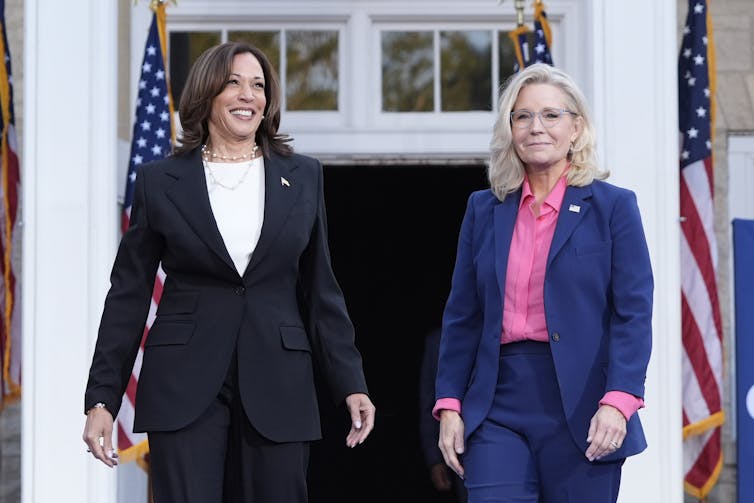
    Two women in suits stand on a stage.
    Vice President Kamala Harris has appeared on the campaign trail with Liz Cheney, a notable former Republican Congresswoman.
    AP Photo/Mark Schiefelbein

    Finding Solutions

    Fortunately, research suggests effective strategies to lessen people’s dependency on these automatic psychological processes. This includes clearly repeating and elaborating on factual information and, importantly, addressing falsehoods through trusted sources within the same political context.

    For example, challenges to Democrats’ views regarding the Trump-related conservative agenda, dubbed Project 2025 as “dangerous,” would be more impactful if articulated by a Democrat rather than a Republican.

    Likewise, a rebuttal to Trump’s assertion that the world is on the brink of World War III under the current Democratic administration would carry more weight if voiced by a fellow Republican. Statements from former Republican Vice President Dick Cheney asserting that Trump “can never be trusted with power again” would have a far greater impact when made by him rather than any Democrat.

    While critiques from within a candidate’s own party are not unrealistic, they remain unlikely given the highly charged environment of the 2024 election season.

  • Kamala Harris Steps into the Spotlight: Is It Paying Off?

    Kamala Harris Steps into the Spotlight: Is It Paying Off?

    Kamala Harris has noticeably shifted her media approach as the U.S. presidential election draws near. After spending much of the campaign steering clear of interviews, she has recently begun to actively engage with the media.

    The Democratic nominee showcased her leadership abilities during her appearance on 60 Minutes with Bill Whitaker, where she shared humorous stories and enjoyed a beer on The Late Show with Stephen Colbert. She also provided quick-witted responses on The Howard Stern Show and spent a full 40 minutes discussing women’s rights, domestic violence, and reproductive health on the popular Call Her Daddy podcast.

    As the presidential election approaches, Harris is making a concerted effort to connect with a diverse range of voters through her media presence. She appeared particularly relaxed and genuine on Call Her Daddy with Alex Cooper, discussing life lessons from her mother and how a friend’s experience with abuse inspired her commitment to advocating for those in need.

    This podcast, which addresses women’s concerns, boasts an audience of 5 million listeners. A recent Marist Poll conducted in Pennsylvania, a key swing state, reveals that Harris currently leads women voters with 55% support compared to former President Donald Trump’s 43%.

    The CBS 60 Minutes interview was particularly significant. This show, which averages around 8.4 million viewers, has been a staple for presidential candidates for over 50 years.

    A controversy arose just a week before the airing when Trump decided to withdraw, claiming it was due to concerns over the show’s fact-checking process. He had also demanded an apology from CBS regarding disputed claims from a past interview about Hunter Biden’s laptop, although CBS did not issue any remarks.

    Trump’s spokesperson, Steven Cheung, contended that the former president had never formally confirmed the interview, labeling it as “fake news.” CBS reporter Scott Pelley, who was set to interview Trump, criticized the shifting justifications for his absence.

    Before Harris’s 60 Minutes segment aired, I spoke with Nick Bryant, author of The Forever War: America’s Unending Conflict with Itself, who suggested that Trump’s withdrawal was strategic. “Scott Pelley is a seasoned professional,” Bryant explained, highlighting that the topics of abortion, January 6th, and the legitimacy of the 2020 election could lead to pointed questions that Trump would find risky to tackle.

    In contrast, Harris had much to gain from her interview as she has struggled with visibility despite performing well in debates against Trump. During what was a challenging interview, she faced inquiries regarding America’s stance on Israeli Prime Minister Benjamin Netanyahu, the funding of her economic policies, her administration’s approach to Ukraine, and her perceived inconsistencies on fracking, immigration, and Medicare.


    iliya Mitskovets / Alamy

    The world is paying close attention to the unfolding U.S. election campaign. Join us for a special Conversation event on October 17, where expert panelists – Thomas Gift, Natasha Lindstaedt, and Inderjeet Parmar – will explore the upcoming election and its potential implications.


    When questioned about her evolving policies, Harris did not deny the changes, as she had done previously. Instead, she explained that during her four years as vice president, she had traveled extensively to “listen to people and find common ground.” She emphasized her belief in the importance of building consensus, a statement that effectively set her apart from her opponent’s more polarizing tactics.

    Bryant expressed concern over Harris’s limited media interactions prior to this recent round of appearances, noting that she might have been “out of practice” and her earlier comments on the economy had been confusing and unclear.

    This time, it wasn’t economic questions that led her to falter, but her responses concerning Israel and Netanyahu. Following the interview, Fox News and the Trump campaign quickly alleged that her answer about Israel presented in the 60 Minutes preview differed substantially from her response during the main segment.

    They claimed that Harris had provided a chaotic answer in the trailer, while her actual response during the show was much more polished and well-structured. Trump’s national press secretary, Karoline Leavitt, questioned: “Why did 60 Minutes choose not to air Kamala’s full word salad, and what other edits might they have made?” So far, there has been no response from the 60 Minutes team.

    Last-ditch maneuvers

    Another issue that has troubled the Harris-Walz ticket involves claims that Governor Tim Walz falsely suggested he was in Beijing during the Tiananmen Square crackdown in 1989.

    He initially addressed this during the vice-presidential debate, admitting he had misspoken and calling himself a “knucklehead.” When pressed further during his segment of the recent 60 Minutes interview, Walz asserted that voters could differentiate between a simple mistake and the lies of someone like Donald Trump.

    Harris on 60 Minutes.

    After Trump’s disastrous showing in the September debate with Harris, he opted out of a second debate. This decision came in the wake of his answers generating widespread ridicule online, spurring countless memes regarding his bizarre claims about Haitian migrants in Springfield, Ohio, supposedly eating pets. Social media erupted in response similar to Republican vice-presidential candidate J.D. Vance’s earlier controversial remarks about the country being run by “a bunch of childless cat ladies.”

    Then Melania Trump added a surprising twist. In her newly published autobiography, she discusses her views on abortion, which stand in direct conflict with those of evangelical Republicans, a key Trump supporter group. “Restricting a woman’s right to choose whether to terminate an unwanted pregnancy is akin to taking away her autonomy over her own body,” she asserts. “I have held this belief throughout my adult life.”

    With the election rapidly approaching and both candidates so closely matched in polling, the intensity of the campaign is escalating. Expect more confrontations in the media as misinformation and disinformation continue to play a role in stirring division on social platforms, especially with Elon Musk, the owner of X, actively campaigning for a Trump victory.

  • Not a Fan of Trump or Harris? Here’s Why You Should Still Vote!

    Not a Fan of Trump or Harris? Here’s Why You Should Still Vote!

    Many Americans are feeling dissatisfied with the leading candidates for president from both major parties. As of October 4, 2024, surveys indicated that 46.5% of respondents held an unfavorable view of Kamala Harris, while 52.6% felt the same way about Donald Trump.

    This discontent has led some voters to consider supporting a third-party candidate or even abstaining from the election altogether. They may view these actions as a protest against the two-party system that prevails in the United States or against the candidates themselves.

    For instance, a poll conducted in September showed that 3.5% of voters in Michigan planned to cast their ballots for someone other than Harris or Trump.

    On the surface, this decision might seem logical: If you’re not a fan of a candidate, why vote for them? However, as someone who studies cognitive biases—systematic errors in judgment—I believe that opting for protest voting may not serve the best interests of these voters.

    In fact, protest voting could inadvertently undermine the democratic process, potentially resulting in the election of the candidate the majority of voters—protest voters included—disfavor the most. There are multiple reasons why voters may make this miscalculation.

    ### The Impact of One Vote

    It’s widely recognized that a single vote is unlikely to sway a presidential election. Some might argue that if one vote doesn’t carry much weight, then individuals might as well vote freely or skip voting altogether. This line of thinking is flawed.

    Consider a scenario where there are 10,000 voters in a state who feel disillusioned with both candidates. It’s very likely that these voters have a preference, disliking one candidate more than the other. Perhaps they disagree with some of Harris’ policies but feel intimidated by Trump, or the opposite might be true. Their dissatisfaction doesn’t require them to be united on all counts—some may think Harris is too liberal, while others may feel she isn’t liberal enough.

    Now, let’s say the remaining voters—those who are content to support one of the major candidates—are closely divided, perhaps by a slim margin of 5,000 votes. If the 10,000 disenchanted voters choose to vote for either of the two major candidates, their decision could tip the scales of the election.

    Moreover, these dissatisfied voters do have preferences; they generally favor one of the major candidates over the other. While each wants to keep their conscience clear by not voting, they typically hope that the other 9,999 unhappy voters take the initiative to steer the election toward their preferred candidate.

    Parents often instill the principle of the Golden Rule in their kids—treat others as you wish to be treated—and most people genuinely try to abide by it. This means that if you’re among the displeased voters who would like others in your situation to hold their noses and vote for the candidate they dislike the least, you should be open to doing the same.

    Yet, not all dissatisfied voters subscribe to this perspective. Some may allow their instincts to guide them, leading them to a protest vote, even if their values suggest otherwise.

    ### The Boycott Misconception

    One reason some voters believe a protest vote is sensible is the belief that boycotting undesirable options is a valid way to foster positive change.

    Boycotting a person or institution that you find objectionable can indeed be effective. For example, if there’s a local restaurant with a reputation for poor service or discriminatory practices, not patronizing it could lead to its closure or prompt it to improve its offerings.

    However, the concept of “boycotting” when it comes to voting is misapplied; one of the candidates will ultimately win, regardless of personal feelings. Not voting or abstaining from supporting a viable candidate doesn’t achieve the objective of eliminating or improving what one dislikes about the options available.

    ### Inaction vs. Action

    Some voters might resort to a protest vote based on a tendency to prefer errors of omission—failing to act—over errors of commission—taking action. Many individuals feel less culpable when they opt for inaction, even if both choices could lead to undesirable consequences.

    For instance, the omission bias could help explain why some hesitated to get vaccinated against serious illnesses. Choosing to get vaccinated can lead to potential side effects, which is seen as a mistake of commission. Conversely, not getting vaccinated might have the same outcome of illness, but isn’t perceived as a direct choice.

    In a similar vein, voting for a less-than-favorable candidate might feel like a mistake of commission. In contrast, skipping the vote or going for a third-party candidate seems like a safer omission. Yet, choosing this route doesn’t guarantee avoiding a mistake; it merely shifts the risk to one that feels less troubling.

    ### Misjudged Similarities

    A common rationale for opting out of voting or supporting a third-party candidate is the belief that both leading candidates are equally undesirable. However, this assertion almost certainly misrepresents reality; the candidates have distinctly different stances on a variety of key issues, as well as differing records of actions taken while in office.

    Those claiming the candidates are essentially interchangeable often fall victim to a cognitive shortcut that encourages categorical thinking. This mindset can simplify complex situations but overlooks significant differences.

    ### Pursuing the Best Outcome

    Reflecting on the 2000 presidential election, I remember a friend expressing that he couldn’t support Democratic candidate Al Gore, believing both he and Republican nominee George W. Bush were equally problematic. In retrospect, Bush’s victory—partially attributed to third-party votes for Ralph Nader—led to numerous outcomes that Gore would likely have opposed, including the U.S. withdrawal from the Kyoto Protocol, military action in Iraq, and tax cuts favoring the wealthy.

    The choices were indeed starkly different, and recognizing those differences before casting a vote is crucial.

    With the transition of power set for January 20, 2025, the nation will see either Trump or Harris in the presidency. A third-party candidate is unlikely to emerge as a real contender in this election.

    In certain states, voters have the option to rank candidates according to preference, allowing them to express their choices more effectively without wasting a vote on an unviable candidate. Those who desire more viable alternatives should work towards implementing ranked-choice voting in their communities or pursue other reform methods that might yield better options in the future. However, none of these changes will materialize in time for the upcoming election.

    Ultimately, whether you’re pleased with the choices or not, you face a binary decision: vote for one candidate or the other. Please make your voice heard—get out there and vote.

  • From Champions to Critics: The Shift in GOP Immigration Rhetoric

    From Champions to Critics: The Shift in GOP Immigration Rhetoric

    In today’s political landscape dominated by Donald Trump, it’s hard to believe that the Republican Party once embraced immigration and advocated for pathways to citizenship for undocumented individuals in the U.S.

    Take, for example, Ronald Reagan’s farewell address as president in January 1989, where he passionately praised immigrants as vital contributors who transformed America into a nation that is “forever young, forever bursting with energy and new ideas.”

    In stark contrast, Trump has normalized derogatory language and policies aimed at immigrants. During the current presidential campaign, he has shamefully referred to undocumented individuals as “animals” and claimed they are “poisoning the blood of our country.”

    Both Trump and his vice presidential pick, JD Vance, have propagated a false narrative suggesting that Haitian “illegal aliens” are responsible for the disappearance of pets in Springfield, Ohio. This misleading story illustrates their disregard for truth.

    Perhaps most alarming is Trump’s promise to initiate “the largest deportation effort in our nation’s history” if he regains the presidency. This pledge casts a shadow over the future of countless families.

    A Historical Perspective on Immigration Policies

    The concept of nativism, or hostility towards immigrants, has a long tradition in U.S. political discourse.

    In 1924, the U.S. implemented a stringent immigration quota system that focused on racial and national origins, envisioning a country predominantly composed of white, Anglo-Saxon Protestants.

    Interestingly, there were no restrictions on immigrants from the Western Hemisphere, as sectors like agriculture and railroads heavily depended on Mexican labor. These industries relied greatly on Mexican workers during this period.

    The quota system was abolished in 1965, replaced by visa preference categories that favored family and employment-based migrants, along with slots for refugees and asylum seekers.

    Fast forward to the 1970s, when violence and economic turmoil in Central America led to a notable increase in undocumented immigration to the U.S.

    In the late 1980s and early 1990s, the so-called “Latino threat narrative” began to dominate media narratives about immigration, largely fueled by Republican politicians in border states who gained politically by amplifying public fears.

    This growing negative rhetoric coincided with a significant rise in income inequality, a consequence of neoliberal policies pushed by Reagan and other Republican leaders.


    Read more:
    There is a long history of race-baiting and fear-mongering that predates Trump


    A Shift in Republican Immigration Rhetoric

    Historically, in the early to mid-20th century, Democrats were often the proponents of restrictive immigration policies.

    In contrast, many national-level Republicans, often backed by business interests, pushed for policies that facilitated the flow of labor across borders and increased legal immigration levels.

    Key conservative figures refrained from demonizing undocumented individuals, portraying immigrants as individuals striving for better opportunities for their families—this narrative highlighted a collective aspiration for the American dream. This perspective emphasized how immigrant labor contributed to economic growth.

    George H. W. Bush and Ronald Reagan engage in a 1980 Republican primary debate regarding immigration.

    Ronald Reagan, a defining conservative figure of the late 20th century, opposed building a border wall and supported amnesty over mass deportations.

    Reagan also strongly favored bipartisan immigration reform. In 1986, Congress enacted an immigration law that not only bolstered border security funding but also enabled 2.7 million undocumented immigrants, mainly from Latin backgrounds, to achieve legal status.

    Two decades later, President George W. Bush and Republican Senator John McCain advocated for a bipartisan measure that aimed to strengthen border enforcement while also “legalizing” around 12 million undocumented individuals. Unfortunately, this legislation was narrowly defeated.

    The vocal support for immigrants by influential Republicans during this time was noteworthy, especially considering that a majority of Americans were in favor of reducing immigration levels between the late 1980s and early 2000s.

    However, starting around 2009, the political narrative shifted dramatically. The Tea Party movement brought border security and sentiments of “racial resentment” towards immigrants into the spotlight, challenging mainstream conservative Republicans.

    Supporters of a controversial 2010 Arizona law that made it illegal to be in the state without proper documentation.
    Ross D. Franklin/AP

    Consequently, an increasing number of Republicans began adopting stringent and xenophobic rhetoric while backing legislation targeting undocumented immigration.

    Interestingly, during this period, the number of undocumented immigrants in the U.S. was actually declining, dropping from 12.2 million in 2007 to 10.7 million in 2016.

    Trump and the Resurgence of Nativism

    Amid the intensifying hostility towards immigrants, Trump launched his presidential campaign in mid-2015 by descending a golden escalator.

    In his inaugural speech, he placed immigration front and center, vowing to “build a tremendous wall” and alleging that Mexico was sending “rapists” and “criminals” across the border.

    Throughout his campaign, Trump frequently employed anti-Mexican rhetoric and advocated for Islamophobic immigration policies. This antagonistic approach towards immigration was pivotal to his success during both the Republican primaries and the general election against Hillary Clinton.

    Once in power, Trump embraced a “zero tolerance” policy on undocumented immigration. His administration implemented an emotionally devastating family separation policy that tore children away from their undocumented parents at the border. Conservative media, including Fox News, heralded this approach.

    During his presidency, Trump nearly halved legal immigration rates, significantly limited the intake of refugees, and enacted bans on individuals from predominantly Muslim countries.

    According to policy analyst David Bier, there has been a noticeable shift in Republican lawmakers’ priorities:

    It seems that the focal point of the immigration narrative is no longer about legality; the primary aim appears to be minimizing the presence of foreigners within the United States.

    Trump’s vision was marked by overt racial undertones.

    In a 2018 meeting, he infamously inquired why the U.S. should accept immigrants from “shithole countries” such as Haiti or El Salvador, expressing a preference for immigrants from Norway instead.

    Immigration’s Role in Elections

    Between 2021 and 2023, undocumented crossings at the U.S.-Mexico border surged due to natural disasters, economic strife, and violence in various Latin American and Caribbean countries, with many newcomers seeking asylum.

    Although the numbers have dropped sharply in 2024, immigration remains a crucial issue for voters across all political affiliations, particularly in key battleground states like Arizona.

    In 2024, Trump’s prominent immigration pledge was symbolized by enthusiastic delegates at the Republican National Convention, waving signs proclaiming “Mass Deportations Now.”

    Trump and Vance have attributed nearly every economic and social challenge to undocumented immigrants, painting them as a threatening and incompatible “other” to American culture.

    Despite this rhetoric, Trump, during both his presidency and his candidacy, has actively blocked border security legislation. Turmoil at the border serves his political interests.

    Moreover, his nativist stance now extends to all types of immigration—he has vowed to limit legal immigration channels as well.

    This rhetoric has profoundly influenced public perception. Between 2016 and 2024, support for the deportation of undocumented immigrants rose from 32% to 47%.

    By July 2024, 55% of Americans expressed a desire to see immigration levels reduced—an increase of 14 points in just one year.

    Many Americans no longer view immigration as a source of renewal and vitality, as they once did. Instead, they increasingly see immigrants as a significant threat to the nation’s future, reflecting the rhetoric employed by Trump.

  • Trump’s Economic Plan: Impact on the US and Australia Explained

    Trump’s Economic Plan: Impact on the US and Australia Explained

    It’s time to start taking Donald Trump seriously as a contender for the presidency. Betting markets indicate there’s a near 50% chance he will be elected in just four weeks.

    Unlike the 2016 election, where his platform was vague, Trump has clearly outlined his intentions for a potential second term. This clarity allows for a meaningful analysis of the potential consequences of his policies.

    The three key promises from Trump with the largest economic implications include:

    • Deporting millions of unauthorized residents in the U.S.
    • Imposing stringent tariffs on imports, particularly from China.
    • Exercising presidential influence over interest rate decisions.

    To best understand the ramifications of these policies, we can rely on well-established economic models, such as those utilized by the International Monetary Fund and various central banks, rather than models specifically tailored to either support or criticize Trump.

    The Peterson Institute for International Economics, based in Washington, D.C., has conducted an analysis using these established models. They observed that throughout Trump’s first term, he largely followed through on his commitments.

    Their findings suggest:

    > Ironically, despite his rhetoric about forcing foreign entities to “pay up,” Trump’s proposed policies are more detrimental to the U.S. economy than they are to any other country in the world.

    No nation would experience as much harm from Trump’s policies as the United States—China included, though several U.S. allies, such as Australia, would also feel significant effects, ranking as the fourth most impacted country under the worst-case scenario outlined by Trump.

    Mass Deportations

    Trump has consistently promised the “largest domestic deportation initiative in U.S. history,” targeting up to 20 million unauthorized immigrants, about 8.3 million of whom are believed to be part of the workforce.

    He cites Operation Wetback—a program from the Eisenhower administration in 1956 that used military tactics to deport 1.3 million Mexicans—as his model.

    The Peterson Institute argues that Eisenhower’s successful efforts contribute to the belief that Trump could feasibly remove 1.3 million immigrant workers. They modeled two scenarios: one where 1.3 million are deported and another with 8.3 million, both carried out over the years 2025 and 2026.

    Both scenarios result in significant job losses, affecting not only immigrants but also non-immigrant employment. They would also lead to increased inflation—a situation that, although eventually stabilized, makes the U.S. a less appealing destination for investment, benefitting other nations.

    The analysis shows that the difference between the lower and higher scenarios primarily lies in the extent of harm inflicted on families, businesses, and the broader economy.

    Sweeping Tariff Increases

    Trump’s proposal involves raising tariffs on all imported goods by 10 percentage points, even on items currently duty-free, and placing tariffs of at least 60% on imports from China. The Peterson Institute has examined the outcomes of these tariffs, considering scenarios both with and without retaliatory measures from China and other nations.

    As expected, the additional tariffs would raise the cost of imports to the U.S. and also elevate prices for domestically produced items that compete with those imports. Many of these items are critical inputs for U.S. manufacturing, leading to a decline in this sector, which is likely contrary to Trump’s objectives.

    The reduced volume of imports translates to less demand for foreign currency in the U.S., resulting in a stronger dollar and diminished competitiveness for U.S. exports. While the U.S. economy may initially appear solid, it would ultimately weaken, with China suffering even more acutely. Australia, due to its resource provision to China, would face similar vulnerabilities.

    Undermining the Federal Reserve

    Trump has suggested the possibility of increasing presidential influence over interest rates, stating that he believes he might have “a better instinct than the board of the Federal Reserve” in many situations. This could manifest in requiring the president’s consultation on rate decisions or appointing a more compliant Fed chair.

    The Peterson Institute’s analysis suggests that such influence could push inflation up by two percentage points, based on patterns observed in developing nations with less central bank independence.

    The predicted outcome is capital flight; while the U.S. economy may initially benefit from the Fed’s tolerance of higher inflation, it would eventually weaken, with other economies experiencing growth as a result.

    Overall, when combining all these proposed measures, extreme scenarios suggest the U.S. economy could be 6.7% weaker by 2035, compared to a baseline forecast, while Australia could see a 0.2% decline. Under more moderate scenarios, the U.S. could be 1.6% weaker, with Australia’s decline at 0.06%.

    Considering Alternatives

    Despite its history of non-partisanship, the Peterson Institute is prepared for potential backlash. It emphasizes that the economic model used is deemed the best globally for scenario planning and was developed by Warwick McKibbin from the Australian National University.

    The Institute chose to model Trump’s policies instead of those of Vice President Kamala Harris, as Trump’s proposals indicate a marked departure from current practices. Harris’s campaign has indicated she will avoid wholesale tariffs, mass deportations, and interference with the Federal Reserve’s independence—positions Trump has signaled he would pursue.

    While there’s always a chance that Trump may not follow through on all his campaign pledges if elected—possibly changing course if the consequences are as damaging as projected—there’s merit in considering his stated agenda as a framework for what might lie ahead following a closely contested election.

  • Kamala Harris Faces Age-Old Double Standards Again

    Kamala Harris Faces Age-Old Double Standards Again

    The recent U.S. presidential debate featuring Kamala Harris and Donald Trump was marked by numerous jabs from both candidates. Trump was able to attack Harris, questioning her intelligence and loyalty to the nation. However, Harris faced a different set of circumstances that limited her ability to respond in kind.

    So, why is that?

    One significant factor is the societal expectations surrounding women in leadership roles. The upcoming 2024 election highlights two distinct visions for America’s future, providing a platform to analyze the political language used by both candidates as they seek to connect with voters.

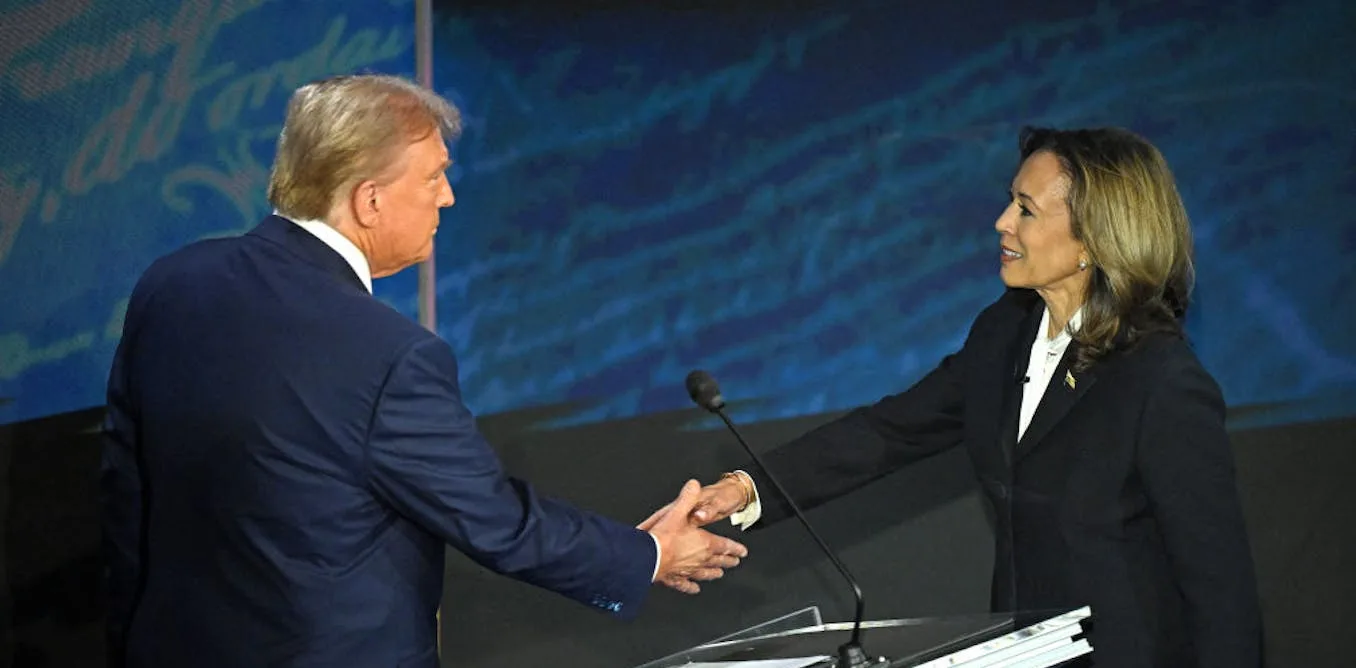
    Donald Trump and Kamala Harris engage in a handshake during the ABC News presidential debate at the National Constitution Center, in Philadelphia, on September 10, 2024.
    (The Associated Press, Alex Brandon)

    This election marks only the second time a Democratic woman is competing against a Republican man. While Hillary Clinton’s race against Trump in 2016 was historic, the media still finds it noteworthy to report on a female presidential candidate, which remains relatively rare. Should Harris win, she wouldn’t just be the first woman president—she would also be the first woman of color to hold the position.

    Given the limited number of women who have ascended to such high-ranking offices in the U.S., the landscape can be perplexing for politicians and the media alike. Female politicians may struggle to determine the best campaign strategy, while the media may need to reassess how they report on these candidates. Voters might also feel uncertain about how to engage with a female candidate on an equal footing.

    In my research at the Université du Québec à Trois-Rivières and my involvement with the Chair on Leadership and Political Confidence, I delve into how women in politics are portrayed in the media and the challenges their leadership styles present. I have previously explored these themes in various La Conversation articles.

    Unequal Standards

    Harris finds herself subject to intense scrutiny regarding her fashion choices and personal life, reflecting a double standard. These discussions often highlight criticisms uniquely aimed at women, while similar attributes in men may be praised. For instance, men might be labeled as assertive, while women are seen as overbearing.

    Research indicates that negative media coverage concerning a female politician’s attire can harm her electoral prospects. Studies have shown that when the media focuses on women’s appearances, it can diminish their support from voters significantly. Conversely, attributes like decisiveness and ambition are often stereotypically viewed as masculine traits.

    A man in a suit looking to his left
    Former President Donald Trump addresses reporters after his debate with Kamala Harris.
    (The Associated Press, Matt Slocum)

    In essence, female politicians face a political landscape riddled with challenges, where double binds and gender stereotypes heavily influence public perception. Emphasizing nurturing traits can often hinder rather than help women in politics. Research indicates that voters typically favor masculine traits, especially during times of crisis.

    Harris’s task is to project the image of a presidential candidate while navigating the tough terrain left by Clinton, who previously attempted to shatter the glass ceiling. How does Harris tackle these hurdles in this unique context?

    Her strategy involves crafting a positive narrative that illustrates her as a capable, genuine leader who empathizes with everyday Americans and their concerns.

    Connecting with the Middle Class

    Harris positions herself as a candidate who relates closely to the electorate and understands their day-to-day realities. This tactic aligns with the proximity aspect of the leadership triangle proposed by Diego Ceccobelli and Luigi Di Gregorio, political communication researchers with whom I collaborate. According to their theory, leaders are evaluated based on three core traits: competence, authenticity, and proximity.

    In line with this framework, Harris emphasizes her middle-class upbringing and her experience as the child of a single mother who worked tirelessly to support her family in a working-class neighborhood in California. Her mother prioritized education and homeownership for her family. Harris weaves this narrative into her speeches, social media posts, debate performances, and interview responses.

    This positioning serves as a strategic way for Harris to differentiate herself from Trump, who embodies the persona of a wealthy white man seemingly disconnected from middle-class issues. Trump’s campaign is characterized by its masculine appeal, often triggering public fears relating to crime, immigration, and economic instability. He asserts that immigrants are the source of America’s challenges, ranging from crime rates to inadequate housing, healthcare, and education, while suggesting that women are inherently weak and incapable of being effective leaders.

    Kamala Harris addressing a crowd
    Kamala Harris delivers a speech at a watch party following the presidential debate in Philadelphia.
    (The Associated Press, Jacquelyn Martin)

    To refute Trump’s characterizations, Harris emphasizes her strength as a woman who has successfully prosecuted numerous cases and confronted challenges head-on, promoting her campaign slogan, “Kamala Harris for the people.” This message was crucial in her speech at the Democratic Convention in August.

    A First for Women

    As coverage of her candidacy often emphasizes her status as the “first woman candidate,” Harris typically refrains from using this framing as a tool to sway voters. Instead, she roots her legitimacy in a narrative that positions her firmly within the heart of middle-class America. 

    Her enduring challenge lies in persuading the American populace that she is the ideal leader for the nation, thereby shattering the glass ceiling for herself and paving the way for future women in politics.

  • Kamala Harris Holds Slim Advantage in Crucial States for 2024

    Kamala Harris Holds Slim Advantage in Crucial States for 2024

    The presidential election in the United States is set for November 5. According to an aggregate of national polls by analyst Nate Silver, Democrat Kamala Harris is currently leading Republican Donald Trump with a score of 49.3% to 46.2%. This marks a slight improvement for Trump, who trailed Harris 49.3% to 46.0% last Monday.

    Before stepping aside as a Democratic candidate on July 21, Joe Biden was behind Trump in national polls with a score of 45.2% to 41.2%.

    The economic landscape shows that the U.S. economy added 254,000 jobs in September, with the unemployment rate dipping by 0.1% to 4.1%, down from a peak of 4.3% in July.

    It’s important to note that the U.S. president is elected through the Electoral College, not by the nationwide popular vote. Each state is allocated electoral votes based on its representation in the House of Representatives (which is population-dependent) and its two senators. Most states utilize a winner-takes-all system for these votes, and a candidate must secure 270 electoral votes out of a total of 538 to claim victory.

    In terms of popular vote, the Electoral College currently favors Trump; for Harris to be favored in Silver’s model, she would need to win the popular vote by at least two points.

    In critical battleground states, Harris is leading by one to two points, according to Silver’s aggregated polls, in Pennsylvania (19 electoral votes), Michigan (15), Wisconsin (10), and Nevada (6). Winning these four states would likely give her a victory in the Electoral College, projected at 276–262. Trump, however, maintains a slight lead in North Carolina (16 electoral votes) by 0.5 points, in Georgia (16) by one point, and in Arizona (11) by 1.2 points.


    Read more:
    Kamala Harris holds a slight edge in U.S. election amid pivotal state leads


    In Silver’s model, Harris has a 56% probability of winning the Electoral College, unchanged since the previous week. The FiveThirtyEight model offered Harris a more favorable chance in September, but currently gives her a 55% shot at victory. The competition is quite close, yet Harris remains a slight favorite.

    With more than four weeks until the election, there’s still plenty of time for polling dynamics to shift, potentially giving one candidate a significant lead in the Electoral College come election day. Additionally, the polls may be overlooking either Harris or Trump, which could lead to a surprising win based on polling inaccuracies.

    Strong Lead for LNP in Queensland

    The Queensland state election is scheduled for October 26. A recent Freshwater poll conducted from September 26–29, which surveyed 1,067 people, shows the Liberal National Party (LNP) ahead with 56% compared to Labor’s 44%, marking a five-point increase for the LNP since the last Freshwater poll in July 2023.

    In terms of primary votes, 43% support the LNP (up three points), 30% for Labor (down four), 12% for Greens (up one), 8% for One Nation (up one), and 7% for all other parties (down one).

    Labor Premier Steven Miles has a net approval rating of -5, while LNP leader David Crisafulli enjoys a net approval of +15. Crisafulli is seen as the preferred premier over Miles by a margin of 46% to 38%.

    The poll also gauged federal leaders’ ratings in Queensland, revealing that Anthony Albanese has a net -17 rating, while Peter Dutton is at net zero. Historically, Queensland tends to lean toward the Coalition in federal elections compared to national trends.

    Queensland’s LNP Leader David Crisafulli is currently leading in the polls.
    Dan Peled/AAP

    Quarterly Data from Federal Newspoll

    On September 30, The Australian released aggregated results for four Newspolls taken between July and September, which involved a total sample of 5,035. The Poll Bludger indicated that the Coalition leads in New South Wales with a score of 51% to 49%, remaining unchanged since the June quarter.

    In Victoria, Labor leads with 52% to 48%, reflecting a two-point gain for the Coalition. In Queensland, the Coalition maintains a steady lead of 54% to 46%. In Western Australia, Labor continues to lead by 52% to 48%, while in South Australia, Labor holds a 54% to 46% lead, marking a one-point gain for Labor.

    The Poll Bludger’s BludgerTrack data breaks down results based on educational backgrounds. For the September quarter, Labor holds a lead of 53% to 47% among those with university degrees, representing a one-point increase for Labor. Among individuals with TAFE qualifications, there was a tie at 50% each, which reflects a one-point gain for the Coalition. The Coalition leads by 51% to 49% among those without tertiary education, also a one-point increase for them.

    Coalition Sees Gains in Morgan Poll

    A national Morgan poll conducted from September 23 to 29 with a sample of 1,668 gave the Coalition a slight edge at 51% to Labor’s 49%, which is a 1.5-point gain for the Coalition compared to the previous Morgan poll from September 16 to 22.

    For primary votes, the Coalition garnered 38% (an increase of 0.5%), Labor received 30% (a decrease of two points), Greens obtained 13.5% (up one), One Nation achieved 4.5% (down 0.5%), independents remained at 9.5% (unchanged), and other parties stood at 4.5% (up one).

    The main figure uses preferences from respondents, but if preferences were allocated based on 2022 election trends, Labor would lead at 51.5% to 48.5%, reflecting a 0.5-point gain for the Coalition. This week saw an unusually large discrepancy between these two metrics.

    Resolve Poll on Middle Eastern Conflict

    The voting intentions have yet to be announced from a national Resolve poll conducted for Nine newspapers from October 1–5 with a sample size of 1,606. Concerning the political responses in Australia regarding the Middle East conflict, 22% felt that Dutton and the Liberals had the best approach, 18% favored Albanese and Labor, and 6% supported Adam Bandt and the Greens, while 55% said that none had responded effectively or were uncertain.

    When it comes to Australia’s stance, 23% believe we should openly support Israel, 12% think support should go to Gaza, and 65% prefer either both or neither. Regarding the acceptance of refugees, 52% oppose allowing any refugees, while 24% would accept refugees from either Israel or Gaza, 13% would accept only from Gaza, and 11% only from Israel.

  • Impact of Middle East Conflict on US Elections: Arab American Votes for Trump

    Impact of Middle East Conflict on US Elections: Arab American Votes for Trump

    As we approach the one-year mark since the October 7 attack on Israel, the situation in the Middle East has intensified immensely. Iran has recently launched nearly 200 missiles at Israel, while Israel continues its military operations against Hezbollah in Lebanon and Hamas in Gaza.

    In the past few days, Israel has targeted numerous sites in southern Lebanon, the Bekaa Valley, and the suburbs of Beirut, including the assassination of key Hezbollah figures, such as leader Hassan Nasrallah. The conflict has also escalated to include a limited ground invasion of Lebanon.

    Despite the ongoing diplomatic efforts by the United States, the prospect of achieving a ceasefire in Gaza and the surrounding region appears increasingly unlikely. Following the Iranian missile strikes, a spokesperson for the U.S. State Department asserted, “We are not giving up on negotiating a ceasefire in Gaza, as we believe it’s the best route to freeing the hostages.” However, they acknowledged that cooperation is necessary, stating, “We have one party refusing to engage.”

    It seems less and less probable that President Joe Biden will secure a political triumph in the Middle East prior to the November 5 election, a development his administration had been hoping for. Some suggest that Israeli Prime Minister Benjamin Netanyahu is counting on a Donald Trump victory, potentially leading to a U.S. engagement with Iran.

    Stalemated Ceasefire Efforts

    In July, U.S. officials seemed to be gaining traction on a ceasefire. However, this was interrupted by the assassination of Hamas political leader Ismail Haniyeh in Tehran, an act Israel has not claimed responsibility for. This move has been interpreted as an effort to drag Iran deeper into the conflict and undermines the chances for a ceasefire, as Haniyeh, known for his more practical approach, was succeeded by the more radical Hamas leader Yahya Sinwar.

    Attempts to negotiate peace in September faced additional roadblocks when Netanyahu introduced last-minute demands. These included stipulations that armed individuals would not be allowed to return to northern Gaza during a ceasefire, as well as a request to maintain Israeli control over the Philadelphi Corridor—a narrow zone along Gaza’s border with Egypt.

    Reports indicate that Netanyahu may have been deliberately sabotaging negotiations throughout the summer. The question arises: What is the political motivation behind delaying a peace agreement?


    Netanyahu seems to be betting on a Trump win in the election, aiming for a U.S. ally who may be more easily influenced than Biden. Netanyahu has claimed credit for persuading Trump to withdraw from the Iran nuclear deal, a landmark agreement established by the Obama administration in 2015 to lift sanctions against Iran in exchange for limits on its nuclear program, which many viewed as a step toward global peace.

    Trump’s controversial decision to relocate the U.S. embassy from Tel Aviv to Jerusalem—a city both Israelis and Palestinians claim as their capital—also served as a symbolic victory for Netanyahu and the Israeli right.

    Arab-American Voting Trends

    Despite Trump’s unwavering support for Israel, many Arab Americans may lean towards voting for Trump (or at least against Kamala Harris) in the upcoming election. Traditionally, Jewish American voters have favored the Democratic ticket, with about 70% identifying as Democrats. This is significant, given the large Jewish populations in swing states like Pennsylvania (433,000), Florida (672,000), and Georgia (141,000).

    Recent surveys indicate that 72% of Jewish voters support Harris against Trump. While 75% of American Jews find Israel to be important, it ranks lower on their list of voting priorities—positioned 9th out of 11 issues.

    In contrast, the Arab-American community has been deeply affected by the ongoing conflict in Gaza and Lebanon, leading to frustration with Biden’s handling of Israel. While the U.S. has pressured for a ceasefire, it simultaneously finalized another $20 billion arms deal with Israel—among the largest military assistance packages since the onset of the Gaza conflict.

    When asked about critical issues, 60% of Arab Americans selected Gaza as a top priority, and 57% indicated that the war in Gaza would influence their voting choices. This might explain why almost 80% of Arab-American voters hold an unfavorable view of Biden, as reported in a May poll, whereas only 55% view Trump unfavorably.

    Though many Arab Americans may not prefer Trump, they feel disillusioned by an administration that has been unable to avert the humanitarian crisis unfolding in Gaza. This dissatisfaction may result in lower voter turnout or support for a third-party candidate.

    Netanyahu appears to be banking on the notion that this discontent will tilt the election in Trump’s favor. The Arab-American demographic is essential in swing states like Pennsylvania (126,000 Arab Americans) and Michigan (392,000 Arab Americans).

    While the Jewish vote may remain stable from 2020 to 2024, Arab Americans provided Biden with 64% support nationally in the last election and offered nearly 70% support in Michigan—a state that Biden won by a mere 154,000 votes.

    Many Arab American voters are unconvinced that Harris represents a significant change from Biden’s policies. A recent poll conducted by the Council on American-Islamic Relations revealed that only 12% of Muslim Americans in Michigan support Harris, with a strong demand for a ceasefire.

    In light of recent events, it seems unlikely that a ceasefire will materialize soon. Prior to the attacks on October 7, Netanyahu was grappling with his own political vulnerabilities. Now, with the renewed momentum following the attacks in Lebanon, his approval ratings have started to improve. There is less internal pressure for a ceasefire in Gaza, emboldening Netanyahu to continue his aggressive approach.

    In our assessment, the more confrontational Netanyahu’s government is in both Lebanon and Gaza, the greater the likelihood of a Trump victory. This scenario works in Netanyahu’s favor, as it could enable him to pursue a larger agenda, particularly his longstanding focus on Iran.


    Natasha Lindstaedt is a panelist for an upcoming discussion titled "America Votes – Why the World is Holding its Breath," hosted by The Conversation in partnership with Campaign for Social Science and Sage. You can register for the event here.

  • Lackluster VP Debate: No Clear Winner Emerges

    Lackluster VP Debate: No Clear Winner Emerges

    In U.S. politics, just like the vice presidents themselves, debates tend to feel insignificant until they suddenly matter. The latest vice presidential debate, likely the final one for the 2024 election cycle featuring Senator JD Vance and Governor Tim Walz, may not hold much weight in the grand scheme of things.

    Organized by CBS, this debate adhered to similar rules as the previous match-up between presidential candidates Kamala Harris and Donald Trump. There was no live audience and minimal fact-checking. The primary difference was that the candidates’ microphones remained active when they weren’t speaking— a setup that was only deviated from by the moderators once.

    From a superficial, optics-based perspective, one might argue that the format benefitted Vance, who managed to portray himself as a rational, commonsense candidate. Meanwhile, Walz also held his own, bolstering his image as a steady, likable figure.

    Ultimately, there was no definitive winner, but the discussion brought forth substantial topics.

    A Nation and Global Community in Crisis

    The CBS moderators opened the debate by highlighting the numerous crises currently affecting both the United States and the world. They specifically pointed to the escalating situation in the Middle East, Hurricane Helene, and a labor strike, starting the conversation with Iran.

    In an odd turn, instead of asking the candidates how they might de-escalate tensions or foster peace in the region, they inquired whether the candidates would support an Israeli “preemptive strike” on Iran.

    Catch off guard by the pointedness of the question, Walz stumbled initially but managed to recover. Vance, on the other hand, confidently articulated his ticket’s strong backing of Israel.

    The fact that neither candidate challenged the casual notion of a “preemptive strike” speaks volumes about America’s current stance in global leadership.

    Unlike the previous presidential debate, the crisis precipitated by Hurricane Helene prompted discussions on climate change right off the bat. While both candidates promoted the bolstering of fossil fuel production and consumption at home, Vance’s response revealed the underlying extremism of his political stance.

    Referring to the tragic fatalities in states like North Carolina, Vance cautiously labeled the hurricane’s victims as “innocent.” He specifically vowed that a future Trump administration would back “citizens” impacted by disasters fueled by climate change, like Helene.

    These subtle allusions to race and immigration were skillfully crafted to support Trump and Vance’s theories about an America under threat, facing an “invasion” of “illegal aliens.”

    Vance adeptly sanitized Trump’s rhetoric, making substantial efforts to present himself as reasonable. Walz’s challenge, along with the overarching Democratic platform, lies in trying to engage with right-leaning perspectives on immigration without alienating the party’s diverse support base. Whether anyone will find this approach convincing remains to be seen.

    This debate is likely the last of the campaign.
    Matt Rourke/AP

    Not surprisingly, Walz excelled on topics favoring Democrats, such as healthcare and reproductive rights. Vance was cautious not to commit to a national abortion ban, a stance favored by many in Trump’s conservative circle. Instead, he spoke in favor of a “minimum national standard,” which effectively conveys the same idea.

    A particularly striking moment occurred towards the end. Just like in that initial debate between President Joe Biden and Trump ages ago, the subject of U.S. electoral integrity wasn’t broached until later in the 90-minute discussion.

    When pressed by Walz about Trump’s refusal to concede the 2020 election, Vance sidestepped the issue, asserting he was “focused on the future.” That future, as Walz pointed out, carries real and credible threats to U.S. democracy stemming from Vance’s running mate.

    Quiet Conspiracies

    Unlike his running mate, Vance largely refrained from promoting conspiracy theories about disputed elections or other extreme right-wing topics. However, in his closing remarks, he alluded to the underlying issues that allow such theories to thrive.

    Attempting to temper Trump’s dismal rhetoric around “American carnage,” Vance leaned into an all-too-familiar narrative of American exceptionalism. In closing, he expressed pride in living “in the most incredible country in the world. But…”

    It is what follows that “but” where conspiracy theories can fester. If the U.S. is truly the greatest nation, how can there be a “but”? The implication must be that its success is being undermined by covert actions against it.

    In last night’s debate, Walz did little to dispel that notion, while Vance subtly expanded upon it.

    The fact that neither candidate definitively succeeded might not ultimately impact the election outcome. Nonetheless, the question that lingers after that “but…” weighs heavily on us all.

  • Harris vs. Trump: Divergent Abortion Policies Reviewed

    Harris vs. Trump: Divergent Abortion Policies Reviewed

    Abortion is a vital issue for many voters—especially women, as recent polls indicate—especially as we move closer to the U.S. presidential election in November.

    Since becoming the Democratic presidential nominee in August 2024, Vice President Kamala Harris has strongly advocated for reproductive rights. She is particularly keen on Congress passing a federal law to safeguard abortion rights following the 2022 overturning of the historic Roe v. Wade decision, which previously established a constitutional right to abortion.

    On the other side, Republican presidential nominee Donald Trump takes pride in appointing three Supreme Court justices who were part of the majority that voted in 2022 to eliminate the constitutional right to abortion. However, in September 2024, Trump stated that he would not endorse a federal abortion ban, marking a shift from his earlier positions. He also refrained from responding during a debate when pressed on whether he would veto legislation aimed at restricting abortion.

    The records of Harris and Trump on abortion could not be more different. As a scholar focused on reproductive health law, healthcare legislation, and family law, I will outline each candidate’s prior actions and opinions regarding abortion as we approach the election.

    Kamala Harris’ Abortion Advocacy

    During her time as California’s attorney general, Harris co-sponsored the Reproductive FACT Act. This law required crisis pregnancy centers to disclose that they are not licensed medical facilities and that abortion services are offered elsewhere, targeting nonprofit organizations that sometimes use misleading tactics to dissuade women from seeking abortions.

    Following the law’s implementation, it faced challenges from anti-abortion organizations that sought to block it. Ultimately, in 2018, the U.S. Supreme Court annulled the law on First Amendment grounds.

    In 2017, Harris probed into the actions of undercover videographers targeting Planned Parenthood clinics, who attempted to ensnare healthcare providers into making controversial statements under misleading circumstances, which may have violated state laws regarding secret recordings.

    As a U.S. senator, Harris voted against anti-abortion initiatives that sought to grant personhood rights to fetuses, none of which were eventually passed.

    On the other hand, she actively supported multiple bills aimed at safeguarding and enhancing reproductive rights. Notably, in 2019, she co-sponsored the Women’s Health Protection Act, which aimed to establish a federal right to abortion but ultimately did not pass.

    Vice President Kamala Harris discusses Florida’s new six-week abortion ban in Jacksonville on May 1, 2024.
    Joe Raedle/Getty Images

    As vice president, Harris has played a significant role in the Biden administration’s efforts to improve access to abortion services, largely utilizing executive powers. For instance, the Food and Drug Administration eliminated a 2021 rule that restricted mailing abortion medication.

    The Department of Health and Human Services clarified that federal regulations mandate that emergency departments perform necessary abortions to stabilize patients requiring immediate care.

    The administration has also backed federal legislation accommodating abortion, such as the Pregnant Workers Fairness Act, passed in 2023, which obligates employers to provide leave for workers experiencing miscarriage, stillbirth, or abortion.

    While the administration’s abortion policies extend beyond just Harris, since the reversal of Roe, she has led the campaign’s “Fight for Reproductive Freedoms,” delivering speeches nationwide advocating for abortion rights. Harris has also spotlighted the negative impacts on 14 states where abortions are either entirely banned or restricted after six weeks of pregnancy.

    Donald Trump’s Abortion Agenda

    During his presidency, Trump implemented a variety of measures—judicial appointments, federal funding modifications, and actions taken by anti-abortion policymakers—aiming to limit access to abortion services.

    Trump’s initial commitment as president in 2016 was to nominate Supreme Court justices who would overturn Roe v. Wade. He appointed three justices—Brett Kavanaugh, Amy Coney Barrett, and Neil Gorsuch—who supported the majority ruling in Dobbs v. Jackson Women’s Health Organization, which nullified Roe in June 2022.

    The Senate confirmed 226 judges that Trump nominated for lower federal court positions, a fulfillment of his 2016 campaign promise to appoint “pro-life judges.” Some of these nominees were publicly known for their anti-abortion views, and some even advocated for the idea that embryos should receive comparable treatment to children.

    From early in his administration, Trump sought to withdraw federal funding from Planned Parenthood clinics, which provide various reproductive health services, including abortions, through the Title X government program. In 2017, Trump signed a bill allowing states to cut state funding for Planned Parenthood and any organizations that provide abortions, even though Title X funding is not designated for abortion services.

    Trump’s administration also attempted to dismantle the Affordable Care Act, particularly targeting its contraceptive coverage and neutral policies on abortion insurance. He supported various measures, including the ever-failed American Health Care Act, aimed at curbing abortion coverage in private health insurance plans.

    Additionally, numerous individuals with strong anti-abortion beliefs were appointed to Trump’s administration. One notable appointee was Charmaine Yoest, former CEO of Americans United for Life, who was appointed as a key official at the Department of Health and Human Services.

    The Trump administration launched multiple other anti-abortion initiatives. For example, the 2017 strategic plan from the Department of Health and Human Services defined life as beginning at conception, bolstering funding for crisis pregnancy centers and abstinence-only education.

    A crowd watches a man in a black suit and red tie on a large screen. Someone is holding a sign that reads 'I vote pro-life.'
    Attendees look at a screen displaying Donald Trump during the 47th annual ‘March for Life’ in Washington, January 2020.
    Olivier Douliery/AFP via Getty Images

    On the international front, Trump reinforced an anti-abortion stance in U.S. foreign policy. He reinstated and broadened the Mexico City Policy, known as the Global Gag Rule, which forbids foreign NGOs receiving U.S. funding from performing or referring patients for abortions. Under this policy, Trump cut US$8.8 billion in foreign aid aimed at supporting programs that provide or refer for abortion services.

    In 2017, Trump also halted U.S. funding to the United Nations Population Fund, which focuses on family planning for low-income individuals and does not promote abortion, but rather supports the right to post-abortion care. This funding was restored by Biden in 2021.

    As we draw closer to the election, both candidates are likely to share more about their stances on abortion, potentially fine-tuning their positions on various aspects of abortion law. Voters might reflect on the candidates’ past actions to gauge how they will approach abortion during their respective administrations.

  • Why Promoting Freedom Might Outpace Campaigning for Democracy

    Why Promoting Freedom Might Outpace Campaigning for Democracy

    When Joe Biden ran for president as the Democratic candidate in 2020 and is campaigning again in 2024, he positioned his candidacy as a mission to defend democracy from the perceived danger posed by Donald Trump.

    In contrast, Kamala Harris has pivoted from this narrative, advocating instead for the concept of safeguarding and promoting freedom. This idea of freedom has emerged as a key theme in numerous ads and speeches from her campaign. Her slogan, “we are not going back,” is designed to raise awareness about increasing concerns over the potential erosion of freedoms in America.

    As researchers examining citizens’ dedication to democracy, we have identified several reasons why framing the campaign around freedom might resonate more effectively with voters than a focus on defending democracy. One notable finding from our studies and those of others is that many Americans show limited concern for the intricacies of democracy itself.

    ### Significant Support for Disregarding Democratic Principles

    Our research indicates that when individuals perceive threats to their values, they may endorse political leaders who promise to protect them from those threats, even if it means compromising democratic principles like free speech and abiding by established laws. In a nationally representative survey conducted in 2019 with 1,500 respondents, we observed that a considerable number of Americans would back leaders willing to sidestep democratic norms.

    A significant number of Americans, regardless of political affiliation, express a desire for leaders who are prepared to take a hard stance against groups they consider intimidating. Many respondents are also supportive of bending established rules to safeguard the interests of people “like them.” Interestingly, those who identify as Republicans are particularly inclined towards this mindset.

    A March 2024 survey by the Public Religion Research Institute found that over 40% of Americans resonate with the sentiment: “Because things have gotten so far off track in this country, we need a leader willing to break some rules if that’s what it takes to set things right.” This perspective is endorsed by half of Republican respondents.

    It’s worth noting that emphasizing threats to democracy doesn’t seem to be an effective strategy. Recent political science studies reveal that negative messages highlighting Trump’s perceived threat to democracy are less impactful than proactive communications focusing on the positives of Harris’s agenda.

    Other research suggests that while fear can provoke thought, it does not necessarily motivate action. In contrast, messages filled with enthusiasm can spur participation in the electoral process. The challenge lies in determining what can generate that enthusiasm among voters.

    ### Is Freedom the Key?

    Historically, the two major parties in America have approached voter mobilization in very distinct ways. Republicans have effectively capitalized on symbolic values and ideologies, often framing their messages around abstract notions like freedom. On the other hand, Democratic candidates have conventionally focused on policy-driven narratives to appeal to a diverse array of social groups.

    For instance, during the debates surrounding the Affordable Care Act, Republican opponents characterized the legislation as an infringement on individual freedom, warning of governmental overreach. This thematic approach played a critical role in many Republican victories during the 2010 congressional elections, as Democrats were more focused on the benefits for specific demographic groups rather than promoting a unifying ideological cause.

    However, Harris’s campaign appears to be shifting this traditional Democratic strategy. She has portrayed restrictive abortion policies as violations of personal freedom and has stressed the protection of rights and freedoms for marginalized communities, including people of color and LGBTQ Americans.

    Even Tim Walz, her running mate, echoed this message during the Democratic National Convention, asserting that “Kamala Harris is gonna stand up and fight for your freedom to live the life you want to lead,” emphasizing a commitment to universal freedoms.

    ### Will This Approach Succeed?

    The success of this new emphasis on freedom in the campaign is still uncertain, but there are indications that it could resonate with voters and yield broader benefits for American society.

    Freedom represents a fundamental American value. For much of this century, it has been largely defined by the Republican Party as the absence of government interference in private lives. This framework has underpinned policies advocating for lower taxes, reduced regulation, and fewer social services.

    The Harris campaign is beginning to propose an alternative vision of freedom, which emphasizes a lack of control over individuals by others. This idea aligns with the theory of “freedom from domination,” suggesting that citizens should exist in conditions where no one has unjust authority over another.

    Achieving this type of freedom entails recognizing that government policies can aid in creating environments that enhance individual autonomy. By addressing barriers like access to childcare, healthcare, or education, social policies can empower individuals to make meaningful life decisions.

    Regardless of their preferred definition of freedom or political allegiance, Harris’s decision to center the campaign around freedom is significant. It sets the stage for a competitive dialogue between parties regarding this essential American concept and steers discussions away from retaliatory politics.

    While countering threats to democracy may not always be straightforward, Harris’s forward-looking approach may offer a viable strategy. If she emerges victorious in November, it could signal that focusing on shared values like freedom is a more effective means to address the challenges facing democracy, rather than merely highlighting the threats.