
Select Language:
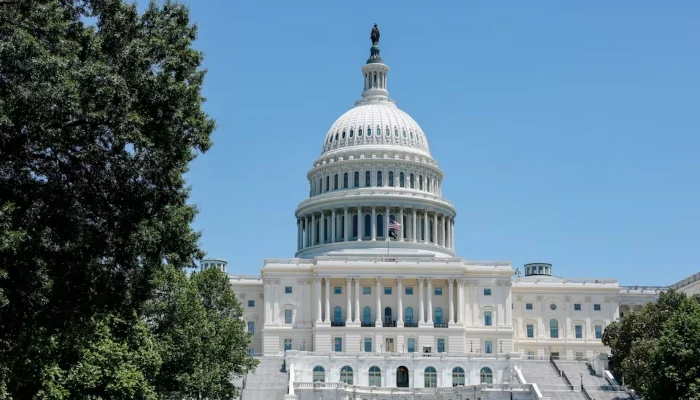
The U.S. Senate approved $70 billion in funding for Donald Trump’s strict immigration enforcement efforts on Friday. This decision came after a lengthy day filled with votes on numerous amendments, which exposed divisions within the Republican Party over other controversial policies proposed by the president.
This legislation will sustain Immigration and Customs Enforcement (ICE) and Border Patrol operations through the remainder of Trump’s presidency, marking a significant victory for him on a key issue after months of intense debate over immigration policies. The bill now moves to the House of Representatives, where Republican leaders aim to pass it early next week and send it to Trump’s desk for signature.
The measure follows a record partial shutdown of the Department of Homeland Security earlier this year. During that shutdown, Democrats refused to allocate additional funds for immigration enforcement unless restrictions were placed on tactics such as raids at sensitive locations and mask mandates for officers. Republicans rejected those conditions, opting instead to fund ICE and Border Patrol through expedited budget reconciliation, sidestepping Democratic opposition as long as they could maintain unity among their members.
The Senate’s approval was the culmination of an intense process known in D.C. as a “vote-a-rama,” where lawmakers forced votes on politically charged issues before final passage. For President Trump, this process prompted renewed focus on several contentious issues, including a proposed “anti-weaponization” fund for allies claiming they were unfairly targeted, and a $1 billion budget for security around his planned White House ballroom.
Although the bill no longer included funding for the ballroom, both issues became symbols of broader concerns among Republicans about defending Trump’s priorities ahead of midterm elections, which are expected to be heavily influenced by voters’ worries about rising living costs.
Rebellion within the party was evident, with senators opposing parts of the bill, particularly the Justice Department’s proposed $1.8 billion “anti-weaponization” compensation fund. Critics labeled it a “slush fund” that could potentially provide taxpayer money to individuals convicted of involvement in the 2021 Capitol attack. Acting Attorney General Todd Blanche announced that the administration would not move forward with funding for it, but Trump continued to praise the proposal, calling it “beautiful” and suggesting it might not be entirely dead, just delayed.
This ambiguity led some Republicans to attempt legally to eliminate the fund altogether. North Carolina Senator Thom Tillis remarked, “When you’re explaining, you’re losing. The best way to deal with the $1.776 billion fund is to eliminate it.”
While these amendments did not derail Trump’s legislative successes, they underscored the limits of party discipline, with some Republicans breaking ranks on measures related to the anti-weaponization fund, future ballroom funding, and Trump’s push to install a loyalist as a top housing official in U.S. intelligence.
Democrats, meanwhile, sought to redirect immigration enforcement funds towards housing and affordability issues, criticizing Republicans for prioritizing deportation efforts over the economic concerns of everyday Americans. Additionally, some Republicans supported a Democratic initiative to impose new sanctions on Russia for its invasion of Ukraine and to provide $8 billion in military loans to Kyiv, arguing that the funds were necessary to restore immigration enforcement funding previously obstructed during the DHS shutdown.
The earlier stopgap measure funded most of Homeland Security through September 30, including agencies like FEMA, the Coast Guard, TSA, and the Secret Service, but excluded ICE and Border Patrol, setting the stage for the subsequent dispute that was resolved with Friday’s vote.
Overall, the legislation offers Trump a significant legislative victory on immigration but highlights ongoing challenges for Republican leaders: even with control of Congress, they still face internal resistance rooted in the controversial nature of some of the president’s policies.
 ChatGPT
 Perplexity
 Gemini AI
 Grok AI