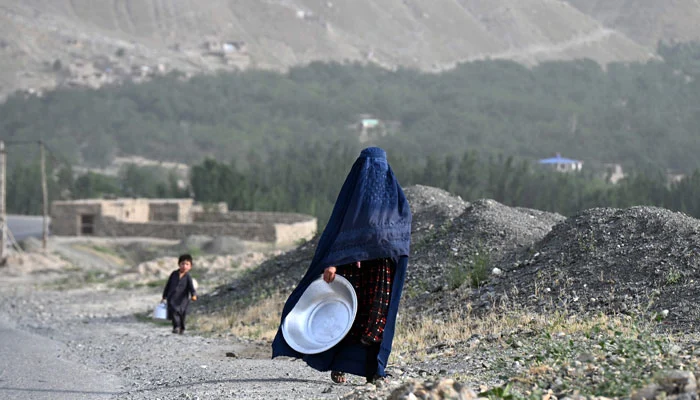
A group of UN experts on Thursday condemned the suppression of women in Afghanistan’s western city of Herat, reporting that at least two individuals had been killed during a protest protesting the new restrictions.
Morality police in Herat began detaining dozens of women on Saturday for not wearing the full-body covering chador or burqa.
The protest against the measures on Tuesday was forcibly dispersed, resulting in the death of a young boy, according to the UN, while witnesses told AFP that security personnel shot into the crowd. Authorities have denied using firearms.
In a statement issued Thursday, ten independent experts appointed by the UN Human Rights Council reported that at least two individuals had lost their lives and more than 20 were injured.
“The allegations that women were detained for dress code violations are deeply troubling and could amount to arbitrary and unlawful detention, as they seemingly punish women for exercising their rights to free expression and protection from gender discrimination,” the experts stated.
They emphasized, “Equality, peaceful assembly, freedom of expression and movement, and protection against arbitrary detention are fundamental human rights.”
The dress code is enforced by the Ministry for the Propagation of Virtue and the Prevention of Vice (PVPV), which mandates that women be almost entirely covered when outside their homes.
Many women opt to wear a loose abaya, a Muslim headscarf, and a face covering instead of a chador or burqa.
MSF Healthcare Worker Detained
Among those detained in Herat was a medical professional employed by Doctors Without Borders (MSF).
She was en route to her shift at Herat Regional Hospital’s pediatric ward when she was stopped by morality police on Saturday, accused of violating the dress code, according to the NGO.
The medic was held for two days and released after signing a written pledge, along with her husband and relatives, to adhere to the dress requirements dictated by the PVPV.
MSF expressed outrage over the detention of its staff member, asserting that “this incident is part of a broader pattern of severe restrictions women face in Afghanistan, limiting their movement and participation in public life.”
The PVPV has yet to comment on the detention, despite requests from AFP. However, the department in Herat acknowledged that new regulations had been introduced recently and warned that violations could result in detention or imprisonment.
A set of rules published Wednesday by Herat’s PVPV included bans on wearing makeup, displaying any hair outside clothing, and mandated wearing socks.