
Select Language:
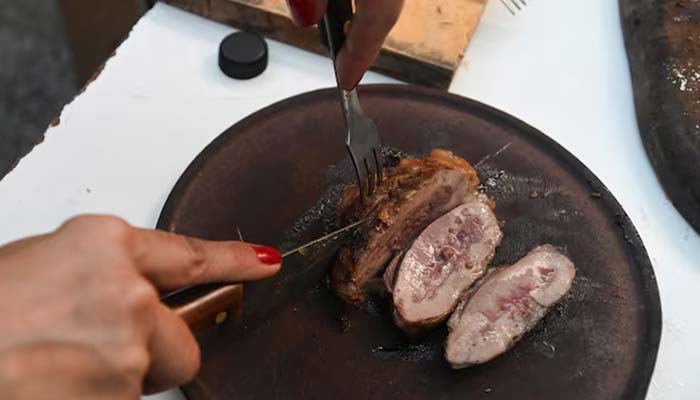
A woman is shown slicing beef at a backyard cookout in Buenos Aires, Argentina, on June 23, 2024. — Reuters
Scientists from Poland and the Czech Republic have discovered that the taboo against cannibalism in human societies didn’t arise purely from instinctive repulsion. Instead, it likely developed because practicing cannibalism posed health risks to populations that engaged in it.
Using mathematical modeling, Michal Misiak from the University of Wroclaw and Petr Turecek of Charles University in Prague demonstrated that sustained cannibalistic behavior can lead to population decline by spreading diseases among those who eat human flesh.
“We examined the human body as a potential food source, analyzing both caloric benefits and hidden health costs,” Misiak explained in a statement issued Wednesday by Wroclaw University. “On paper, a person provides an average amount of energy… the real danger, however, lies in infection risk. Pathogens find it easier to transmit because they end up in an organism with nearly identical physiology.”
Their model shows that the threat of disease increases exponentially when individuals consume other humans, since cooking does not eliminate prions—misfolded proteins responsible for fatal neurological diseases like kuru.
Kuru was prevalent among the Fore tribe in Papua New Guinea, who consumed the bodies of their deceased relatives in the belief they were releasing the spirit of the departed.
The researchers believe these health risks likely contributed to the development of one of humanity’s oldest taboos, which served a protective purpose.
“Taboo functions as an evolutionary safeguard,” Misiak stated. “Our findings suggest it was a biologically justified response to the escalating threat of epidemics. Communities that failed to suppress cannibalism simply did not survive.”
 ChatGPT
 Perplexity
 Gemini AI
 Grok AI