

Select Language:
Nvidia announced a powerful new laptop processor for Windows devices on Monday, marking its entry into the next-generation consumer PC market with built-in artificial intelligence capabilities.
Industry experts noted that this move by the American hardware giant challenges established players like Apple, Intel, and AMD, although the new laptops are expected to come with a significant price tag.
This development also signals Nvidia’s effort to diversify beyond its core strengths. While the AI boom has propelled it to become the world’s most valuable company, thanks to record profits from its data center processors used by global tech giants, Nvidia is now venturing into the consumer market.
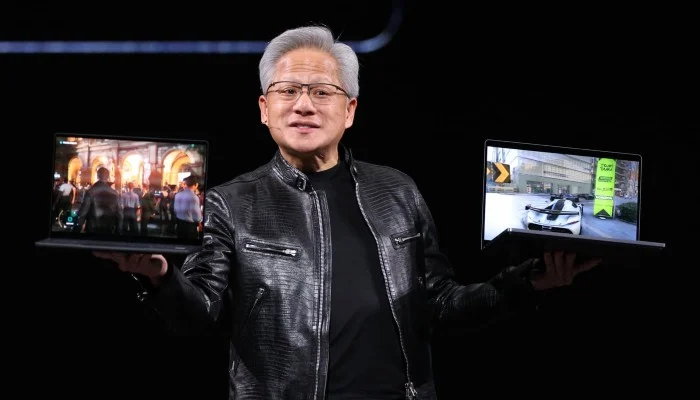
“Microsoft and Nvidia are going to transform the PC. This will be the new standard,” said Jensen Huang, Nvidia’s CEO, as he launched the RTX Spark ahead of Computex, a major tech industry event.
“Need to run digital biology? No problem. Seismic processing? No problem. Astrophysics work? No problem,” Huang stated.
“Microsoft and Nvidia have meticulously optimized everything so this computer can handle anything ever created, and now it can run AI agents—an incredible computing device.”
Nvidia, best known for its graphics processing units (GPUs) that initially revolutionized high-speed video game rendering, has increasingly become a driving force behind AI technologies—powering chatbots, image generators, and autonomous agents capable of performing complex tasks.
As governments and corporations pour hundreds of billions into building AI infrastructure, Nvidia’s valuation has soared past $5 trillion, exceeding the gross domestic product of countries like Japan and India.
However, Monday’s announcement centers around a new central processing unit (CPU), which functions as the brain of a personal computer.
“By skipping the traditional PC supply chain, Nvidia is building a complete hardware monopoly,” explained Stephen Wu, a former AI software engineer and founder of the Carthage Capital investment fund. He called this a long-anticipated shift for the tech industry.
Wu described it as an “existential threat” to existing laptop chip designs and viewed it as a strategic move by Nvidia to encourage developers to design new products on their hardware, ultimately boosting demand for data center GPUs.
“Intel and AMD are the immediate losers,” Wu said, adding that this hardware will finally give AI users the memory bandwidth needed to run robust local models without latency.
While Nvidia chips previously powered some Windows tablets in the early 2010s, this latest device is designed to run AI services, like agents, capable of executing tasks for users more efficiently and seamlessly.
Huang claimed this is “the first fully re-engineered, reinvented line of PCs in 40 years.”
He compared it to how the smartphone transformed the phone industry, saying, “This reinvention of the PC is as significant.”
 ChatGPT
 Perplexity
 Gemini AI
 Grok AI