

Select Language:
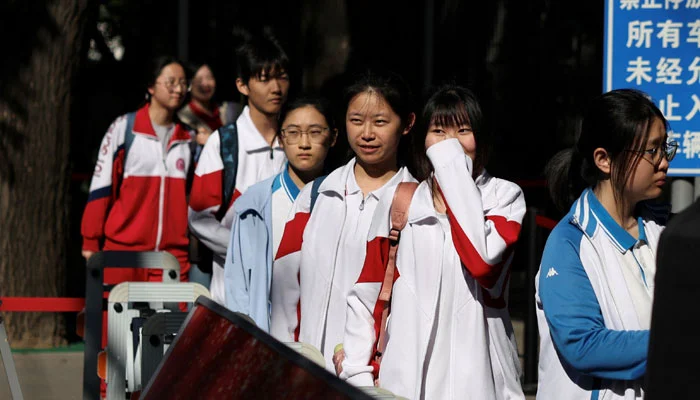
Hundreds of young students in China, holding pens and ID cards, shuffled into a testing center in Beijing under a bright blue sky on Sunday. Parents gathered around as they joined millions across the country taking the high-stakes college entrance exam, known as “gaokao.”
This year, approximately 12.9 million students registered for the exam, which is typically the only criterion for university admission in China, according to the Ministry of Education. The exam spans multiple days, starting Sunday, covering subjects such as Chinese, math, English, science, and the humanities. Results will be announced later this month.
Zhang Xinnan, a student on the verge of entering the exam hall, expressed feelings of nervousness, especially about the Chinese essay component. Wearing his school uniform, the 18-year-old shared that he’s been preparing extensively with practice questions over the past year. Despite the nerves, he believes his preparation will help him succeed, aiming to work in the new energy vehicle industry.
Outside the exam centers, some parents dressed in red—symbolizing good luck—stood nearby, with police and security personnel present to manage the crowds. Parents hoped to capture their children’s moments entering the exam halls.
In China, education has expanded rapidly amid economic growth, raising parental expectations for their children’s futures. However, the job market for new graduates is more challenging than before, with youth unemployment a significant issue. Official figures indicate that about one in six young people aged 16 to 24, excluding students, are unemployed.
Attitudes toward the gaokao are shifting, with many students and parents now prioritizing health over high test scores. Deng Ju, a mother holding a stack of practice books for her daughter, said, “Just perform normally—that’s enough. I care more about physical health; the test is just a formality.” For her, skipping the exam entirely would be ideal, especially since her daughter isn’t aiming for prestigious universities like Tsinghua or Peking University. She joked, “No more gaokao. Let’s not gaokao anymore,” but added with a smile, “That’s impossible.”
For many students in Beijing, the gaokao remains a key step toward their dreams. Zhang hopes to attend his ideal university, and he mentioned that staying calm is essential. “Mentality is the most important part of the gaokao,” he noted. His friends share similar concerns, emphasizing the importance of a steady mindset when facing this critical exam.
 ChatGPT
 Perplexity
 Gemini AI
 Grok AI