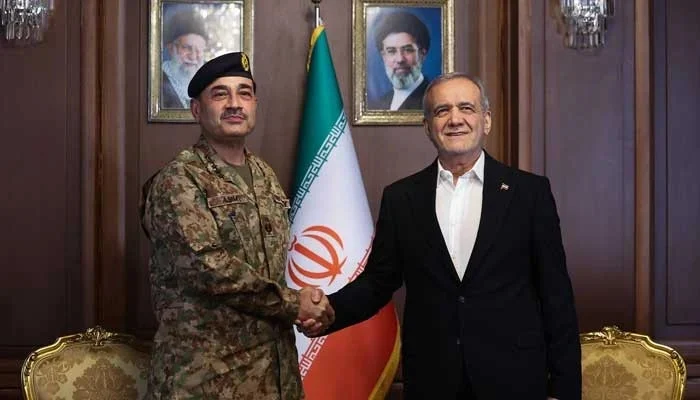
The Chief of Defence Forces (CDF) and Army Chief, Field Marshal Asim Munir, is scheduled to visit Tehran on Monday amid rising tensions between Iran and the United States. The U.S. is ramping up what it describes as “the largest financial offensive ever coordinated” against Iran, which has responded by threatening to shut down all oil exports from the Gulf if the economic warfare persists. Tehran has vowed to prevent any oil from flowing out of the region “if the economic war continues.”
U.S. Treasury Secretary Scott Bessent is set to hold a press conference at 2 p.m. EDT (6 p.m. GMT) on Monday, during which he plans to announce even stricter measures against Iran—an country subjected to nearly constant sanctions since the 1979 Islamic Revolution. Iran stated that Munir’s visit aims to promote regional peace and stability. A Pakistani government source indicated that discussions will include recent developments, such as the U.S. threat of new sanctions.
Pakistan’s government, led by Shehbaz Sharif, brokered a two-week ceasefire between Iran and another involved party on April 8, ending six weeks of conflict. Pakistan continues to facilitate communication between Washington and Tehran. Two Pakistani officials confirmed Munir’s visit to Reuters, with one noting that Iran and Pakistan remain in direct contact. The other mentioned that talks would also address recent conflict developments, including U.S. President Donald Trump’s warning of harsher sanctions.
The official suggested Munir will discuss peace initiatives under Islamabad’s memorandum of understanding, as well as Trump’s threats and the broader regional situation, including the recent Pakistan-Turkey-Saudi Arabia agreement and issues related to Houthi movements.
This visit occurs at a time of heightened tension, as Iran warns it may respond militarily to U.S. sanctions that threaten to further damage its fragile economy. Bessent described the U.S. campaign as “the greatest financial offensive ever mounted against an adversary,” in an opinion piece published in the Financial Times. Since late February, American and Israeli strikes have resulted in numerous casualties—most notably in Iran and Lebanon—damaging parts of Iran’s conventional military capacity and hurting its economy. These actions have also resulted in the death of Iranian Supreme Leader Ayatollah Ali Khamenei.
Despite these setbacks, Iran maintains enough missile and drone capabilities to threaten Gulf neighbors and disrupt oil shipments through the Strait of Hormuz, a vital maritime corridor. This has nearly halted shipping traffic in the area, leading to rising global fuel prices. The current state of Iran’s nuclear program remains uncertain, as the U.S. and Israel aim to dismantle it.
Bessent cautioned that the U.S. intends to target “fearful nations” that support Iran’s economy and financial systems through engagement and appeasement, warning of the potential consequences of continued cooperation. Iran, meanwhile, has prepared for increased sanctions with assertive statements, including threats of economic retaliation. Mohsen Rezaei, secretary of Iran’s Supreme National Security Council, declared that if the economic war persists, Iran will cease oil exports entirely—both through the Strait of Hormuz and from anywhere in the Persian Gulf—and will consider any support for U.S. measures as an act of war.
The U.S. has urged China to cooperate, noting that China imports around half its oil from the Gulf region. A Chinese embassy spokesperson in Washington responded by emphasizing that sanctions and pressure do not resolve the issues and called for diplomatic solutions.
Iran’s economy was already strained from prior international sanctions before recent American and Israeli attacks damaged infrastructure. While Iranian officials publicly remain defiant, they have issued warnings that intensified economic sanctions could worsen hardships, spark unrest, and undermine the legitimacy of the Islamic Republic. Iran is grappling with high inflation, a weakening currency, energy shortages, sanctions, and structural weaknesses, compounded by damaged infrastructure, disrupted trade routes, decreased production, and the costly process of rebuilding.
In the absence of direct negotiations—last held in June in Switzerland—other countries such as Qatar, Pakistan, and Turkey have attempted to mediate diplomatic efforts. Meanwhile, ongoing U.S.-Israeli strikes on Iran and attacks on Lebanon have killed thousands and displaced millions, with the U.S. reporting the deaths of 18 military personnel and over 750 wounded.