

Select Language:
Low Male Circumcision Rates Around the Globe
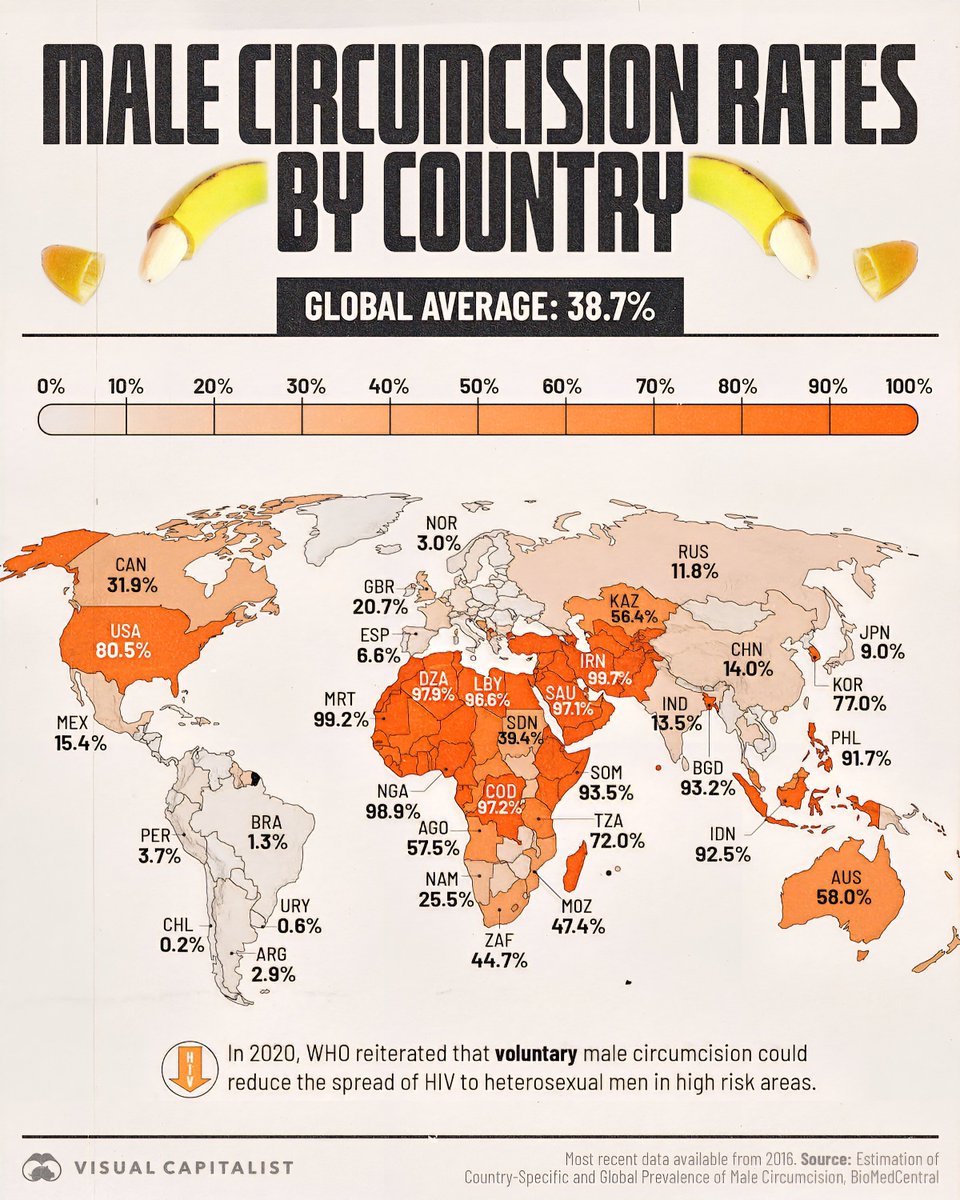
Male circumcision, a common surgical procedure often performed for cultural, religious, or medical reasons, exhibits significant variation worldwide. Despite global discussions on health and tradition, certain countries maintain remarkably low prevalence rates. Here’s a detailed look at nations with the least male circumcision rates as of 2025.
Countries With Nearly Universal Absence of Circumcision
Armenia, Belize, Bolivia, and Costa Rica
All report only about 0.1% of adult males having undergone circumcision, marking them as among the countries with the lowest rates. Cultural norms that favor natural or non-surgical approaches contribute heavily to these statistics.
Cuba, Czechia, Ecuador, and El Salvador
Similar to their neighbors, these nations show negligible circumcision figures, emphasizing that in much of Central America and parts of Eastern Europe, the practice is rarely adopted.
Greenland, Guatemala, Honduras, and Iceland
Despite geographical differences, these countries also sit at the 0.1% mark, with cultural, religious, and medical practices explaining the minimal procedure rates.
Low Adoption in European and Asian Countries
Laos, Nicaragua, North Korea, and Poland
With only about 0.1% to 0.2% circumcision rates, these countries reflect cultural environments where circumcision has limited social or religious prominence.
Thailand, Vietnam, and Laos
These nations showcase low rates, often due to traditional health practices, with only around 0.1 to 0.2%.
South American and Caribbean Countries
Chile, Lithuania, The Bahamas, and Vietnam
These nations have circumcision rates close to 0.2%, generally influenced more by medical advice than tradition.
Paraguay, Poland, Puerto Rico, and Slovakia
Similarly, low prevalence persists, with less than 0.3% of males circumcised.
Middle East and Eastern Europe
Belarus, Estonia, Malta, and Romania
While some Middle Eastern countries have high circumcision rates, these European groups maintain minimal prevalence, often under 0.4%.
European Countries with Slightly Elevated Rates
Latvia (0.4%), Moldova (0.5%), and Portugal (0.6%)
Here, slight increases reflect trends toward medical circumcision, possibly driven by health campaigns or migration patterns.
Countries With Notable but Still Low Rates
Uruguay (0.6%), Finland and Hungary (both 0.8%)
Higher than other European nations but still below 1%. These figures suggest mild shifts possibly tied to medical advice or evolving cultural attitudes.
The Americas and Asia: Slightly Higher figures
Ireland and Panama (both 0.9%) and Bhutan (1%)
While still low, these rates hint at changing perceptions of circumcision in these regions.
The few countries with truly modest rates
Brazil, Croatia, and Ukraine
Range from 1.3% to 2.3%, showing that circumcision remains a minority practice, usually prompted by medical or religious reasons.
Europe’s Surprising Low Rates
Despite being predominantly non-practicing regions, some European countries report extremely low rates, reflecting cultural preferences rather than medical necessity. Countries like Norway, Germany, and Greece have rates around 3-4%, which are still quite low globally.
Asia, Africa, and the Middle East: The Prevalence Is Much Higher
In regions known for higher circumcision rates, such as the Middle East and North Africa, prevalence exceeds 80%. Countries like Saudi Arabia (97.1%), Nigeria (98.9%), and Iraq (98.9%) show that circumcision is nearly universal, often performed for religious reasons.
The Global View: Approximately 38.7% of Males Worldwide Are Circumcised
While the global average remains under 40%, in many countries, especially in Africa and the Middle East, participation exceeds 90%. Conversely, in the Americas, parts of Europe, and Central America, rates are often under 10%.
Why the Disparity?
The divergence in circumcision rates can be attributed to various factors:
- Religious Practices: Predominantly Islamic and Jewish populations tend to maintain high prevalence.
- Cultural Norms: Societies with non-circumcising traditions typically report minimal rates.
- Medical Policies: Countries with strong healthcare guidance may promote or discourage circumcision based on health data.
- Migration and Demographic Changes: Increased immigration from high or low prevalence countries influences local statistics.
In Summary
While the global average of male circumcision sits around 38.7%, some countries maintain near-zero prevalence, driven by cultural, religious, or political reasons. Conversely, many Middle Eastern, African, and Asian nations show extremely high rates, often above 90%. As cultural attitudes continue to evolve in 2025, so too might these figures, influenced by health policies, migration, and changing social norms.
Note: Data represents estimates based on 2016 figures, with ongoing updates expected as more recent health surveys are completed.
Source: Estimation of Country-Specific and Global Prevalence of Male Circumcision, BioMedCentral.
 ChatGPT
 Perplexity
 Gemini AI
 Grok AI