
Select Language:
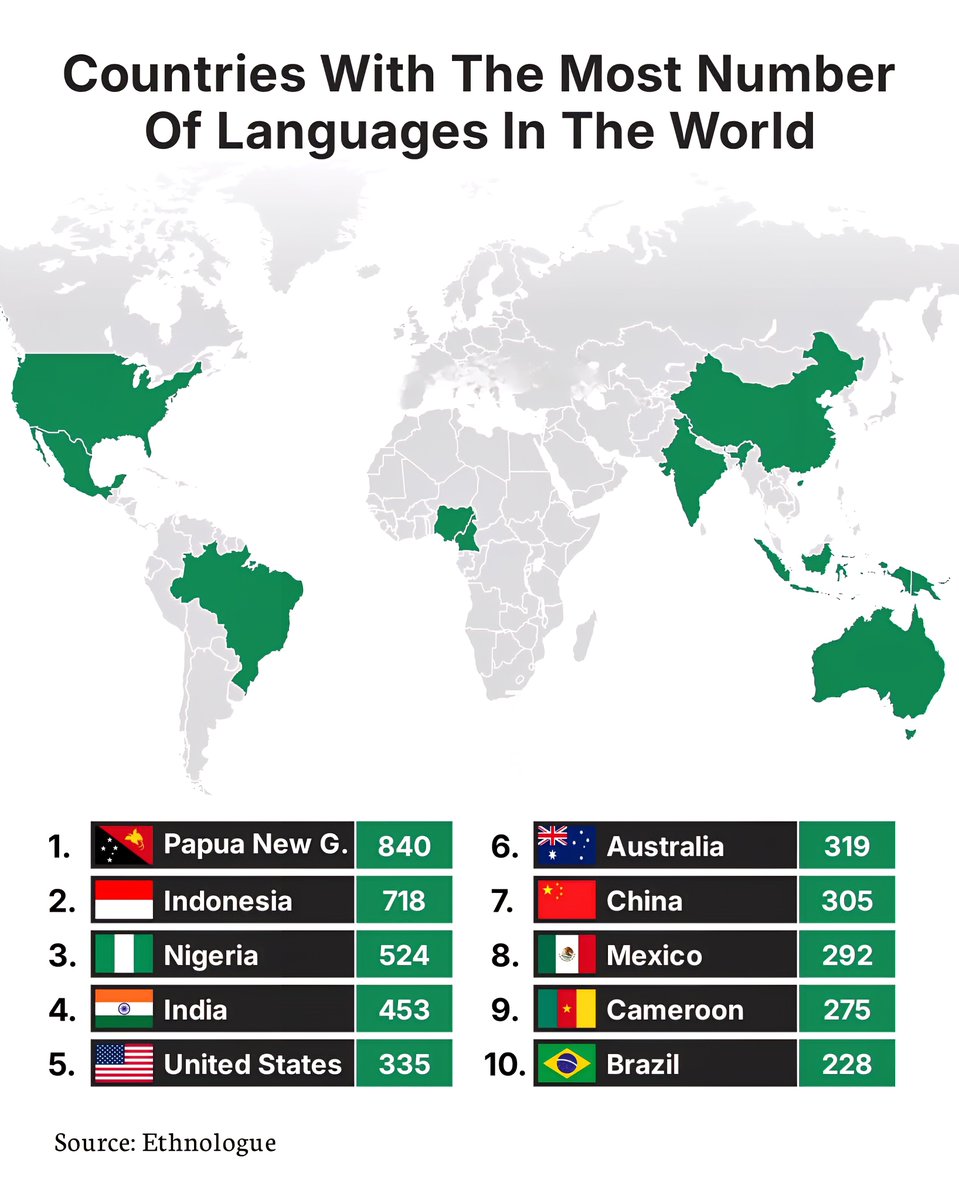
Top 10 Countries Leading the World in Linguistic Diversity in 2025
Papua New Guinea Dominates with Over 800 Living Languages
Topping the list once again, Papua New Guinea is home to an astonishing 840 distinct languages. This incredible linguistic diversity is largely attributed to the country’s rugged terrain and extensive cultural variety. Small indigenous communities, often isolated by geography, have preserved their unique languages over centuries. Despite its relatively small population of around 9 million, Papua New Guinea’s linguistic richness far surpasses that of much larger nations, making it a global leader in linguistic variety.
Indonesia Features Over 700 Languages, Reflecting Its Archipelagic Complexity
Indonesia, an expansive island nation, clocks in with 718 languages. Its vast archipelago, consisting of thousands of islands, has fostered a multitude of local dialects and tongues. This linguistic mosaic reflects Indonesia’s diverse ethnic groups, including Javanese, Sundanese, and many indigenous tribes, each with their own language and cultural traditions. The country’s language diversity is a testament to its rich historical tapestry and cultural complexity.
Nigeria’s Multilingual Landscape with Over 520 Languages
With over 524 languages spoken within its borders, Nigeria stands as Africa’s most linguistically diverse country. Its array of languages spans from Hausa, Yoruba, and Igbo to dozens of smaller tribal dialects, each vital to regional identities. This diversity results from Nigeria’s complex ethnic makeup, comprising dozens of tribes and communities, many of which have maintained their linguistic heritage amidst modernizing influences.
India’s Linguistic Richness Surpasses 450 Languages
India is home to approximately 453 languages, making it one of the most linguistically diverse nations on the planet. The country’s linguistic landscape is characterized by a multitude of regional languages, such as Hindi, Bengali, Telugu, Marathi, and Tamil, alongside numerous lesser-known dialects. India’s multilingual fabric shapes its cultural, political, and social identities, with language often acting as a marker of regional and ethnic distinction.
United States Hosts Over 330 Languages
The United States boasts a surprisingly high linguistic diversity, with 335 languages spoken across the nation. This diversity is driven by immigration, with communities from Asia, Latin America, Africa, and beyond contributing their native languages. Major immigrant languages like Spanish, Chinese, Tagalog, and Vietnamese are widely spoken, while indigenous languages such as Navajo and Cherokee continue to be preserved despite declining numbers.
Australia’s Indigenous and Immigrant Languages Reach Over 310
Australia’s linguistic repertoire includes 319 languages, with a significant portion rooted in the country’s Indigenous communities. Aboriginal languages, once more widespread, are now endangered but remain an important part of Australia’s cultural identity. Additionally, immigrant communities from Asia, Europe, and the Middle East have enriched the country’s linguistic landscape, contributing to its diversity.
China’s Count of Over 300 Languages Highlights Its Ethnic Complexity
China, with its vast territory and multiple ethnic groups, accounts for around 305 languages. While Mandarin Chinese is the official language, numerous minority tongues such as Tibetan, Uyghur, Mongolian, and Zhuang are also spoken. These languages reflect China’s immense ethnic diversity and cultural history, with ongoing efforts to preserve and promote minority languages amid rapid modernization.
Mexico’s Rich Tapestry of Over 290 Native Languages
Mexico is home to approximately 292 languages, many of which are indigenous. Languages like Nahuatl, Yucatec Maya, and Mixtec are still spoken by millions and are crucial to indigenous identity and cultural continuity. Despite dominant use of Spanish, Mexico’s indigenous languages are experiencing revival efforts and increased recognition for their importance in national heritage.
Cameroon’s 275 Languages Embody Its Cultural Diversity
Cameroon’s linguistic landscape includes 275 languages, representing its mosaic of over 250 ethnic groups. Languages such as Fang, Duala, and Fulfulde are spoken alongside numerous smaller dialects. This diversity supports a vibrant tribal culture with strong oral traditions and a rich heritage that embodies the country’s multi-ethnic identity.
Brazil’s 228 Languages Reflect Its Indigenous and Immigrant Roots
Brazil, famous for its vibrant culture, has around 228 languages spoken within its borders. Indigenous languages like Tupí and Guarani are still present, particularly in remote areas, despite the dominance of Portuguese. Additionally, immigrant communities from Europe, Asia, and the Middle East have contributed to Brazil’s diverse linguistic profile. Preserving this linguistic heritage is increasingly recognized as essential to maintaining Brazil’s cultural identity.
Summary
The global tapestry of languages showcases the depth and breadth of human cultural diversity. Countries like Papua New Guinea and Indonesia showcase extreme linguistic richness, often tied to geography and history, while nations like the US and China highlight the influence of migration and ethnic diversity. Recognizing and preserving these languages remain vital to understanding our shared human story in 2025.
Source: Ethnologue 2025
 ChatGPT
 Perplexity
 Gemini AI
 Grok AI