
Select Language:
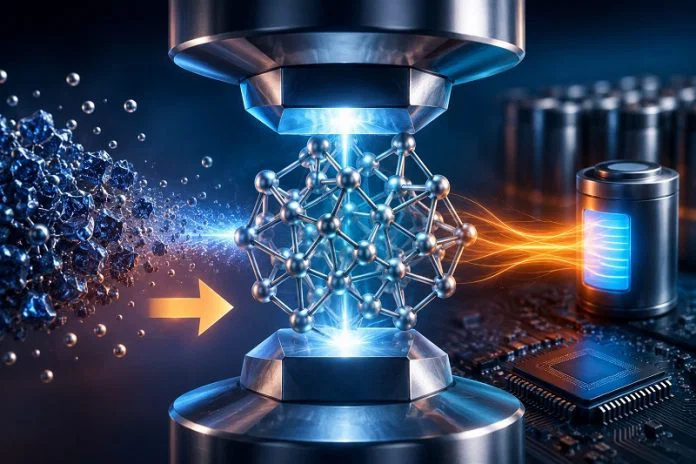
Scientists have crafted a novel three-dimensional material that could revolutionize battery technology, aid in environmental cleanup, and facilitate numerous advanced technological applications.
For the first time, researchers successfully mapped its atomic structure, offering crucial insights that could accelerate the development of even more effective materials.
This research, detailed in Science Advances, was conducted by scientists from several Japanese institutions, including the National Institute of Natural Sciences, Osaka University, Nagoya University, and SOKENDAI.
The new material falls under the category of three-dimensional covalent organic frameworks, or 3D COFs. These are highly organized materials composed of lightweight elements linked into sturdy, repeating networks. Their tiny pores provide an extensive internal surface area, making them ideal for gas capture, energy storage, and catalyzing chemical reactions.
Scientists have long recognized the potential of 3D COFs in various critical areas. They could someday help trap carbon dioxide from the atmosphere, remove toxic chemicals from polluted water and soil, enhance battery efficiency, or serve as catalysts to speed up chemical processes.
However, synthesizing these materials has been difficult. During production, bonds tend to form too quickly, leading to disordered structures instead of precise, crystalline frameworks. This disorder hampers detailed structural analysis and limits understanding of how these materials function, resulting in only a few fully characterized 3D COFs.
To overcome this challenge, the team experimented with an alternative linking approach. Instead of conventional chemical bonds, they used borate ions—compounds containing boron and oxygen—which create strong, rigid connections, helping the framework organize into a stable, crystalline form.
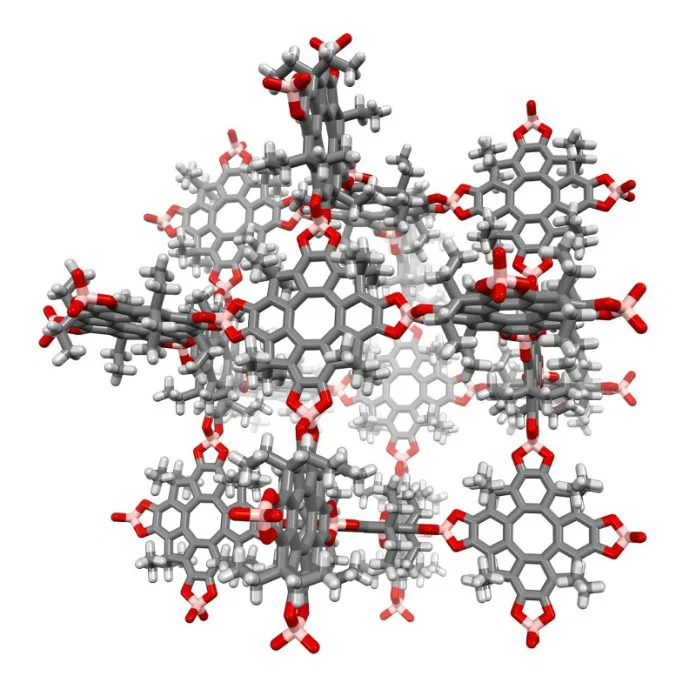
Using this method, the scientists successfully produced a new 3D COF dubbed TCTP-COF. This material features a highly ordered crystal structure with numerous tiny open spaces, or pores, enabling the passage of gases, liquids, or ions—making it suitable for various future uses.
They employed a cutting-edge technique called microcrystal electron diffraction to determine the atom-by-atom arrangement of TCTP-COF. This marked the first time a borate-linked 3D crystalline COF was fully structurally characterized using this method.
Understanding the precise atomic layout is vital for grasping how such materials behave and for tailoring their properties—like strength, stability, and pore size—for specific applications.
The findings open the door to designing a new range of customized 3D COFs. Future iterations could be optimized to store more energy in batteries, sequester larger quantities of carbon dioxide, filter pollutants from water or air, or enhance industrial chemical processes.
Although further research is necessary before these materials can be commercialized, this breakthrough provides a powerful new approach to materials design.
By creating a highly ordered 3D framework and unveiling its atomic details, the scientists have taken an important step toward developing smarter materials that can contribute to clean energy, environmental protection, and other next-generation technologies.
 ChatGPT
 Perplexity
 Gemini AI
 Grok AI