
Select Language:
Java Island Leads in Population Despite Smaller Size Compared to Russia
Java Island: Indonesia’s Crowded Gem
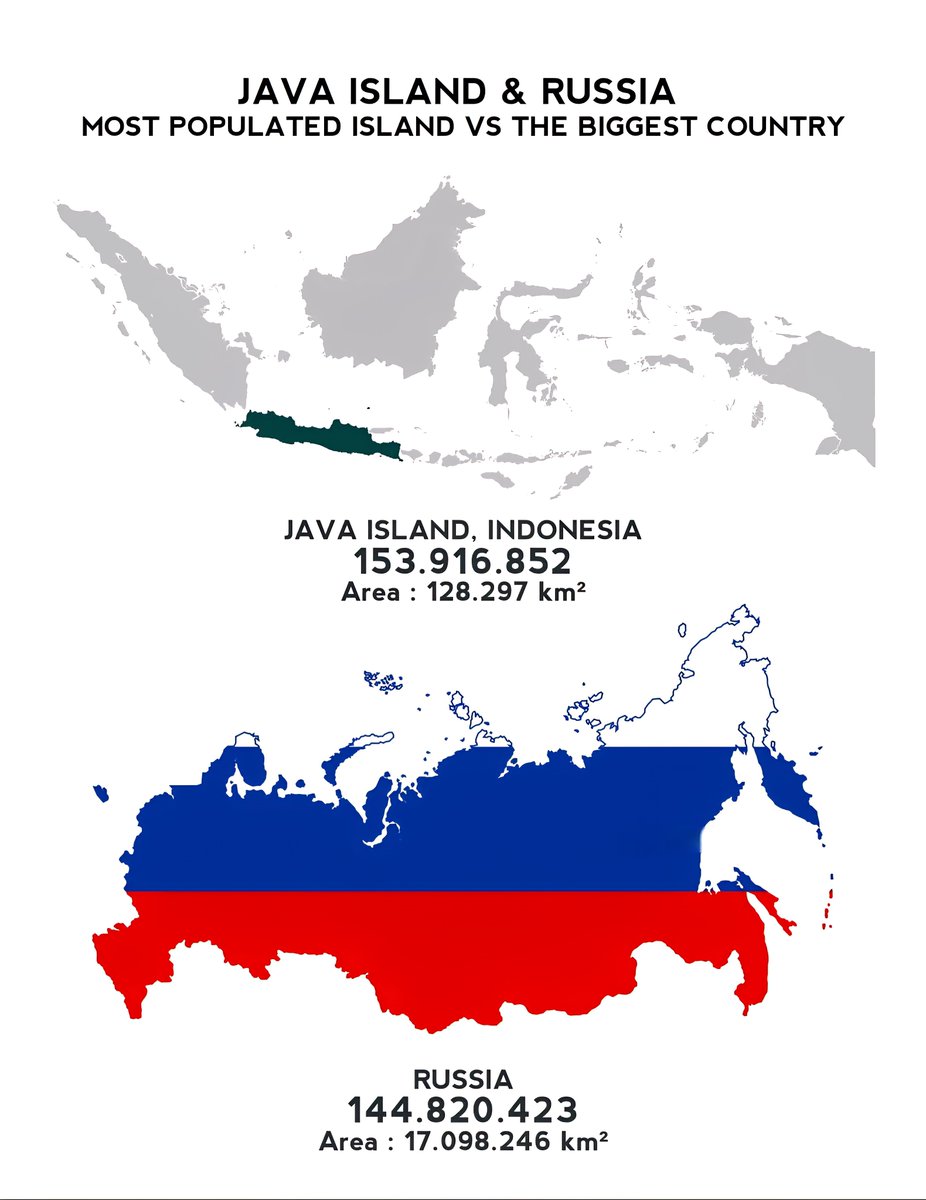
Java Island, situated in Indonesia, continues to be one of the most densely populated islands in the world. With a population nearing 154 million residents in 2025, Java is home to more than half of Indonesia’s entire population. Covering an area of only 128,297 square kilometers, its high population density makes it a significant hub for economic, cultural, and political activities in Southeast Asia.
Java’s sprawling cities, including Jakarta—the capital of Indonesia—are bustling centers of commerce, governance, and innovation. Despite its relatively small landmass, the island’s population density surpasses many other regions globally, leading to unique urban challenges such as housing shortages, traffic congestion, and demands for sustainable development. Java’s vibrant culture combined with rapid urbanization continues to attract people from across Indonesia and neighboring countries, fueling its growth.
Image: Java Island, Indonesia, is depicted as the most populated island in the world, illustrating the high density of its urban landscapes.
Russia: The Land of Vastness and Population
Contrasting sharply with Java’s high density, Russia is the largest country on Earth by land area, spanning over 17 million square kilometers. With a population of approximately 145 million as of 2025, Russia represents a land of paradoxes—immense in size but relatively modest in population size.
Most of Russia’s population is concentrated in a few key urban centers such as Moscow and Saint Petersburg, leaving vast rural areas sparsely populated. This enormous territory encompasses diverse climates and landscapes—from Siberian tundra to lush forests and mountain ranges. While Russia boasts a population close to Java in raw numbers, its population density is one of the lowest globally due to its expansive landmass.
Russia’s vastness influences its geopolitical importance, energy resources, and cultural diversity. Its sprawling territories serve as strategic assets, but also pose logistical and administrative challenges for governance and development.
Comparing Population and Area Dynamics
The juxtaposition of Java Island and Russia highlights fascinating demographic trends. Java’s concentrated population signifies rapid urban growth and high density, which could pose sustainability questions for the future. Conversely, Russia’s immense landmass with a relatively stable population showcases the contrasts in how countries utilize their territory.
Java’s dense urban hubs are engines of economic activity and cultural exchange, but they must address the sustainable management of resources. Russia’s expansive territories, on the other hand, present opportunities for resource exploitation but require innovative strategies to connect distant regions and foster balanced development.
The Global Significance
Understanding the population patterns of Java and Russia provides insight into broader geopolitical and economic shifts. Java’s demographic weight makes Indonesia a vital player in Asian economics, while Russia’s size offers strategic military and energy advantages on the global stage. Both regions exemplify how geography shapes population distribution, urbanization, and national priorities.
In summary, Java Island’s dense population makes it a standout among the world’s most populated areas, despite its modest size. Meanwhile, Russia’s vast landmass hosts a sizable but more dispersed population, demonstrating contrasting demographic profiles that impact their respective countries’ development and strategic importance in 2025.
 ChatGPT
 Perplexity
 Gemini AI
 Grok AI