
Select Language:
Researchers in Japan have created a new light-based technology that can quickly gather thousands of bacteria into a small area, making them much easier to detect. This breakthrough could aid doctors in diagnosing infections earlier and support environmental monitoring as well as other biological testing methods.
Led by Professor Takuya Iida from Osaka Metropolitan University, the research team detailed their innovation in the journal Communications Physics. Detecting dangerous bacteria swiftly is vital for public health and medicine. Some harmful strains, like certain types of E. coli, can cause severe illness even if only a few cells are present. Early detection allows healthcare providers to diagnose illnesses sooner and helps authorities respond rapidly to potential outbreaks.
Current detection methods have limitations. Growing bacteria in a lab can take days before enough cells are available for testing. Faster methods, like antibody-based tests, often take several hours and require specialized equipment. To overcome these challenges, the team turned to an unconventional tool: light.
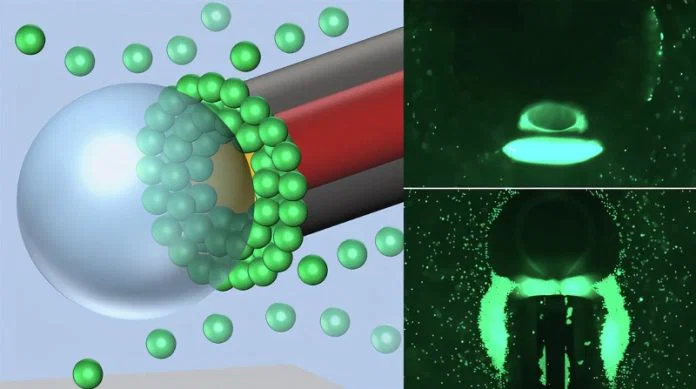
Their solution involves a specialized optical fiber coated with a thin layer of gold. When laser light is transmitted through this fiber, the gold coating absorbs the light and converts it into heat. Although this heated zone is tiny, it produces strong effects in the surrounding liquid. This localized heating causes the liquid to move and forms tiny bubbles near the fiber tip. These bubbles, along with fluid motion, generate three-dimensional currents that pull bacteria and other microscopic particles from all directions toward the concentrated area between the bubble and the fiber tip.
Professor Iida notes that this approach offers a significant advantage over many existing light-based methods that mainly collect particles along flat surfaces. The new system can gather targets from throughout the liquid sample, greatly boosting efficiency.
Test results showed the system could collect between thousands and hundreds of thousands of bacteria or microscopic particles from just 20 microliters of liquid in only 60 seconds. The collection efficiency surpassed traditional techniques by more than tenfold.
Another benefit is the simplicity of this design. Many advanced optical detection systems rely on complex arrangements of lenses and mirrors. In contrast, this fiber-based approach is compact and can deliver high performance without complicated equipment.
The team envisions integrating this technology with other analytical tools, like optical sensors and spectroscopy systems, to create faster, more sensitive testing platforms. Future plans include testing the method on a wider range of bacteria, nanoparticles, and other microscopic materials.
Ultimately, their goal is to develop a versatile, rapid analysis technique for tiny liquid samples. Such a tool could revolutionize applications in medical diagnostics, biological research, environmental assessment, and beyond—where quick detection of microscopic particles is crucial.
 ChatGPT
 Perplexity
 Gemini AI
 Grok AI