
Select Language:
Scientists in Australia have developed a compact device capable of revolutionizing how we detect pollutants, monitor health, and identify various materials. This innovative technology features an electrically tunable infrared filter small enough to be integrated onto a single chip, potentially replacing larger, more costly sensing systems.
Created by researchers from The University of Western Australia and The Australian National University, their findings were published in Advanced Materials Technologies. The filter operates within the long-wave infrared spectrum—the type of invisible radiation emitted naturally by objects at room temperature. While traditional thermal cameras rely on this radiation to produce heat-based images that distinguish warmer from cooler objects, they aren’t able to identify the materials of those objects.
This new device advances that capability by recognizing distinct infrared emission patterns—unique signatures or “fingerprints”—of gases, chemicals, and other substances. Lead researcher Oleg Bannik, a Ph.D. candidate at UWA’s School of Engineering, compares it to human vision: “Our eyes blend red, green, and blue light, enabling us to see colors,” he explains. “Similarly, this technology can compare specific infrared wavelengths. Instead of just detecting hot and cold spots, it can differentiate between substances that look identical in standard thermal images.”
Infrared spectroscopy, traditionally confined to labs, military applications, or large industrial setups due to bulky, expensive, and power-intensive equipment, now benefits from this miniaturized innovation. The device consists of ultra-thin gold and silicon layers with microscopic perforations separated by an extremely narrow gap. Adjusting this gap electrically allows control over which infrared wavelengths pass through, effectively tuning the filter.
Notably, shifting the gap by only a few hundred nanometers—hundreds of times thinner than a human hair—significantly impacts how the device interacts with infrared light around 10 microns in wavelength. This sensitivity paves the way for numerous practical applications.
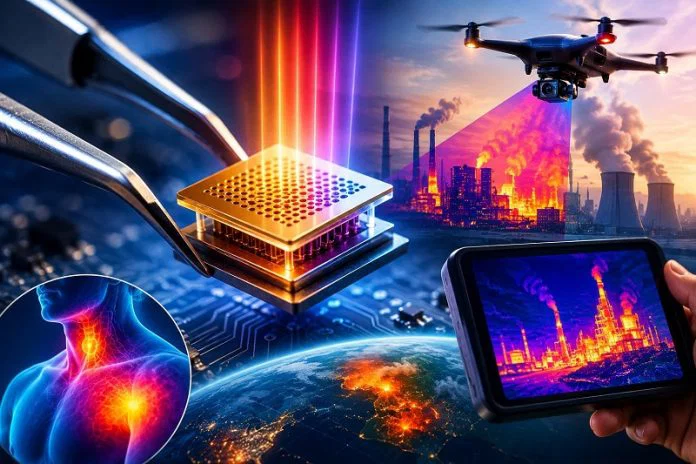
Environmental monitoring stands to gain substantially. The device could facilitate faster detection of methane leaks and industrial emissions, crucial for combating climate change, since methane is a potent greenhouse gas. It also promises enhancements in industrial safety, thermal imaging, and medical diagnostics. Researchers believe it could eventually help physicians identify inflammation, track wound healing, and detect minute tissue changes undetectable by conventional thermal cameras.
Thanks to its lightweight design and low power consumption, the sensor can be mounted on drones or portable devices. Future handheld infrared detectors or drone-mounted sensors could be used to track pollution, inspect industrial sites, or perform remote medical screenings, broadening the scope of environmental and health applications.
 ChatGPT
 Perplexity
 Gemini AI
 Grok AI