
Select Language:
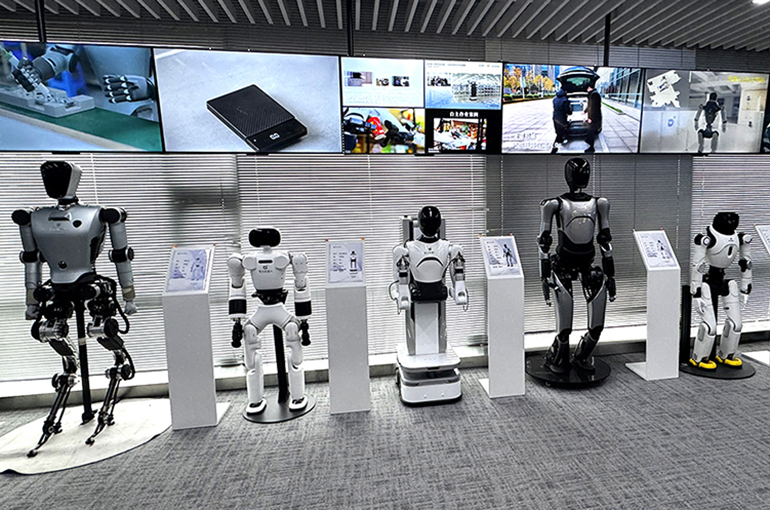
China’s embodied artificial intelligence sector amassed approximately $13.8 billion in funding during the first half of this year, marking a fivefold increase compared to the same period last year. This surge was driven by advances in large language models, anticipation of initial public offerings by key players, and proactive government policies, all fueling investor interest.
The industry—focused on creating AI-powered robots capable of sensing, reasoning, and interacting with the physical environment—saw more than 320 funding rounds in just six months, more than doubling the activity of the previous year, according to data from a prominent tech research platform.
This rapid funding growth has accelerated the rise of new unicorn companies, indicating increased investor confidence despite ongoing concerns about how soon these robots will be commercially viable. Investment has mainly concentrated on three core areas: research and development of embodied AI language models, large-scale data collection, and enhancement of product delivery capabilities, based on publicly available information.
Experts caution that widespread commercial deployment of robots remains a work in progress. They believe the industry may experience a period of consolidation once a business demonstrates a scalable, profitable model.
Growth Driven by Unicorns and Investment Activity
Recent data indicates that three humanoid robot startups—Unitree Robotics, AgiBot, and Galbot—each reached valuations exceeding $1.4 billion last year, earning unicorn status within China’s embodied AI scene.
This year, an additional 19 companies—including Deep Robotics, X Square Robot, AI² Robotics, Galaxea AI, and Spirit AI—also crossed the unicorn mark. Among them, Galbot, X Square Robot, AI² Robotics, and Galaxea AI have valuations surpassing $3 billion.
According to a financial data provider, ten companies in the robotics space went public in Hong Kong during the first half of the year, with another 16 in the process of applying for listings awaiting approval. Meanwhile, in China’s A-share market, companies like Unitree Robotics, Deep Robotics, Leju Robotics Technology, and Dobot Robotics are advancing through the initial public offering process.
Both government-backed and industrial investors have increased their stakes in the industry. A national AI development fund has invested in firms such as Galbot and Deep Robotics, while local government-backed entities—including Shenzhen Capital Group—have poured funds into at least a dozen companies. Major automotive investors, including SAIC Motor and BAIC Group Industrial Investment, have also participated in funding rounds.
Among prominent venture capital firms, HongShan (formerly Sequoia Capital China) engaged in 20 funding rounds covering 14 companies in the first half of the year, while GL Ventures, an early-stage investment arm of Hillhouse Capital, was involved in 18 rounds across 14 firms.
Leading the investment charge among internet giants, Meituan and its affiliates backed seven companies, including X Square Robot, Galaxea AI, and TARS Robotics. Tencent, Alibaba, and JD.com also participated in multiple rounds, with X Square Robot being the only company in China’s embodied AI sphere to secure strategic investments from all four giants.
“Embodied intelligence that remains purely for demos, marketing, or research won’t hold long-term commercial value,” remarked a partner at a growth-focused investment firm. “As valuations climb, we risk inflating a bubble.”
He emphasized that real industry demand lies in embodied AI solutions capable of addressing practical, real-world problems.
Industry insiders stressed that large-scale robotic deployment remains commercially unfeasible at this stage. Still, once a company proves its business model is viable, it could trigger a shakeout across the industry.
 ChatGPT
 Perplexity
 Gemini AI
 Grok AI