
Select Language:
The secretary-general of the China Passenger Car Association has pinpointed three primary reasons behind the surge in the country’s vehicle exports this year.
“China’s new energy vehicle industry boasts a fully developed supply chain, with the costs and speed of iteration for batteries, motors, and electric control systems reaching world-leading levels,” said Cui Dongshu. “Additionally, countries in Southeast Asia, the Middle East, and Russia have reduced their tariff costs through free trade agreements with China.”
“Finally, Chinese vehicles have distinct product advantages,” Cui added. “Features like fast charging and intelligent driving systems in electric vehicles align with global electrification trends.” He explained that a supply gap has emerged in the international market due to traditional automakers transitioning their production, which has contributed to increased exports.
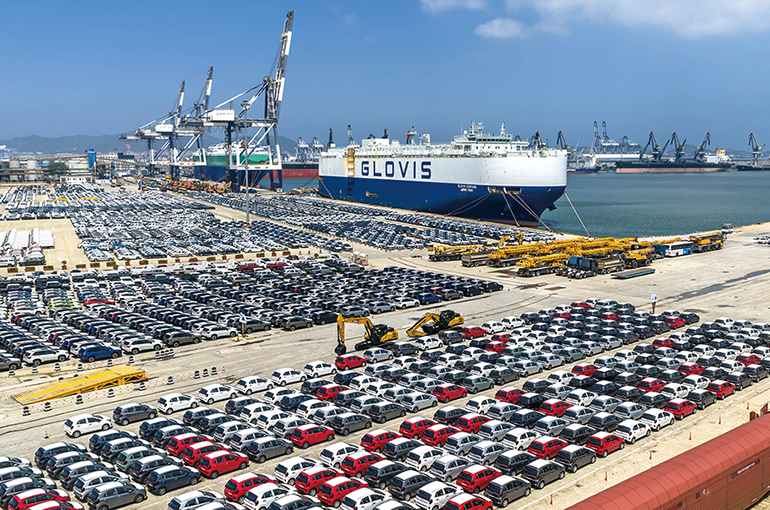
Data from the China Association of Automobile Manufacturers show that auto exports grew by 54 percent in the first five months of the year compared to the same period last year, with export value increasing by 56 percent. Notably, exports of new energy vehicles (NEVs) jumped 79 percent in volume, making up nearly 72 percent of total exports.
“Expectations are high for China’s auto exports to surpass previous forecasts, reaching close to five million units in the first half of the year,” said Chen Shihua, deputy secretary-general of the association, during a June monthly meeting.
The rising competitiveness of domestic NEV products over their foreign counterparts is a key factor driving the overall growth in exports, a senior executive of a high-end Chinese NEV brand told reporters.
With intense competition and limited growth opportunities within the domestic market, many manufacturers are increasingly relying on expanding overseas sales to meet their goals—this approach also proves profitable, according to a spokesperson from a Zhejiang-based automaker.
However, entering international markets presents hurdles. Geopolitical tensions and trade restrictions are significant challenges for Chinese automakers, noted Chen Jingjing, secretary-general of the automotive branch of the China Chamber of Commerce for Import and Export of Machinery and Electronic Products. She mentioned that tariffs, non-tariff barriers, and investment restrictions imposed by the European Union are becoming more formidable obstacles.
To sustain growth, China’s auto export sector must evolve beyond mere trade activities and move toward local manufacturing and systematic development, with stringent regulation and control over non-compliant export practices, Chen emphasized.
 ChatGPT
 Perplexity
 Gemini AI
 Grok AI