
Select Language:
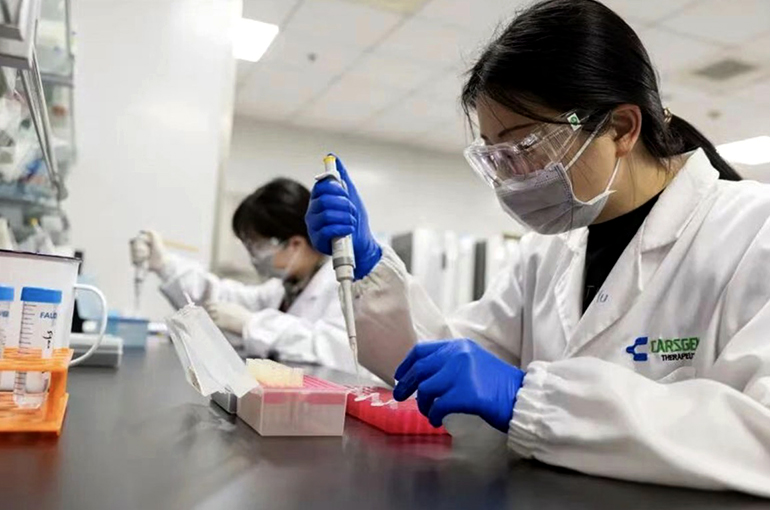
Shares in CARsgen Therapeutics Holdings declined for a second consecutive day following the company’s announcement of the pricing for its newly approved chimeric antigen receptor T-cell therapy—the world’s first of its kind targeting solid tumors—priced at nearly 1 million Chinese yuan (approximately $147,000) per dose.
The company’s stock on the Hong Kong exchange dropped 11.7%, settling at HKD13.91 ($1.77) by the end of the day, after a 6.4% fall the previous day. Since reaching a four-year high of HKD28.60 on April 20, the Shanghai-based biotech firm’s market value has been nearly cut in half.
The CAR-T therapy, named satribtagene autoleucel or satri-cel, was approved by China’s National Medical Products Administration on June 22. It is intended for patients with advanced gastric or esophagogastric junction cancers who have not responded to at least second-line treatments. This approval marks the first time such a therapy has been authorized for a solid tumor; existing CAR-T treatments have been used solely for blood cancers.
The therapy’s price is CNY990,000 (around $145,500) per infusion, aligning with the cost of other CAR-T products in the market, according to company executives during an investor briefing yesterday. The company projects annual sales could reach CNY2 billion ($294 million) within four to five years.
Industry insiders noted that this pricing exceeds market expectations and emphasized the need to explore innovative payment options, such as commercial health insurance, to help offset costs.
CAR-T therapy remains a key focus in cancer treatment development. It involves genetically modifying a patient’s T cells to identify and destroy cancer cells. These engineered immune cells are grown in labs and then reintroduced into the patient’s body.
Clinical data indicates that satri-cel can increase median survival in patients with advanced gastric or esophagogastric junction cancers who have failed second-line treatments—from less than four months to nearly nine months.
Given the high cost, CAR-T therapies are not covered under China’s basic public health insurance system, placing the financial burden solely on patients. However, as of late last year, the country’s medical insurance authority included several domestic CAR-T treatments and an innovative drug list in the commercial health insurance scheme, allowing some patients to share costs through private insurance options.
Nonetheless, integrating these therapies into insurance reimbursement practices and expanding hospital access pose ongoing hurdles, industry experts say.
 ChatGPT
 Perplexity
 Gemini AI
 Grok AI