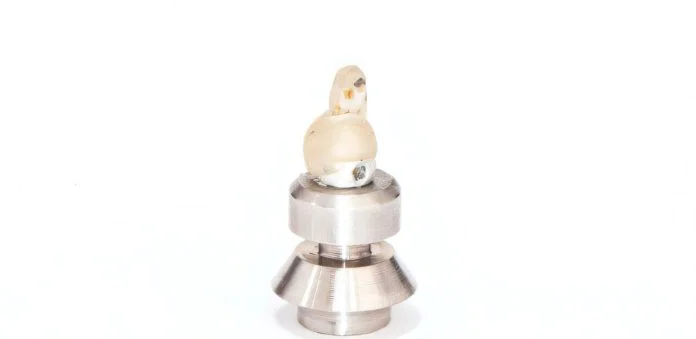
A tiny gemstone from Brazil has provided new, compelling evidence that water may penetrate much deeper into Earth’s interior than previously believed. Inside this small diamond, scientists discovered a mineral capable of enduring the crushing pressures and extreme heat of the Earth’s lower mantle. This suggests it could serve as a conduit, transporting water hundreds of kilometers beneath the planet’s surface.
Published in Scientific Reports, the study was led by Brazilian researchers utilizing the advanced Sirius particle accelerator at the Brazilian Synchrotron Light Laboratory. The diamond itself is only about 3 millimeters in diameter but contains microscopic mineral inclusions that serve as natural time capsules, offering a glimpse into conditions deep within the Earth from hundreds of millions of years ago — a record preserved within the gemstone’s interior where direct exploration is impossible.
One standout mineral found within the diamond is goethite, an iron-rich mineral commonly found on Earth’s surface and responsible for the brown hues in many soils. It also forms on the ocean floor when iron-rich rocks interact with water. Notably, goethite contains water within its crystal structure, leading scientists to believe it could play a significant role in transporting water into Earth’s depths.
Previously, many believed that goethite could not survive the intense conditions during subduction, the process where oceanic tectonic plates sink into the mantle. Under such circumstances, rising temperatures were thought to cause the mineral to break down and release its water relatively shallow in the Earth’s interior. However, this recent discovery suggests a more complex story.
The diamond originated from the Juína region of Brazil, an area famous for producing rare super-deep diamonds. Unlike most diamonds that form roughly 150 kilometers below the surface, these originate at depths exceeding 300 kilometers and are brought to the surface by magma during volcanic eruptions. Many of these diamonds contain mineral inclusions, which, though often considered imperfections, are incredibly valuable because they provide rare insights into Earth’s deep interior.
Using high-powered X-ray imaging and spectroscopy at Sirius, researchers meticulously examined around 100 mineral inclusions within the diamond. One particular inclusion was surprising because it appeared to contain iron hydroxide — a mineral rarely expected to be found inside Earth’s mantle. Further tests identified goethite along with hematite and magnetite within this sealed inclusion. Finding these three minerals together was unexpected because they do not typically coexist under surface conditions.
Laboratory experiments have shown that goethite can withstand pressures up to 57 gigapascals and temperatures approaching 1,800°C — the extreme conditions present between approximately 900 and 1,250 kilometers beneath Earth’s surface in the lower mantle. The researchers propose that goethite might survive inside cooler sections of sinking oceanic plates. As the mineral gradually alters into other iron-rich minerals, it releases the water stored within its structure deep inside the mantle.
This hidden water could be crucial for Earth’s geology. Water reduces the melting point of rocks, enabling small amounts of magma to form. Over extended periods, this magma may ascend, contributing to volcanic activity. Some scientists believe this process could be integral to forming the volcanic rocks that eventually reintroduce diamonds—even super-deep ones—back to the surface.
This research marks a significant milestone for Brazilian science, representing the first comprehensive study of a super-deep diamond conducted entirely by a Brazilian team using Brazilian facilities. Beyond revealing the extraordinary journey of this tiny gemstone, the findings shed light on how water moves through Earth’s interior—potentially more interconnected with surface water cycles than previously understood. This enhances our understanding of the long-term geological processes that shape our ever-changing planet.