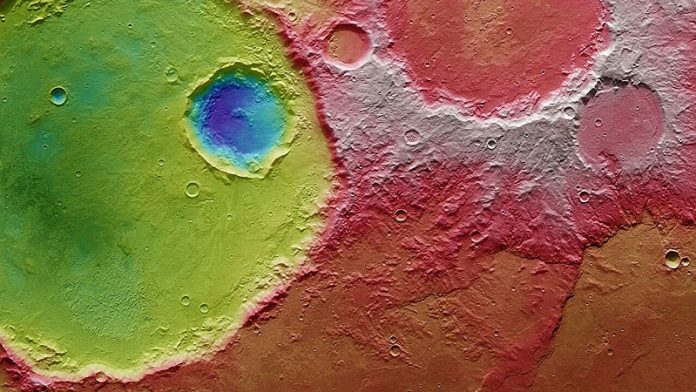
Venus features massive rift valleys that indicate the planet may still be geologically active. NASA/JPL/USGS
For many years, scientists thought Venus was a dead world with little to no activity inside. Despite being Earth’s closest neighbor, Venus is incredibly harsh. Its surface temperatures are hot enough to melt lead, the atmosphere is extremely thick, and the pressure is about 90 times greater than Earth’s. There are no oceans, forests, or signs of life as we know them.
However, recent research suggests that beneath this tough exterior, Venus might still be a dynamic, changing planet. Researchers from ETH Zurich utilized a sophisticated computer simulation to explore how some of Venus’s large cracks, called rift valleys, may have formed more recently than previously believed. Their study, published in Nature Geoscience, adds to evidence that Venus remains geologically alive and might even host active volcanoes today. The project was led by Professor Taras Gerya and MSc student Xi Yang from the university’s Department of Earth and Planetary Sciences.
A major clue lies in the giant rift valleys. These vast cracks appear when a planet’s crust is pulled apart by forces deep within. On Earth, the East African Rift Valley is a well-known example. On Venus, some of these rifts are much larger, extending up to 10,000 kilometers. Traditionally, scientists assumed these features formed over 100 million years ago and had not changed since. But the new study questions this belief.
Using a detailed 3D computer simulation, the team recreated how Venus’s rift valleys could develop. Unlike older, simpler models, these new simulations offered a more realistic view of how the planet’s crust behaves. They showed that young or still-active rift valleys develop broad, elevated edges called rift flanks, which stay steep while the crust is moving apart. Over time, once the activity ceases, these flanks gradually flatten as the crust relaxes under its weight—without erosion by water, since Venus lacks liquid surface water.
The simulations also indicated that these rift zones might expand up to 3 to 10 centimeters annually, much faster than previously thought. When these results were compared with images from NASA’s Magellan spacecraft, taken in the 1990s, many of Venus’s rift valleys still displayed the tall, steep flanks characteristic of relatively young features. This points to the possibility that parts of Venus are still tectonically active today.
These discoveries could help future missions target the most promising areas for study. NASA and the European Space Agency are preparing new spacecraft for Venus exploration, planned for the early 2030s. ESA’s EnVision mission, for example, aims to investigate from the planet’s deep interior to its upper atmosphere.
Beyond understanding Venus, this research enhances our knowledge of how rocky planets evolve—insights that could inform our understanding of distant Earth-like worlds orbiting other stars.