الوسم: War

  • Is Trump Losing the Iran Conflict After Three Months?

    Is Trump Losing the Iran Conflict After Three Months?

    Three months after engaging in a conflict with Iran, President Donald Trump finds himself facing a difficult question: is he losing the broader war? While he may have claimed victories on the battlefield—diminishing Iran’s missile capabilities, sinking parts of its navy, and killing key leaders—the realities on the ground tell a more complicated story. Iran’s control over the Strait of Hormuz, its persistent resistance to nuclear restrictions, and its resilient theocratic regime remain largely unchallenged. Many critics argue that Trump’s tactical gains haven’t translated into a strategic win, especially as diplomatic efforts veer between uncertain negotiations and threats of renewed strikes, which risk provoking Iranian retaliation across the region.

    The risk now is that the United States and its Gulf allies might find themselves worse off after the conflict, while Iran, despite military and economic penalties, could end up wielding greater influence—having demonstrated its ability to cut off a significant portion of the planet’s oil and gas supplies. Some experts suggest that there might still be an opportunity for Trump to secure a face-saving exit if negotiations somehow turn in his favor, but many warn of a bleak outlook if the current trajectory persists.

    Many analysts argue that what was initially meant to be a brief operation has morphed into a prolonged strategic failure. Aaron David Miller, a former Middle East negotiator, explained that the effort, originally intended as a short-term display of strength, now threatens to become a long-term quagmire. This matters greatly to Trump, who often views himself through the lens of perceived success or failure, and who finds himself commanding the world’s most powerful military against a nation that remains confident in its resilience.

    Without a clear endgame, Trump might be reluctant to compromise—resisting concessions that could be interpreted as retreating from his maximalist demands or repeating the 2015 nuclear deal, which he later rejected. Alternatively, he might attempt to shift attention elsewhere, possibly targeting Cuba, which he has indicated as a new focus, hoping for an easier victory. However, some aides acknowledge that Trump may be underestimating the challenges this would pose, much as they believe he misjudged Iran, assuming that the recent raid on Venezuela’s president would mirror earlier operations.

    Despite these setbacks, Trump has defenders. Alexander Gray, a former adviser during his first term and CEO of a strategic consultancy, maintains that the military strikes represented a strategic success—damaging Iran’s military capacity, enhancing US influence in the Gulf, and creating uncertainty over Iran’s nuclear ambitions. Still, frustration with controlling the narrative appears to be growing. Trump has publicly criticized critics and accused the media of treason, highlighting his sensitivity to negative coverage.

    The conflict has extended far beyond its initial six-week target, with battles of words and military actions lasting three times as long. While many Americans, especially his political base, have supported him through the crisis, cracks are forming among Republican lawmakers who were once mostly unified in backing his approach. Initial strikes severely compromised Iran’s missile stockpiles, sank parts of its navy, and killed prominent leaders, but Iran responded by closing the Strait of Hormuz and attacking Israel and Gulf nations. Trump responded with a blockade, which also failed to force Iran into submission.

    Iranian leadership has portrayed Trump’s campaign as a crushing defeat, though observers suggest that Iranian officials have exaggerated their own military strength. Trump had aimed to achieve several key objectives: disabling Iran’s nuclear program, ending its regional threats, and enabling the Iranian people to overthrow their government. None of these goals have been realized, and many analysts believe they are unlikely to be achieved. Iran has survived the US assault and learned how to exert considerable control over Gulf shipping—confidence that appears to embolden them to endure additional economic pain.

    Tehran’s nuclear ambitions remain unhalted; a stockpile of highly enriched uranium still exists underground, and Iran refuses to send its near-weapon-grade uranium abroad. There is concern among analysts that Iran may accelerate efforts to develop nuclear weapons, much like North Korea has done, as a form of strategic protection. Additionally, Iran’s support for proxy groups remains largely unchanged, and the newly hardened leadership suggests continued regional threat.

    Furthermore, the crisis has strained alliances with European nations, most of which have refused to assist in the war effort, and revealed lessons for China and Russia about US military shortcomings against asymmetric tactics and depleting weapon supplies. Some experts contend that US influence has suffered an even more decisive blow than during the Vietnam or Afghanistan withdrawals, with Donald Kagan arguing that no return to the pre-conflict status quo is likely—meaning no victory that undoes the harm inflicted.

  • Iran hosts mass weddings for couples prepared for sacrifice

    Iran hosts mass weddings for couples prepared for sacrifice

    Iranian officials in Tehran organized large-scale public weddings for couples who signed up for a government-backed initiative expressing their willingness to sacrifice themselves in the ongoing conflict against the United States and Israel.

    The events took place late Monday night, involving hundreds of couples in key areas of the city, including over 100 couples at Imam Hossein Square in central Tehran, reports from Iranian media indicated.

    These ceremonies were broadcast live on state television to bolster domestic spirits during wartime, amid escalating tensions with the U.S., with President Donald Trump repeatedly warning of potential military actions. The ceasefire that paused hostilities since February 28 remained fragile.

    Participants had reportedly signed up for the so-called “self-sacrifice” program — or janfada in Persian — where individuals pledged to risk their lives for the war effort, such as forming human chains outside critical infrastructure like power plants.

    Iranian authorities claim tens of millions have volunteered, including prominent figures like Parliament Speaker Mohammad Bagher Ghalibaf and President Masoud Pezeshkian.

    The wedding processions saw couples arriving in military-style jeeps equipped with mounted machine guns, and wedding ceremonies took place on stages decorated with balloons and large images of Supreme Leader Mojtaba Khamenei, overseen by clerics.

    Some young women, dressed in traditional Islamic bridal attire, expressed that despite the war situation, they valued their right to marry. One woman, whose name was not disclosed, spoke alongside her groom, emphasizing the significance of the occasion as an anniversary of the marriage of Hazrat Ali (RA) and Hazrat Fatima, daughter of the Prophet Muhammad (PBUH).

    Participants shared sentiments of happiness and hope, stating they received blessings and came to extend well-wishes to those on the streets. In total, about 110 couples took part in the Imam Hossein Square event alone, watched eagerly by crowds of supporters holding roses.

  • Israel’s Netanyahu Meets UAE President Amid Iran Tensions: PM Office

    Israeli Prime Minister Benjamin Netanyahu participated in a state memorial ceremony honoring those who fell during the Iron Swords War on Mount Herzl in Jerusalem on October 16, 2025. — Reuters

    – Netanyahu held a clandestine meeting with the UAE president, according to the Prime Minister’s Office.
    – The office described Netanyahu’s visit as “a historic breakthrough.”
    – It was emphasized that relations between Arab countries and Iran “should not be based on confrontation.”

    During the conflict with Iran, Netanyahu secretly met with UAE President Sheikh Mohammed bin Zayed Al Nahyan amid the war, his office confirmed on Wednesday.

    “During Operation ‘Lion’s Roar,’ Prime Minister Benjamin Netanyahu visited the UAE secretly and met with Sheikh Mohammed bin Zayed,” their statement said.

    The announcement came a day after US Ambassador to Israel Mike Huckabee revealed that Israel had dispatched Iron Dome missile defense systems and personnel to operate them in the UAE during the Iran conflict. While Netanyahu’s office did not directly confirm Huckabee’s statement, they called the visit “a historic breakthrough in Israel-UAE relations.”

    Iran targeted the UAE more than any other nation during the ongoing conflict, which was ignited by US and Israeli strikes against Iran in late February. Despite a ceasefire taking effect last month, the UAE has reported multiple missile and drone attacks from Iran.

    An advisor to the UAE president, Anwar Gargash, stated earlier that the country remains committed to diplomatic solutions amid regional tensions, stressing the UAE’s right to defend its sovereignty. The UAE added that it had not sought conflict and has worked to avoid it, emphasizing that relations with Iran should not be confrontational.

  • Putin Labels NATO-backed Force ‘Aggressive’ in Victory Parade Speech

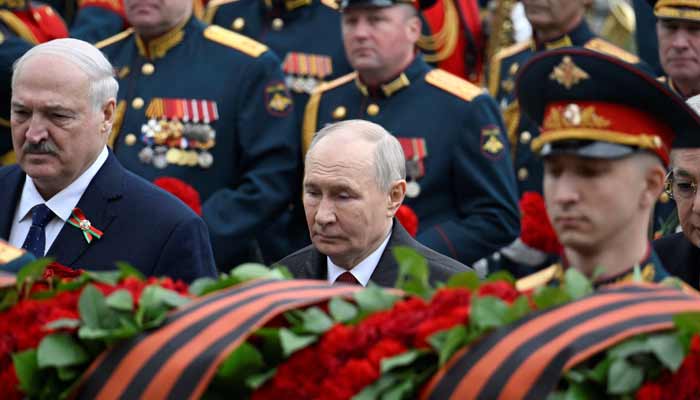
    Russian President Vladimir Putin attends a ceremony to lay flowers at the Tomb of the Unknown Soldier by the Kremlin wall in central Moscow, Russia, on May 9, 2026. — Reuters
    Russian President Vladimir Putin attends a ceremony to lay flowers at the Tomb of the Unknown Soldier by the Kremlin wall in central Moscow, Russia, on May 9, 2026. — Reuters

    • No Russian military hardware was visible during the event.
    • Putin references Soviet victory to boost support for the military.
    • Overnight drone exchanges between Ukraine and Russia.

    During the Victory Day parade on Red Square, President Vladimir Putin declared that Russian forces in Ukraine are combating an “aggressive force” supported by NATO countries and justified his war aims as “just.” His speech was delivered in a defiant tone.

    Putin frequently emphasizes Soviet triumph over Nazi Germany in World War II as a core part of his 25-year leadership narrative, with celebrations traditionally marked with grandeur and pomp.

    Recent Ukrainian long-range attacks have heightened Kremlin security and led to a scaled-down observance this year, with no military hardware on display—the first time in nearly 20 years—and mostly officials from Russia’s allied nations in attendance.

    Moscow and Kyiv agreed to a three-day ceasefire around the parade, following a last-minute appeal from U.S. President Donald Trump. Moscow threatened a significant strike on central Kyiv if Ukraine interfered with the parade plans.

    At the parade, Putin invoked Soviet victory to rally support for his military efforts in Ukraine, stating, “The remarkable achievement of the WWII generation inspires our soldiers today.” He added, “They face an aggressive force supported by NATO, yet our heroes continue to advance.” Later, he expressed his firm belief that their cause is just.

    Three-Day Ceasefire

    After attempts at truce earlier this week failed, Trump announced on Friday that a ceasefire between Russia and Ukraine would be in effect from May 9 for three days. He described it as “possibly the beginning of ending a long, deadly conflict,” and noted that the ceasefire would include a prisoner exchange.

    Ukrainian President Volodymyr Zelensky ordered his military not to attack during the ceasefire and confirmed his government would honor the truce to facilitate the exchange of 1,000 detainees from each side. Zelensky stated that the lives of Ukrainian prisoners are more critical than the historic event at Red Square.

    Both Ukrainian and Russian official sources reported a reduction in drone attacks overnight.

    The ongoing war, now in its fifth year, has resulted in hundreds of thousands of deaths and remains Europe’s deadliest conflict since WWII. Negotiations mediated by the U.S. have seen little progress since February, when attention shifted to Iran.

    Prior to Trump’s announcement, Zelensky had expressed reluctance to agree to a ceasefire during the parade and warned against attendance by Moscow’s allies. Russia had threatened to strike Kyiv heavily if the parade was disrupted and advised foreign diplomats to evacuate the city ahead of the event.

    In Kyiv, security was tight, with empty streets and disrupted mobile internet. Only leaders from Belarus, Malaysia, Laos, and Slovak Prime Minister Robert Fico were expected to attend, notably lower-profile than last year’s Chinese delegation with Xi Jinping.

    On Friday, Zelensky expressed hope that U.S. diplomats would visit Ukraine soon to help restart peace negotiations.

  • Trump calls for 3-day ceasefire in Russia-Ukraine conflict

    A three-day ceasefire has been announced to take effect from May 9 to May 11, in the ongoing conflict between Russia and Ukraine. This pause coincides with the Soviet Union’s victory celebrations over Nazi Germany in World War II and a military parade in Moscow’s Red Square.

    President Donald Trump revealed on social media that the truce will involve halting all active military operations and a prisoner exchange, releasing 1,000 detainees from each side. “Hopefully, this marks the start of the end for a very long, deadly, and bitter war,” Trump stated, noting continuous progress in peace talks.

    Following a phone conversation with Vladimir Putin on April 29, Trump indicated that a temporary ceasefire was possible. Last year, Putin had suggested a similar three-day halt, but it was not coordinated with Ukraine.

    Ukraine has proposed an open-ended ceasefire starting at midnight on Tuesday (2100 GMT), urging Russia to match the effort. Meanwhile, Russia has announced its own ceasefire for May 8 and 9, aiming to align with Victory Day commemorations and a parade in Moscow.

    Negotiations appear to be at a standstill, with discussions about eastern Ukraine’s Donetsk region stuck over demands that Kyiv withdraw troops from certain territories, which Ukraine refuses. Both sides have accused each other of violating previous ceasefires.

    In recent developments, Ukraine’s chief negotiator, Rustem Umerov, has traveled to Miami for talks with U.S. representatives, as diplomatic efforts to end the war face setbacks. The deadlock revolves around territorial disputes, with Russia insisting Kyiv retreat from contested regions and Ukraine pledging to defend its current positions.

  • White House Cites Iran War End, Bypassing War Powers Deadline

    The Biden administration’s recent statement emphasizes that the ceasefire with Iran has effectively ended hostilities, aligning with the legal deadline for congressional notification. According to the 1973 War Powers Resolution, the president has 60 days to engage in military action before needing to seek congressional approval or request a 30-day extension due to unavoidable military necessity while withdrawing troops.

    The conflict ignited on February 28 when Israel and the U.S. launched airstrikes against Iran. On Friday, Iran’s state news agency IRNA announced that Tehran had submitted its latest negotiation proposal to Pakistani mediators. President Biden formally informed Congress of the ongoing conflict 48 hours after the initial airstrikes, setting the 60-day window to expire on May 1.

    As the deadline neared, congressional experts and analysts anticipated that Biden might bypass the legal time limit. A senior White House official noted that they believe the War Powers Resolution did not apply in this situation, asserting that “hostilities that began on February 28 have been effectively terminated” under their interpretation, though this view is contested.

    Democratic lawmakers continue to argue that the law does not allow for a ceasefire and emphasize that the ongoing deployment of U.S. naval vessels enforcing economic sanctions on Iran constitutes continued hostility rather than peace. Senator Jeanne Shaheen, the lead Democrat on the Senate Foreign Relations Committee, criticized the administration, stating, “Six months into this poorly managed war, President Biden still lacks a clear strategy or exit plan,” framing the upcoming deadline as a legal threshold that Biden must address.

    Republican members of Congress, who represent a slim majority in both chambers and largely support the president, have predominantly opposed resolutions calling for an end to the conflict. The war has resulted in thousands of casualties, billions in damages, and turmoil in global markets, disrupting energy supplies and increasing consumer prices nationwide.

    Polls indicate that the war remains unpopular among Americans, with support waning six months ahead of the November elections that will decide congressional control. President Biden’s approval ratings have dipped to their lowest of his current term, largely attributed to rising living costs linked to the conflict.

    The U.S. Constitution grants Congress the authority to declare war, but this restriction is often bypassed during short-term military operations or those deemed necessary to counter immediate threats. On Thursday, Biden was briefed on new military plans aimed at compelling Iran to cease hostilities. If hostilities restart, Biden can notify Congress, effectively restarting the 60-day clock, a common practice used by presidents from both political parties during intermittent conflicts since the passage of the War Powers Act.

    Just as with the Vietnam War—an unpopular conflict that was never formally authorized by Congress—the current situation reflects the ongoing tension between executive action and congressional war powers.

  • Iran Offers Updated Proposal to Pakistan for US Talks

    A Pakistani official stands during the arrival of U.S. Vice President JD Vance for discussions with Iranian officials in Islamabad, Pakistan, Saturday, April 11, 2026. — Reuters

    • Tehran states it does not want to return to war, according to the judiciary chief.
    • Mohseni Ejei affirms, “We definitely do not accept imposition.”
    • President Trump faces mounting domestic pressure regarding the Iran conflict.

    Iran has submitted a fresh proposal for peace negotiations with the U.S. through mediator Pakistan, according to state media on Friday. Negotiations between the two nations remain stalled despite a ceasefire that has lasted several weeks.

    The proposal was delivered to Islamabad on Thursday evening, the IRNA news agency reported.

    The conflict, initiated by surprise strikes from the United States and Israel on February 28, has been paused since April 8. However, only one direct dialogue session has taken place between Iranian and U.S. representatives so far.

    Meanwhile, Iran continues to control the Strait of Hormuz, disrupting vast quantities of oil, gas, and fertilizer from entering the global economy. The U.S. has responded with a counterblockade on Iranian ports.

    The Wall Street Journal reported Thursday that President Donald Trump instructed security officials to prepare for the blockade to last for months, leading to a spike in oil prices.

    Despite the failed negotiations to end the war, the ceasefire remains intact. On Friday, judiciary chief Gholamhossein Mohseni Ejei, a prominent and respected cleric, stated, “The Islamic Republic has never backed away from negotiations.”

    However, he also added, “We certainly do not accept imposition,” in a video shared by the judiciary’s Mizan Online website, highlighting the ongoing challenges in reaching an agreement.

    Tehran, he emphasized, is not eager to revert to war.

    “We do not want war in any form; we do not desire its continuation.”

    Market responses remain tense, with oil prices over 50% higher than prewar levels amid concerns over prolonged Hormuz closure, and the European Central Bank maintaining its interest rates due to inflation fears.

    Debate Over War Authority

    In Washington, a legal debate is underway about whether President Trump missed a deadline to seek congressional approval for the Iran conflict.

    Officials, including Defense Secretary Pete Hegseth, argue that the ceasefire has paused the 60-day window for the president to request war powers from Congress.

    “Ahead of the War Powers Resolution, hostilities that commenced on Saturday, February 28, are considered ended,” an senior official told AFP late Thursday.

    Trump faces increasing pressure at home, with no clear victory in sight, rising inflation due to the conflict, and midterm elections approaching in November.

    Recent U.S. government data showed slower-than-expected economic growth and inflation reaching 3.5%.

    In Iran, the economic toll is becoming more evident. The U.S. military announced Thursday that its blockade has prevented Iran from exporting $6 billion worth of oil, while inflation, which was already over 45% before the war, has increased to 53.7% recently, according to national statistics.

    “Many are struggling to pay rent or buy food; some have nothing left,” said Mahyar, a 28-year-old who told AFP that his company had laid off 34 employees—almost 40% of its workforce.

    Hormuz Mission Efforts

    President Trump has criticized Washington’s allies for not joining efforts to reopen the Strait of Hormuz.

    While France and Britain are leading efforts to assemble an international coalition to reopen the strait, they have insisted this will only happen once peace is secured.

    On Thursday, a U.S. official confirmed to AFP that Washington is launching its own international coalition called the “Maritime Freedom Construct” to restart shipping through Hormuz.

    French Foreign Minister Jean-Noel Barrot clarified that the U.S. and French missions are meant to complement each other, not compete.

    “The U.S. initiative is different from ours; it’s intended to be a complementary effort,” Barrot said during his visit to the Gulf.

  • Mideast Tensions Reach Cold War Level Amid US-Iran Standoff

    The ongoing Middle East conflict has shifted into a standstill reminiscent of a Cold War, with the U.S. and Iran steadfast in their positions, each claiming military successes. The global community feels the ripple effects of this confrontation.

    According to sources familiar with U.S. officials, Axios reports that there’s no immediate resolution in sight for the deadlock between the U.S. and Iran. The confrontation has devolved into a period marked by economic sanctions, naval blockades, and unfolding dialogue—though substantive negotiations remain elusive.

    The situation is described as a “frozen conflict,” where neither war nor peace has been achieved. The U.S. anticipates maintaining its military presence in the region for several months, which would sustain the closure of the Strait of Hormuz, ongoing blockades, and a tense stalemate where each side awaits the other to capitulate or escalate.

    President Donald Trump reportedly remains undecided about whether to initiate new military actions or to wait, banking on the effectiveness of maximum pressure tactics, including strict financial sanctions, to coax Iran into negotiations. An insider close to Trump suggests that a prolonged “frozen conflict” could be damaging politically and economically for him, especially as elections near. While the President appears frustrated, he seems to acknowledge that force isn’t his preferred course, yet he remains resolute.

    Some senior advisers are urging against immediate escalation, instead advocating for the continuation of the blockade and increased sanctions on Iran before contemplating another round of bombings.

    The Middle East erupted into open hostilities when the U.S. and Israel launched an attack on Iran on February 28, targeting high-ranking Iranian officials, including Supreme Leader Ayatollah Ali Khamenei. Iran retaliated with missile strikes against U.S. bases across Gulf nations and Israel, causing significant casualties.

    In early April, Trump announced a two-week ceasefire with Iran, just ahead of a deadline for Tehran to reopen the Strait of Hormuz, following discussions with Pakistani leaders. Trump previously warned that failure to meet demands could result in catastrophic fallout.

    Pakistan hosted peace negotiations between the U.S. and Iran earlier this month, but after over 21 hours of intense talks, no formal agreement was reached, and diplomats had to leave Islamabad on April 12. On April 22, Trump extended the ceasefire to give peace talks more time, at Pakistan’s request.

    Meanwhile, Gulf leaders convened in Saudi Arabia—marking their first meeting since the regional escalation turned their states into a frontline in the Iran conflict. The gathering aimed to formulate a response to ongoing missile and drone attacks from Iran.

    Domestically, President Trump faces mounting pressure to end the conflict, especially as his approval ratings decline. Confidential Iranian sources indicate that proposals are floating to start detailed negotiations by first halting the U.S.-Israeli actions and ensuring guarantees against future attacks. The next steps would involve resolving Iran’s trade blockade and control of the Strait of Hormuz, before addressing nuclear issues and Iran’s uranium enrichment rights, seeking some recognition from the U.S.

    — Additional details from Reuters contribute to this developing story.

  • US Official: Trump Dissatisfied with Iran’s New Peace Proposal

    The U.S. insists that nuclear issues must be addressed right from the beginning. President Trump expressed displeasure over Iran’s delay in reaching a deal concerning its nuclear program. Iran, on the other hand, demands that the blockade be lifted prior to any negotiations taking place.

    According to a U.S. official familiar with Monday’s meeting between the president and his advisers, Trump is frustrated with Iran’s latest proposal, which postpones discussions on its nuclear ambitions until the war is over and shipping disputes in the Gulf are settled. This stance is unlikely to satisfy Washington, which emphasizes that nuclear matters should be tackled immediately.

    White House spokesperson Olivia Wales stated that the U.S. “will not negotiate through the press” and has “been clear about our red lines,” as the Trump administration seeks to conclude the conflict with Iran, which it began in February alongside Israel.

    An agreement made in 2015 between Iran and several countries, including the U.S., severely limited Iran’s nuclear activities, claiming they were for peaceful purposes. However, that deal collapsed after Trump unilaterally withdrew during his first term.

    Efforts to revive peace negotiations have diminished, especially after the U.S. canceled a planned visit by special envoy Steve Witkoff and President’s son-in-law Jared Kushner to Islamabad last weekend. Meanwhile, Iranian Foreign Minister Abbas Araqchi met with officials in Oman and Russia, where he received support from longstanding allies.

    Oil prices increased once again as negotiations stalled, with early Asian trade showing gains on Tuesday. Market analyst Fawad Razaqzada noted that traders are more concerned with the actual flow of oil through the Strait of Hormuz rather than rhetoric, and that this flow remains restricted. Recent days have seen at least six Iranian oil tankers turned back to Iran due to U.S. sanctions, severely impacting maritime traffic.

    Iran’s foreign ministry condemned the U.S. seizures of Iranian-linked tankers as “piracy and armed robbery on the high seas,” via social media. Normally, 125 to 140 ships transit the Strait of Hormuz daily, but only seven have crossed in the past 24 hours, and none carried oil for global markets, according to ship-tracking data.

    With President Trump’s approval ratings declining, domestic pressures mount to end a conflict that he has justified with shifting rationales. In Russia, Araqchi revealed that Trump asked for negotiations because the U.S. had achieved no tangible objectives.

    Iranian officials, speaking under anonymity, shared details of a proposal presented over the weekend, which outlines a staged approach: first ending the U.S.-Israeli sanctions against Iran and securing guarantees that hostilities won’t restart; then resolving the U.S. naval blockade and reopening the Strait of Hormuz under Iran’s control; and finally, addressing broader issues like Iran’s nuclear rights—a stance Iran insists should include acknowledgement of its right to uranium enrichment.

  • Should You Save Nyx During the Marauder War to Solving Them in Tides of Tomorrow

    Should You Save Nyx During the Marauder War to Solving Them in Tides of Tomorrow

    As you explore different parts of the story in Tides of Tomorrow, you’ll meet many characters. However, they mainly belong to three groups: Marauders, Mystics, and Reclaimers. To unlock the best ending, it’s important to gain their support.

    To do this, you must follow three separate storylines, each affected by your choices with that faction throughout the game. To persuade the Marauders, you need to go back to Wrecklandia and do certain things to increase your chances.

    Since your previous decisions can influence outcomes, this guide is still a work in progress as we find all possible endings for this part of the story.


    Where to Find Nyx’s Hidden Members

    When you enter the area, your first task is to find Kass. She can be found easily in the middle of the main area. She will then ask you to locate Nyx’s hidden rebels. Remember, this only happens if you chose to save Nyx from Obin at the start of the war at Obin’s Tower.

    To find these hidden survivors, go behind Kass. You’ll see a small path on your right behind some crates. Enter that area first to gather all items available. Afterward, tell Kass about their location. She will then go to the hideout and close the door behind her.


    Where to Find Nyx

    As Kass heads toward the hideout, she will ask you to find Nyx. From the main area, turn left into a small alley. Follow this path and turn right at the T-intersection. Continue straight, and you’ll be ambushed by Nyx’s guards. During conversation, choose the option “Only on my condition” when she asks for your help. This will open Nyx’s will meter.

    You can then select to help “reclaim the Maelstrom” to lower the red bar. If you have the Troublemaker trait, you can pick the first option on the next choice. If not, choose “You owe me,” and remind her of how you saved her from Obin.

    Keep choosing options until you can say, “I’m your best chance at survival right now.”


    How to Leave the Area Alive

    After talking with Nyx, you’ll do a stealth mission to avoid Obin’s guards. Start by jumping down the small gap in the fence where Nyx’s soldier was standing. Follow the path until you can climb back up, then wait for the soldiers to pass.

    Once they do, crouch, grab some scrap, and follow the same path they took. The soldiers walk in a circle, so if they come back, you can jump onto the platform on your right to stay hidden.

    Before reaching the large red door, you can sneak through the right side and find stairs going up. Climb these stairs, go down the other side, crouch in the left area, and listen for Nyx’s voice again.

    After this, swim across the water to reach the other side, then take the elevator up to the room with Kass and Nyx.


    What to Do With Nyx

    To get the best ending, you want to save Nyx and convince the Marauders to support you. During the dialogue, choose these options:

    • Kass, don’t hurt her.
    • Killing him was still wrong.
    • Help us, and you’ll live.
    • Will you help us reclaim the Maelstrom?
    • That’s not enough. We need an army.
    • Nyx, you have to surrender.
    • Play dead. We’ll pretend we killed you.

    Choosing the last option will greatly boost Nyx’s will meter, turning it into the blue section. Once that’s achieved, you can select “Stop Kass” and leave the area. As you exit, the Marauders will support you.

  • Framing the Fight: Words Shaping US-Israel-Iran Conflict Narratives

    Framing the Fight: Words Shaping US-Israel-Iran Conflict Narratives

    The old saying goes that truth is often the first casualty of war. While that might have been true on the chaos-filled frontlines, the way deception works today has been transformed by technology. Historically, the idea of “truth as a casualty” meant a complete blackout—an actual “fog of war” that left the public in complete darkness. Now, the opposite is true: we’re overwhelmed with “truth.” High-definition footage of airstrikes and live streams of tragedies in Gaza or Lebanon are constantly streaming directly into our phones.

    In this new landscape, the real victim isn’t truth itself but our perception of it. Media outlets no longer need to create outright fake news; instead, they manipulate perception simply by framing images and choosing words carefully—most people don’t even realize they’re being influenced. This was particularly clear during the late February joint US and Israeli strikes on Iran.

    While official narratives emphasized “sovereignty threats” and the assassination of Ayatollah Ali Khamenei, the coverage painted Tehran as a cold, unfeeling fortress, driven by “ideological fervor” and populated by a waiting-to-launch nuclear threat. But that depiction was a selective omission. It ignored the everyday realities — the coffee shops of North Tehran, students engaged in pragmatic debates about their future, a population exhausted from repression by their own government and the weight of foreign sanctions. When Western media portray Iran as a monolithic villain, they’re not just reporting—they’re shaping a narrative that makes conflict seem inevitable.

    Media narratives aren’t neutral; they are carefully constructed. While the threat of escalation seemed imminent, the story wasn’t just told through missile strikes or military reports. A parallel media war operates, often unseen without close scrutiny. Nations invest not just in arms but in language—crafting statements deliberately, using specific words and phrases to align the story with Western interests. Sometimes, this language works to influence how the public perceives the conflict, framing it in a way that shifts responsibility or responsibility away from certain actors.

    Noam Chomsky famously pointed out that “The smart way to keep people passive and obedient is to limit the spectrum of acceptable opinion, but allow lively debate within that spectrum.” This concept is evident in recent coverage. For example, a report from the Al Jazeera Media Institute highlighted how Western media often portray strikes as acts of “self-defense” while framing Iranian responses as “provocation”—a narrative that ends up legitimizing military actions and downplaying civilian casualties.

    The Washington Post headlines discussed the strikes as “a surprise daytime attack,” emphasizing heroism with words like “bold” and “eliminated,” creating a perception of bravery. CNN’s headlines suggested that Hezbollah “restarted the fight” that Israel was merely waiting to finish—an oversimplification that ignores the broader historical context. Western media’s coverage of an Iranian school hit in the first day of the attack used qualifiers like “near,” “adjacent to,” or “likely” to minimize the tragedy, making the incident seem less brutal or deliberate.

    The language used in framing these wars reveals a pattern. Terms like “conflict” or “clashes” are chosen deliberately—they downplay agency and responsibility. Dr. Dania Arayssi from the New Lines Institute points out that such passive language obscures who initiated violence and who holds military superiority, often shielding allied governments from moral scrutiny. Critics say it’s a structural bias embedded in Western journalism, aiming to maintain a certain narrative.

    Ex-BBC journalist Shumaila Jaffery notes that these choices aren’t random. The terminology signals a clear editorial stance—placing responsibility on Iran by calling it an “Iran conflict” keeps the focus away from US and Israeli actions, thus protecting those involved from blame. This framing also erases the individuals at risk; calling it an “Iran war” erases the diverse realities of ordinary Iranians and their daily lives.

    The echoes of Iraq’s past coverage are clear in today’s reporting. Media scholars have long noted similarities: framing government narratives as neutral, marginalizing skeptics, inflating threats, and only holding actors accountable after significant damage is done. Yet, the media landscape has evolved. During the Iraq war, the mainstream media manufactured crises, like the weapons of mass destruction, to support government narratives. Today, digital ecosystems like social media and alternative outlets provide counterpoints, with influencers and independent voices challenging official claims—a shift that wasn’t possible during Iraq.

    Despite these new channels, the reliance on government sources remains strong. Journalists still depend heavily on military and government officials for information, maintaining a pattern that reinforces official narratives. Moreover, the framing often involves selective context. For instance, coverage of Gaza or Iran tends to omit decades of sanctions, covert operations, and proxy conflicts, presenting violence as a sudden act rather than part of a long-standing pattern. This omission creates a moral clarity that oversimplifies complex realities.

    Language further carries ideological weight. Terms like “conflict” or “clashes” tend to obscure asymmetries of power and responsibility, presenting situations as mutual struggles when they are often heavily skewed. When the media simplifies or omits historical and structural details, it alters public understanding and accountability.

    Structural constraints within newsrooms shape reporting too. Speed, engagement metrics, biases, regulations, and risk aversion influence what gets emphasized or suppressed. Sources within governments and militaries continue to provide much of the information, which influences how stories are shaped and what histories are foregrounded. When histories of sanctions and covert actions are ignored, audiences lack crucial context to evaluate the events proportionally.

    In effect, the lives and experiences of everyday people in regions of conflict are often erased in the process—reduced to mere backdrops for geopolitical battles. This erasure hinders the public’s ability to see who is really acting and who is responsible for harm, making accountability far more difficult. The language and framing used in Western media serve not just to report but to shape perceptions, often pushing the bigger picture out of sight.

  • US Senate Supports Trump’s Iran War, Blocks Democratic Effort to Prevent Conflict

    US Senate Supports Trump’s Iran War, Blocks Democratic Effort to Prevent Conflict

    Members of the House of Representatives gather for the fourth round of voting for a new House Speaker on the second day of the 118th Congress at the U.S. Capitol in Washington, January 4, 2023. — Reuters

    – Senate Republicans have blocked war powers legislation four times.
    – Nearly all Republicans remain strongly supportive of Trump.
    – Democrats warn that escalating conflict could be dangerous.

    The majority of the U.S. Senate on Wednesday supported President Donald Trump’s military actions against Iran, voting to defeat a Democratic-led resolution that sought to halt the war unless Congress approved it. The Senate’s 52-47 vote to prevent the war powers resolution from moving forward highlights continued Republican backing for Trump’s foreign policy, even more than six weeks after the U.S. and Israel carried out airstrikes on Iran.

    Trump, in a Tuesday interview with Fox Business Network aired Wednesday, said the conflict was nearing its end. Meanwhile, Pakistan’s army chief of mediating nations arrived in Tehran to work on preventing a renewed clash after peace talks over the weekend ended without agreement.

    This marks the fourth occasion since the conflict began that Democrats have attempted to bring war powers measures before the Senate, all of which failed due to opposition primarily from every Senate Republican except Kentucky’s Rand Paul.

    Paul, known for advocating restrained military spending and constitutional adherence, was the only Republican to support the resolution. The only Democrat voting against was Pennsylvania’s John Fetterman. West Virginia’s Jim Justice abstained from voting.

    Though the Constitution states that only Congress can declare war, presidents from both parties have generally argued that short-term military operations or immediate threats don’t require Congressional approval.

    White House officials and nearly all of Trump’s Republican colleagues argue his actions are legal, asserting his authority as commander-in-chief to safeguard U.S. interests through limited military strikes.

    Public opinion shows the war is broadly unpopular, with a Reuters/Ipsos poll from March 31 indicating 60% of Americans oppose military action against Iran. Support for the strikes was higher among Republicans at 74%, compared to just 7% among Democrats.

    Senator Jim Risch of Idaho, chairman of the Foreign Relations Committee, accused backers of the war powers resolution of supporting Iran during his speech before the vote, stating, “Nobody is coming to help Iran except for the 47 senators supporting this resolution.”

    Democrats emphasized the importance of Congress reclaiming its constitutional authority to declare war and warned against letting this conflict drag on. Rhode Island Democrat Jack Reed, the top Democrat on the Armed Services Committee, urged colleagues to pursue peace before Trump’s war escalates beyond control.

    Party leaders have committed to introducing additional war powers resolutions until the conflict concludes or Congress authorizes ongoing military engagement. A similar measure will be considered in the House later this week.

  • Easter Ceasefire Starts Between Russia and Ukraine

    Easter Ceasefire Starts Between Russia and Ukraine

    A temporary ceasefire between Russia and Ukraine came into effect on Saturday, with Kyiv warning it will respond immediately if Russia breaches the agreement. Russian President Vladimir Putin ordered the ceasefire on Thursday to align with Orthodox Easter, more than a week after Ukrainian President Volodymyr Zelensky initially proposed it. Both parties have agreed to follow the terms of the ceasefire.

    The truce is scheduled to last for 32 hours, starting at 4:00 p.m. local time (1:00 p.m. GMT) on Saturday and ending at the close of Sunday, according to the Kremlin. Ukrainian President Zelensky stated, “Ukraine will observe the ceasefire and respond strictly in kind. The absence of Russian strikes by air, land, or sea will mean no retaliation from us.” The Ukrainian military remains prepared to respond immediately if the ceasefire is violated.

    Just hours before the ceasefire was to begin, Russia launched at least 160 drones at Ukrainian territory, resulting in four deaths in the country’s east and south, and injuring dozens of others, Ukrainian officials reported. The Odesa region in the south was among the hardest hit, with authorities confirming two fatalities and damage to civilian infrastructure. Meanwhile, Ukrainian drones ignited a fire at an oil depot and damaged apartment buildings in Russia’s Krasnodar region. Russian-occupied areas in Ukraine’s Donetsk and Kherson regions also suffered attacks, resulting in four deaths.

    Public skepticism about the ceasefire holding remains high among Ukrainians, especially given past violations—last year, both sides accused each other of numerous breaches during similar Easter truces. Despite the ongoing tension, both sides carried out a prisoner exchange, handing over 175 soldiers each, with the United Arab Emirates mediating the process, according to Russian Defense Ministry reports.

    Diplomatic efforts to resolve the conflict have largely stalled in recent weeks, especially amid the escalation of the conflict in the Middle East. Prior to this, efforts toward peace had been slow, chiefly due to disagreements over territorial control. Ukraine suggested maintaining current front lines as the basis for peace, but Russia rejected this, insisting Ukraine cede all territories in the Donetsk region that it currently controls—a demand Kyiv finds unacceptable. Several US-led negotiations have failed to produce an agreement, with Kremlin spokesperson Dmitry Peskov denying that Russia discussed ceasefire terms with Ukraine or the U.S. in advance, emphasizing that the ceasefire is unrelated to broader peace talks.

    The conflict has resulted in hundreds of thousands of deaths and displaced millions, making it Europe’s deadliest war since World War II. After over four years, fighting has largely stagnated. Russia has made some small territorial gains at a high cost, while Ukraine has recently pushed back in the southeast, with Russian advances slowing since late 2025, according to the Institute for the Study of War (ISW). Analysts attribute this slowdown to Russia’s ban from using SpaceX’s Starlink satellites and Moscow’s efforts to restrict the Telegram messaging app. However, the situation remains unfavorable for Ukraine in parts of the Donetsk region near Kramatorsk and Sloviansk, where Russia controls just over 19 percent of Ukrainian territory—most of it seized in the early weeks of the conflict.

  • Iran calls for Lebanon ceasefire and asset recovery before peace talks

    Iran calls for Lebanon ceasefire and asset recovery before peace talks

    A man stands near a damaged building following an Israeli strike on Wednesday in Tallet El Khayat, Beirut, Lebanon, April 9, 2026. — Reuters/File

    • U.S. Vice President Vance warns Iran not to “play” the U.S. during Pakistan talks.
    • Israeli airstrikes persist across southern Lebanon on Friday.
    • Negotiations won’t commence until the U.S. meets prior demands, according to Iran.

    Iran announced on Friday that the release of blocked Iranian assets and a ceasefire in Lebanon are prerequisites before peace talks can proceed, casting doubt over the scheduled negotiations in Pakistan on Saturday. Iran’s Parliament Speaker Mohammad Baqer Qalibaf stated on X that these two issues had been previously agreed upon with the U.S. and warned that talks would not begin until they are addressed. The White House has not issued an immediate comment.

    Earlier, Vice President JD Vance, leading the U.S. delegation, traveled to Pakistan expressing optimism about a positive resolution. However, he cautioned that any attempt to manipulate the process would be met with resistance from the negotiation team. Iran has been blocked from accessing tens of billions of dollars in foreign bank accounts, mainly from oil and gas exports, due to U.S. sanctions targeting its banking and energy sectors.

    Tense Ceasefire

    U.S. President Donald Trump declared a two-week ceasefire in the six-week conflict on Tuesday, just days before a deadline after which he had threatened to destroy Iran’s civilization. The truce remains fragile, with Israel continuing its bombardment of Lebanon and ongoing restrictions in the Strait of Hormuz, which have caused the most significant disruption to global energy supplies in history. The ceasefire halted U.S. and Israeli airstrikes on Iran but has failed to resolve the blockade of the Strait or stop Israel’s parallel conflict with Iran’s Hezbollah allies in Lebanon.

    President Trump criticized Iran via social media for its handling of oil transit through the Strait, accusing Tehran of mismanaging the flow and warning against attempts to collect crossing fees. Israel has maintained that its campaign against Hezbollah in Lebanon is separate from the ceasefire agreement.

    Israeli airstrikes persisted in southern Lebanon on Friday, reportedly killing over a dozen individuals in various towns. Lebanese state media reported that eight members of the country’s security forces lost their lives in one such strike.

  • WHO warns Lebanon’s hospitals may face critical supply shortages in days

    WHO warns Lebanon’s hospitals may face critical supply shortages in days

    Some Lebanese hospitals are on the brink of running out of critical trauma medical supplies within days due to a surge in casualties from recent Israeli airstrikes, according to the World Health Organization (WHO) on Thursday. The depleted supplies include essential items like bandages, antibiotics, and anesthetics used to treat war-related injuries.

    Dr. Abdinasir Abubakar, the WHO’s representative in Lebanon, warned, “Some trauma management supplies are already running low, and we might exhaust our stock in just a few days.” The violence continues, with Israel targeting more locations in Lebanon following its most intense attacks of the conflict on Wednesday, which resulted in over 250 deaths and more than 1,000 injuries.

    “If another large-scale incident occurs, similar to yesterday’s, it would be disastrous,” Abubakar stated. “We’re likely to lose more lives simply because we do not have enough supplies on hand.” The shortage of trauma kits has been driven by a rapid increase in casualties—mainly civilians—with an estimated three weeks’ worth of supplies consumed in a single day.

    In addition to trauma supplies, medications necessary for chronic illnesses, such as insulin for diabetics, are at risk of running out within weeks. Disrupted supply chains, impacted by the Gulf War and the closure of the Strait of Hormuz, have complicated the situation further, causing delivery costs to triple. Funding constraints are also hampering relief efforts, the WHO noted.

    To prevent total depletion of stocks, the WHO and Lebanese health authorities are planning to transfer supplies between hospitals, but the strain on the healthcare system remains severe. Since the conflict began on March 2, prompted by joint US-Israeli strikes on Iran in late February, over a million people have been displaced across Lebanon, according to the United Nations.

  • Iran’s 10 Conditions to End War with the US

    Iran’s 10 Conditions to End War with the US

    Iran has proposed a detailed 10-point plan to end the conflict with the United States, outlining broad military, economic, and strategic conditions. President Donald Trump agreed to a two-week ceasefire with Iran, just under two hours before his specified deadline, following mediation efforts by Pakistan.

    According to Iran’s National Security Council, discussions with the U.S. will commence in Islamabad on April 11, based on this 10-point proposal.

    Key proposals include:

    • Allowing limited passage through the Strait of Hormuz, coordinated with Iranian forces, which would give Iran a unique geopolitical and economic advantage.
    • Ending all hostilities against groups aligned with the axis of resistance.
    • Withdrawing U.S. military forces from regional bases and deployment points.
    • Establishing a secure transit protocol in the Strait of Hormuz that affirms Iran’s dominance per the negotiated agreement.
    • Full compensation for Iran’s damages as estimated.
    • Lifting all primary and secondary sanctions.
    • Removing international resolutions and oversight mechanisms targeting Iran.
    • Releasing Iranian assets and properties frozen abroad.
    • Recognizing Iran’s uranium enrichment program as part of the agreement.
    • Final approval of all these measures in a binding Security Council resolution.

    The plan was communicated through mediators, including Pakistan, amid urgent diplomatic efforts to de-escalate the conflict.

    The U.S. has characterized the proposal as a “workable basis” for negotiations, hinting at possible progress toward a ceasefire and a broader resolution.

    Earlier in the day, Trump issued a stark warning via social media, suggesting that “a whole civilization will die tonight” if his demands were not satisfied. Later, his stance shifted with the announcement of the temporary ceasefire.

    Shehbaz Sharif, Pakistan’s Prime Minister and a mediator, announced on X that Iranian and U.S. delegations had been invited to meet in Islamabad on Friday.

    Trump indicated that the deal was contingent upon Iran agreeing to halt its blockade of oil and gas shipments through the Strait of Hormuz, which typically accounts for about 20% of global oil traffic.

    Iran’s Foreign Minister Abbas Araghchi confirmed that Tehran would cease retaliatory actions and allow safe passage through the waterway.

  • Trump’s latest threat: Cyber, nuclear, or invasion? What’s Iran’s risk?

    Trump’s latest threat: Cyber, nuclear, or invasion? What’s Iran’s risk?

    WASHINGTON: Donald Trump’s escalating threats to devastate Iran have sparked fears over how far the U.S. might go militarily to force Iran into compliance.

    On Tuesday, Trump declared that “an entire civilization will perish” if Iran refuses his ultimatum to accept U.S. demands for war. Vice President JD Vance added that Washington still has more “tools in our toolkit” ready to be used against Tehran.

    New Military Options

    The U.S. has already deployed a broad range of military assets targeting Iran, including advanced aircraft, cruise missiles, stealth bombers, and attack drones. Daniel Schneiderman, Director of Global Policy Programs at Penn Washington (the University of Pennsylvania’s policy center), stated that the U.S. has “employed many of its most sophisticated capabilities in this conflict.” These include “air assets, cruise missiles, stealth bombers, and one-way attack drones,” he noted.

    He suggested there may be “specialized hypersonic weapons or other bespoke systems” available for specific strikes. However, Schneiderman emphasized that “unless nuclear weapons are involved, the administration appears to have not placed limits on what it might employ.”

    There’s also been no official ruling out the possible deployment of ground troops, which would signify a major escalation.

    Etienne Marcuz, an analyst with France’s FRS think tank, highlighted that “cyber warfare remains a potential option” in the U.S.’s arsenal.

    Trump has previously referred to a weapon called the “discombobulator,” used during the January operation aimed at capturing Venezuelan leader Nicolás Maduro, which reportedly disabled military equipment in Venezuela.

    Nuclear Threats and Possibilities

    Trump’s remarks about erasing Iranian civilization have led to speculation about the potential use of nuclear weapons. The U.S. has both strategic warheads capable of destroying cities and smaller tactical nuclear devices intended for battlefield use.

    Historically, the U.S. is the only country to have used nuclear weapons during combat — dropping two bombs on Japan in World War II. Last year, Trump authorized the resumption of nuclear testing.

    The White House quickly dismissed suggestions that nuclear weapons might be used against Iran, emphasizing that “nothing” in Vance’s warnings indicates such an action.

    Schneiderman considers it “highly unlikely” that nuclear weapons would be used against Iran, calling crossing that “Rubicon” a “last resort.” He warned that a nuclear strike would lead to “massive losses of human life, global economic upheaval, environmental contamination from nuclear fallout, and the crippling of Iran’s oil and gas exports.”

    Marcuz agreed, saying the political fallout of such a move would be immense and could set a dangerous precedent, possibly inciting similar actions from Russia in Ukraine.

    Potential U.S. Actions

    Trump has already warned of bombing Iran’s bridges, power plants, and other civilian infrastructure, potentially bringing these vital systems to a standstill. If the current deadline passes without a deal, Schneiderman warned, “the U.S. may escalate attacks on dual-use infrastructure like bridges and energy facilities.”

    He also pointed out that such strikes could inflict severe damage on Iran’s infrastructure and worsen living conditions for its citizens, with limited chances of achieving strategic success. “The harm to civilians would likely be significant,” he added.