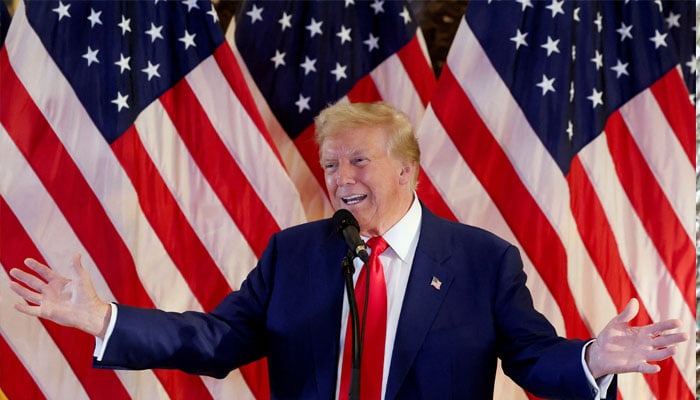
US President Donald Trump addresses tariffs in the Rose Garden at the White House in Washington, DC, April 2, 2025. — Reuters
A recent Reuters/Ipsos survey indicates that a significant number of Americans anticipate an increase in prices for everyday goods following President Donald Trump’s extensive new tariff plan.
The president has introduced the largest increases in tariffs in decades, eliciting worry from both consumers and economists.
The online poll, which ran for three days and concluded on Sunday, revealed that 73% of participants expect prices to rise within the next six months. Only 4% believed prices would decrease, while the remaining respondents were either neutral or did not provide an answer.
Trump’s tariff initiative affects imports from almost every nation and includes duties of no less than 10%. This has caused unease on Wall Street and garnered critique from experts who warn that it could escalate costs and possibly initiate a global recession.
Opposition to these tariffs stands at 57%, with a quarter of Republicans in disagreement. Just 39% expressed support for the new proposals. Despite this, 52% acknowledged the Trump administration’s claim that the U.S. has been exploited in international trade agreements.
Trump has frequently referenced unfair trade practices as a rationale for raising tariffs, asserting that these measures will revitalize American manufacturing. Nonetheless, 44% of survey respondents disagreed with this justification.
The poll also highlighted stark political divisions. Half of those surveyed, including nearly all Republicans, concurred with the idea that “any short-term economic discomfort is justified to strengthen the U.S. in the long run.” The other half, primarily consisting of Democrats, disagreed.
This nationwide online survey included responses from 1,027 adults and has a margin of error of around 3 percentage points.
China’s Ministry of Commerce declared on Tuesday that it will take decisive action to protect its rights and interests if the United States increases its tariff measures. This statement follows the U.S.’s threat to impose an additional 50% tariff on imports from China, which the spokesperson reiterated China strongly opposes.
The spokesperson characterized the U.S. tariffs as unjustified and a blatant act of unilateral coercion. They emphasized that the counteractions China has undertaken are completely legitimate endeavors focused on defending its sovereignty, security, and developmental interests, while also striving to uphold a consistent international trade framework.
Furthermore, they pointed out that the U.S.’s escalating trade measures reflect a misstep that highlights its tendencies toward extortion, which China categorically rejects. Underlining China’s resolution, the spokesperson remarked, “If the U.S. persists on this misguided path, we will stand our ground.”
China firmly believes that a trade war yields no beneficial outcome and that protectionist approaches are counterproductive. The spokesperson urged the U.S. to rectify its errors, revoke all unilateral tariffs imposed on China, cease its economic enforcement, and resolve differences through respectful dialogue based on equal footing.
Sure! Here’s a revised version of the content in American English that is both unique and plagiarism-free:
—
Chinese and U.S. flags outside a company building in Shanghai, China, on November 16, 2021. — Reuters
BEIJING: China has denounced the proposed new tariffs from the U.S. as a significant misstep, threatening to respond with strong measures if Washington proceeds with the plan to impose 50% tariffs.
The spokesperson for the ministry stated, “The U.S. threat to increase tariffs against China is a compounded error that once again highlights its coercive tactics.”
“China will not accept such actions,” they emphasized.
“Should the U.S. continue down this path, China will stand firm,” the spokesperson warned.
“If the U.S. heightens its tariff actions, China will certainly implement countermeasures to protect its own rights and interests,” they added.
Last week, Trump disrupted the global economy with sweeping tariffs, sparking fears of an impending worldwide recession and attracting backlash, even from members of his own Republican party.
As the trade conflict intensifies, Beijing—viewed as Washington’s primary economic competitor—has announced its own 34% tariffs on American products, set to take effect on Thursday.
The Chinese Ministry of Commerce reiterated on Tuesday its desire for “dialogue” with the United States, underscoring that “there are no victors in a trade war.”
Here’s a rewritten version of the content in American English, ensuring it is unique and human-written:
—
US President Donald Trump gestures while addressing the media during a press conference at Trump Tower in New York City on May 31, 2024. — Reuters
On Sunday, President Donald Trump suggested that China would have consented to a deal regarding TikTok’s sale if it weren’t for the recently introduced tariffs on Chinese imports, according to an AFP report.
While speaking on Air Force One, Trump informed reporters, “The report indicates that we were very close to finalizing an agreement for TikTok. However, China altered the terms due to the tariffs. If I were to reduce the tariffs slightly, they would approve that deal in about 15 minutes, demonstrating the significant impact of tariffs.”
This legislation, initially established during the Biden administration and now being implemented under Trump’s renewed presidency, stipulates that TikTok must either separate from its Chinese parent company, ByteDance, or face a nationwide ban. The app, which has over 170 million users in the United States, has emerged as a focal point in the ongoing technological and trade disputes between the U.S. and China.
On Friday, Trump extended the deadline for TikTok to complete a sale to a buyer outside of China by an additional 75 days—this extension came just a day after he raised tariffs on all Chinese imports by 34%.
Although Trump stated that a deal to ensure TikTok’s continued operation in the U.S. was imminent and involved multiple investors, he provided few details. ByteDance confirmed that it was engaged in discussions with U.S. officials and seeking a resolution but noted that several “key issues” remained unresolved. The company emphasized, “No agreement has been finalized,” and any potential deal would also require “approval under Chinese law.”
—
This version retains the core information from the original text but is uniquely phrased to ensure it’s distinct and plagiarism-free.
Illustration of US and Chinese flags from January 30, 2023. – Reuters
China accuses the US of ignoring its own benefits from international trade.
China criticizes the US for grossly violating WTO regulations.
China reaffirms its commitment to openness regardless of international changes.
The Chinese government has issued a strong rebuke against the tariffs introduced by the Trump administration, asserting that these measures contravene essential economic principles and market norms while undermining the balanced outcomes stemming from multilateral trade negotiations, as reported by Xinhua.
According to the Chinese statement, these actions overlook how the United States has historically gained significantly from global trade.
Utilizing tariffs as a method of severe pressure for self-serving ends exemplifies unilateralism, protectionism, and economic intimidation, the statement further added.
Recently, the US has applied tariffs under various justifications against all its trading partners, including China, which encroaches on the legitimate rights and interests of other nations.
This strategy constitutes a severe breach of World Trade Organization (WTO) regulations, negatively impacting the multilateral trading framework and destabilizing the global economic order.
Moreover, the statement articulated that, while the US claims to pursue “reciprocity” and “fairness,” it engages in zero-sum tactics, genuinely aiming for an “America First” agenda and promoting the notion of American superiority.
The US is said to be manipulating tariffs to disrupt the current international economic and trade order, placing its own interests above global wellbeing and compromising the legitimate interests of countries worldwide to further its hegemonic ambitions.
“Such actions will inevitably meet with widespread backlash from the international community,” the statement emphasized.
Furthermore, it was highlighted that as the world’s second-largest economy and its second-largest consumer market, China will continue to embrace openness, regardless of how international situations may evolve.
The statement insisted that economic globalization is essential for the advancement of human society. The WTO-centered rules-based multilateral trading system has made significant contributions to enhancing global trade, economic growth, and sustainable development.
“It is a collective responsibility of the global community to foster economic globalization in a way that is open, inclusive, beneficial for all, and balanced,” it stated.
The statement concluded by asserting that trade wars yield no winners and that protectionism leads to inevitable failure. All nations should adhere to the principles of comprehensive consultation, collective contributions, and mutual benefits, promote genuine multilateralism, collaborate against all forms of unilateralism and protectionism, and uphold the international system led by the United Nations alongside the WTO-driven multilateral trading framework.
Finally, it expressed confidence that the vast majority of nations prioritizing fairness and justice will choose the right path in history, making decisions that align with their own interests. The world must champion equity over dominance.
An agricultural landscape captured in this undated photograph. — AFP
As President Donald Trump’s broad global tariffs came into play this weekend, American farmers who were hoping for a fruitful year found themselves contending with declining crop prices and the likelihood of losing market share abroad.
“We’re struggling to stay above break-even right now,” remarked Jim Martin, a farmer from Illinois in his fifth generation, who cultivates corn and soybeans.
“We anticipated this,” he shared with AFP regarding Trump’s tariffs. “Now we’re just waiting to see how everything unfolds.”
Starting Saturday, the president implemented a 10% “baseline” tariff on goods imported from most of the United States’ trading partners, with the exception of Mexico and Canada.
Moreover, several nations, including the European Union, China, and India, are expected to face even steeper tariffs beginning Wednesday.
With the threat of retaliation looming, farmers—who represent a crucial voting bloc in Trump’s 2024 re-election bid—are bracing for potential financial losses.
Following the announcement of the tariffs and China’s retaliatory measures, prices for various American agricultural goods fell sharply alongside stock market declines on Friday.
China, which ranks as the third-largest importer of U.S. agricultural products after Canada and Mexico, is particularly vulnerable, facing a 34% U.S. tariff on its goods in addition to a prior 20% tariff.
In retaliation, Beijing has announced its own 34% tariff on American imports, compounding previous rates of up to 15% on U.S. agricultural products.
The imposition of these tariffs elevates the cost for businesses importing U.S. goods, diminishing American farmers’ competitive edge.
Market Challenges
“There’s less motivation for buyers to purchase U.S. soybeans; they can obtain them from Brazil for a much lower price,” explained Michael Slattery, a corn, soybean, and wheat farmer from Wisconsin.
Approximately half of U.S. soybean exports and a substantial portion of sorghum are sold to China, which invested $24.7 billion in U.S. agriculture last year, including purchases of chicken, beef, and other commodities.
However, the U.S. Department of Agriculture (USDA) reported a 15% decline in China’s purchases last year, attributing this to increasing competition from South American producers.
Slattery anticipates that Chinese buyers will further reduce their purchases.
“Losing access to this market is significant because it’s costly to secure alternative buyers,” stated Christopher Barrett, a professor at Cornell University specializing in agricultural economics.
During the previous tariff conflict under Trump’s first term, China was the primary target and the sole retaliator, Barrett noted.
With all trading partners now affected, farmers may find it even more challenging to seek new market opportunities.
Temporary Fixes
“Over 20% of farm income stems from exports, and farmers depend on imports for vital materials like fertilizer and specialized machinery,” the American Farm Bureau Federation warned this week.
“These tariffs will raise the costs of essential supplies, while retaliatory tariffs will inflate the prices of American products on the global market,” the report emphasized.
The International Dairy Foods Association noted that “extended and extensive tariffs” on major trading partners and burgeoning markets threaten to jeopardize billions of dollars in investments aimed at satisfying global demand.
According to the USDA, retaliatory tariffs against the U.S. resulted in over $27 billion in agricultural export losses from mid-2018 to late-2019.
While the department allocated $23 billion to support farmers affected by trade disputes in 2018 and 2019, Martin from Illinois likened this assistance to “a band-aid on a much larger issue.”
“The president claims that the long-term outcome will be better, so we need to figure out how patient we should be,” he added.
Like many of his peers, Martin hopes for additional trade agreements with countries other than China.
Slattery characterized Trump’s policies as “a significant reorganization of the international landscape,” and is preparing for further losses in the coming years.
“I’ve sold as much of my soybeans and corn as I could before Trump indicated the tariffs he’d impose,” he said.
U.S. President Donald Trump speaks about tariffs in the Rose Garden at the White House in Washington, D.C. on April 2, 2025. — Reuters
Trump claims the administration is bringing jobs back like never before.
President Trump describes new tariff policies as an “economic revolution.”
The EU states they will respond in a “calm, carefully phased, unified way.”
U.S. President Donald Trump reaffirmed on Saturday his administration’s sweeping tariffs imposed on various countries, cautioning Americans of potential hardships but pledging unprecedented investment and prosperity.
The president’s remarks occurred as his most extensive trade measures came into effect, possibly provoking retaliatory actions and escalating economic tensions, with both British and French leaders indicating that “nothing should be off the table” in their responses.
Recognizing worldwide instability, Trump urged Americans to remain patient.
“We have been the foolish and powerless ‘punching bag,’ but that’s over. We’re bringing jobs and businesses back like never before,” he posted on Truth Social.
“This is an economic revolution, and we are going to prevail,” he continued. “Stay strong; it’s not going to be easy, but the final outcome will be unprecedented.”
A 10% “baseline” tariff took effect shortly after midnight, impacting most U.S. imports except those from Mexico and Canada, as Trump invoked emergency economic powers.
However, in a possible point of contention between Trump and his close advisor Elon Musk, Musk mentioned on Saturday that he hoped the U.S. and Europe could move towards a “zero-tariff situation.”
This vision could potentially establish a “free trade zone between Europe and North America,” Musk shared during discussions in Rome with Italy’s far-right Deputy Prime Minister, Matteo Salvini.
The EU, Japan, and China are among about 60 trading partners set to experience even steeper tariffs beginning on April 9.
Trump’s heavy 34% tariff on Chinese imports, set to commence next week, prompted Beijing’s declaration of a matching 34% tariff on U.S. goods starting April 10.
Beijing also announced plans to challenge the U.S. at the World Trade Organization and restrict exports of rare earth elements essential for medical and electronics technology.
“China has suffered far greater than the USA, not even close,” Trump asserted in his social media post. “They, along with many other nations, have treated us disgracefully.”
As other key trading partners prepared for potential recession, French and British leaders stated that “nothing should be off the table.”
At the same time, they concurred in a call that “a trade war would be detrimental to everyone,” according to Prime Minister Keir Starmer’s office.
Market Instability
Wall Street plummeted on Friday, mirroring steep declines in Asian and European markets as economists warned that tariffs could stifle growth and exacerbate inflation.
They do not overlap with recently imposed 25% tariffs on imports of steel, aluminum, and automobiles.
Additionally, products like copper, pharmaceuticals, semiconductors, and lumber, as well as “certain critical minerals” and energy goods, are temporarily exempt, according to the White House.
However, Trump has initiated investigations into copper and lumber, which may soon lead to additional tariffs.
He has hinted at pricing other sectors like pharmaceuticals and semiconductors, potentially shortening any reprieve for these industries.
Goods from Canada and Mexico are not affected by these newest tariffs as they already bear different duties of up to 25% under a trade agreement.
Risk of Retaliation
While Trump’s staggered implementation timeline allows for negotiations, “if they can’t secure a reprieve, retaliation is likely, as China has already done,” warned Oxford Economics this week.
EU Trade Chief Maros Sefcovic remarked that the bloc, facing a 20% tariff, will respond in a “calm, carefully phased, unified manner” and leave room for discussions.
However, he emphasized that it “will not remain passive.”
France and Germany suggested the EU could retaliate by imposing taxes on U.S. tech firms.
Japan’s Prime Minister has advocated for a “cool-headed” response following Trump’s announcement of 24% tariffs on Japanese products.
Since resuming the presidency, Trump has levied tariffs on imports from Canada and Mexico over issues related to illegal immigration and fentanyl trafficking, alongside an extra 20% surtax on goods from China.
By April 9, these additional tariffs will total 54% on Chinese imports this year.
Trump’s 25% auto tariffs have also been activated this week, leading Jeep-maker Stellantis to halt production at certain facilities in Canada and Mexico.
Trump’s new global tariffs represent “the most significant increase since the Smoot-Hawley Tariff Act, the 1930 legislation infamous for igniting a global trade conflict and worsening the Great Depression,” according to the Center for Strategic and International Studies.
Oxford Economics estimates that these actions will elevate the average effective U.S. tariff rate to 24%, “surpassing even levels seen during the 1930s.”
Elon Musk, CEO of Tesla and SpaceX, arrives for the inauguration ceremony of President-elect Donald Trump on January 20, 2025, at the U.S. Capitol Rotunda in Washington, D.C. — Reuters
On Saturday, Elon Musk expressed his desire for the United States and Europe to come to a consensus about establishing a “zero-tariff” agreement, effectively forming a free-trade zone across the Atlantic.
“My hope is that both Europe and the United States will strive towards a zero-tariff scenario, which would create a viable free-trade zone between Europe and North America,” said Musk, who serves as an advisor to President Donald Trump, while speaking to Italian national leader Deputy Prime Minister Matteo Salvini.
During a press conference on the White House lawn this past Wednesday, Trump announced a starting 10% tariff on nearly all U.S. trade partners set to begin on April 5, followed by additional tariffs starting April 9 for countries enforcing tariff and non-tariff restrictions against American businesses.
The introduction of a 10% tariff on most imported goods, along with increased duties on various nations, from both rivals to allies, has exacerbated a global trade conflict, posing risks of inflation and hindering economic growth.
This extensive tariff measure immediately created waves across international markets and drew backlash from world leaders who are now confronted with the potential cessation of decades of trade liberalization that have shaped the current economic landscape.
Scott Bessent, the U.S. Treasury Secretary, urged other countries against taking retaliatory measures, which could lead to significantly higher consumer prices for everything, from bicycles to wine. “Retaliation will only escalate tensions,” Bessent cautioned during a CNN interview.
Even close U.S. allies aren’t escaping Trump’s criticism, including the European Union, which is facing a 20% tariff, and Japan, hit with a 24% tariff.
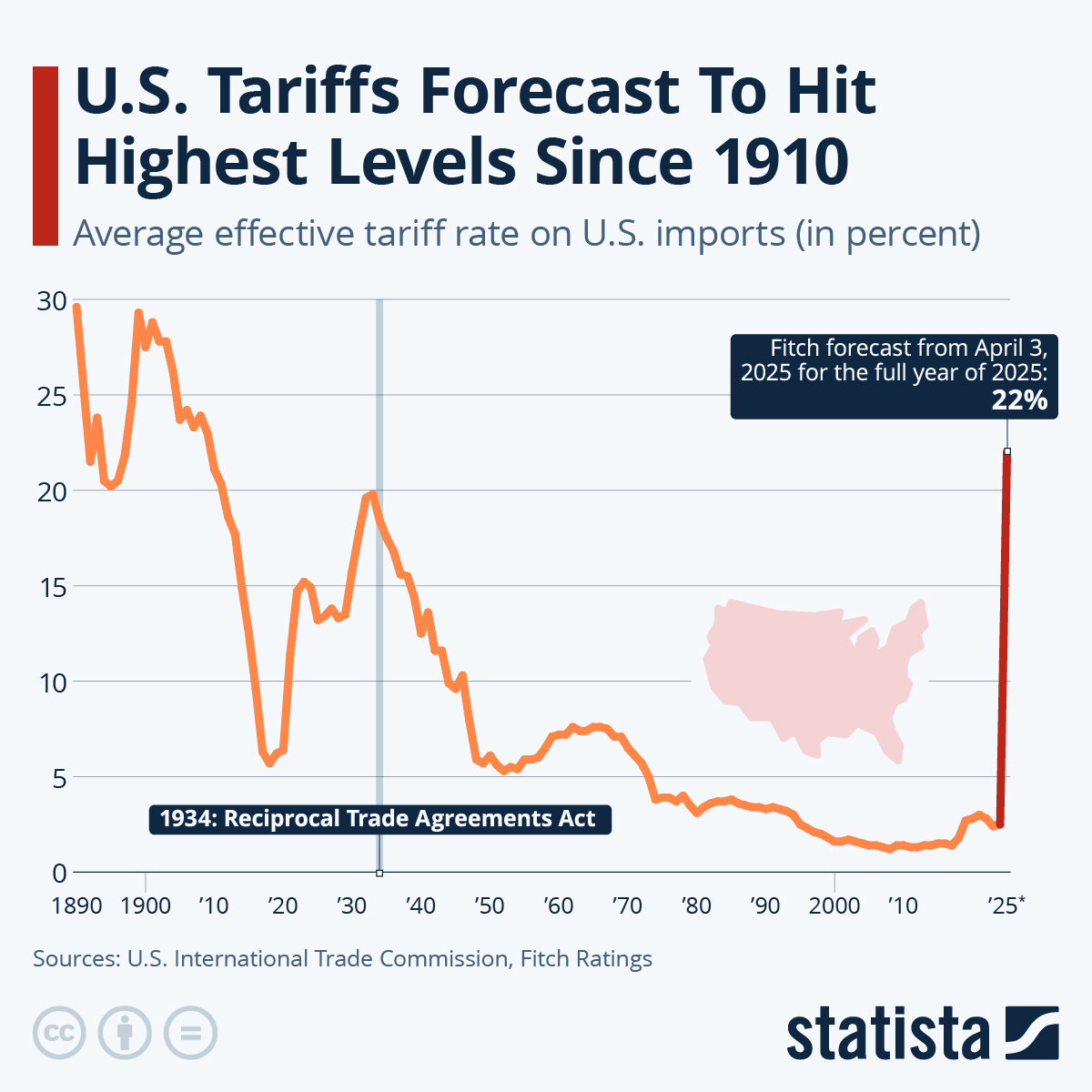
According to the head of U.S. research at Fitch Ratings, the effective import tax rate in the U.S. has surged to 22% under Trump’s administration, a substantial increase from just 2.5% in 2024.
“We’ve not seen a rate like this since about 1910,” remarked Olu Sonola. “This is a transformative moment, not just for the U.S. economy but also for global economic conditions. There’s a strong likelihood that numerous countries will face recessions. Many economic forecasts will likely become irrelevant if these tariffs remain in place for an extended period.”
Trump defended the “reciprocal” tariffs, arguing they are necessary responses to prior barriers faced by American goods. He believes these tariffs will support the growth of domestic manufacturing jobs.
“For years, our nation has been exploited, robbed, and undermined by both friends and rivals,” Trump stated.
Experts have warned that these tariffs could decelerate the global economy, increase the chances of a recession, and burden average American families with thousands of dollars in additional costs.
European leaders have reacted with concern, arguing that a trade war would adversely affect consumers and turn out to be unbeneficial for either side.
“We will do everything possible to reach an agreement with the United States, aiming to avoid a trade war that would ultimately weaken the West and aid other global competitors,” stated Italian Prime Minister Giorgia Meloni.
In a bold and significant policy move, the Trump administration implemented additional tariffs aimed at various countries around the world. This strategy reflects an effort to curb trade imbalances and address grievances related to perceived unfair trade practices. This blog delves into the implications and specifics of these tariffs and their potential impact on global trade dynamics.
The Announcement of New Tariffs
On a pivotal Wednesday, the Trump administration declared that it would impose tariffs of at least 10 percent on a wide swath of imports from other nations. This decision was particularly focused on countries that not only levied high duties on U.S. goods but were also accused of unfair trade and currency policies.
Key Reasons Behind the Decision
The U.S. trade deficit has been a central concern for the administration, particularly with countries noted for their robust export activities and lower domestic consumption rates compared to GDP. Nations like Singapore, China, Germany, and Ireland were specifically highlighted in the administration’s justification for the tariffs. The core argument was that these countries benefit disproportionately from trade with the U.S., at the expense of domestic production and employment.
The Targeting of China
China stood out as the predominant target of Trump’s tariff policy. As the country with the highest trade deficit with the United States, it faced escalated tariffs designed to counterbalance the perceived economic imbalance. Initially facing a standard tariff, China’s rate surged to a staggering 54 percent in response to these trade policies.
Broader Implications for Trade with China
The ongoing trade tensions with China have broad implications for global supply chains, affecting industries that rely on components or goods manufactured in China. Companies may face higher costs, which could translate to increased prices for American consumers, prompting discussions around the effectiveness of tariffs in reshaping trade relations.
Tariffs on Other Countries
While China received the most attention, numerous other countries also faced escalated tariffs as part of the administration’s wider strategy. Notably, countries imposing high import duties on U.S. goods were hit the hardest.
Specific Cases of Increased Tariffs
Countries such as India, Tunisia, and Algeria saw their exports to the U.S. subjected to significant additional tariffs:
India: Tariffs increased by 26 percent.
Tunisia: Tariffs increased by 28 percent.
Algeria: Tariffs increased by 30 percent.
This action demonstrates the administration’s commitment to technology and industrial tariffs, asserting that reciprocity in tariff levels is essential for fair trade.
European Union Countries and Other Targets
Even nations that are generally recognized for having low tariff structures were not spared from increased tariffs.
Tariff Increases for the European Union
Countries within the European Union faced tariffs of 20 percent, reflecting the administration’s critical stance towards the EU’s existing trade practices and tariffs.
Additional Tariffs in Response to Specific Issues
The U.S. administration also erected tariffs based on particular goods. An interesting example is Indonesia, which suffered a reciprocal tariff of 32 percent. This additional tax was specifically levied in response to the nation’s 30 percent duty on U.S. ethanol imports.
Impacts on Countries Specializing in Low-Cost Goods
Several countries known for sending a significant volume of low-cost products—such as footwear, apparel, and furniture to the United States—were similarly affected by higher tariffs. The additional duties assigned to these nations were often disproportionate to their existing tariff levels:
Vietnam: 46 percent
Cambodia: 49 percent
Bangladesh: 37 percent
Sri Lanka: 44 percent
The implications of these tariffs extend beyond pricing; they are expected to disrupt supply chains and may compel manufacturers to seek alternative markets for their goods.
The Consequence of Tariff Policies
The decision to implement these tariffs aligns with the administration’s ideology regarding trade, emphasizing a more protectionist approach as a means of safeguarding American interests. Critics argue, however, that such measures could lead to retaliatory actions from other countries and a potential trade war, thereby complicating global commerce further.
Examining the Economic Landscape
The escalation of tariffs under the Trump administration has opened a discourse on the future of international trade practices. Stakeholders across various sectors continue to monitor the situation closely as they navigate the evolving landscape shaped by these fiscal policies. The long-term effects of these tariffs on both the U.S. economy and global trade remain to be seen, presenting a compelling case for ongoing analysis and engagement from economists, policymakers, and business leaders alike.
Analyzing the Impact of Trump’s Tariff Policy on U.S. Trade
The recent announcement of significant tariff increases by U.S. President Donald Trump has sparked intense debates and discussions regarding its potential impact on the American economy and international trade relations. With projections indicating that the average effective tariff rate on U.S. imports could leap from 2.5 percent in 2024 to a staggering 22 percent by 2025, it is essential to delve into the context, implications, and historical parallels of such drastic measures.
Understanding Tariffs and Their Historical Context
The Role of Tariffs in Trade Policy
Tariffs are taxes levied on imported goods and services, primarily aimed at making foreign products less competitive in comparison to domestic products. While often promoted as a strategy to protect local industries and jobs, the broader implications of tariff increases can lead to retaliatory measures from trading partners and ultimately disrupt global supply chains.
Historical Instances of High Tariffs
The backdrop of current tariff measures can be traced back to significant historical events. For instance, the Smoot-Hawley Tariff of 1930 is often cited as a classic case where the United States raised tariffs on numerous imported goods, leading to international retaliation and a sharp decline in global trade. In response to the economic turmoil of that era, the Reciprocal Trade Agreements Act of 1934 allowed for tariff reductions to foster international trade, which contrasts sharply with the recent trends.
Trump’s Tariff Policy: Current Landscape
New Tariff Rates on Imports
In his recent announcement, Trump proposed substantial tariffs across various countries, significantly affecting imports from the European Union and China. Specifically, imports from the EU could face surcharges of 20 percent, while goods from China may incur tariffs as high as 34 percent. Trump has also indicated a minimum tariff rate of 10 percent for other trading partners, further broadening the scope of his tariff policy.
Reactions from International Leaders
The international response to these proposed tariffs has been immediate and critical. EU Commission President Ursula von der Leyen described the tariffs as a "severe blow to the global economy," highlighting the potential for cascading effects on international trade relations. This sentiment underscores the apprehension that countries might resort to protective measures in retaliation, igniting a cycle of trade conflicts reminiscent of historical precedents.
Projections and Economic Implications
Forecasts from Rating Agencies
According to estimates from Fitch, the proposed tariff hikes could result in the effective average tariff rate on U.S. imports rising dramatically, reaching levels not seen since 1910. Such an increase could have profound consequences on inflation, consumer prices, and the overall economic landscape if these tariffs are implemented.
Effects on Domestic Industries
While the goal of tariff increases may be to protect U.S. industries and jobs, there are concerns regarding the unintended consequences. Increased tariffs could lead to higher production costs for domestic manufacturers reliant on imported materials, potentially passing those costs onto consumers. Additionally, retaliatory tariffs from other countries could hurt U.S. exporters and limit market access for American goods abroad.
Historical Parallels: Lessons from the Past
The Smoot-Hawley Tariff and Its Fallout
The Smoot-Hawley Tariff of 1930 serves as a cautionary tale in tariff history. Initially intended to protect American agriculture and manufacturing, the resulting trade war significantly contracted global trade volumes and intensified the economic downturn during the Great Depression. This historical instance raises questions about whether current tariff strategies might repeat such adverse outcomes.
Shifts Towards Free Trade
Post-World War II, the trend in U.S. trade policy shifted towards reducing tariffs to foster global trade relationships. Agreements such as the General Agreement on Tariffs and Trade (GATT) emphasized cooperation among nations to promote free trade, a stark contrast to the protectionist measures currently being pursued.
Potential Futures for U.S. Trade Relations
Navigating the Trade Landscape
As the U.S. embarks on this path of heightened tariffs, the implications for both domestic and international trade are manifold. The evolving landscape will necessitate strategic responses from both policymakers and businesses as they navigate the challenges posed by increased tariffs and the potential retaliation from global partners.
The Road Ahead
The future of U.S. trade relations will hinge on careful consideration of the balance between protecting domestic industries and maintaining collaborative ties with international partners. As history has shown, the repercussions of tariff wars can extend far beyond the borders of a single nation, affecting global economic stability.
In summary, the ramifications of America’s evolving trade policy under Trump showcase a fundamental shift in economic strategy, echoing lessons from the past while raising critical questions about the path forward.
Title: US Business Leaders Raise Alarm Over President Trump’s Tariff Plan
WASHINGTON: Business leaders across the United States have voiced their concerns regarding President Donald Trump’s recent tariff plan. They warn that the extensive new tariffs on imports could lead to increased costs, supply chain disruptions, and detrimental effects on both American companies and consumers.
During a press conference held on the White House lawn, Trump announced a baseline tariff of 10 percent on nearly all countries that trade with the US, set to take effect on April 5. Additionally, from April 9, an extra surcharge will be applied to nations that impose tariffs and other barriers against US companies.
Trade organizations expressed alarm over these tariffs, especially the new duty that would raise tariffs on many goods imported from China to a staggering 34 percent when combined with existing fees.
"The implementation of such significant tariffs will create challenges and disruptions that restaurant owners will have to manage to ensure their businesses remain operational," stated the National Restaurant Association in their press release.
Jay Timmons, president of the National Association of Manufacturers, echoed this sentiment, emphasizing the severe risks manufacturers face. "Many US manufacturers already operate on narrow profit margins," he explained. "The escalating costs tied to these new tariffs pose a threat to investments, jobs, and supply chains, ultimately undermining America’s position as a leading manufacturing power."
In addition to China, other major US trading partners, including the European Union and India, will encounter new tariffs of at least 20 percent starting April 9.
Neil Bradley, chief policy officer of the US Chamber of Commerce, criticized the broad tariffs before they were officially announced, asserting, "These tariffs constitute a tax hike that will inflate prices for American consumers and negatively impact the economy." He urged policymakers to pivot their focus toward programs that promote economic growth, like extending current tax policies and rebalancing regulations.
A recent analysis from Yale University’s Budget Lab revealed that a blanket 20 percent tariff could cost the average American household over $3,400—an alarming adjustment for many.
Gary Shapiro, CEO of the Consumer Technology Association, commented, "President Trump’s extensive tariffs are essentially massive tax increases on everyday Americans that will spur inflation, endanger jobs, and potentially lead to a recession."
While many expressed concern, some advocacy groups welcomed the tariff announcement. "Today’s trade action prioritizes domestic manufacturers and American workers," said Scott Paul, president of the Alliance for American Manufacturing. "These dedicated individuals have endured the consequences of unfair trade practices for far too long. They deserve a fair opportunity," he affirmed, calling the announcement "a crucial step toward reform."
Title: Trump Announces New Tariffs, Escalating Trade Tensions
Image Caption: President Donald Trump speaks about tariffs in the Rose Garden at the White House in Washington, DC, on April 2, 2025. — Reuters
Washington, D.C.: On Wednesday, President Donald Trump declared he would be implementing reciprocal tariffs to match those imposed on U.S. products by various countries, intensifying the trade battle that he reignited since returning to office.
These extensive tariffs are set to create significant new barriers for the world’s largest consumer market, effectively reversing many years of trade liberalization that have defined the global economic landscape. In response, trading partners are likely to introduce their own measures, potentially leading to substantially increased prices on a wide range of products, from bicycles to wine.
Trump referred to the tariffs as "our declaration of independence" during his remarks in the White House Rose Garden.
While specifics regarding the tariffs were not available immediately, Trump’s statements reflected his long-standing grievances regarding the negative impact of global trade on U.S. workers and businesses.
This uncertainty has caused turmoil in financial markets and has unsettled companies that have relied on trading frameworks established since 1947.
The administration has indicated that the new tariffs will take effect immediately following Trump’s announcements, though an official notification necessary for enforcement has yet to be released.
Nevertheless, the administration did confirm that a separate set of tariffs on imported vehicles, which Trump voiced last week, will commence as of April 3.
Previously, Trump enacted a 20% tariff on all imports from China and a 25% levy on steel and aluminum, extending these measures to nearly $150 billion worth of related goods.
Advisors to Trump have expressed confidence that these tariffs will help restore critical manufacturing jobs within the United States.
However, economists outside the administration have raised alarms that such tariffs could hinder the global economy, heighten the risk of recession, and increase living expenses for average U.S. households by thousands of dollars. Many businesses have voiced concerns that Trump’s series of trade threats have complicated their operational planning.
Fears over tariffs have already contributed to a slowdown in manufacturing activities globally while simultaneously driving consumers to buy automobiles and other imported items in anticipation of rising prices.
Karoline Leavitt, Press Secretary at the White House, conducts a briefing in Washington, DC, USA, on March 26, 2025.
White House announces tariffs to protect American jobs.
Trump’s forthcoming press conference will include members of his Cabinet.
Karoline Leavitt states, “The U.S. should impose tariffs as well.”
On Monday, the White House issued a warning to countries it considers to be conducting “unfair” trade practices against the United States, indicating that they may soon face tariffs.
During a press briefing, White House spokesperson Karoline Leavitt announced that President Donald Trump is expected to reveal his tariff strategy on Wednesday.
“Any nation that has treated American citizens unjustly should prepare for a tariff in response come Wednesday,” Leavitt remarked, highlighting the Trump administration’s dedication to ensuring equitable trade practices.
While she refrained from providing additional specifics, Leavitt mentioned that the upcoming media event, which will feature key members of the U.S. Cabinet, aims to clarify the administration’s plans regarding perceived trade imbalances.
Leavitt underscored that these tariffs are intended to safeguard American jobs and take a stand against economic practices that disadvantage the U.S.
“Wednesday will mark a new Independence Day for America,” she stated. “President Trump is taking these steps for the welfare of American workers.”
Emphasizing the administration’s focus on domestic economic interests, Leavitt also remarked that excessive tariffs imposed by other nations are unfair to American citizens and that the U.S. should reciprocate accordingly.
When asked about possible exemptions for specific industries, such as agriculture, she replied, “Currently, there are no exemptions available.”
Additionally, Leavitt mentioned the potential for “alternative tariffs” to be introduced, suggesting some flexibility in the administration’s strategy.
As global trade dynamics continue to shift, tariffs have become a focal point of economic discussion, particularly in the United States. Recent surveys indicate that a significant portion of the American populace is skeptical about the potential advantages of tariffs.
The Recent Survey Insights
A compelling survey conducted by YouGov on behalf of The Economist reveals that a substantial 61% of U.S. adults believe that the implementation of higher tariffs will adversely affect average Americans. This statistic is striking, especially when considering that only 14% of respondents feel that increased tariffs would yield positive outcomes for them.
Public Sentiment on Inflation
Why are U.S. adults so wary of tariffs? A critical factor contributing to this sentiment is the recent history of inflation that has plagued American households. Over the past three years, rising prices have heightened financial concerns for many families. There is a pervasive fear that further tariffs will exacerbate this crisis, pushing prices even higher on essential goods and services.
Political Divide: Democrats vs. Republicans
The survey results highlight a notable division in political opinions regarding tariffs. Unsurprisingly, a majority of Democrats oppose the tariff strategies outlined by the Trump administration. However, what may come as a surprise is that a considerable percentage of Republicans also harbor similar concerns.
Republican Perspectives
About 36% of Republican respondents anticipate that the recent trade policies will harm the average American. In contrast, only 28% believe that these tariffs will provide some benefit. This reflects a growing bipartisan anxiety regarding the real-world implications of tariff policies.
The Broader Context of Tariff Impacts
Tariffs are essentially taxes imposed on imported goods, and while they are often intended to protect domestic industries, the immediate effects on consumers can be less favorable. Increased tariffs usually lead to higher prices as manufacturers and retailers pass their additional costs onto consumers, which can worsen inflation scenarios.
Economic Understanding of Tariffs
To comprehend the broader implications of tariffs on the economy, it is crucial to understand the balance between protecting domestic markets and the potential downstream effects on consumers. While protecting certain industries may lead to job preservation in the short term, the long-term repercussions often place a burden on the overall economy and consumer spending power.
The Future of Trade Policies
Looking ahead to upcoming tariff announcements—designated as "Liberation Day" by President Trump—economic analysts will undoubtedly watch public reaction and the unfolding consequences closely.
Consumer Behavior Predictions
With consumer confidence already shaken by inflation, it can be expected that news of new tariffs will affect purchasing behaviors further. Americans may begin tightening their belts, fostering a more cautious approach to spending, which can inevitably impact economic growth.
Conclusion
As the discourse surrounding tariffs continues to evolve, understanding public sentiment and the economic landscape becomes essential for navigating the complexities of trade policies. Whether through consumer opinions, political alignments, or economic forecasts, tariffs will undeniably influence the average American’s financial well-being in the foreseeable future.
Trump Threatens Tariffs on Russian Oil Sales Amid Ukraine Conflict
An oil pump jack depicted in front of U.S. and Russian flags, captured on October 8, 2023. — Reuters
Former U.S. President Donald Trump has expressed his intention to impose secondary tariffs ranging from 25% to 50% on Russian oil purchasers if he perceives that Russia is hindering his efforts to bring an end to the ongoing conflict in Ukraine, according to a report by Reuters.
In a recent interview with NBC News, Trump shared his frustration with Russian President Vladimir Putin, describing himself as “pissed off” due to the slow progress in achieving a ceasefire.
These comments came in response to Putin’s criticism of Ukrainian President Volodymyr Zelenskiy, which struck Trump as a direct challenge to his attempts at brokering peace.
“If I can’t reach an agreement with Russia to halt the violence in Ukraine, and I believe the responsibility lies with them, then I will move forward with secondary tariffs on all oil exported from Russia,” Trump declared. He elaborated that such tariffs would mean, “anyone purchasing oil from Russia will be barred from doing business in the United States,” announcing the potential for a “25% to 50% tariff on all oil.” Trump suggested these tariffs could take effect within a month.
While there was no immediate reaction from Moscow, the Russian government has consistently condemned Western sanctions as “illegal” and motivated by economic interests.
During the weekend spent in Florida, Trump mentioned he would be discussing the situation with Putin later this week. The Kremlin has confirmed a couple of public conversations between the leaders in recent months, hinting at more private dialogues. The White House has not disclosed the timing of the upcoming call or whether Trump would also reach out to Zelenskiy.
Trump remains focused on ending what he has termed as a “ridiculous” war, although tangible progress appears limited. Recently, Putin proposed that Ukraine could be temporarily administered to facilitate new elections—a notion that Trump has previously supported.
Trump maintained that while he believes Putin understands his frustrations, he also has a solid working relationship with him. He noted that his anger tends to subside quickly “if he does the right thing.”
This comes amid broader trade tensions, as Trump has already imposed secondary tariffs on buyers of Venezuelan oil and is contemplating duties on imports from countries with significant trade surpluses, particularly affecting major Russian oil importers like India and China. Additionally, Trump indicated that he might implement similar tariffs on Iranian oil buyers unless Tehran ceases its nuclear weapons initiative.
SEOUL: On Sunday, representatives from China, South Korea, and Japan agreed to bolster free trade in response to a series of new tariffs set forth by U.S. President Donald Trump.
This decision was reached during a meeting of senior trade officials—the first of its kind in five years—just days before tariffs are scheduled to take effect on a wide array of U.S. imports, including automobiles and their components.
Both South Korea and Japan are significant auto exporters, while China has been adversely affected by the American tariffs as well.
In attendance were South Korea’s Minister of Trade, Industry and Energy, Ahn Duk-geun, Japan’s Minister of Economy, Trade, and Industry, Yoji Muto, and China’s Commerce Minister, Wang Wentao.
The trio called for a swift advancement in their discussions regarding a comprehensive trilateral free trade agreement and agreed on the importance of establishing a "predictable trade and investment environment," according to a joint statement.
Minister Ahn emphasized the necessity for collective action in tackling common global challenges. "Today’s economic and trade landscape is increasingly fragmented," he noted.
Yasuji Komiyama, a Japanese trade official, remarked during a press briefing that "the international environment around us is continuously evolving, bringing increased uncertainties."
Chinese official Wang Liping pointed out that "unilateralism and protectionism are on the rise," stressing that the three nations bear the responsibility of upholding the multilateral trading system.
These three countries represent about 20% of the world’s population, 24% of the global economy, and 19% of international merchandise trade.
President Trump has announced tailored tariffs for each trading partner starting April 2, aimed at addressing practices he views as unfair. However, he indicated last week that there would be "flexibility," which seemed to ease market concerns by the end of the previous week.
Global Economic Outlook: OECD’s Projections for 2025 and 2026
The Organization for Economic Cooperation and Development (OECD) recently released its economic outlook, revealing troubling signs in the global economic landscape. The report, published on January 9, 2025, highlights substantial downward revisions in global growth projections for the years 2025 and 2026. These adjustments reflect ongoing political and economic uncertainties that are reshaping investment and consumption patterns worldwide.
Revised Global GDP Growth Projections
Key Changes in Projections
In its latest appraisal, the OECD downgraded the anticipated global GDP growth for 2025 from an earlier estimate of 3.3% to 3.1%. Similarly, the forecast for 2026 was also reduced from 3.3% to 3.0%. This cautious outlook underscores the challenges that economies face as they navigate a complex international environment.
Factors Behind Downgrades
Lingering Inflation
One of the central themes affecting economic growth is persistent inflation. As consumers and businesses adjust to rising prices, spending patterns become more conservative, influencing overall economic momentum. The OECD’s outlook emphasizes how inflation continues to pose a significant risk not only to macroeconomic stability but also to individual purchasing power.
Increased Trade Barriers
Another critical factor contributing to the downward revision is the rise of trade barriers. The OECD highlights that any further escalation in trade restrictions, particularly tariffs, can significantly hinder global economic growth. The imposition of new tariffs not only disrupts international supply chains but also reduces trade flows, which are vital for economic growth.
The Impact of Trade Wars
Potential Consequences of Increased Tariffs
The OECD’s report provides alarming insights into how trade wars could unfold in the coming years. For instance, a hypothetical 10% increase in tariffs on all non-commodity imports to the United States, matched by equivalent tariffs on imports from the U.S., could trigger a decline in global GDP by approximately 0.3% by the third year compared to baseline projections.
Regional Impacts
The study reveals that the United States, alongside its North American trade partners—Canada and Mexico—would be disproportionately affected by these trade tensions. The potential GDP losses projected for these countries are striking: the U.S. could see a reduction of 0.7%, Canada 0.6%, and Mexico a staggering 1.3%. Such estimations indicate that the ramifications of a trade war extend beyond tariffs, affecting overall economic health.
Inflationary Pressures from Tariffs
Increased Inflation Rates
In addition to the GDP implications, the OECD’s outlook addresses the inflationary effects of increased tariffs. It predicts that an additional 10% increase in tariffs could lead to a rise in global inflation by 0.4 percentage points annually for the first three years. In the United States specifically, inflation could spike even more, potentially increasing by 0.7 percentage points per year in response to new tariffs.
Consequences for Consumers
The inflationary pressures driven by tariffs can pose serious challenges for consumers and businesses alike. Increased prices can stifle consumer spending, leading to a compounding effect on economic growth. As consumers face higher costs, their ability to make discretionary purchases diminishes, thereby affecting overall economic vitality.
The Trade War Dilemma
No Winners in a Trade War
The overarching message from the OECD’s findings is clear: there are no winners in a trade war. The affected countries, particularly those imposing tariffs, are likely to face significant economic drawbacks. The report underscores the paradox of protectionist policies, which, while aimed at bolstering domestic industries, can ultimately hinder economic growth.
U.S. as a Major Loser
Amidst this backdrop, the United States emerges as one of the biggest potential losers from a trade war. The report illustrates how the U.S. is not only at risk of facing reduced GDP growth and heightened inflation but also of undermining its own economic stability in the longer term.
Conclusion on the Trade Tensions’ Broader Implications
The OECD’s recent economic outlook serves as a sobering reminder of the interconnectedness of global economies. As trade tensions simmer and uncertainties proliferate, the implications for growth, inflation, and consumer welfare become increasingly pronounced. Understanding these dynamics is crucial for policymakers, businesses, and consumers alike as they navigate the complexities of an evolving economic landscape.