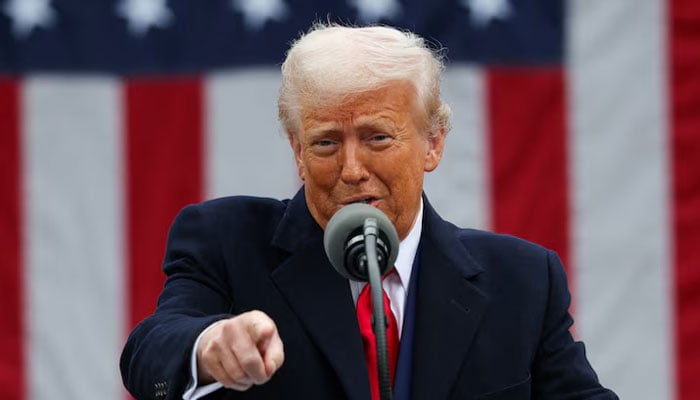
US President Donald Trump meets with Italian Prime Minister Giorgia Meloni in the Oval Office at the White House in Washington, DC, on April 17, 2025. — Reuters
WASHINGTON: President Donald Trump has announced that talks are underway between the United States and China regarding tariffs, and he is optimistic about the potential for an agreement to resolve the ongoing trade conflict.
“Yes, we’re in discussions with China,” Trump stated during a press briefing in the Oval Office. “I would say they have contacted us several times.”
These negotiations come after Trump raised tariffs on Chinese products to an astonishing 145 percent, a move following China’s response to his broad “Liberation Day” global tariffs.
However, Trump was non-committal when asked if he had had a direct conversation with Chinese President Xi Jinping, though he had previously alluded to such interactions.
“I’ve never confirmed whether those conversations took place,” he remarked when questioned about talks with Xi. “It’s simply not appropriate.”
When reporters asked if Xi had made any outreach to him, Trump stated: “You’d think it would be evident that he has, but we’ll discuss that soon.”
Trump’s administration is deeply involved in a trade war characterized by escalating tariffs with global powerhouse China, a struggle that has unsettled international markets.
“I believe we are going to achieve a very favorable agreement with China,” he expressed earlier at the White House while Italian Prime Minister Giorgia Meloni was present for discussions aimed at resolving U.S. tariffs on the European Union.
US President Donald Trump Engages in Trade Talks with Japan
Image Caption: US President Donald Trump delivers remarks at a prayer service and dinner in anticipation of Easter Sunday at the White House in Washington, DC on April 16, 2025. — Reuters
WASHINGTON: On Wednesday, President Donald Trump highlighted significant advancements in trade discussions with Japan, marking one of the initial in-person negotiations since implementing tariffs on global imports, which had disturbed market stability and raised concerns about a potential recession.
Initially, Japan did not expect Trump to participate in these discussions, anticipating that they would be primarily exploratory in nature. This involvement indicates his desire to maintain a hands-on approach as negotiations unfold with numerous countries in the coming days and weeks.
While Japan had hoped to confine the dialogue to trade and investment issues, Trump announced his engagement in the discussions early Wednesday and mentioned that contentious topics, such as Japan’s financial contributions to the hosting of US military personnel, would also be on the table.
“It’s a great honor to have just met with the Japanese delegation concerning trade. Big progress!” Trump shared in a social media post that did not provide further specifics about the discussions.
Facing Trump was Ryosei Akazawa, a trusted advisor to Japanese Prime Minister Shigeru Ishiba, who holds a junior cabinet position as the Minister of Economic Revitalization.
After their meeting, Akazawa told reporters that while few specifics were disclosed, both parties agreed to reconvene later this month. He also noted that Trump emphasized that reaching an agreement with Japan is a "top priority."
Akazawa added that the discussions did not address exchange rates, a concern previously raised by the Trump administration regarding Japan and other countries allegedly manipulating currency values to gain trade advantages. Following Trump’s comments on foreign exchange, the dollar gained about 0.5% against the yen. Japan rejects the allegation of intentionally lowering the yen to boost exports.
Akazawa met with Trump for approximately 50 minutes at the White House, followed by a session with Treasury Secretary Scott Bessent, Commerce Secretary Howard Lutnick, and Trade Representative Jamieson Greer, which lasted almost an hour and a half, according to Japanese accounts of the meeting.
Meanwhile, Ishiba has previously stated that he does not intend to rush towards a deal and is not planning significant concessions. However, he spoke cautiously to reporters later in Tokyo, stating, “Naturally, these negotiations will be challenging going forward, but President Trump has made it clear that he wants to prioritize discussions with Japan.”
On Thursday, Italian Prime Minister Giorgia Meloni is scheduled to visit the White House to talk about tariffs imposed on the European Union, while Secretary Bessent has invited South Korea’s finance minister to Washington for discussions next week.
Li Chenggang, China’s Ambassador to the World Trade Organization (WTO), gestures during an interview on the sidelines of a ministerial meeting discussing a draft agreement to limit fisheries subsidies in Geneva, Switzerland, on July 15, 2021. — Reuters
Li Chenggang succeeds seasoned trade negotiator Wang Shouwen.
Wang had served as China’s main trade negotiator since 2022.
The U.S. insists that China should take the lead in any trade negotiations.
In a surprising move on Wednesday, China appointed a new lead trade negotiator crucial for discussions aimed at resolving the growing tariff conflict with the United States. Li Chenggang, the country’s representative to the World Trade Organization (WTO), replaces veteran negotiator Wang Shouwen.
Li, 58 years old, previously served as an assistant commerce minister during Donald Trump’s first term as U.S. President. He takes the reins from Wang, who is 59, according to a statement issued by the Ministry of Human Resources and Social Security.
It remains unclear whether Wang, who took on the No. 2 position at the commerce ministry in 2022, has moved to another position within the government. His name is no longer listed among the ministry’s leadership, as per the ministry’s official website on Wednesday.
The ministry did not immediately respond to a request for comment from Reuters regarding this unexplained change.
A source within Beijing’s international business community described Wang as a tough negotiator, known for having had confrontations with U.S. officials in past meetings. “He was quite intense and aggressive,” said the source, who wished to remain anonymous.
Wang Shouwen, China’s Commerce Vice Minister, attends the APEC Ministerial Meeting (AMM) Opening Session in San Francisco, California, on November 14, 2023. — Reuters
This leadership transition within the commerce ministry comes as Beijing takes a hardline approach in the escalating trade conflict with Washington, sparked by Trump’s significant tariffs on goods imported from China.
The unexpected change coincides with President Xi Jinping’s tour of Southeast Asia, aimed at strengthening economic and trade relations with nearby countries amid ongoing tensions with the U.S.
Commerce Minister Wang Wentao was present alongside Xi during his recent visits to Vietnam, Malaysia, and Cambodia.
Alfredo Montufar-Helu, a senior advisor at the Conference Board’s China Center, remarked that the change seems “very abrupt and potentially disruptive,” especially given how quickly trade tensions have intensified, and considering Wang’s extensive experience in negotiations with the U.S. since the onset of Trump’s presidency.
“We can only speculate on the reasons behind this timing, but it could be that China’s leadership believes a new face is necessary to break the current impasse and initiate meaningful negotiations,” he stated.
In contrast to many other countries that have sought to negotiate bilateral agreements with Washington in light of Trump’s tariff plans, Beijing has responded by increasing tariffs on U.S. goods and has not pursued talks, asserting that discussions must be rooted in mutual respect and equality.
On Tuesday, Washington indicated that Trump is open to a trade agreement with China, but emphasized that the responsibility lies with Beijing to initiate the process, asserting that “they need our money.”
‘Tariff shocks’
During a February meeting at the WTO in Geneva, Li criticized the U.S. for unilaterally imposing tariffs on its trade partners, including China, stating such actions have resulted in “tariff shocks” worldwide.
“The U.S. unilateral approach blatantly violates WTO regulations, heightens economic uncertainty, disrupts global trade, and has the potential to undermine the multilateral trading system. China firmly opposes this and calls on the U.S. to reverse its erroneous practices,” he stated.
Li, who holds significant experience in various capacities within the commerce ministry, including in areas related to treaties and trade law, has academic credentials from Peking University and Hamburg University in Germany.
“Li appears to be a classic Chinese technocrat with extensive experience in trade matters, both at the commerce ministry and the WTO,” said Alfred Wu, an associate professor at the National University of Singapore.
While the transition seems like a standard promotion, it is taking place during a sensitive period of heightened tensions between the U.S. and China.
On March 31, Li was recognized as a “leader” of the commerce ministry at a forum for Chinese private entrepreneurs, marking one of the first official signals regarding his impending new role.
White House Press Secretary Karoline Leavitt conducts a press briefing at the White House in Washington, DC, US, on April 15, 2025. — Reuters
WASHINGTON: The United States has expressed its readiness to negotiate a trade agreement with its primary economic competitor, China. However, the U.S. insists that Beijing must take the initiative to begin discussions.
During a press briefing on Tuesday, White House press secretary Karoline Leavitt informed reporters that President Donald Trump is willing to pursue a trade deal with China.
“The responsibility lies with China. They must come to us with an offer; we are not obligated to initiate a deal with them,” Leavitt stated, relaying comments from Trump made during a private meeting in the Oval Office.
“China desires what we possess… the American consumer—essentially, they rely on our financial resources,” Leavitt emphasized.
In a retaliatory action, China increased its tariffs on imports of U.S. goods to 125% on Friday, following Trump’s decision to raise tariffs on Chinese products to 145%, while suspending planned tariffs on goods from other nations.
Trump has previously spoken positively about Chinese President Xi Jinping, yet both leaders have remained firm amidst the escalating trade conflict between their nations.
“The president has clearly stated that he is open to negotiation with China. However, China must come forward and make a deal with the United States,” Leavitt reiterated.
Trump has indicated hope for a favorable resolution to the trade tensions between these two major global economies. Unlike various other countries that have sought negotiations with Washington in response to his tariff strategies, Beijing has chosen to escalate its tariffs on American goods and refrain from engaging in talks.
U.S. Treasury Secretary Scott Bessent Comments on Trade Relations with China Amid Rising Tensions
April 14, 2025 – Buenos Aires, Argentina
US Treasury Secretary Scott Bessent departs the Economy Ministry building in Buenos Aires, noting recent loan negotiations between Argentina’s President Javier Milei’s administration and the IMF. — Reuters
Bessent expresses belief that the U.S. and China can avoid economic separation.
Anticipates more complexity in negotiations with China compared to other countries.
Identifies China as the U.S.’s primary economic and military contender.
In a recent statement, U.S. Treasury Secretary Scott Bessent expressed his concerns regarding comments made by China’s commerce minister, who referred to President Donald Trump’s tariffs as a “joke.” Despite this, Bessent remains hopeful that a substantial agreement can be achieved, even as tensions escalate between the two economic powerhouses.
“There is definitely a significant agreement to be considered at some point,” Bessent shared during an interview with Bloomberg TV, addressing the potential for a decoupling of the world’s two largest economies. He emphasized, “Decoupling doesn’t have to happen; however, it is a possibility.”
Bessent indicated that negotiating a deal with China would present greater challenges compared to other nations, pointing out that “China is not only our largest economic competitor but also our foremost military adversary.”
The ongoing trade dispute has led to escalating confrontations, beginning when President Trump implemented tariffs that specifically impacted Chinese imports. This has resulted in U.S. tariffs on Chinese goods rising to 145 percent, while retaliatory tariffs imposed by Beijing on U.S. imports have reached 125 percent.
The American administration has delivered mixed signals regarding its objectives and the potential impact of tariffs on the global economy. Recently, the White House has appeared to ease some pressure by announcing tariff exemptions for certain electronic products, including smartphones and laptops, in which China plays a significant role in supply.
Nevertheless, President Trump and several senior aides clarified that these exemptions were misrepresented and would be temporary as new tariffs could still be applied to various items on the list. “Nobody is getting ‘off the hook’… especially not China, which has the worst trade practices against us!” he posted on his Truth Social platform.
Bessent noted that Trump’s tariffs are “not a laughing matter.” He pointed out the significant financial implications, stating, “These figures are large. I don’t believe anyone who understands their impact sees them as sustainable in the long term.”
In response, Chinese President Xi Jinping began a tour of Southeast Asia with a stop in Vietnam, where he warned that protectionist measures “will lead nowhere” and cautioned that a trade war would yield no winners. “We must bolster our resolve, oppose unilateral bullying together, and maintain the stability of the global free trade and supply systems,” Xi told Vietnam’s leader, To Lam.
Despite the escalating tensions, the White House affirms that President Trump remains optimistic about forging a trade agreement with China, although officials expect to hear from Beijing first. The trade conflict continues to exacerbate fears of an economic downturn, with the dollar’s value diminishing and investors as a result offloading U.S. government bonds, which are typically viewed as a safe investment.
Semiconductor chips displayed on a computer circuit board in this illustration captured on February 25, 2022.
Fresh tariffs on smartphones, computers, and electronics are on the way.
The trade conflict has led to the most volatile markets seen in five years.
Senator Warren criticizes Trump’s tariff strategy as chaotic.
On Sunday, U.S. President Donald Trump announced that he would reveal the tariff rates on imported semiconductors within the week, indicating there will be some flexibility for certain companies in the industry.
This announcement suggests that the current exemptions for smartphones and computers from his reciprocal tariffs on China might be temporary, as Trump aims to overhaul trading practices in the semiconductor sector.
“We wanted to simplify the situation for various companies because our goal is to produce our chips and semiconductors right here in the U.S.,” Trump shared with reporters while onboard Air Force One, heading back to Washington from his resort in West Palm Beach.
While Trump refrained from stating whether items like smartphones could still be exempted, he emphasized the need for flexibility, saying, “Nobody should be so rigid.”
Earlier that day, Trump initiated a national security trade investigation focusing on the semiconductor industry.
“We are thoroughly examining Semiconductors and the entire ELECTRONICS SUPPLY CHAIN in the upcoming National Security Tariff Investigations,” he posted on social media.
Following the announcement on Friday about exemptions from high reciprocal tariffs, there was optimism that the tech sector might avoid being pulled into the intensifying conflict between the U.S. and China, thereby keeping consumer goods like phones and laptops affordable.
However, Trump’s Commerce Secretary Howard Lutnick clarified on Sunday that essential technology products imported from China would face new separate tariffs, on top of those for semiconductors, in the upcoming two months.
Last week, Trump’s inconsistent remarks about tariffs resulted in significant fluctuations on Wall Street, marking the most volatility since the onset of the COVID-19 pandemic in 2020. The Standard & Poor’s 500 index has plummeted over 10% since Trump assumed office on January 20.
Lutnick noted that Trump plans to implement a “special focus-type of tariff” on smartphones, computers, and other electronic goods in about one to two months, alongside industry-specific tariffs on semiconductors and pharmaceuticals. These new tariffs will be distinct from Trump’s reciprocal tariffs, which saw levies on Chinese imports increase to 125% last week.
“He’s implying that these products are exempt from the reciprocal tariffs, but they are included in the semiconductor tariffs that are likely to come in about a month or two,” Lutnick explained in an interview on ABC’s “This Week,” predicting that the tariffs would lead to production of these items within the U.S.
China retaliated by raising its tariffs on U.S. imports to 125% on Friday. Following Lutnick’s comments on Sunday, China announced it is assessing the implications of the recently implemented product exemptions for technology.
“The bell on a tiger’s neck can only be untied by the person who tied it,” stated China’s Ministry of Commerce.
Billionaire investor Bill Ackman, who had supported Trump’s presidential campaign but has criticized the tariffs, urged Trump on Sunday to pause the extensive reciprocal tariffs on China for three months, similar to what he did for other nations last week.
If Trump were to temporarily reduce the tariffs on China to 10% for 90 days, “he would achieve his goal of prompting U.S. businesses to shift their supply chains away from China without causing disruptions and risks,” Ackman expressed on X.
‘Daily Changes’
Sven Henrich, founder and chief market strategist for NorthmanTrader, was very critical of how the tariff situation is being managed.
“Sentiment check: The biggest rally of the year would occur on the same day Lutnick gets fired,” Henrich remarked on X. “I recommend that the administration clarifies who controls the narrative because it seems to change every day. U.S. businesses cannot make plans or invest amid this inconsistency.”
Senator Elizabeth Warren, a Democrat, also criticized the recent alterations to Trump’s tariff plan, warning that it could negatively impact economic growth and contribute to inflation.
“There is no actual tariff policy—just chaos and corruption,” Warren declared on ABC’s “This Week,” shortly before Trump’s latest post on social media.
In a notice issued to shippers late Friday, the U.S. Customs and Border Protection agency published a list of tariff codes exempted from these import taxes, which included 20 categories of products such as computers, laptops, disc drives, semiconductor devices, memory chips, and display panels.
In an interview on NBC’s “Meet the Press,” White House trade adviser Peter Navarro stated that the U.S. has extended an invitation to China for negotiations but criticized the country’s involvement in the dangerous fentanyl supply chain. He did not include China on the list of seven entities—with the United Kingdom, the European Union, India, Japan, South Korea, Indonesia, and Israel—currently in talks with the administration.
Trade Representative Jamieson Greer told CBS’s “Face the Nation” that there were no current plans for Trump to engage in discussions with Chinese President Xi Jinping regarding tariffs, accusing China of exacerbating trade tensions by imposing its own levies. However, he expressed hopes for reaching some agreements with non-Chinese partners.
“My objective is to secure meaningful deals before the 90-day mark, and I believe we’ll achieve that with several nations in the coming weeks,” Greer stated.
Ray Dalio, the billionaire founder of the largest hedge fund globally, expressed concerns during an appearance on NBC’s “Meet the Press” about the potential for the U.S. falling into a recession, or worse, as a consequence of the tariffs.
“We are currently at a pivotal decision-making point and very close to a recession,” Dalio cautioned on Sunday. “I fear for something more severe than a recession if this situation is not resolved properly.”
U.S. President Donald Trump signs an executive order concerning tariffs in the Rose Garden at the White House in Washington, D.C., April 2, 2025. — Reuters
On Sunday, President Donald Trump emphasized that no nation is exempt from U.S. tariffs, regardless of recent efforts to temporarily pause some tariffs for 90 days, as reported by AFP.
He also minimized the importance of the temporary exemptions that were granted for selected technology products made in China.
The stock market has experienced fluctuations since Trump announced extensive tariffs on April 2. Although stocks initially dropped significantly, they made a partial recovery following the announcement of a 90-day hold on the most severe tariff rates. During this period, most countries will encounter a 10 percent tariff, while China will respond with its own tariff increases.
The U.S. and China have been involved in a back-and-forth regarding duties, resulting in U.S. tariffs on Chinese goods reaching 145 percent, with China imposing retaliatory tariffs at a level of 125 percent. Trump has continued to argue that unfair trade practices have contributed to trade deficits in the U.S., even as some tariffs impact countries where the U.S. actually has trade surpluses.
“NOBODY is escaping accountability for the unfair trade imbalances and non-monetary tariff barriers that other nations have imposed against us, particularly China, which treats us the worst!” Trump stated on Truth Social.
While the administration provided exemptions on Friday for certain Chinese semiconductors and electronics, citing consumer price concerns, Trump asserted on Sunday that “no tariff ‘exception’” was made. He clarified that those products are still classified under a different category, facing a 20 percent tariff rate.
This reprieve may be short-lived. The electronics that were exempted last week might soon face additional sector-specific tariffs relating to national defense. Trump mentioned that more details would be announced on Monday.
Commerce Secretary Howard Lutnick indicated that the implementation of semiconductor tariffs could occur “in a month or two” and added that pharmaceutical products would also be exempted from reciprocal tariffs.
While Trump remains optimistic about reaching an agreement with China, Trade Representative Jamieson Greer stated on Face the Nation that “we currently do not have any plans” for a meeting between Trump and Xi.
In the meantime, Chinese President Xi Jinping is embarking on a tour of Southeast Asia this week to strengthen ties with key regional manufacturing countries. With U.S. consumer confidence and investor sentiment eroding, the White House insists that its tariff policy is compelling other nations to negotiate before the 90-day delay concludes.
US President Donald Trump addressing tariff policies in the Rose Garden of the White House, Washington, DC, April 2, 2025. — Reuters
On Sunday, US Secretary of Commerce Howard Lutnick revealed that certain electronic items, such as smartphones and computers that were temporarily exempt from new tariffs, will soon be subject to additional duties, according to a report by Reuters.
During an appearance on ABC’s This Week, Lutnick stated that the administration plans to implement “a special focus-type of tariff” within the next month or two. This new duty will affect semiconductors, pharmaceuticals, and various electronic devices that are not included under the existing steep reciprocal tariffs currently set at 125%.
“Although they are currently exempt from the reciprocal tariffs, they will fall under the semiconductor tariffs that are likely to be implemented soon,” Lutnick explained.
He underscored the importance of these products for national security and emphasized the need for domestic manufacturing: “These items are crucial for national security and should be produced in America.”
Just last Friday, the Trump administration had excluded numerous tech products from the reciprocal tariffs, providing a temporary reprieve for companies like Apple and Dell. However, Lutnick’s remarks suggest that this relief might be short-lived.
Trump’s evolving strategy has caused fluctuations in the market, resulting in significant volatility and a decline of over 10% in the S&P 500 since January. Analysts note that the constant changes complicate business and investment planning.
These comments from Lutnick came on the heels of an announcement from the administration about a forthcoming national security investigation into semiconductors. In retaliation, China, which had raised its tariffs to 125%, indicated it is reviewing the US exemptions for tech products.
“Only the person who tied the bell around the tiger’s neck can untie it,” remarked China’s Ministry of Commerce.
Billionaire investor Bill Ackman called on Trump to pause tariffs on China for 90 days, a move similar to the temporary relief granted to other nations. “This would accomplish the same goal… without the associated disruption and risks,” Ackman noted on X.
Market strategist Sven Henrich criticized the inconsistent messaging. “If Lutnick gets fired, it could trigger the year’s biggest rally,” he stated. “US businesses cannot plan or invest amidst this constant back-and-forth.”
Democratic Senator Elizabeth Warren also criticized the lack of a coherent policy. “There is no clear tariff strategy—just chaos and corruption,” she said.
The notice from US Customs and Border Protection outlined 20 categories of tech products, including computers, memory chips, and displays, that are exempt from tariffs, although a 20% tariff related to the fentanyl crisis remains in place.
White House adviser Peter Navarro confirmed that outreach efforts are underway with several allies, but not China. Meanwhile, Trade Representative Jamieson Greer mentioned that Trump currently has no plans to communicate with President Xi but aims to secure trade agreements with non-Chinese partners soon. “I want to finalize meaningful deals within 90 days,” he stated.
Ray Dalio issued a warning about potential economic repercussions: “We are at a crucial decision-making moment and very close to a recession. I’m worried about something even worse if this situation isn’t managed properly.”
U.K. Finance Minister Rachel Reeves prior to a meeting at the European Bank for Reconstruction and Development (EBRD) in Canary Wharf, London, Britain, February 20, 2025. — Reuters
LONDON: U.K. Finance Minister Rachel Reeves expressed her desire for a stronger partnership with the European Union and cautioned that recent tariffs from the United States could significantly impact both the British economy and the global market.
In a column scheduled for publication in The Observer on Sunday, Reeves indicates her goal of establishing “an ambitious new relationship” with the EU while continuing to negotiate a trade agreement with the U.S.
A separate report in The Observer mentioned that Reeves stated the tariffs implemented by former President Donald Trump would have a “profound” effect on both the U.K. and global economies.
According to The Observer, Reeves acknowledges the considerable challenges ahead, making it clear: “The Labour Party stands as an internationalist organization. We recognize the advantages of equitable and open trade collaboration. Now is not the moment to isolate ourselves from the global community.”
At the forthcoming International Monetary Fund meeting later this month, the finance minister intends to advocate for a “more equitable global economic and trading framework.”
Following a period of stagnation, the U.K. economy saw renewed growth in February, marking its fastest expansion in 11 months, surpassing economists’ predictions and positioning it slightly more robustly as it anticipates the repercussions of the tariffs.
Additionally, Pamela Coke-Hamilton, the director of the United Nations trade agency, warned on Friday that tariffs and retaliatory measures could have a “catastrophic” effect on developing nations, likely more detrimental than cuts to foreign aid.
[Image of President Donald Trump taking a selfie with former NASCAR driver Greg Biffle and NASCAR Hall of Famer Richard Petty prior to the Daytona 500 at Daytona International Speedway in Daytona Beach, Florida, February 16, 2025.]
Trump Administration Eases Tariffs on Electronics
WASHINGTON/WEST PALM BEACH – The administration of President Donald Trump has recently lifted reciprocal tariffs on smartphones, computers, and various other electronic devices primarily imported from China. This decision provides significant relief for technology companies like Apple that depend on international supply chains.
The U.S. Customs and Border Protection agency released a notice listing the tariff codes exempt from import duties. These exclusions take effect retroactively from 12:01 AM EDT on April 5.
Among the 20 product categories listed by the CBP is the general code 8471, covering all computers, laptops, disc drives, as well as automatic data processing equipment. The exemption also includes semiconductor devices, memory chips, and flat panel displays.
Although the announcement does not specify the rationale behind it, the late-night exception is a welcome relief for major tech players such as Apple and Dell Technologies.
Additionally, Trump’s policy exempts the specified electronics from the 10% "baseline" tariffs imposed on goods from most countries outside of China, thereby lowering import costs for semiconductors sourced from Taiwan and Apple iPhones made in India.
Dan Ives, an analyst at Wedbush Securities, described the announcement as “the most optimistic news we could have received this weekend.”
Ives noted, “There is still significant uncertainty and volatility surrounding negotiations with China. Major companies like Apple, Nvidia, and Microsoft within the tech sector can breathe a major sigh of relief going into the new week."
Many technology executives have rallied around Trump as he begins his second term, attending his inauguration on January 20 and celebrating alongside him. Apple’s CEO Tim Cook has even hosted a functions prior to the inauguration and visited Trump at his residence in Florida.
It should be noted that the exclusions for Chinese imports only pertain to Trump’s reciprocal tariffs, which escalated to 125% this week, according to a White House representative. His previous duties of 20% on all Chinese imports—linked to the U.S. fentanyl crisis—remain in effect.
Furthermore, the official stated that Trump is expected to initiate a new national security trade investigation focused on semiconductors, potentially leading to further tariffs.
White House spokesperson Karoline Leavitt emphasized that Trump has stressed the importance of reducing dependence on China for critical technology manufacturing, such as semiconductors and smartphones.
She added that under Trump’s leadership, major tech firms—including Apple, Nvidia, and Taiwan Semiconductor—are racing to shift their manufacturing back to the United States as swiftly as possible.
Impact of Tariffs on the Market
The recent exemptions indicate a growing awareness within the Trump administration of the negative effects his tariffs could have on consumers grappling with inflation.
Even with a reduced tariff rate of 54% on Chinese imports, analysts predict that the price of a high-end Apple iPhone could soar to $2,300 from $1,599. At a rate of 125%, economists warn that trade between the U.S. and China could come to a near halt.
According to data from the U.S. Census Bureau, smartphones represented the largest U.S. import from China in 2024, averaging $41.7 billion, closely followed by laptops at $33.1 billion.
Recently, Apple arranged for cargo flights to ship approximately 600 tons of iPhones—up to 1.5 million units—from India to the U.S. in an effort to sidestep Trump’s tariffs.
Trump’s bid to reclaim the presidency last year prominently featured a commitment to reduce consumer prices, which have soared due to inflation, thus tarnishing the economic legacy of former President Joe Biden and his Democratic allies.
Nonetheless, Trump continues to pledge to enforce tariffs that are central to his economic agenda, viewing the resulting financial market disturbances and escalating prices as a necessary adjustment to rebalance global trade.
His reciprocal tariffs have raised recession concerns and met with dissent within his own party, as some fear losing congressional control in the upcoming midterm elections. Democrats have also been outspoken in their criticism of Trump’s methods.
In a recent move, Trump postponed increased tariff rates for 57 trade partners along with the European Union, maintaining most nations at a 10% rate while negotiations with Washington remain ongoing.
Spending the weekend at his residence in Florida, Trump told reporters he is comfortable with the elevated tariffs on China but maintains a positive relationship with President Xi Jinping, expressing hope for a beneficial outcome from the ongoing trade tensions.
Financial markets experienced turbulence again on Friday following China’s matching of Trump’s recent tariff increase on U.S. goods, raising their duties to 125%. This escalation threatens to disrupt global supply chains.
While U.S. stocks concluded a tumultuous week on a high note, gold prices surged to a record level. Benchmark U.S. 10-year government bond yields saw their most significant weekly increase since 2001, while the dollar fell sharply—indicative of decreasing investor confidence.
Shipping containers at a port in Tianjin, China, on February 8, 2025. — Reuters
China labels Trump’s escalating tactics as a “joke”.
New tariffs from Beijing set at 125% will take effect on Saturday.
The Chinese finance ministry states that further U.S. actions will be disregarded.
On Friday, China announced that it would increase tariffs on American goods to 125%, declaring that any additional levies from President Donald Trump would be ignored as it no longer made economic sense for importers to purchase from the U.S.
Amid a week of market volatility as both nations imposed trade restrictions, Beijing dismissed Trump’s aggressive tactics, calling them a “joke” and merely a “numbers game.”
China accused Trump of destabilizing the market with sweeping tariffs affecting the global economy, stating that the U.S. must take full accountability for the resulting chaos.
In an effort to drive manufacturers to relocate to the U.S. and reduce barriers for American products, Trump has imposed wide-reaching tariffs, including significant increases for numerous major economies.
Following a week of market instability, he momentarily halted many tariffs for a period of 90 days; however, he raised tariffs for China to an astonishing total of 145%.
The latest Chinese retaliation brings its tariffs to 125%, starting Saturday.
Nonetheless, the finance ministry stated that any further U.S. actions would be disregarded, asserting that “at the current tariff level, there’s no chance for acceptance of U.S. goods exported to China.”
According to Beijing’s commerce ministry, the ongoing series of high tariffs imposed by the U.S. have become a meaningless numerical game lacking real economic significance.
A spokesperson proclaimed, “If the U.S. continues with this tariff game, we will ignore it.”
Additionally, Beijing revealed intentions to file a complaint with the World Trade Organization regarding the latest tariff impositions.
‘A Beautiful Outcome’
Despite the global market’s turmoil, Trump recognized that there would be “transition costs and challenges” due to his tariff strategies but dismissed the broader market instability.
“Ultimately, this will lead to a beautiful outcome,” he claimed.
He acknowledged the European Union’s prudence in refraining from retaliatory tariffs.
“They were ready to announce retaliation until they saw our actions concerning China,” Trump explained.
However, Ursula von der Leyen, the head of the 27-nation EU bloc, advised the Financial Times that they have a “variety of countermeasures” prepared if negotiations with Trump falter.
“For instance, we could impose a tax on advertising revenue from digital services across the EU,” she suggested.
French President Emmanuel Macron encouraged the EU to remain proactive in preparing measures against the tariffs, emphasizing that these actions are only paused, not eliminated.
“With the European Commission, we must present a united front: Europe has to continue formulating all necessary countermeasures,” he stated on social media platform X.
During discussions with Spain’s Prime Minister Pedro Sanchez, state media reported Xi Jinping stating that China and the EU should collaborate on this issue.
“China and Europe must fulfill their international obligations… and stand together against unilateral coercive practices,” Xi remarked, stressing that this would not only protect their own rights but also uphold global fairness and justice.
‘No Winners’
Following another decline on Wall Street, Asian markets faced additional pressure on Friday.
Tokyo fell by over four percent, just a day after a more than nine percent surge, while markets in Sydney, Seoul, Singapore, and elsewhere also diminished.
European markets likewise dropped in response to China’s latest retaliatory measures.
Concerns of a global economic slowdown contributed to decreasing oil prices and the dollar, while gold prices soared to a new high, exceeding $3,200, as investors, unsettled by Trump’s unpredictable policies, sold off traditionally stable U.S. Treasury bonds.
“The temporary relief provided by Trump’s tariff pause is rapidly evaporating,” stated Stephen Innes from SPI Asset Management.
“The conclusion is clear: the world’s two largest economies are entrenched in a trade war, and there are no victors.”
‘A Promising Future’
Critics of Trump’s trade policies argue that they are disrupting businesses reliant on intricate supply chains, straining alliances, and increasing costs for American consumers.
Meanwhile, Howard Lutnick, his commerce secretary, shared on social media that “a Golden Age is on the horizon. We are dedicated to safeguarding our interests, engaging in global dialogue, and boosting our economy.”
Trump has also cautioned that the tariffs could be reinstated after the 90-day period.
“If we can’t reach a favorable agreement… we’ll revert to the previous situation,” he indicated.
Canadian Prime Minister Mark Carney welcomed Trump’s tariff pause as “a welcome breather,” stating that Ottawa would initiate talks with Washington on a new economic agreement following the elections on April 28.
Vietnam announced its agreement with the U.S. to commence trade discussions, while a delegation from Pakistan is also heading to Washington.
As China seeks partners against Trump’s trade policy, Xi plans to visit Vietnam, Malaysia, and Cambodia next week, where discussions on tariffs will likely be a significant focus.
Donald Trump at a campaign rally in Indiana, Pennsylvania, USA, on September 23, 2024. — Reuters
In a surprising turn of events, President Donald Trump announced his openness to negotiate a deal with China regarding tariffs during a cabinet meeting broadcasted on television on Thursday.
President of the European Commission Ursula von der Leyen arrives for a meeting with new European Commissioners in Brussels, Belgium on March 19, 2025. — Reuters
EU to suspend countermeasures for 90 days: von der Leyen.
“Response measures will activate if talks are unproductive.”
Global stock markets rebound after Trump halts tariffs.
The European Union will temporarily suspend its initial countermeasures against U.S. tariffs after President Donald Trump announced a temporary reduction of some tariffs imposed on multiple countries, European Commission President Ursula von der Leyen stated on Thursday.
The EU was set to introduce counter-tariffs on approximately 21 billion euros ($23.25 billion) of U.S. imports starting next Tuesday in response to Trump’s 25% tariffs on steel and aluminum. The EU is also considering its response to U.S. tariffs on cars and the ongoing 10% tariffs.
“We wish to allow room for negotiations,” von der Leyen explained on platform X. “While we finalize the EU countermeasures, which received strong backing from our member states, we will pause them for 90 days.”
Trump’s abrupt decision on Wednesday to postpone most of his new tariffs provided relief to struggling global markets and anxious leaders worldwide, even as he escalated the trade conflict with China.
This policy reversal came less than a day after significant new tariffs were introduced and followed a period of intense financial market instability reminiscent of the early days of the COVID-19 pandemic.
U.S. stock indexes surged in response, and this optimism continued into Asian and European markets on Thursday.
Prior to Trump’s reversal, market upheaval had caused trillions of dollars in losses and resulted in a sharp increase in U.S. government bond yields, which seemed to draw the president’s attention.
Meanwhile, Trump intensified pressure on China, which is the world’s second-largest economy and a major source of U.S. imports, by raising tariffs on Chinese goods from 104% to 125%.
Additionally, he signed an executive order aimed at diminishing China’s influence over the global shipping industry and revitalizing U.S. shipbuilding.
Trade Conflict with China
China labeled Washington’s actions as threats and extortion.
Commerce Ministry spokesperson He Yongqian stated at a regular briefing that China would “follow through until the end” if the U.S. insists on its unilateral approach. However, the ministry emphasized that China remains open to dialogue based on mutual respect.
In response, Beijing may retaliate after announcing an 84% tariff on U.S. imports on Wednesday to counter Trump’s earlier tariff announcement.
Trump argues that the tariffs aim to correct trade imbalances with China and believes a trade resolution is still possible. However, officials have indicated that they will prioritize discussions with other countries such as Vietnam, Japan, South Korea, and others looking to negotiate agreements.
The value of China’s yuan fell to its lowest level against the dollar since the global financial crisis on Thursday.
EU Suspension
In Europe, yields on eurozone government bonds rose, spreading narrowed, and market expectations for European Central Bank rate cuts diminished following Trump’s announcement. Stock prices across Europe rallied.
Von der Leyen stated that Trump’s decision marked a significant step toward stabilizing the global economy before revealing the EU’s decision to suspend its own counter-tariffs.
However, she cautioned that these measures could be reinstated.
“If negotiations do not yield satisfactory results, our countermeasures will be activated. Preparatory work for further countermeasures is ongoing,” she commented, adding, “All options remain on the table.”
Trump’s reversal is not absolute; a 10% tariff on nearly all U.S. imports will still remain in effect, as per White House statements. This announcement does not appear to change the existing duties on autos, steel, and aluminum.
The U.S. tariff suspension also does not affect duties imposed on Canada and Mexico, as their goods are still subject to a 25% fentanyl-related tariff unless they comply with the rules of origin in the US-Mexico-Canada Agreement.
The EU had planned to impose additional tariffs on U.S. imports, including maize, wheat, motorcycles, poultry, fruit, and clothing, but those tariffs are now halted.
Other countries, like India, have expressed eagerness to quickly negotiate trade deals with the United States.
Uncertainty and Concerns
Meanwhile, oil prices dropped by 2% on Thursday as concerns regarding a deepening U.S.-China trade conflict and potential recession overshadowed the earlier relief caused by Trump’s announcement.
Some central bankers also expressed caution.
European Central Bank official Francois Villeroy de Galhau referred to the tariff pause as “less bad news” during an interview with France Inter Radio, highlighting that uncertainty continues to pose a threat to trust and economic growth.
Business leaders echoed the sentiment that not all issues have been resolved.
Nicolas Ozanam, head of the French wine and spirits industry group FEVS, commented on Trump’s pause as “half good news.”
He noted that the temporary break allows French wine and spirits exporters to resume shipments with reduced tariffs, leveling the playing field with other suppliers. However, the 90-day period presents logistical challenges, and the persisting 10% customs duties will still result in inflationary pressures.
This situation, he remarked, is likely to cause price hikes and subsequently a decline in U.S. consumption.
President Donald Trump signs executive orders in the Oval Office, Washington, D.C., April 9, 2025. — Reuters
WASHINGTON: In an unexpected shift, President Donald Trump announced a temporary reduction of the heavy tariffs he recently implemented on a multitude of countries, all while intensifying pressure on China, leading to a surge in global stock prices.
Following Trump’s declaration, various experts and lawmakers took to social media to share their opinions, with some accusing the president of engaging in a reverse “pump and dump” scheme that affected the U.S. economy.
Democratic Senator Adam Schiff is advocating for an investigation into possible market manipulation or insider trading. He tweeted, “Is Donald Trump’s inner circle illegally benefiting from these drastic fluctuations in the stock market through insider trading? Congress needs to find out.”
— X@SenAdamSchiff
Senator Elizabeth Warren echoed these calls for an investigation, stating, “I’m demanding an inquiry into whether President Trump manipulated the market to favor his Wall Street donors, at the expense of everyday workers and small businesses.” She added, “Did Trump assist insiders in profiting from his sudden tariff changes? It certainly appears corrupt.”
— X@SenWarren
Furthermore, Senator Chris Murphy responded to Trump’s announcement, indicating, “A scandal involving insider trading may be unfolding. Trump’s tweet at 9:30 AM signaled his eagerness for his associates to benefit from private information not available to the public. Who had advance knowledge, and how much profit did they make?”
— X@ChrisMurphyCT
Trump’s announcement on Wednesday came just under 24 hours after new tariffs were implemented on many trading partners, marking the most significant period of financial market volatility since the onset of the COVID-19 pandemic. This instability wiped out trillions of dollars in stock market value and triggered a concerning rise in U.S. government bond yields, which caught the president’s attention.
“I thought people were overreacting; they were getting a bit too excited,” Trump remarked to reporters post-announcement, using a golf term.
Since resuming office in January, Trump has repeatedly threatened punitive actions against trading partners only to backtrack at the last minute. This erratic behavior has left world leaders perplexed and unnerved business leaders, who claim the unpredictability complicates market forecasts.
The recent events highlighted the uncertainty surrounding Trump’s policies and the ways in which they are conceived and executed.
U.S. Treasury Secretary Scott Bessent suggested that the reduction of tariffs was intended to incentivize negotiations with other countries. However, Trump later implied that the recent turmoil in the markets had influenced his decision-making.
Despite maintaining for several days that his policies were set in stone, he stated on Wednesday, “You need to be adaptable.”
Nonetheless, he continued to apply pressure on China, the second largest source of U.S. imports, announcing that tariffs on Chinese imports would increase to 125% from the 104% rate that had gone into effect at midnight, further escalating tensions between the two economic giants, which had already been engaged in a series of reciprocal tariff increases.
The reduction in country-specific tariffs is not entirely comprehensive. The 10% blanket duty on nearly all U.S. imports will remain in effect, as confirmed by the White House. The new measures will not impact existing duties on automobiles, steel, and aluminum, which remain in place.
The 90-day suspension does not apply to tariffs imposed on Canada and Mexico, which will continue to be subject to 25% fentanyl-related tariffs unless they comply with the rules set forth in the U.S.-Mexico-Canada trade agreement. These tariffs still remain until further notice, with an indefinite exemption for goods that comply with the USMCA.
Experts believe that China is unlikely to alter its strategy, which involves staying resolute, enduring the pressure, and allowing Trump to make overly ambitious moves. According to Daniel Russel, vice president of international security and diplomacy at the Asia Society Policy Institute, “Beijing perceives concessions as a sign of weakness and believes that yielding will only invite additional demands.”
Russel added, “While other nations may welcome the 90-day reprieve—if it lasts—such abrupt changes create the kind of uncertainty that businesses and governments dread.”
Trump’s tariffs initially incited a prolonged sell-off that resulted in the loss of trillions in global stock market value and exerted pressure on U.S. Treasury bonds and the dollar, which serve as the foundation of the global financial system. In response, Canada and Japan announced they would step in to stabilize the situation if necessary, a role typically assumed by the United States during economic crises.
Analysts indicated that the sudden increase in stock prices might not restore all the lost value. Surveys have indicated diminished business investment and household spending as a result of concerns over the tariffs’ consequences. A recent poll found that three out of four Americans anticipate rising prices in the near future.
Goldman Sachs revised its recession probability estimate from 65% down to 45% following Trump’s announcement, asserting that the tariffs still in place are likely to result in a 15% increase in the overall tariff rate.
Treasury Secretary Bessent dismissed inquiries regarding market turbulence, claiming that the abrupt shift benefited countries that adhered to Trump’s advice to avoid retaliation. He posited that Trump employed the tariffs to achieve maximum negotiating advantage, stating, “This was his strategy from the start,” and suggested that Trump had pushed China into a precarious position.
Bessent is the primary negotiator in discussions with over 75 countries concerning issues that may include foreign aid, military collaboration, and economic matters. Trump has also communicated with leaders from Japan and South Korea, and a delegation from Vietnam met with U.S. officials on Wednesday to discuss trade.
Bessent did not disclose how long these negotiations might take.
Trump indicated that an agreement with China could be on the horizon, although officials plan to prioritize discussions with other nations. “China wants to strike a deal,” Trump remarked. “They just aren’t sure how to approach it.”
He noted that he had been contemplating a pause in tariffs for several days. On Monday, the White House sharply denied a report suggesting that such a pause was under consideration, labeling it “fake news.”
Earlier on Wednesday, before the official announcement, Trump attempted to reassure investors, posting on his Truth Social account, “STAY CALM! Everything will turn out well. The USA will emerge bigger and better than ever!” He later added, “NOW IS A GREAT TIME TO INVEST!”
The Trump administration’s implementation of reciprocal tariffs has been a significant point of contention in economic discussions, particularly given its projected revenue implications and broader economic effects. Announced on April 2, the tariffs have been described as the largest tax hike since 1982, raising questions about their impact on consumers, companies, and the overall economy.
The Projected Revenue Increase
According to analysis by the Tax Foundation, these tariffs are expected to generate an additional $290 billion in government revenue by 2025, which translates to approximately 0.95% of the Gross Domestic Product (GDP). However, the dynamics of how tariffs function suggest that the burden is largely borne by U.S. entities. Though the government frames tariffs as taxes on foreign products, it is often the American importers who ultimately absorb these costs. The expectation is that these importers will transfer the increased costs down the line, affecting consumers directly.
Conventional vs. Dynamic Modeling
The Tax Foundation utilized conventional revenue estimates based on the new tariffs for its calculations. It anticipates a government revenue increase of $290 billion. However, adopting a dynamic economic model—one that accounts for changes in behavior and the broader impact of tariffs—would lower this estimate to about $244 billion. This reduction considers potential losses in tax income due to decreased personal and business earnings caused by the tariffs.
Implications for the Overall Economy
JPMorgan has characterized the tariff strategy as the most significant tax hike since 1968, citing an increase in the overall U.S. tariff rate projected to reach 22% by 2025. In contrast, the Tax Foundation’s estimate is slightly lower at 18.8%. This divergence in projections raises important questions about the long-term viability of the tariffs and their ability to generate expected revenue.
Potential for Global Recession
With rising tariffs, concerns regarding global economic stability have been amplified. JPMorgan has reported an increase in the risk of a global recession climbing from 40% to 60% due to these trade policies. This sentiment is echoed across various organizations, including the libertarian Cato Institute, which criticized the tariffs as hidden “massive tax increases” detrimental to free trade.
Impact on U.S. Incomes
The Tax Foundation’s analysis further estimates that these tariffs could reduce the average U.S. after-tax income by approximately 2.1%. However, the effect is somewhat less severe for those in higher income brackets, with the 99th and 100th percentiles seeing a smaller decrease of 1.8%. This effective tax increase translates to about $2,100 for the average U.S. household by 2025, leading to a re-evaluation of disposable income and consumer spending.
Effects on GDP and Employment
Updates regarding the impact of the tariffs on U.S. GDP and employment forecasts present a bleak outlook. The tariffs imposed on April 2 are projected to lead to a 0.5% decrease in GDP and the loss of nearly 400,000 full-time equivalent jobs. This is in addition to the existing tariffs on other countries, which already contribute to a GDP reduction of about 0.2% and a loss of 270,000 jobs.
Comparison with Past Trade Wars
To put these numbers in perspective, analyses of prior trade conflicts, such as the 2018-2019 trade war with China, demonstrate similar detrimental trends. That conflict alone was estimated to reduce GDP by about 0.2% and eliminate approximately 142,000 jobs.
Conclusion
In summation, the tariffs announced by the Trump administration have significant implications for U.S. economic health, underscoring the complexity of trade policies and their far-reaching effects on government revenues, employment rates, and consumers’ financial well-being. Understanding these dynamics is crucial not only for policymakers but also for businesses and households grappling with the tangible impacts of such financial decisions.
Impact of U.S. Tariffs on India’s Gem and Jewelry Industry
In recent developments, U.S. President Donald Trump’s introduction of new tariffs has cast a shadow over India’s gemstone and jewelry industry. This sector, already facing challenges, could be adversely affected by these changes, influencing not only exports but also employment opportunities.
The U.S. Market: A Crucial Player
The United States stands as one of India’s largest markets for gemstones and jewelry. In the financial year 2024-25, it is estimated that approximately one-third of India’s total gem and jewelry exports will be directed towards the U.S. The industry has come to rely significantly on American consumers, making the current tariff situation particularly concerning.
Rising Tariff Rates: A Game Changer
Historically, the diamond and gems sector enjoyed zero tariffs when exporting to the U.S. However, the recent increase in duties, which has surged to 26 percent, substantially alters the landscape for exporters. This new rate isn’t isolated; it carries implications for other jewelry categories as well:
Gold and Platinum Jewelry: Previously subject to certain tariffs, these items will now see rates escalate to between 31% and 33%.
Silver Jewelry: Exporters can expect duties ranging from 31% to 39.5%, marking a steep climb in costs.
Imitation Jewelry: Similar trends are observed here, with tariffs elevating to between 26% and 37%.
This blanket rise in tariffs presents challenges for Indian jewelers, who may struggle to remain competitive against domestic producers in the U.S. facing lower or non-existent tariffs.
Challenges Beyond Tariffs
The tariff increases come at a time when the diamond and gems industry is grappling with a host of other challenges. In particular, the sector has been hindered by a slowdown in demand:
Declining Demand from China
One of the contributing factors to the downturn is a noticeable reduction in demand from China, a key market for luxury goods. Economic challenges have impacted consumer spending, leading to a trend that has reverberated through the global market.
Shift in Consumer Preferences
In addition to external market pressures, there is a shift in consumer behavior that is also causing concern:
Lab-Made Diamonds: More consumers are gravitating towards affordable, lab-produced alternatives, which offers similar aesthetic value without the high price tag of natural diamonds.
Changing Marriage Trends: Falling marriage rates have coincided with reduced interest in traditional engagement rings, further dampening demand within the jewelry sector.
Employment at Risk
The interplay of increased tariffs and declining demand poses risks not only to profitability but also to employment within the industry. With reduced exports to one of its major markets, the gemstone sector may face layoffs and reduced job opportunities, putting many livelihoods at stake.
Conclusion
As the U.S. implements new tariffs affecting India’s gem and jewelry sector, the situation remains dynamic. The policy shift has implications that extend beyond immediate financial effects, potentially reshaping the industry’s landscape as it navigates newfound challenges. With evolving global market trends and changing consumer preferences, the future of India’s gem industry stands at a critical juncture.
The New Trade War: Understanding the Leverage Dynamics
The international trade landscape is constantly evolving, and recent developments have thrust a renewed trade war into the spotlight. With tariffs imposed and retaliatory measures threatened, it is crucial to analyze who holds more leverage in this escalating economic conflict. This blog delves into the complexities of trade relationships, focusing on the United States, China, and the European Union.
H2: An Overview of the Tariff Landscape
H3: U.S. Tariffs and Retaliation
Recently, the U.S. government implemented tariffs exceeding 10% on imports from various countries. The immediate response was swift, particularly from China, which retaliated by slapping an eye-watering 84% tariff on U.S. imports. The European Union also joined the fray, imposing tariffs on $23 billion worth of U.S. goods—though these tariffs were significantly smaller compared to China’s.
H3: The Current Tariff Situation
With the new round of tariffs, the total tariffs imposed by the U.S. on Chinese goods have escalated to an average of 104%. Meanwhile, the EU implemented additional tariffs at a rate of 20%. These figures serve to outline the aggressive posture both the U.S. and its trading partners have taken in an effort to assert dominance in international trade.
H2: Trade Dynamics: The U.S. vs. China and the EU
H3: The U.S. as a Buyer of Foreign Goods
The U.S. has positioned itself as a significant buyer of foreign goods, a trend that President Trump aimed to reverse. However, transforming this dynamic is fraught with challenges. U.S. tariffs could lead to increased costs for American consumers and businesses reliant on imports, thereby complicating the overall effectiveness of the tariffs aimed at changing trade behavior.
H3: China’s Position in the Trade War
China represents a crucial market for the U.S., as it purchases approximately 15% of its exports. This significantly establishes the U.S. as China’s top international customer, thereby granting it considerable leverage in negotiations. However, China’s robust, centralized economy may be more resilient to the adverse effects of the trade conflict, revealing an interesting balance of power.
H3: Understanding EU Trade Dynamics
The trade relationship between the U.S. and the EU is also noteworthy. U.S. imports from the EU account for about 18% of total U.S. imports, while U.S. exports to the EU make up a similar share. By contrast, trade with the U.S. constitutes only 6% of EU imports and 8% of exports, suggesting that while critical, the EU does not depend on the U.S. to the same extent.
H2: Comparative Economic Strengths
H3: Economic Size and Resilience
While China’s economy is smaller than that of the United States in nominal terms, the EU’s economy stands on more equal footing with the U.S. in size. This economic parity affects the dynamics of the trade war, as both parties have much to gain or lose from the conflicts that arise.
H3: Retaliation Options for the EU
In addition to tariff strategies, the EU has options to target U.S. services—an area in which America has a significant competitive advantage. This potential form of retaliation adds another layer of complexity to the ongoing trade war, illustrating how interwoven trade relationships are.
H2: Impacts on Neighboring Trade Partners
H3: Canada and Mexico: The Ripple Effect
Two of the U.S.’s closest trade partners, Canada and Mexico, are feeling the reverberations of the escalating trade conflict. With their economies heavily reliant on trade with the U.S., the introduction of additional tariffs makes them particularly vulnerable. Tariffs projected at 12% on non-free-trade goods are an immediate concern, as previous tariffs on U.S. imports ranged from 10% to 25%.
H3: The Broader Economic Implications
The trade war will not only reshape bilateral relationships but may also have broader economic ramifications. The interconnected nature of modern economies means that setbacks in one region can quickly lead to adverse effects elsewhere. Understanding these dynamics is crucial for anticipating the potential fallout from the trade war.
As we explore these multi-faceted relationships and economic strategies, it’s clear that the stakes are high and the path ahead is fraught with uncertainty. The complexities of this trade war require a nuanced understanding of leverage and dynamics among the primary stakeholders involved.