There’s been considerable uncertainty regarding the launch timeline for AMD’s Ryzen 9 9950X3D and 9900X3D processors.
After their initial announcement at CES 2025, speculation around these chips has been rampant. However, a recent report indicates that the release schedule is beginning to solidify. According to sources, AMD plans to roll out these new CPUs in just a few weeks, with performance reviews going live the day prior to their official launch.
Source: Weibo
According to a Weibo post from Golden Pig Upgrade, the Ryzen 9 9950X3D and 9900X3D are set for a March 12 release, with review embargoes lifting on March 11. The publication corroborated these dates with other sources, but official confirmation from AMD is still pending.
The Ryzen 9 9950X3D features 16 cores and is tailored specifically for gaming enthusiasts, while the Ryzen 9900X3D comes equipped with 12 cores. Both processors belong to the Zen 5 generation and incorporate 3D V-Cache technology.
Get your weekly breakdown of the technology behind PC gaming
The new CPUs follow the Ryzen 9800X3D, an 8-core model that launched in November 2024 to great acclaim and demand. Priced at $479, it has only recently started becoming more widely available.
According to TechRadar, the new processors may face stiff competition from their predecessor, despite their enhanced specifications. AMD suggests that while the Ryzen 9950X3D will provide a marginally superior gaming experience, users of the Ryzen 9800X3D may not find a pressing need to upgrade unless they engage in more resource-intensive tasks, especially considering the likelihood of a price increase with the new models.
While the exact pricing for the Ryzen 9950X3D and 9900X3D has not yet been finalized, rumors indicate potential retail prices of $699 and $599, respectively, following an early listing on Newegg.
The AMD RX 9000 series is on the verge of launch, gearing up to compete with some of the top graphics cards on the market. Each day brings fresh rumors regarding their performance and pricing. A recent update from a credible source on X (formerly Twitter) has emerged, offering insights into the expected capabilities of these new cards. Although the details are somewhat unclear—typical for this kind of information—it suggests that some of the earlier predictions concerning the RX 9070 might have been inaccurate.
The latest buzz about RDNA 4 came from momomo_us on X, known for delivering trustworthy GPU and CPU news. However, it’s always wise to approach such information with a degree of caution.
This particular leaker provided some insight into the anticipated clock speeds for AMD’s upcoming GPU. While it wasn’t specified which model they were referencing, it seems likely that this information applies to the RX 9070 non-XT, not the higher-end RX 9070 XT. The clock speeds appear to show a modest advancement over the RX 7700 XT, which aligns with the expectations.
Stay updated on the latest technology in PC gaming
Since the RX 9070 XT is likely comparable to the RX 7900 XT, this further supports the idea that the information pertains to the non-XT version.
Sources have long suggested AMD’s new GPUs could reach clock speeds exceeding 3GHz. However, this new information raises some doubts. It’s plausible that both predictions might hold true: the RX 9070 XT could still hit 3GHz and above, while the non-XT variant maxes out around 2.7GHz, as suggested above.
Numerous updates have surfaced concerning the specifications and performance expectations for both the RX 9070 XT and the non-XT model. Prior leaks anticipated clock rates of at least 3GHz for RDNA 3, which did not materialize. As such, I’m proceeding cautiously, but the announcement isn’t far off. AMD is slated to unveil the new series on February 28 during a dedicated event.
AMD is gearing up for the release of its new Radeon RX 9070 and RX 9070 XT graphics cards, which are scheduled to hit the shelves on March 6, according to various retail listings. These graphics cards, designed around AMD’s RDNA 4 architecture, will be launched shortly after Nvidia’s RTX 5070 Ti and likely ahead of the RTX 5070, igniting a competitive showdown in the mid-range GPU market.
Screenshots of RX 9070 and RX 9070 XT models by XFX surfaced on Amazon, shared by the hardware leaker momomo_us. The prices are reported to range from $649 to $849, with one listing clearly stating, “This item will be released on March 6, 2025.”
These new graphics cards are designed to outperform their predecessors, with the RX 9070 XT expected to come equipped with 16GB of GDDR6 memory on a 256-bit bus, making it a viable option against Nvidia’s offerings. Although the official specs have yet to be disclosed, leaks indicate that AMD is prioritizing efficiency and larger VRAM over direct competition with Nvidia’s advanced AI features such as DLSS 3 and breakthroughs in ray tracing.
In anticipation of the launch, AMD has scheduled a special event on February 28, during which the company is expected to unveil official specifications for the RX 9070 series, along with information on other upcoming GPU models. This announcement comes just as Nvidia prepares to introduce the RTX 5070 Ti, marking AMD’s strategic timing as a challenge to its rival. The event will likely highlight final specs, performance benchmarks, and AMD’s marketing efforts to differentiate itself from Nvidia’s latest products.
AMD is positioning the RX 9070 series to enhance its influence in high-end 1440p and entry-level 4K gaming sectors. The company is expected to capitalize on its historically favorable price-to-performance ratio to attract gamers seeking an alternative to Nvidia’s 50-series lineup. While Nvidia’s upcoming RTX 5070 series is forecasted to excel in AI-enabled applications, AMD’s focus on increased VRAM could resonate well with content creators and consumers who value memory capacity over proprietary upscaling technologies.
This product launch represents a pivotal shift in AMD’s GPU strategy, as the company has indicated a reduction in high-end RDNA 4 models to concentrate on the mid-range and upper-market segments. As the February 28 event draws closer, additional details regarding the performance and feature sets of the RX 9070 and RX 9070 XT will likely emerge, providing prospective buyers with a better understanding of how these new GPUs will compete against Nvidia’s offerings.
Nvidia began this year with the release of two exceptional graphics cards, while AMD chose to remain quiet. As we step into 2025, the competitive landscape is about to intensify. Recently, Nvidia set the release date for its upcoming GPU, the RTX 5070 Ti. In a swift response, AMD unveiled significant news regarding the RX 9070 XT. Here’s what we’ve discovered so far.
Nvidia’s RTX 5070 Ti is Almost Here
The RTX 5070 Ti from Nvidia is just around the corner, reinforcing the predictions made by numerous insiders regarding its launch date. Set to debut on February 20 and starting at $749, it may prove challenging to locate one at the manufacturer's suggested retail price. Beyond pricing, the RTX 5070 Ti boasts 8,960 CUDA cores, a boost clock reaching up to 2.45GHz, and 16GB of GDDR7 VRAM across a 256-bit memory bus with a total graphics power (TGP) of 300 watts.
GeForce RTX 5070 Ti availability starts February 20th at 6AM PT from our add-in-card partners and system integrators. pic.twitter.com/T2LzKfEjHz
While the RTX 5070 Ti is a step down from the RTX 5080, it remains a formidable option given both cards feature 16GB of video memory, which is increasingly essential in modern gaming. However, the RTX 5070 Ti will utilize slower memory modules compared to its more powerful counterpart, dropping the memory speed from 30Gbps to 28Gbps. This slower memory speed applies across the RTX 50-series lineup, with the RTX 5080 being the only exception featuring faster memory for now.
An interesting note is that the RTX 5070 Ti will not be available in Nvidia’s Founders Edition. Instead, it will only be sold through Nvidia’s add-in board (AIB) partners, which means the prices may vary significantly based on clock speeds and additional cooling options.
AMD Strikes Back
AMD wasn’t going to let Nvidia enjoy the spotlight for too long. David McAfee, AMD’s VP and general manager of the Ryzen CPU and Radeon graphics division, took to social media to announce an update regarding the RX 9000 series. The good news—details are forthcoming; the bad news—further specifics remain unclear.
“The wait is almost over,” McAfee shared in a post, inviting followers to tune in to AMD’s YouTube channel on February 28 at 8 a.m. Eastern Time. Although he didn’t specify which RX 9000 series card is set to be unveiled, he did clarify that these cards will be available in early March, aligning with existing leaks.
It’s highly probable that we will see the RX 9070 XT and RX 9070 announced. The RX 9060 XT is likely to be absent for now. AMD appears to be mirroring Nvidia’s course, as it’s reasonable to expect midrange cards to launch in April, coinciding with the anticipated release of the RTX 5060.
Timing the announcement of its GPU for a week after Nvidia’s RTX 5070 Ti could be a strategic maneuver for AMD, allowing them to adjust pricing based on the reception of Nvidia’s release. If the RTX 5070 Ti achieves positive reviews, AMD might need to consider competitive pricing for their own offerings to differentiate themselves. Additional information will be revealed in the upcoming weeks.
Last month, AMD unveiled its upcoming graphics card, the RX 9070 XT, but information has been limited. Fortunately, there seems to be a positive development on the horizon. According to VideoCardz, AMD is expected to host a press conference later this month that will provide insights into the new RDNA 4 architecture and the performance capabilities of the forthcoming GPU.
While it’s well-known that AMD would step back in the competition with Nvidia’s RTX 5090, there was a noticeable absence of specifics during the RX 9070 XT announcement. The company refrained from disclosing technical specifications, leaving that task to its board partners. Additionally, there are reports suggesting that the launch of the card has been postponed. Initially, AMD indicated a release in just a few weeks, but has since shifted its focus to a March debut.
As reported by VideoCardz, this information comes from Benchlife, a Chinese source, though locating the original report has proven challenging. The mention of an architecture event for RDNA 4 in late February aligns with AMD’s indications of a possible March launch.
Even though AMD has not made any official announcements, it appears logical for the company to time an event for this period. Nvidia is gearing up to roll out its RTX 5070 Ti and RTX 5070 graphics cards soon, and AMD may wish to leverage this moment to draw attention away from its competitor. This would be an ideal time for AMD to elaborate on the RDNA 4 architecture. Although specifications have been partially disclosed by board partners, AMD has yet to provide details regarding the architecture itself.
Irrespective of whether AMD holds an event or not, the coming months are set to become increasingly competitive in the graphics card market. Both AMD and Nvidia are launching new GPUs, and it looks like they will compete closely in terms of performance and price. Let’s hope consumers benefit when these cards are released, avoiding the disappointment experienced with Nvidia’s recent RTX 5080.
Get your weekly breakdown of the technology behind PC gaming
AMD’s RX 9000 series remains largely under wraps, but intriguing details continue to emerge from unexpected sources. Recently, Gplay, a Bulgarian retailer, disclosed the anticipated pricing for AMD’s upcoming high-end graphics cards. Initially, it appears that AMD aimed to set the price of its new flagship model closer to the RTX 5080 rather than the RTX 5070.
In a video discussing the forthcoming Radeon GPUs, Gplay shared insights, although, as highlighted by VideoCardz, they didn’t provide the specific details many gamers are eager to learn about—which is understandable as the GPUs haven’t officially launched yet. Nevertheless, they showcased the packaging for PowerColor’s Red Devil RX 9070 XT Limited Edition, along with some insider information.
According to the retailer, AMD originally intended to debut the RX 9070 XT on January 23, which aligns with what we found regarding B&H’s preorder dates. The pricing details are noteworthy—reports indicate that the card was meant to launch at a staggering $900, while the RX 9070 non-XT version would be priced at $750.
To put these figures into perspective, it’s essential to consider existing and upcoming GPUs. AMD has shared limited information, but it anticipates the RX 9070 XT will perform similarly to the RX 7900 XT. The original RX 7900 XT launched at $900, but is now available for around $650. Even if the RX 9070 XT surpasses its predecessor in performance (especially regarding ray tracing capabilities), a $250 price increase is quite steep.
Meanwhile, Nvidia is set to release the RTX 5080 soon. Though leaked benchmarks suggest it may not outperform the RTX 4090, it’s safe to assume it will outperform the RX 9070 XT. The RTX 5080 is expected to launch at $1,000, with the RTX 5070 Ti priced at $750 and the RTX 5070 at $550. Seeing AMD’s new graphics card positioned at the higher end of that price range raises some concerns for potential buyers.
It’s crucial to note that these prices aren’t official. Even if AMD did plan for the RX 9070 XT to carry a $900 price tag, there may never be a formal acknowledgment of that plan—unless they proceed to launch it at that price, which seems unlikely. A previous pricing leakage from early January suggested that the cards would be competitively priced between $480 and $550, indicating a significant disparity.
Gplay is one of several retailers preparing to sell the RX 9070 XT. However, it appears AMD has postponed the rumored January 23 launch date. As shared by David McAfee, the RX 9000 series is now scheduled for a March release, potentially setting the RX 9070 XT on a challenging path against Nvidia’s offerings.
AMD has been somewhat reticent about sharing details regarding its RX 9000 series graphics cards. However, there’s new information shedding light on the anticipated launch delay until March. The company’s rationale points to software optimization and the implementation of FSR 4 as key factors influencing the postponement of the RDNA 4 rollout. But could there be more at play? Might AMD also be biding its time to observe Nvidia’s leading graphics cards before finalizing the launch of the RX 9070 XT?
This update is conveyed by David McAfee, AMD’s vice president and general manager of the Ryzen CPU and Radeon graphics division. Recently, McAfee took to X (formerly Twitter) to express AMD’s enthusiasm about the RX 9000 series launch slated for March. This announcement sparked considerable discussion among gaming enthusiasts, raising questions about the prolonged wait.
I really appreciate the excitement for RDNA 4. We are focused on ensuring we deliver a great set of products with Radeon 9000 series. We are taking a little extra time to optimize the software stack for maximum performance and enable more FSR 4 titles. We also have a wide range…
McAfee elaborates that AMD is “taking a little extra time to optimize the software stack for maximum performance and enable more FSR 4 titles.” Although this explanation may seem a bit vague, it aligns with speculation from various insiders indicating that the RDNA 4 hardware is ready, but there’s an emphasis on enhancing it through software adjustments. While this approach is certainly valid, it hints at the possibility of underlying factors influencing the timeline.
Interestingly, preorders for these GPUs became available on January 22, and multiple retailers reportedly have them in stock. Acknowledging this, McAfee noted: “We also have a wide range of partners launching Radeon 9000 series cards. While some have commenced building initial inventories at retailers, expect many more partner cards available at launch.”
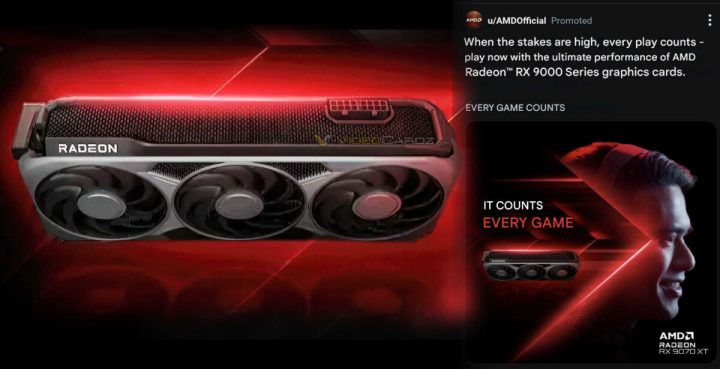
Further signs indicate that AMD might have initially planned a different release timeline for the RDNA 4 series. A Reddit advertisement from the official AMD account hinted that the GPUs are already available, stating, “When the stakes are high, every play counts — play now with the ultimate performance of AMD Radeon RX 9000 series graphics cards.” This ad also showcased the RX 9070 XT in its Made By AMD (MBA) design.
If late January was the originally intended launch period for the RX 9000 series, it appears that AMD opted to delay. While enhanced driver support and increased availability for FSR 4 titles are solid reasons for this decision, it’s plausible that AMD is also waiting to see how Nvidia’s RTX 5070 Ti performs once it is released, likely in February.
On the bright side, McAfee suggests that there will be ample RDNA 4 cards available upon launch, which is encouraging news, especially considering the potential scarcity of Nvidia’s RTX 50 series cards at debut.
While there was a buzz suggesting that AMD’s latest graphics cards would be released shortly, we now have confirmation that this won’t be the case. David McAfee, the vice president and general manager of AMD’s Ryzen CPU and Radeon graphics division, revealed that although the GPUs are performing well and are expected to be widely available, they won’t be launched until March.
This postponement is intriguing, particularly since some retailers had anticipated starting preorders on January 22. Numerous global listings have emerged, and while there’s a scarcity of detailed specifications, these listings suggested the cards were primed for release or would be soon.
Radeon 9000 series hardware and software are looking great and we are planning to have a wide assortment of cards available globally. Can’t wait for gamers to get their hands on the cards when they go on sale in March!
The way the news was shared was rather unusual. After the GPUs were absent from CES 2025, AMD hinted that a dedicated event was more appropriate for the GPUs rather than including them in the 45-minute keynote, which also didn’t mention its next-generation Z2 chips. McAfee later took to X (Twitter) to reveal that AMD’s timeline isn’t firmly established, leading to a vague release window in March.
As the full range of Nvidia’s RTX 50-series is nearing launch, many enthusiasts from the AMD community expected more substantial news. The response to McAfee’s announcement on Twitter was tepid, with numerous fans questioning the cause of the delay. In the ongoing competition in the GPU market, it seems Nvidia holds an advantage, as the release dates for their initial two GPUs are known, along with detailed specifications for all models. Conversely, all that is confirmed about the RX 9000 series is that it will feature 16GB of VRAM, with that information sourced from leaks.
Though AMD did not showcase the cards during the event, affiliated partners had them on display at CES 2025, indicating that the hardware is ready for release. Frank Azor from AMD had previously informed the press that the launch was intended to happen “in a matter of weeks,” which could still align with the end of March, albeit just barely. Nvidia’s RTX 5070 and RTX 5070 Ti are expected to be available by that time, tentatively slated for February.
It’s possible that one of my least favorite rumors is proving to be accurate. A leaker from the Chiphell forum suggested that AMD delayed the RX 9000 series release from late January, citing “waiting for Nvidia” as a reason. It’s unclear exactly what AMD might be waiting for, but we now have confirmation that we will have to wait until March to see the RX 9000 series arrive.
A recent revelation from the Chiphell forums has shed light on AMD’s ambitious strategies for its next-generation CPU and GPU architectures. A post by forum contributor zhangzhonghao states that AMD is planning to implement TSMC’s advanced N3E process node in its forthcoming line of Radeon GPUs and potentially for future CPUs as well.
This leakage emphasizes the development of GPUs built on the innovative UDNA architecture, designed to replace the existing RDNA framework. Among these new GPUs is expected to be a flagship model, aimed at rivaling Nvidia’s elite GeForce RTX offerings, which would fill a significant gap in AMD’s current RDNA 4 range.
AMD affirmed its commitment to UDNA during last year’s IFA, indicating it will cater to both gaming and enterprise markets. This new unified architecture aims to streamline development by merging the previously separate RDNA and CDNA architectures into a cohesive design. This consolidation should enhance software optimization across all AMD GPUs, addressing previous inefficiencies in the hierarchy.
Utilizing TSMC’s N3E node, an upgraded version of the 3nm process, signals AMD’s dedication to improving both performance and efficiency. This cutting-edge technology is poised to enhance transistor density and power management capabilities, contributing to improved gaming and computing power. Furthermore, the UDNA architecture may introduce advancements tailored for ray tracing and AI tasks, areas where AMD has historically trailed behind rivals.
On the CPU front, the leak indicates that AMD intends to leverage TSMC’s N3E process node for its upcoming Zen 6 CPU chiplets, while the N4C node is anticipated for the next-generation input/output dies. This shift to more advanced lithography coupled with architectural innovations suggests that the next iteration of AMD CPUs could yield significantly better performance compared to prior generational updates.
Additionally, the post reveals AMD’s plans for additional X3D chips, notably the next-gen Halo, a successor to Strix Halo. The company is looking into implementing 3D V-Cache on both CPU and GPU components, potentially allowing X3D tiles to be incorporated into both chiplet designs and I/O configurations. There is speculation that the next PlayStation 6 APU could feature 3D V-Cache, while Microsoft has yet to finalize its decision regarding the adoption of this technology in future Xbox consoles.
Recently, a YouTube presentation highlighted the gaming prowess of AMD’s forthcoming Ryzen Z2 Go chipset, aimed at budget-friendly gaming handhelds. As part of the Ryzen Z2 series, the Z2 Go’s performance was evaluated on a Lenovo Legion Go S, with comparisons made to the previous year’s Z1 Extreme found in the Asus ROG Ally X.
Performance data released by FPS VN indicates that the Z2 Go has certain constraints when set against the Z1 Extreme. For example, in Black Myth: Wukong, the Z2 Go reached 36 fps compared to 40 fps at 15W, 30 fps versus 32 fps at 20W, and 60 fps versus 64 fps at 30W. In Cyberpunk 2077, it achieved 50 fps against 54 fps at 15W, 45 fps versus 47 fps at 20W, and 61 fps compared to 66 fps at 30W. A similar pattern was observed in Ghost of Tsushima, where it managed 62 fps compared to 66 fps at 15W, 48 fps against 52 fps at 20W, and matched 62 fps to 66 fps at 30W. Even though the performance disparity is slight, it consistently hovers around 7-10% across all games tested.
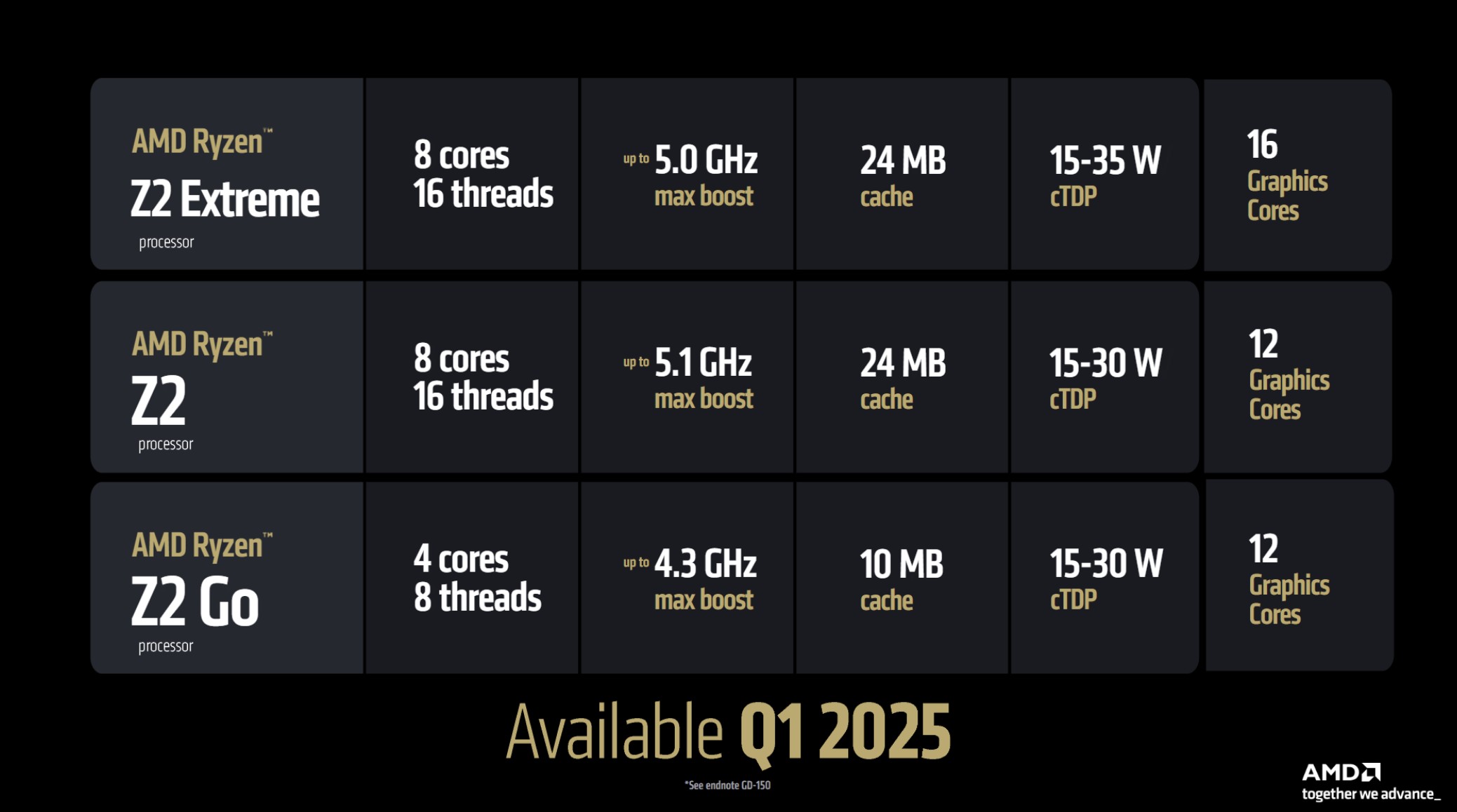
Based on information provided by AMD during CES, the Ryzen Z2 Go is expected to have a 4-core and 8-thread CPU architecture alongside a 12 CU RDNA 2 GPU. While confirmations are still awaited, it’s anticipated that the chipset will incorporate the older Zen 3 architecture paired with RDNA 2 technology for its GPU.
This chipset introduces minimal enhancements compared to the Z1 Extreme, which boasts the new Zen 4 design with 8 cores and 16 threads. Nevertheless, the Z2 Go holds its own and comes impressively close to the Z1 Extreme, making it an appealing option for gamers searching for an economical handheld gaming device.
AMD
The Legion Go S equipped with the Z2 Go is set to retail at $599 running Windows and $499 with SteamOS, presenting an affordable choice compared to the ROG Ally X. Stay tuned for our in-depth review, which will include a thorough assessment of battery performance.
AMD’s Chief Takes a Swipe at Intel’s Arrow Lake CPUs Amid Processor Shortages
Shots fired in the tech arena! Frank Azor, a top executive at AMD, recently criticized Intel’s Arrow Lake series of processors by labeling them as "horrible." This bold statement is tied to an ongoing shortage of AMD’s high-demand gaming CPUs. Astonishingly, AMD has pointed a finger at Intel, claiming its competitor’s lackluster performance is contributing to the current scarcity of AMD’s X3D processors.
During a recent media roundtable reported by Tom’s Hardware, AMD candidly acknowledged it underestimated the demand for its CPUs. The company initially anticipated lower interest, assuming Intel would put forth a more competitive push. However, with Arrow Lake failing to impress, consumers have increasingly favored AMD’s offerings for their next-gen processors.
Azor commented to Tom’s Hardware, "We were confident in the quality of our products. What we didn’t expect was that the competitor’s offerings would be so subpar, leading to demand exceeding our forecasts."
The Ryzen 7 9800X3D, a highlight of AMD’s Zen 5 lineup featuring cutting-edge 3D V-Cache technology, has been grappling with significant supply challenges since its release. AMD representatives noted during the discussion that they are actively working to alleviate these shortages, but creating a new 3D V-Cache chip is a lengthy endeavor.
David McAfee, AMD’s corporate VP and head of Client Channel Business, revealed to PC World that the company is ramping up production capabilities. "We’re increasing our output of X3D processors, significantly surpassing our initial plans. The demand for both the 9800X3D and 7800X3D has been unprecedented," he stated.
The limited supply of the Ryzen 7 9800X3D has frustrated consumers, resulting in inflated prices and scarce availability at retailers. In response, AMD assured its customer base that it is diligently collaborating with TSMC to boost production and address shortages effectively.
Recent data shared by X user @TechEpiphanyYT highlights AMD’s success, indicating that during the first week of 2025, the company sold 8,830 processors compared to Intel’s mere 435—a striking indicator of AMD’s dominance in the market. This preference is evident, especially as AMD fulfilled 5,000 back-ordered Ryzen 7 9800X3D units in just one week, while Intel’s latest Arrow Lake CPUs managed to sell only 20 units, showcasing a clear tilt toward Team Red in the current competitive landscape.
As Intel faces mounting scrutiny regarding its production delays and overall performance, the pressure on TSMC’s manufacturing capabilities remains a critical issue that could have broader implications for the tech industry. While Intel has not addressed AMD’s recent claims directly, industry analysts note that the current dynamics between these two giants can potentially reshape market trends.
AMD is gearing up to unveil new graphics cards, despite their noticeable absence from the CES 2025 keynote. However, an informative interview with Frank Azor, AMD’s chief architect for gaming solutions and marketing, sheds some light on what’s ahead. Notably, FSR 4, which is currently exclusive to the RDNA 4 architecture, may eventually be available for older AMD GPUs.
Azor spoke with Michael Quesada in an interview highlighted by El Chapuzas Informatico and VideoCardz. The discussion covered FSR 4, pricing strategies, and the anticipated performance of the RX 9070 XT. It’s evident throughout the conversation that AMD is focusing on delivering value with this new lineup.
FSR 4, as discussed in the interview, marks a shift for AMD, as it has chosen to make this technology exclusive to the RX 9000 series. Historically, AMD’s upscaling solutions were not confined to a single generation of hardware.
There is hope that FSR 4 might be accessible to users without RDNA 4 GPUs in the future. Azor confirmed that AMD is heavily investing in ray tracing improvements and aims to continue enhancing FSR 3 technology alongside FSR 4, given its broader compatibility and absence of machine learning requirements.
“Utilizing Machine Learning allows for enhanced quality, but it requires considerable computational power. This is why FSR 4 technology is currently limited to RDNA 4 graphics cards,” Azor told Quesada (translated). “We are looking into the possibility of optimizing it for RDNA 3 architecture. We want to do this, but there’s still work to be done.”
This news is promising but lacks specificity. Nevertheless, it surpasses the commitments made by Nvidia, with DLSS 3 currently restricted to RTX 40-series cards, and the next iteration expected to be limited to the RTX 50-series.
Azor indicated that the GPUs would fall within a price range of $300 to $1,000. While this is quite broad, recent leaks suggest a retail price closer to $500, with the reference card estimated at $480. He also asserted that the new products would strike a balance between performance and cost, akin to AMD’s successful releases like the RX 7800 XT.
“We aim to deliver a highly competitive product. This upcoming launch will benefit everyone, and it will be worth the wait,” Azor stated. He also highlighted the challenges AMD faces in developing GPUs priced at $1,000, citing the need for multiple chips and significant resources, including manpower, time, and finances.
Bringing up the RX 7900 GRE and RX 7800 XT, Azor expressed satisfaction with these product launches, stating, “The Radeon RX 7800 XT and RX 7900 GRE provided aggressive pricing for their performance, which resonated well in a market where costs are persistently increasing.” He reiterated AMD’s commitment to being a value-focused company.
During the CES 2025 presentation, AMD chose not to unveil the next-generation graphics cards, nor did their Ryzen Z2 chips get any mention. However, Azor assured that the company plans to reveal more information about the RX 9000 series soon. He acknowledged that AMD opted to wait and see Nvidia’s strategy before moving forward and intends to host a separate event specifically for RDNA 4 announcements.
Recent leaks indicate that preorders for the GPUs are expected to start on January 23.
AMD debuted its RDNA 4 architecture during CES 2025, yet the reveal did not create a significant buzz, as many of the details remained vague. However, leaked benchmark results have emerged, providing unofficial insights that indicate the new graphics card outperforms Nvidia’s $1,000 RTX 4080 Super. This information helps us position AMD’s offering within the hierarchy of top-tier graphics cards.
The benchmarks were shared on the Chiphell forum by a user named nApoleon, who posted results from 3DMark along with GPU-Z specifications. The message encouraged users to hold off on purchasing Nvidia’s upcoming RTX 50-series, asserting that the GPU landscape has experienced a “complete transformation” due to these findings.
Following the initial leak, the original screenshots were taken down, but community members contributed additional information. Another user, Zhanghonghao, pointed out a noteworthy rise in the GPU’s total board power (TBP). Initially projected at 265W, recent reports suggest that the RX 9070 XT may now hit 330W, comparable to the RTX 4080 Super’s TDP of 320W.
The leaked benchmarks showcased the RX 9070 XT achieving a graphics score of 14,591 in 3DMark Time Spy Extreme and 6,345 in 3DMark Speedway. The Time Spy Extreme result places it on equal footing with the RTX 4080 Super. However, the Speedway score, which focuses on ray tracing, reveals AMD’s weaker performance in that category. As AMD finalizes its drivers for these GPUs, there is potential for improved performance.
The GPU-Z data referred to the card as an RX 7800 XT but indicated different specifications, hinting it may be an unreleased model. The card could feature a base clock speed of 2,520MHz alongside a boost clock of 3,060MHz, though these specifications haven’t been confirmed by AMD.
In materials distributed to the press prior to the keynote, AMD highlighted several updates for the RX 9070 series: a shift to a 4nm manufacturing process, enhanced ray tracing capabilities with third-gen RT accelerators, expanded media encoding options with the second-gen AMD Radiance Display Engine, and improved AI performance via second-gen AI accelerators. However, none of these points were discussed during the CES 2025 presentation.
The standout feature of the RX 9070 series is likely to be FSR 4, which will be available exclusively on RDNA 4 GPUs. While official performance data remains elusive, Hardware Unboxed previewed the technology with Ratchet & Clank: Rift Apart. This demo showcased crisper visuals and a notable reduction in ghosting compared to FSR 3.1, offering an encouraging glimpse of AMD’s upcoming upscaling technology.
These benchmark results are significant, marking the second instance where RDNA 4 technology appears to rival the RTX 4080 Super, with the non-XT variant reportedly achieving 99 frames per second in Call of Duty: Black Ops 6. Although the release date remains a mystery—preorders are expected to start on January 23—more benchmark leaks are likely to surface before AMD officially announces the GPUs.
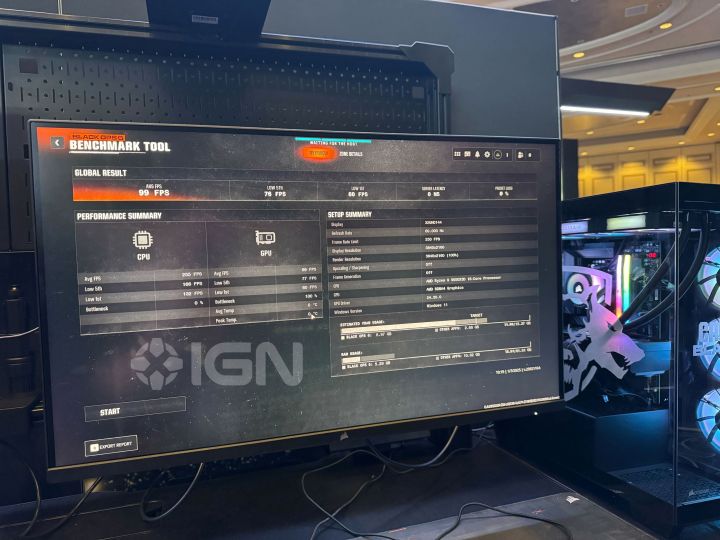
While AMD’s RX 9000 series remains shrouded in mystery, the company gave a preview of the RX 9070 at CES 2025. Although specific specifications aren’t yet available, an early benchmark shows that it performs admirably in Call of Duty: Black Ops 6. The question is whether it can hold its own against some of Nvidia’s top-tier graphics cards.
At the AMD booth, the RX 9070 was tested alongside the powerful Ryzen 9 9950X3D. IGN reported on its performance in Call of Duty: Black Ops 6, which includes a built-in benchmarking option. Notably, this was the standard version of the card, not the XT variant, leaving us uncertain about how it compares to the flagship model.
The benchmarking was conducted without any upscaling, which eliminates concerns about the additional enhancements from FSR and allows for a clearer picture of the GPU’s capabilities. At 4K resolution with Extreme settings, the RX 9070 achieved an impressive average of 99 frames per second (fps).
This performance is noteworthy and is even compared to the RTX 4080 Super. Given that AMD states its top GPUs will only compete with the RX 7900 XT, this is an encouraging outcome. While IGN did observe some visual glitches, this is not surprising since the GPU was operating with pre-release drivers.
However, there are some caveats to consider before jumping to conclusions. This game has a history of favoring AMD in benchmarks, which might not hold true for all titles. Additionally, the powerful CPU could have played a role in this performance. Nevertheless, seeing the RX 9070, a mainstream card, come close to averaging 100 fps in 4K is a promising sign.
Additional Insights
Nvidia is holding a giveaway for the RTX 5090 — learn how to enter.
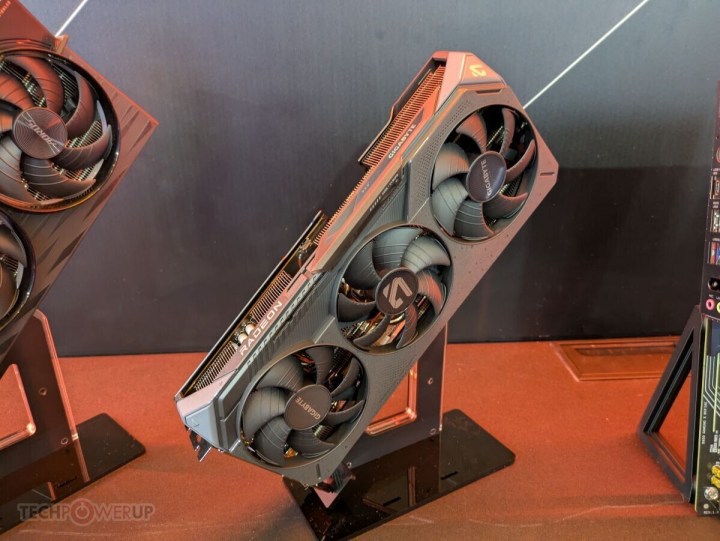
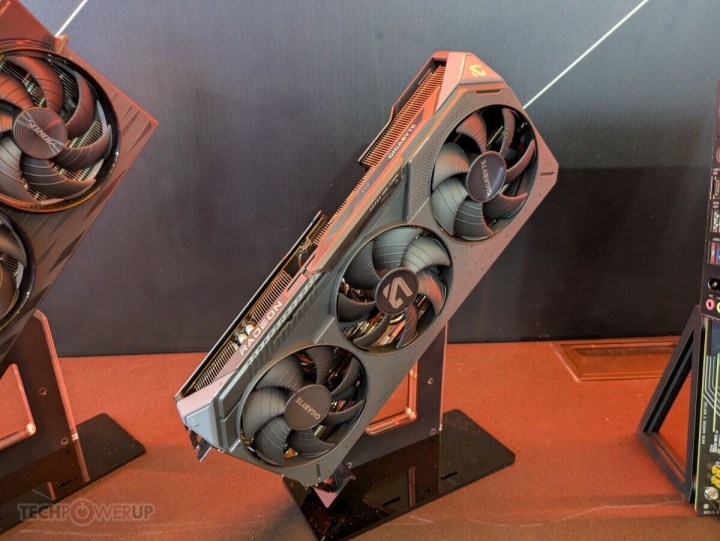
Asus and Gigabyte are shedding light on the RX 9000 series.
Nvidia’s RTX 5090 boasts impressive performance at a price point of $2,000.
If it weren’t for this preliminary test, we would lack any benchmarks for the new RDNA 4 GPUs at this moment. While it’s common for new technologies to be kept under wraps without a release date, it would have been nice to see some projections. Despite Nvidia sharing some benchmarks for its new RTX 50 series — which are hard to trust at face value — AMD has remained tight-lipped about its forthcoming GPUs, with promises of more information in the near future.
During its CES 2025 keynote, AMD offered minimal information regarding its new RDNA 4 graphics cards, opting not to showcase the GPUs. Instead, much of the information surrounding the new cards has come from AMD’s partner manufacturers. This unusual approach has left many Team Red enthusiasts feeling anxious about the impending release of the new GPUs.
The good news is that the RX 9070 XT is on its way.
How soon, you ask? AMD’s Frank Azor mentioned that the launch is set for mere weeks away, emphasizing, “When we say Q1, we’re certainly not talking about March 31st.”
While “weeks” is certainly broad and could refer to late January, early February, or even March, Azor assured me that AMD is prepared to launch its next generation of graphics cards. He explained that the graphics cards were overlooked during the keynote presentation due to time limitations. It’s also worth noting that AMD had a lot to announce, from the Ryzen 9 9950X3D to its new range of Ryzen Z2 processors designed for handheld devices.
Get weekly insights into the technology behind PC gaming
Azor also revealed that AMD was awaiting Nvidia’s moves before detailing their launch. With Nvidia’s newly announced $2,000 RTX 5090 and its other RTX 50-series cards, AMD seemed eager to understand where its new GPUs would fit relative to Nvidia’s offerings. This strategy appears wise, as AMD has indicated a focus on the midrange segment rather than directly competing with Nvidia for the high-end market this generation.
However, the exact positioning of AMD’s new GPU remains uncertain. Nvidia’s performance metrics lack clarity, with much of the information made vague by their new DLSS 4 multi-frame generation technology. Azor expressed his opinion that while he has “immense respect” for Nvidia, their performance charts are essentially “worthless,” a sentiment that many might echo. The lack of clarity in these charts does not provide a complete picture of what PC gamers can really expect from Nvidia’s latest graphics cards.
AMD has reassured that there is nothing amiss with the RDNA 4 series. I’ve seen both the RX 9070 XT and AMD’s significantly upgraded FSR 4 in action. If there were serious issues with AMD’s new graphics cards, I seriously doubt they would have appeared at CES, an event known for showcasing new technology.
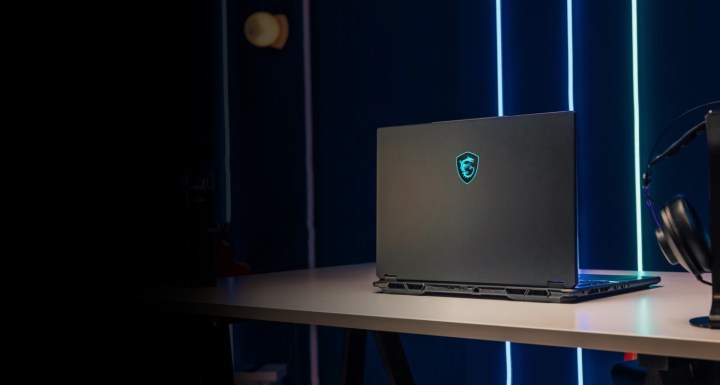
At CES 2025, MSI is unveiling a robust lineup of gaming laptops, featuring a surprising shift toward AMD processors in many new models—a notable deviation from their historical preference for Intel chips. Additionally, MSI is emphasizing larger laptops, showcasing five models with 18-inch displays alongside 17-inch and 16-inch options.
The premium models, including the Titan, Raider, and Vector, will benefit from PCIe 5.0 support, and they’ll incorporate enhanced thermal solutions with dedicated heatsinks for improved cooling of both the CPU and GPU. Improvements in speaker driver materials are also set to minimize resonance and enhance audio quality. Let’s dive into the various laptops MSI has just introduced.
MSI Titan
MSI
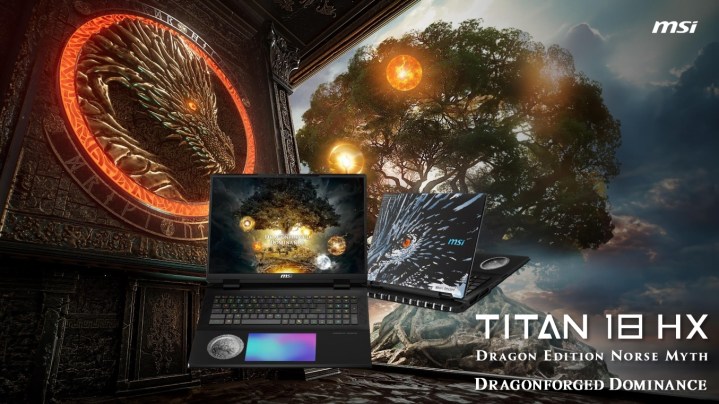
The Titan series continues its tradition of excellence with the new Titan 18 HX. This year's model showcases a Dragon Edition influenced by Norse mythology, featuring intricate designs including a dragon motif and rune-etched lid. The unique aesthetics are complemented by a textured metal finish and a Norse-themed coin set beneath glass in the palm rest, with designs illustrating Yggdrasil, the tree of life in Norse lore.
Also notable is the inclusion of a large RGB haptic touchpad and RGB-lit Cherry mechanical switches. Under the hood, the Titan 18 HX boasts Intel’s Core Ultra 9 275HX CPU and Nvidia's latest RTX 50-series GPUs. To manage its impressive 270W power usage (comprising 95W for CPU and 175W for GPU), MSI employs advanced vapor chamber cooling, alongside support for up to 96GB DDR5-6400 RAM and up to four SSDs.
The display features an 18-inch UHD+ (3,840 x 2,400) mini LED panel supporting a 120Hz refresh rate, 100% DCI-P3 color gamut, and VESA Display HDR 1000 certification. Connectivity includes two Thunderbolt 5 ports, three USB 3.2 Gen2 Type-A ports, a 2.5GbE LAN, Wi-Fi 7, Bluetooth 5.4, and HDMI 2.1.
This powerhouse weighs approximately 7.9 pounds and is powered by a substantial 99.9 watt-hour battery, rechargeable via a hefty 400W power supply. While official pricing hasn't been disclosed, last year's model was priced above $5,000, suggesting the latest Titan 18 HX may surpass that benchmark.
MSI Raider and Vector
MSI
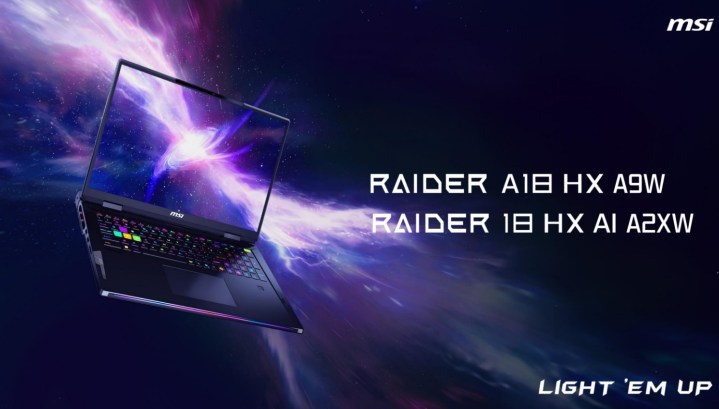
The Raider lineup also sees the introduction of an 18-inch model, which closely mirrors the Titan 18 HX in features and dimensions. Customers can choose between Intel’s Core Ultra 9 275HX (Raider 18 HX A2XW) and AMD’s Ryzen 9 9955HX3D (Raider A18 HX A9W) processors, complemented by Nvidia's RTX 50-series graphics cards.
Similar to its premium counterpart, it features the same 18-inch mini-LED display, options for up to 96GB DDR5 RAM, and dual M.2 SSD slots. Connectivity remains robust, offering dual Thunderbolt ports (version 4 on the AMD version), a 2.5GbE LAN port, Wi-Fi 7, a per-key RGB keyboard from SteelSeries, and a potent 400W power supply.
Meanwhile, the new Vector series, while a tad less premium than the Raider, still packs a punch. The 18-inch Vector 18 HX AI A2XW is available with an Intel Core Ultra 9 275HX, while the Vector A18 HX A9W can be configured with an AMD Ryzen 9 9955HX processor. While the GPU will still be Nvidia, it might not be as powerful as the Raider’s offerings. The display on the Vector series boasts a QHD+ (2,560 x 1,600) resolution, a 240Hz refresh rate, and 100% DCI-P3 coverage.
Interestingly, MSI specifies that the AMD model will sport a 99.9Whr battery paired with a 400W power supply, whereas the Intel model will have a 90Whr battery and a 330W adapter.
MSI Stealth
MSI
The Stealth series, known for its sleek design, is now offering an 18-inch variant equipped with either the Intel Core Ultra 9 275HX (Stealth 18 HX AI A2XW) or the AMD Ryzen AI 9 HX 370 (Stealth A18 AI+ A3HW). Users can choose a high-end Nvidia RTX 50-series GPU, paired with 96GB of DDR5 memory. Other features include a single NVMe M.2 PCIe Gen 4 SSD slot, a per-key RGB keyboard from SteelSeries, and a Dynaudio six-speaker audio system.
For its display options, MSI provides a choice between an 18-inch UHD+ (3840×2400) panel with a 120Hz refresh rate or a QHD+ (2560×1600) IPS panel with a higher 240Hz refresh rate. Both configurations come with a 99.9Whr battery and a 280W power supply.
In addition, there’s a compact 16-inch variant (Stealth A16 AI+ A3HW), which is solely powered by AMD’s Ryzen AI 9 HX 370 processor. This model supports up to an RTX 5090 GPU, 64GB of LPDDR5x memory, an NVMe M.2 PCIe Gen 4 SSD slot, and shares similar keyboard and speaker technologies with its larger counterpart. Display options include a 16-inch QHD+ (2560×1600) OLED panel that provides a 240Hz refresh rate, 100% DCI-P3 color gamut, and VESA DisplayHDR True Black 600 certification.
MSI Crosshair, Cyborg, and Venture
MSI is also launching mid-range gaming options with the Crosshair 18 HX AI A2XW and the Cyborg A17 AI B2HW. The Crosshair 18 model features an 18-inch screen and offers configurations up to an Intel Core Ultra 9 275HX, a QHD+ 240Hz IPS display, dual NVMe M.2 SSD slots, up to 96GB of DDR5 RAM, and a 240W power adapter.
Aiming at a more budget-conscious audience, the Cyborg A17 AI B2HW is available with up to an AMD Ryzen 7 260 processor, RTX 50-series graphics, and DDR5 memory up to 96GB. The display measures 17.3 inches, utilizes an FHD (1,920 x 1,080) IPS panel with a refresh rate of 144Hz. Other specifications include a modest 55.2Whr battery and a 150W power adapter.
MSI
Lastly, the Venture series fills the gap for everyday computing needs, offering a variety of models in 14-inch, 16-inch, and 17-inch sizes with options for both Intel Core Ultra and AMD Ryzen 300 processors.
We’re currently in an exhilarating phase leading up to the launch of some of the top graphics cards of next year, which has resulted in a flurry of leaks and predictions surfacing daily. The past few weeks have particularly highlighted AMD’s upcoming flagship, reportedly named the RX 9070 XT. However, we are increasingly encountering a mix of conflicting information regarding the performance we can anticipate from this premium RDNA 4 card. Recent leaks suggest its performance could be quite close to Nvidia’s RTX 4080.
Insights from zhangzhonghao on the Chiphell forums (a well-known leaker in the CPU and GPU community) indicate that the performance difference between the RX 9070 XT and the RTX 4080 might be just 5%. However, it remains unclear which of the two cards comes out on top, as well as the specific games used for testing.
This aligns with numerous earlier predictions about AMD’s new flagship. Some prior leakers positioned it on par with the RTX 4080, while others suggested it would be more in line with the RX 7900 XT, which is not an equivalent comparison. So far, the only leaked benchmark for this GPU comes from a Time Spy test, showing it lagging behind the RX 7900 XT but suggesting competitiveness with the RTX 4070 Ti.
It’s safe to say the information we’ve gathered is quite scattered.
Get your weekly breakdown of the technology behind PC gaming
OpenAI’s Sora leaked amid allegations of ‘art washing’
AMD RDNA 4: everything we know about the RX 8000 series
In addition to the vague performance estimates, zhangzhonghao also shared some significant specifications for the RX 9070 XT. The leaker anticipates the AMD model to have a total board power (TBP) of around 260 watts, although variants from AMD’s partners could reach up to 330 watts. This TBP is comparable to what we might see in the RTX 5070 Ti, though that does not necessarily imply similar performance levels.
Furthermore, the leaker predicts a base clock speed of 2.8GHz that could be increased to 3.0 to 3.1GHz. These speeds are achievable with overclocking in the current lineup, yet they still represent the upper echelon of what’s possible.
With just 10 days until AMD unveils the RX 9070 XT — likely alongside other cards from its lineup — we should approach all of this information with a degree of skepticism. It won’t be long before we learn the precise specifications, providing more clarity on potential performance.