- Tensions escalate after recent U.S. and Iranian strikes.
- Tehran asserts it will retaliate if the U.S. does.
- Iran claims it has sufficient foreign currency reserves, according to the central bank chief.
Iran announced Tuesday that it would respond if the United States honors its commitments under a June interim agreement aimed at reducing hostilities. Despite this, tensions remain elevated following U.S. President Donald Trump’s warning of potential additional strikes on Tehran.
Oil prices increased after the first exchange of fire since late July, amid reports that two tankers had been hit while passing through the Strait of Hormuz— a crucial global oil shipping lane that Iran has effectively shut down.
The conflict, ongoing for six months, has shifted from military clashes to a broader economic standoff. This escalation came after a U.S. attack on Iran’s Larak Island on Sunday, which Iran responded to overnight with missile strikes on two U.S. bases in Jordan.
“We will strike back hard… There will be a response,” a Fox News reporter quoted Trump as saying on Monday, though the president later clarified that the renewed strikes don’t mean a full-scale war is imminent.
A senior Iranian source told Reuters that the exchanges were a “limited and contained confrontation,” but Iran warned it would deliver a tough response if attacked again.
Neither side seems eager for all-out war, but their commitments to retaliate suggest that what has been primarily a conflict of sanctions, blockades, and economic pressure could rapidly turn into military action.
Fears that the Iran conflict could ‘run and run’
Tehran has repeatedly stated it will permit free navigation through the Strait of Hormuz only if Washington fulfills the terms of a June Memorandum of Understanding (MoU), which was quickly broken down.
The MoU declared an end to hostilities but postponed many complex issues and set a 60-day negotiation period — which has since expired without further progress.
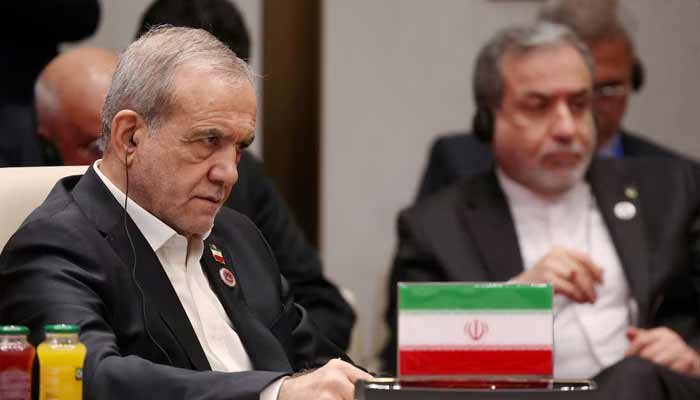
“I want to be clear: if the U.S. returns to its commitments under the MoU, Iran will immediately reciprocate,” Iranian President Masoud Pezeshkian said during the SCO summit in Bishkek, Kyrgyzstan.
On Monday, he also emphasized that war benefits no one and that Tehran remains open to diplomatic solutions.
However, no breakthrough has occurred, and rising tensions this week have renewed fears of disruptions to oil supplies from the world’s leading crude-producing region. Brent crude futures rose by 1.3% on Tuesday.
“The tit-for-tat missile exchanges between the U.S. and Iran reinforce fears that, even if not a ‘forever war,’ this conflict could persist indefinitely,” remarked PVM analyst John Evans.
Adding to these concerns, two supertankers carrying Saudi oil were struck by unidentified projectiles within minutes of each other while transiting the Strait of Hormuz late Monday, according to data from maritime tracking firms Marisks and Kpler.
Economic and geopolitical pressure
Since the conflict began with U.S. and Israeli strikes on Iran on February 28, thousands have been killed, mostly in Iran and Lebanon. The U.S. has increasingly relied on economic sanctions in an effort to force Tehran to lift its blockade of the Strait and end hostilities.
U.S. Treasury Secretary Scott Bessent warned that any countries dealing with Iran could face U.S. sanctions, with secondary sanctions expected to be rolled out weekly, initially targeting financial institutions.
Iran’s central bank governor, Abdolnaser Hemmati, stated Tuesday that Tehran maintains enough foreign currency reserves. The central bank is prepared to inject up to $2 billion into the foreign exchange market to stabilize recent fluctuations, he added.
“I am telling the U.S. president: Iran has enough foreign currency reserves,” Hemmati said.
His comments serve to reassure financial markets amid concerns about Iran’s economic stability, which has already seen the rial plummet to a record low in August— crossing 2 million rials to the dollar— and inflation reaching 66% in July.