Select Language:
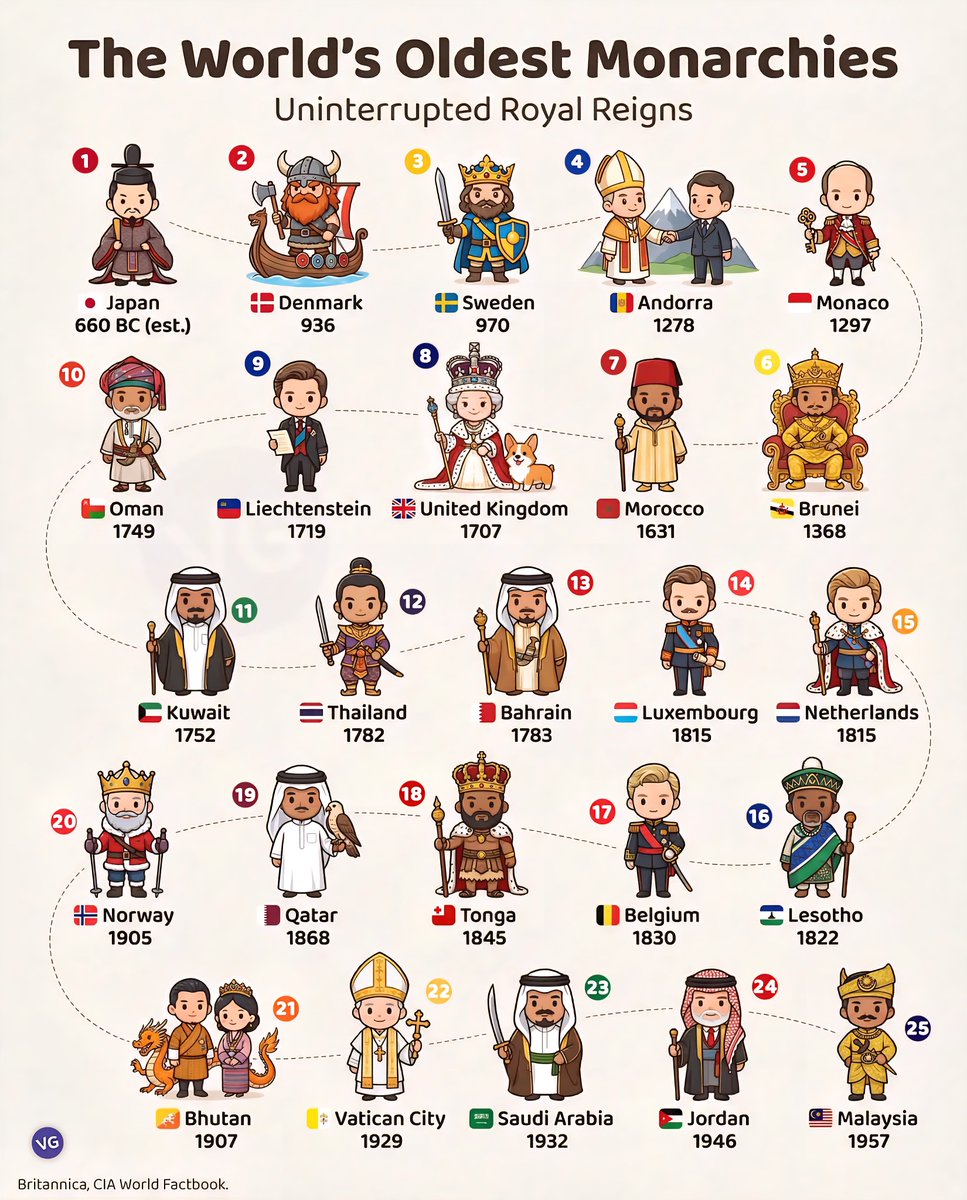
Exploring the World’s Oldest Monarchies in 2025: A Historical Perspective
In an era of rapid change and modernization, some monarchies have endured for centuries, symbolizing stability, tradition, and cultural heritage. Here’s a comprehensive look at the world’s oldest reigning monarchies in 2025, showcasing the richness of history that continues to shape nations today.
Japan: The World’s Longest-Standing Dynasty
Established circa 660 BC
Japan’s imperial family is recognized as the oldest hereditary monarchy still in existence today. The Emperor traditionally serves as a symbol of unity, with a lineage tracing back over 2,600 years. While their political power is symbolic in modern times, the emperor’s role as a cultural and spiritual figure remains prominent.
Denmark: The Danish Royal Lineage
Founded in 936
Denmark’s monarchy is one of the oldest in Europe. The Danish royal family has been a staple of Scandinavian history for over a millennium, with Queen Margrethe II reigning since 1972. The monarchy’s influence has transformed from political authority to a symbol of national identity.
Sweden: A Regal Heritage
Originating in 970
Swedish kings have ruled for over a thousand years, with the current monarchy dating back to the late 10th century. The Swedish royal family is admired for its rich traditions and modern diplomacy, maintaining a constitutional role since the 19th century.
Andorra: A Unique Co-Principality
Established in 1278
Nestled in the Pyrenees, Andorra’s status as a co-principality makes its monarchy unique. The country has two princes—a bishop of Urgell and the President of France—serving as joint heads of state, exemplifying historical diplomacy and regional independence.
Monaco: The Glamorous Microstate
Founded in 1297
Famous for its luxury and financial hubs, Monaco’s Grimaldi family has ruled for over 700 years. The principality’s monarchy is renowned worldwide, exemplifying stability and wealth in the Mediterranean.
Brunei: A Crown of Southeast Asia
Ruled since 1368
Brunei’s Sultan is one of the world’s wealthiest monarchs, presiding over a nation rich in oil and gas reserves. The Sultan’s role combines religious authority and political leadership, maintaining continuity for over six centuries.
Morocco: A Historic Kingdom
Established in 1631
Morocco’s monarchy is one of Africa’s oldest, with the Alaouite dynasty in power since the 17th century. The current King, Mohammed VI, remains a pivotal figure in politics and society, bridging tradition and modern governance.
The United Kingdom: A Legacy of the Highlands
Founded in 1707 (Act of Union with Scotland)
The British monarchy’s roots extend deeper into history, but the current constitutional monarchy dates from the early 18th century. Queen Elizabeth II’s long reign exemplified stability, and the royal family continues to be a global symbol of tradition.
Liechtenstein: The Tiny Alpine Sovereign
Established in 1719
This European principality has maintained its monarchy for over 300 years. Prince Hans-Adam II is known for his influential role within the constitutional framework, representing stability in the heart of Europe.
Oman: The Sultanate of the Arabian Peninsula
Under Sultan Qaboos’ lineage since 1749
Oman’s monarchy has historically been a central player in Middle Eastern geopolitics. The Sultan’s leadership has focused on modernization while preserving traditional Bedouin culture.
Kuwait: A Gulf Country’s Regal Tradition
Founded in 1752
Kuwait’s monarchy has shaped its oil-rich economy and regional diplomacy. The Emir’s family has been pivotal in national development since the 18th century, fostering stability amidst regional upheavals.
Thailand: The Land of Smiles’ Royal Heritage
Established in 1782
Thailand’s Chakri dynasty has lasted over two centuries, with King Maha Vajiralongkorn reigning since 2016. The monarchy plays a central role in national identity, often revered as a unifying force.
Bahrain: The Gulf’s Pearl
Founded in 1783
As part of the Gulf Cooperation Council, Bahrain’s monarchy combines Islamic traditions with modern governance. The Al Khalifa family has ruled for over two centuries, overseeing a strategic island nation.
Luxembourg & The Netherlands: European Monarchical Guardians
Luxembourg since 1815
The Netherlands since 1815
Both monarchies have contributed to stability within Europe, with constitutional monarchs acting as symbols of continuity and tradition amid democratic governance.
Lesotho & Belgium: African and European Monarchies
Lesotho since 1822
Belgium since 1830
These monarchies exemplify the diverse inheritance of royalty, with Lesotho’s kings focusing on unity in Africa, and Belgium’s royal family representing European stability.
Tonga & Qatar: Pacific and Middle Eastern Dynasties
Tonga since 1845
Qatar since 1868
These nations feature monarchs deeply intertwined with their cultural and political identities, symbolizing enduring sovereignty in their regions.
Norway and Bhutan: Northern Monarchies
Norway since 1905
Bhutan since 1907
Both monarchs serve as spiritual and cultural symbols, with Norway embracing its constitutional role and Bhutan pioneering Gross National Happiness.
The Vatican City: The Sovereign Holy See
Established in 1929
As the spiritual leader of over a billion Catholics worldwide, the Pope’s sovereignty underscores religious authority rather than temporal power in Vatican City.
Saudi Arabia & Jordan: Middle Eastern Monarchies
Saudi Arabia since 1932
Jordan since 1946
These monarchs are key players in regional politics, with the Saudi royal family shaping global energy markets and Jordan maintaining stability amid regional challenges.
Malaysia: A Southeast Asian Federation
Established in 1957
Malaysia’s constitutional monarchy has evolved as a vibrant mix of tradition and modern governance, with reigning kings serving rotating roles across Malaysian states.
A Legacy to Celebrate
Despite the modern world’s rapid evolution, these monarchies demonstrate the resilience of tradition, serving as symbols of unity, culture, and historical continuity. Their enduring presence in 2025 underscores an appreciation for heritage amid changing times.
Source: Britannica, CIA World Factbook 2025
 ChatGPT
 Perplexity
 Gemini AI
 Grok AI