

Select Language:
Countries with the Largest Immigrant Populations in 2025
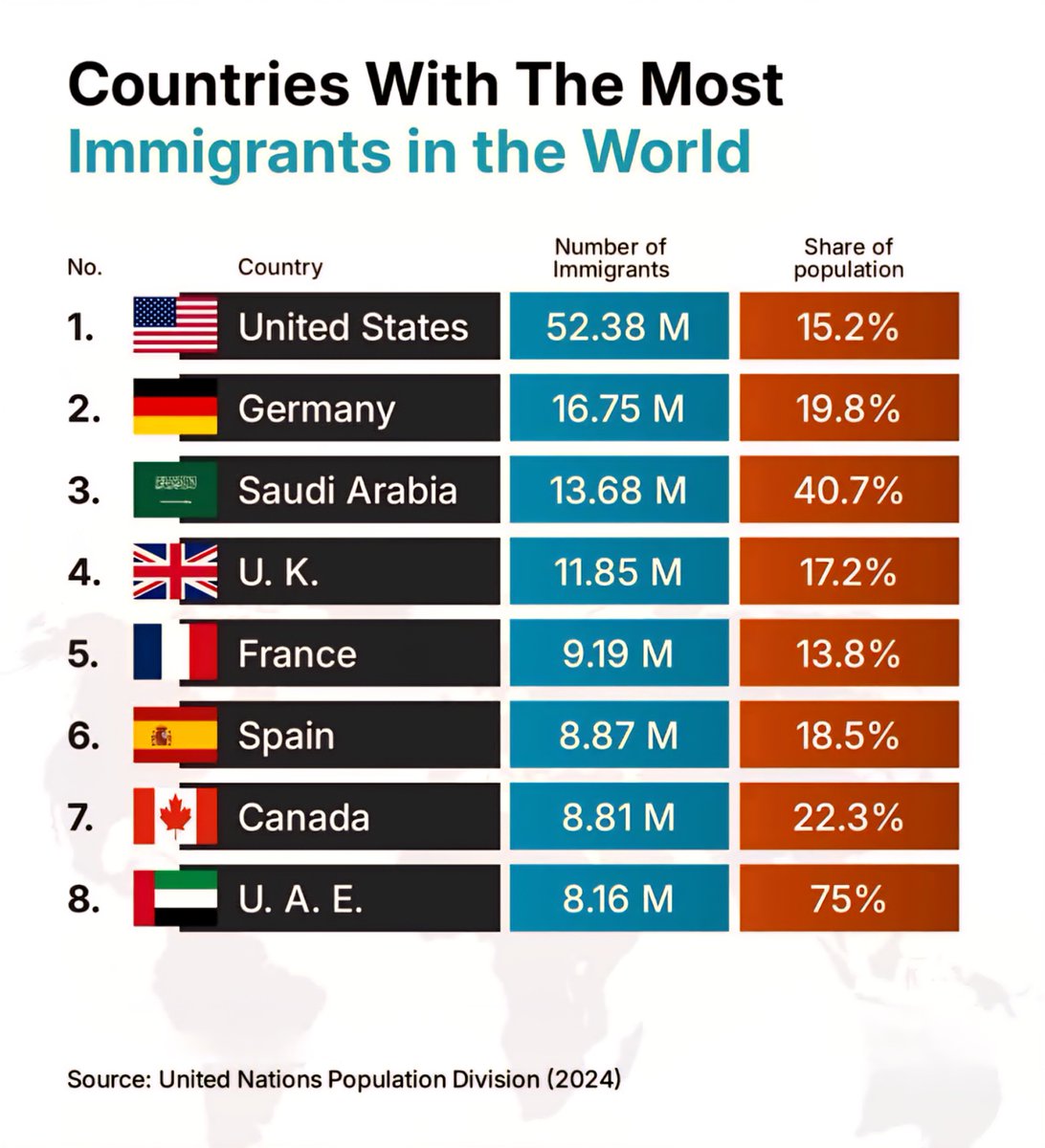
- United States Continues to Lead with Immigrant Numbers
The United States remains the global leader in hosting immigrants, with approximately 52.38 million individuals from abroad calling the country home as of 2025. This accounts for about 15.2% of the total U.S. population, highlighting its longstanding position as a melting pot of cultures and nationalities. The diverse immigrant community plays a critical role in shaping the nation’s economy, innovation, and cultural landscape. Major cities like New York, Los Angeles, and Houston continue to be epicenters for immigrant communities, offering opportunities and fostering multicultural integration.
- Germany Holds Strong as Europe’s Top Destination for Immigrants
Germany maintains its position as Europe’s primary destination for immigrants, with roughly 16.75 million residents born outside its borders — representing nearly 19.8% of its population. Over the past few years, Germany has managed to attract a significant number of refugees, skilled professionals, and students, especially from conflict-affected regions such as Syria and Ukraine. The country’s robust economy and welcoming policies have contributed to its reputation as a hub for immigrant integration, though challenges around social cohesion persist.
- Saudi Arabia Boasts the Highest Percentage of Immigrants
Saudi Arabia stands out with an astonishing 40.7% of its population composed of immigrants, totaling about 13.68 million people. The country’s economy heavily relies on foreign workers, primarily from South Asia, Southeast Asia, and Africa, who fill roles across the construction, manufacturing, and domestic sectors. The expatriate community has become an integral part of Saudi society, though migrant workers often face issues related to labor rights and residency regulations. Their presence underscores the kingdom’s deep dependence on foreign talent for its economic development.
- United Kingdom’s Evolving Immigrant Demographics
Britain continues to host a substantial immigrant population of around 11.85 million, constituting approximately 17.2% of its population. A diverse array of communities from India, Pakistan, Nigeria, and Eastern Europe add richness to British society. With ongoing debates over immigration policies since the Brexit transition, the UK’s immigrant demographic remains dynamic, influencing everything from local economies to cultural policies. The UK continues to adapt its immigration processes to balance economic needs with social integration.
- France’s Diverse and Growing Immigrant Population
France is home to nearly 9.19 million immigrants, making up about 13.8% of its population. The country’s colonial history has contributed to large communities from North and Sub-Saharan Africa. Paris and the surrounding regions exemplify multicultural urban life, though social integration and social cohesion are ongoing challenges. France’s immigrant population is vital for sectors such as hospitality, manufacturing, and technology, fueling its economic resilience.
- Spain’s Rising Immigrant Numbers Amid Economic Shifts
Approximately 8.87 million individuals in Spain are foreign-born, accounting for 18.5% of the population. Recent years have seen an uptick in immigrants from Latin America, Eastern Europe, and Africa, driven by Spain’s recovering economy and improved quality of life. Madrid and Barcelona remain hotspots for immigrant communities, contributing significantly to the local labor market and cultural diversity. Spain continues to balance integration efforts with economic growth, especially in tourism and construction.
- Canada’s Welcoming Policies and Growing Immigrant Population
Canada has attracted about 8.81 million immigrants, representing 22.3% of its population — one of the highest proportions globally. Its policy of openness and inclusive immigration programs, including Express Entry and Provincial Nominee Programs, continue to make Canada a preferred destination for skilled migrants. Cities like Toronto, Vancouver, and Montreal flourish with multicultural communities that enhance innovation, arts, and economic development. Canada’s focus remains on sustainable integration and fostering diversity.
- United Arab Emirates’s Overwhelming Dependence on Foreign Workers
The UAE hosts approximately 8.16 million immigrants, accounting for a staggering 75% of its total population. This high percentage reflects the country’s economic model, heavily reliant on foreign labor in sectors like construction, finance, real estate, and hospitality. Workers hail mainly from South Asia, the Philippines, and Africa. While migration has been pivotal to the UAE’s rapid development, ongoing discussions focus on improving migrant workers’ rights and providing pathways to permanent residence.
Source: United Nations Population Division (2024)
 ChatGPT
 Perplexity
 Gemini AI
 Grok AI