
Select Language:
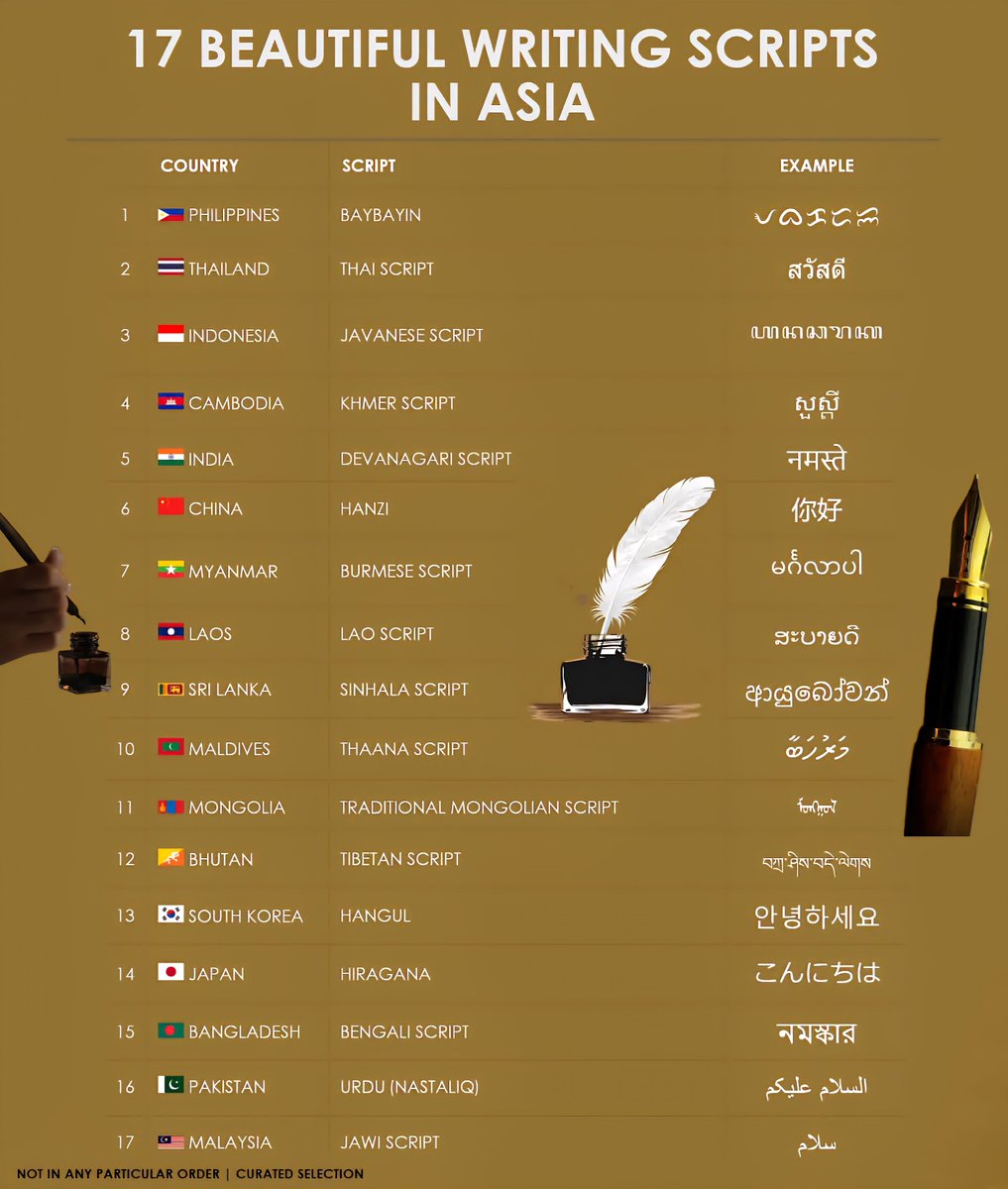
Discover 17 Unique and Beautiful Asian Writing Systems
1. Philippines – Baybayin Script
The Philippines’ historic script, Baybayin, features elegant curves and swirls, embodying the country’s pre-colonial cultural identity. Though less common today, this script remains a symbol of Filipino heritage and resistance, with “Salamat” (thank you) written as ᜐᜎᜋᜆ᜔.
2. Thailand – Thai Script
The Thai alphabet is renowned for its graceful, looping characters. Used in everything from official documents to street signs, it reflects the country’s rich history and artistic traditions. “Hello” in Thai, สวัสดี, is both functional and visually stunning.
3. Indonesia – Javanese Script
The traditional Javanese script is an ornate and intricate writing system with flowing lines and complex characters. Despite modern shifts, it endures in cultural ceremonies and art, with the text ꦩꦠꦸꦂꦤꦸꦮꦸꦤ꧀ representing “matur nuwun” or thank you.
4. Cambodia – Khmer Script
Khmer, with its rounded characters and distinctive loops, is among Southeast Asia’s oldest scripts. It beautifully captures the history of Cambodia, used predominantly in religious texts and official signage. The greeting สวัสดี means “hello.”
5. India – Devanagari Script
Devanagari, one of the most widely used scripts in India, features a distinctive horizontal line atop each character. It is employed for Hindi, Sanskrit, and several other languages. “Namaste” (नमस्ते) demonstrates its elegant form.
6. China – Chinese Characters
Chinese characters are logograms, each carrying visual and cultural significance. The characters are often considered art, reflecting millennia of tradition. The phrase 你好 (hello) exemplifies their simplicity and depth.
7. Myanmar – Myanmar Script
Myanmar’s script is characterized by its circular and flowing shapes, designed to suit the tonal language. It’s used for religious manuscripts and daily communication, with မင်္ဂလာပါ translating to “hello” or “greetings.”
8. Laos – Lao Script
Sharing similarities with Thai and Khmer scripts, Lao writing features smooth, rounded characters evoking a sense of calm. ສະບາຍດີ is the casual greeting meaning “hello.”
9. Sri Lanka – Sinhala Script
Sinhala script boasts curving and looping characters, a visual signature of Sri Lankan linguistic heritage. It’s used in religious texts and literature, with the greeting ආයුබෝවන් (ayubowan) meaning “may you live long.”
10. Maldives – Thaana Script
Distinct for its unique style influenced by Arabic, Thaana is written from right to left and features striking diacritical marks. އައްސަލާމު (assalamu) is a common greeting.
11. Mongolia – Traditional Mongolian Script
Derived from the Old Uyghur script, Mongolian script is written vertically and has a flowing, calligraphic appearance. It symbolizes Mongolia’s nomadic heritage.
12. Bhutan – Tibetan Script
The Tibetan script features ornate, highly decorative characters used in religious texts and official communications within Bhutan. The phrase བཀྲ་ཤིས་བདེ་ལེགས (Tashi Delek) means “hello” or “good luck.”
13. South Korea – Hangul
Invented in the 15th century, Hangul is praised for its logical structure. It combines consonants and vowels into compact syllabic blocks. 안녕하세요 (annyeonghaseyo) is the culturally significant greeting.
14. Japan – Hiragana and Kanji
Japan’s writing system blends two scripts: Hiragana, with its flowing, cursive characters, and Kanji, logographic characters borrowed from Chinese. こんにちは (konnichiwa) means “hello.”
15. Bangladesh – Bengali Script
The Bengali script features rounded, flowing characters that appear almost calligraphic. It’s used extensively in Bengali literature, with নমস্কার (nomoskar) serving as a formal greeting.
16. Pakistan – Perso-Arabic Script
Primarily used for Urdu, this script is noted for its cursive, flowing style written right to left. السلام علیکم (As-salamu alaykum) translates to “peace be upon you,” embodying respect.
17. Malaysia – Jawi Script
Jawi is an Arabic script adapted for Malay language, combining Islamic calligraphy with local language nuances. It’s historically significant and still used in religious contexts today.
Asia’s linguistic tapestry is woven with numerous scripts, many of which have deep cultural, religious, and historical significance. This curated list highlights some of the most captivating writing systems across the continent, showcasing the beauty and diversity that make Asian scripts truly remarkable.
 ChatGPT
 Perplexity
 Gemini AI
 Grok AI