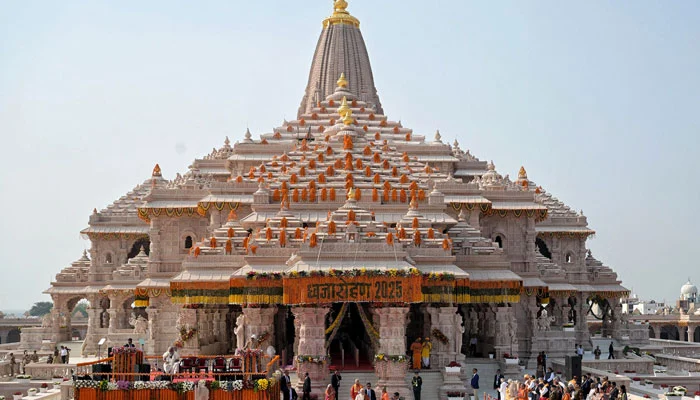
A review into the donations allegedly diverted at India’s grand Ram temple has reignited concerns over how religious sites handle large sums of money and gold donated by devotees.
Police began investigating in June and detained eight individuals responsible for managing donations at the revered Hindu temple in Ayodhya, northern India.
While the authorities haven’t revealed the exact amount allegedly stolen, reports suggest it could be around INR30 million ($314,000). Ashok Prasad Kushwaha, an auto-rickshaw driver in Delhi who visited the Ram temple three times in two years, noted that donations are acts of faith from people with modest means.
“When we donate, we trust that the money is for God’s work,” he said. “If that hard-earned money is stolen from a temple, it feels like a personal loss.”
This case adds to a series of scandals involving donations at major pilgrimage sites, such as the Badrinath shrine and Tirumala Tirupati Devasthanams, one of the world’s wealthiest temple trusts, with assets estimated at $31 billion.
Given that some religious organizations manage enormous amounts of money and operate on a scale comparable to large corporations, transparency remains a constant challenge. Rahul Easwar, a Hindu activist and grandson of a former chief priest of Kerala’s Sabarimala temple, stated, “The fundamental systemic issue is the lack of transparency and accountability.”
Major religious institutions require stronger financial controls, including the issuance of official receipts, digital accounting systems, CCTV cameras for donation handling, and independent oversight, Easwar told AFP. The vulnerabilities at the Ram temple are evident, where accused individuals reportedly exploited weak bookkeeping and surveillance gaps.
Inaugurated in 2024 by Prime Minister Narendra Modi, the Ram temple has become one of India’s most prominent religious sites, attracting about 90,000 visitors daily. Devotees often bring offerings—cash, gold, and silver—which contribute to a continuous flow of donations.
Because of its significance—built on a site historically linked to one of India’s longest-standing religious conflicts—the allegations of misconduct are particularly sensitive. Devout Hindus believe Lord Ram was born there over 7,000 years ago, and that the Babri mosque was constructed over his birthplace by a 16th-century Muslim ruler. This dispute led to widespread unrest in 1992 when Hindu mobs demolished the mosque, resulting in more than 2,000 deaths.
In 2019, the Supreme Court awarded the land for the construction of the temple, prompting a nationwide fundraising effort that raised approximately $341 million, according to the managing trust.
India’s religious and spiritual economy was valued at $70.14 billion in 2025 and is projected to reach $135.41 billion by 2034, according to IMARC. Oversight across India varies significantly because religious institutions function under diverse laws and tax codes. Sonam Chandwani, managing partner at KS Legal & Associates, explained, “There’s no uniform national framework enforcing consistent financial transparency standards across all religious organizations.”
Easwar also highlighted the challenges of overseeing massive gatherings like the Kumbh Mela, where millions assemble and large amounts of offerings are collected. Political analyst Anurag Naidu emphasized that institutions handling substantial cash flows need systems similar to those used in major public entities. “Religious organizations have expanded well beyond their traditional worship roles; they require institutionalized financial controls and independent oversight,” he said.