

Select Language:
Scientists have pioneered a new technique for constructing extremely small sulfur-based molecules that could revolutionize the design of future flexible, faster, and more efficient electronic devices.
This advancement grants researchers unprecedented control over the molecular assembly process, paving the way for innovative materials in the realm of organic electronics.
The research was spearheaded by Associate Professor Hidenori Kinoshita and his team at Saitama University in Japan.
The findings were published in the journal Organic Letters.
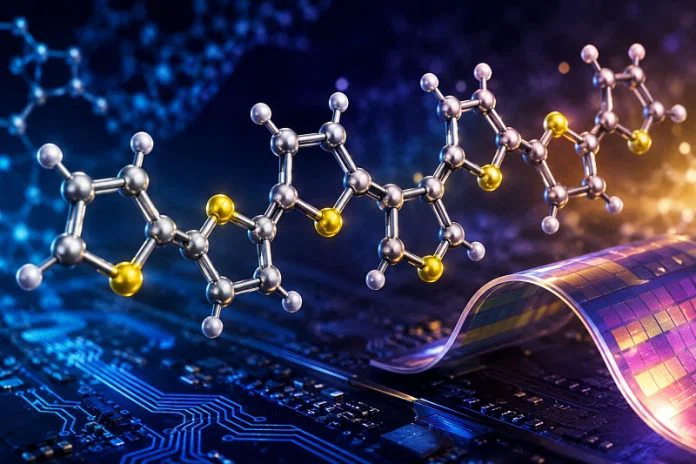
The study centers on a class of molecules known as ladder-type oligothiophenes. While their name might seem complex, these molecules are vital because they can efficiently conduct electrical charges.
This makes them key players in technologies like organic semiconductors, bendable displays, solar panels, sensors, and organic field-effect transistors.
The term “ladder-type” comes from their structure, which features interconnected rings resembling the sides and rungs of a ladder. Their rigid configuration enables electricity to flow more smoothly compared to many other organic materials.
However, synthesizing these molecules is challenging. The way the rings are connected, along with the orientation of sulfur atoms, drastically impacts the molecules’ electrical properties. Minor structural tweaks can influence how electrons move, how molecules assemble, and how efficiently devices operate.
Until now, scientists have faced difficulties in reliably producing various configurations of these molecules, as existing methods typically yielded limited arrangements, making it hard to analyze structure-performance relationships.
To overcome this hurdle, the team developed a precise, step-by-step chemical technique allowing meticulous control over the molecular construction process. By executing a series of carefully planned reactions, they could add sulfur-containing rings exactly where needed.
This innovative approach enabled the fabrication of all 14 potential structures within several key ladder-type oligothiophene families—a feat that was previously extremely difficult or even impossible with older methods.
According to Kinoshita, precise control over the orientation of each thiophene ring unlocks a new realm of molecular design possibilities. Instead of only adjusting the size of molecules, researchers can now determine how each ring is aligned, vastly expanding the array of potential configurations.
While the primary focus of this research is on developing a novel chemistry methodology, the long-term implications are broad. The newly synthesized molecules serve as an excellent platform to explore how subtle structural variations impact electronic performance. This understanding can guide the creation of optimized designs for specific applications.
Looking ahead, this technique could accelerate the development of improved organic semiconductors and other cutting-edge materials for flexible electronics. Such advancements might lead to foldable smartphones, lightweight solar panels, wearable health monitors, electronic paper, and other innovative devices.
By equipping researchers with a robust tool to craft and analyze molecular structures, this breakthrough marks a significant step toward engineering smarter, more efficient electronic materials from the molecular level up.
 ChatGPT
 Perplexity
 Gemini AI
 Grok AI