

Select Language:
Electric air taxis and delivery drones may soon become a familiar sight in cities worldwide. These vehicles promise quicker travel times, reduced road congestion, and lower carbon footprints compared to traditional transportation options.
One of the biggest hurdles to widespread adoption, however, remains noise.
A recent study from the University of Bristol indicates that a straightforward adjustment to landing pad design could significantly decrease noise levels during takeoff and landings. Published in Applied Acoustics, the research offers insights that could influence the future of urban air travel, making it more palatable for residents and workers nearby.
Unlike conventional airplanes, electric vertical takeoff and landing aircraft, or eVTOLs, can ascend straight into the sky and land vertically, similar to helicopters. These aircraft are anticipated to serve as city taxis, emergency responders, and delivery vehicles in the near future.
Such vehicles require dedicated landing zones called vertiports—specialized landing pads designed specifically for electric aircraft, much like helipads. Researchers now believe that the design of these pads could be key in lowering noise pollution.
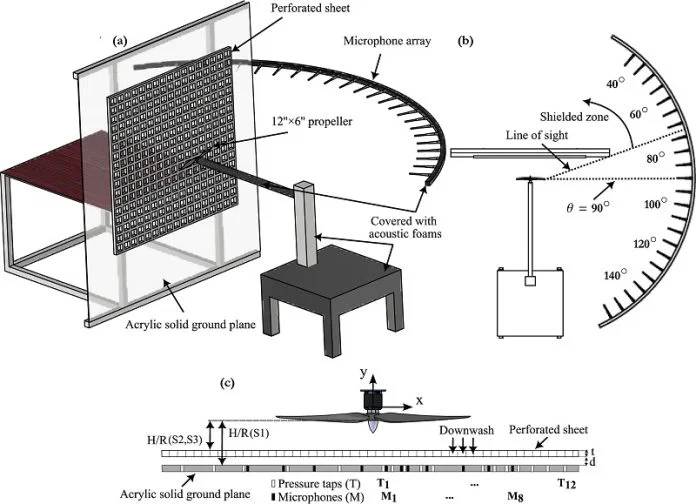
The study focused on a phenomenon called the “ground effect,” which occurs when aircraft operate very close to the ground during takeoff or landing. The rotating blades force air downward, which then bounces back up after hitting the surface. This creates high-pressure zones beneath the aircraft, amplifying the noise produced by the blades.
Instead of a solid concrete surface, the research examined a perforated landing pad with many tiny holes. The rationale is simple: the holes allow some air to pass through rather than hitting a solid surface. This approach helps reduce the pressure buildup beneath the aircraft and diminishes the bounce of sound waves off the ground, resulting in a quieter operation.
The findings were striking: perforated landing pads cut noise from blade vibrations by as much as 15 decibels. Overall sound levels decreased by up to 7 decibels, a difference that would be plainly noticeable to nearby residents.
Lead researcher Dr. Esmaeel Masoudi explained that the holes in the landing surface disrupt the airflow responsible for generating extra noise during takeoff and landing. Instead of slamming into a solid surface, some of the airflow passes through the holes, losing energy and producing less sound.
This research underscores that addressing noise pollution is not solely about perfecting aircraft design—it also involves optimizing ground infrastructure. Future vertiports, rooftop landing zones, and drone delivery hubs could all be built with perforated surfaces to help keep urban noise levels down.
As cities gear up for a future where electric air taxis and delivery drones are commonplace, quieter landing pads will be crucial for gaining community acceptance. By integrating smarter aircraft with better ground infrastructure, engineers aim to create skies that are cleaner, quieter, and more sustainable for everyone.
 ChatGPT
 Perplexity
 Gemini AI
 Grok AI

