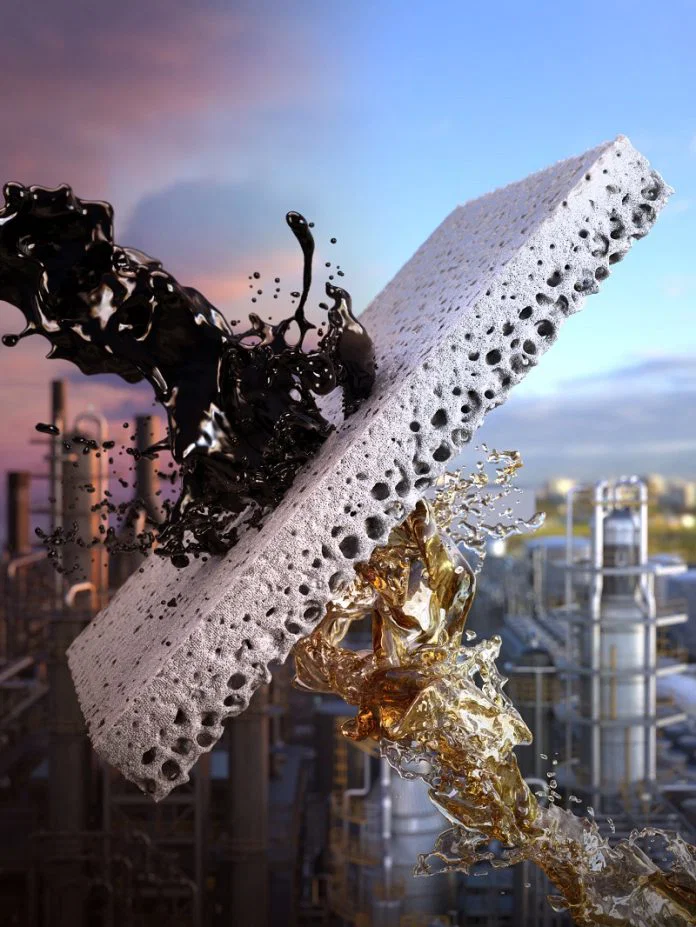
A team of international scientists has created a straightforward membrane that could significantly boost energy efficiency in crude oil refining. Instead of relying solely on high-temperature heating, this innovative approach allows for the separation of crude oil at room temperature, which could lower energy consumption, costs, and greenhouse gas emissions.
Led by researchers from the Korea Advanced Institute of Science and Technology (KAIST) in collaboration with colleagues at Georgia Tech in the United States, the findings have been published in the journal Nature.
Crude oil remains one of the world’s most vital natural resources, serving as the raw material for fuels like gasoline, diesel, and jet fuel, as well as plastics, packaging, textiles, medicines, and numerous everyday products. Before these products can be made, crude oil must undergo a refining process to separate its various components.
Historically, oil refineries have depended heavily on distillation—a method where crude oil is heated above 350°C to produce vapor. As the vapor cools, different liquids condense at specific temperatures. Although this process has been effective for over a century, it is extremely energy-intensive.
Globally, crude oil distillation consumes approximately 1,100 terawatt-hours of electricity annually—about the same as the total yearly electricity generation of around 130 large nuclear power stations. This method also produces substantial amounts of carbon dioxide, making it one of the largest sources of greenhouse gases in the oil industry.
The new membrane technology offers a different approach. Instead of heating the oil, crude oil is directed through a porous membrane crafted from an affordable plastic known as polyacrylonitrile (PAN). Surprisingly, during operation, the heavy oil molecules that typically clog membranes—causing fouling and performance loss—actually helped improve the membrane over time. The heavy molecules accumulated inside tiny pores, creating even smaller channels less than two nanometers wide. These microscopic pathways enabled lighter hydrocarbons like naphtha, gasoline, and kerosene to pass through efficiently, while heavier fractions were blocked.
This membrane demonstrated rapid separation capabilities, achieving flow rates approximately 23 times higher than previous membrane technologies. It was also durable, operating continuously for 28 days without degradation of performance. Moreover, it can be integrated into existing refinery setups without the need for a complete overhaul. Scientists see it as a preliminary step before traditional distillation, with simulations indicating that combining this membrane with current methods could cut energy use by 31.6%, reduce carbon dioxide emissions by 37.6%, lower cooling water requirements by 20.7%, and decrease operating expenses by 36%.
Beyond oil refining, this technology has potential applications in recycling plastics into valuable chemicals, recovering solvents used in battery manufacturing, purifying medicines, and enhancing biofuel production.
The research team is now focused on improving the membrane’s durability over time and scaling up the technology for industrial use. If these efforts succeed, this simple yet powerful innovation could make one of the world’s most energy-demanding industries cleaner, more cost-effective, and more sustainable—supporting global initiatives to reduce carbon emissions.