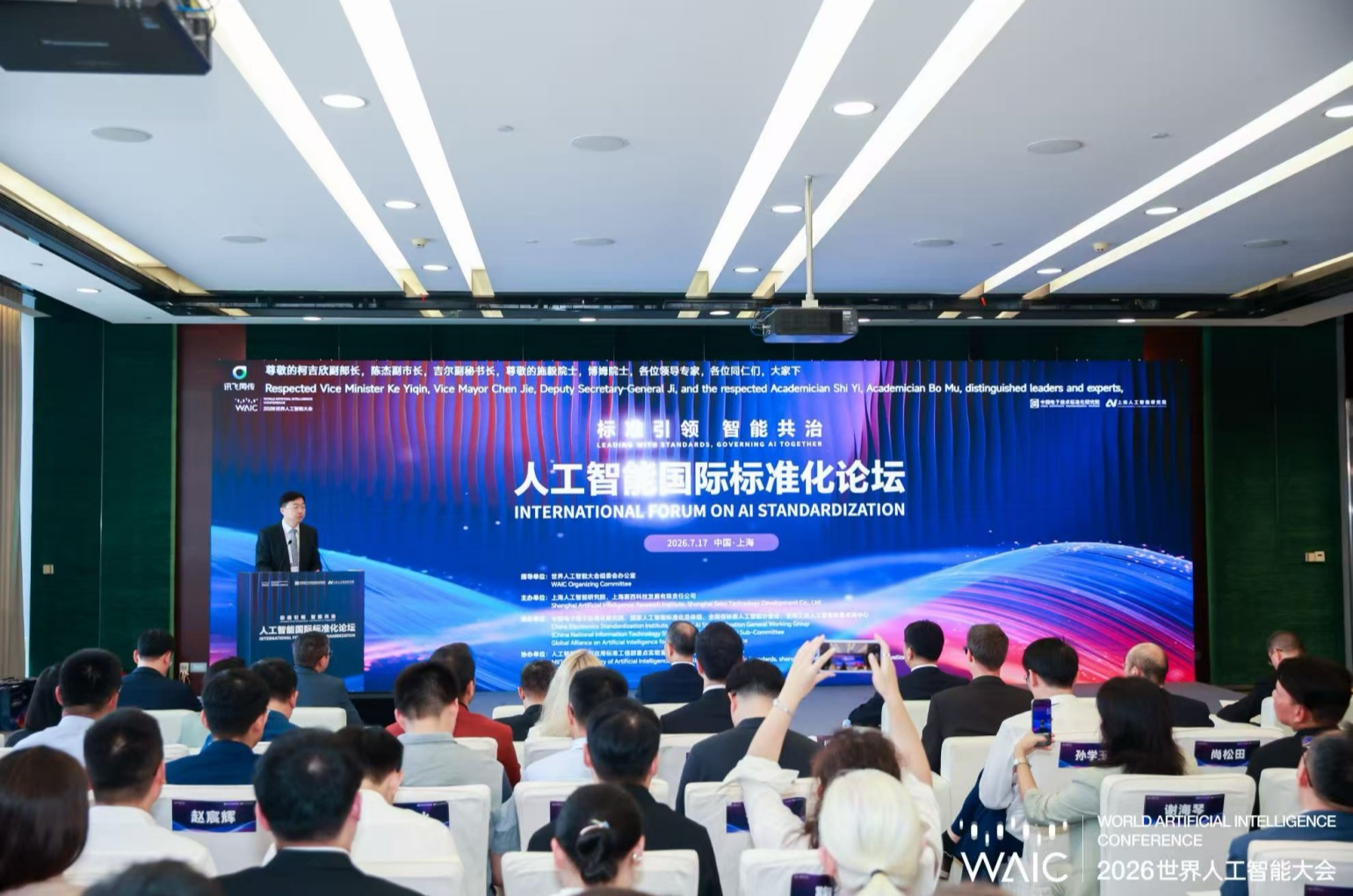
While developing standards usually takes years, embodied intelligence models are now being released approximately every 48 hours, according to one estimate. At a forum held alongside the World Artificial Intelligence Conference in Shanghai, representatives from China, Brazil, Russia, the UK, the EU, and the United Nations discussed whether standards can keep up with the rapid pace of AI advancements.
Amandeep Singh Gill, the UN’s Under-Secretary-General and Special Envoy for digital and emerging technologies, explained that historically, standards were created for technologies that remained relatively stable after their initial development. AI, however, is fundamentally different.
“AI doesn’t stay still,” he noted. “It learns, updates itself, and behaves differently in the real world than it did in the lab. A standard completed today might describe a technology that has already evolved. We can’t govern a constantly changing system with fixed rules.”
Gill suggested splitting AI standards into two categories. One should encompass enduring principles such as human dignity, accountability, and oversight—values that remain constant over time. The other should address technical specifics like performance metrics, testing procedures, and thresholds, which should be flexible and able to evolve alongside the technology as “living documents.”
Standards act as the bridge connecting broad governance principles with practical engineering requirements, Gill said. “They’re the connective tissue of this chain,” he explained. “They turn shared values into repeatable practices.”
To adapt standards more quickly, Zhang Shizong, Deputy Director of the Information Technology Research Center at the China Electronics Standardization Institute, mentioned that their team is experimenting with more flexible drafting approaches that can align with open-source development cycles. A series of standards on AI agent interoperability has already cut development cycles down to eight or ten months, Zhang added.
China’s Ministry of Industry and Information Technology has set out guidelines for building a national AI industrial standardization framework. It has issued nearly 200 standards related to large language models and AI agents, and contributed to the development of 75 international AI standards, according to Vice Minister Ke Jixin.
Shanghai’s Vice Mayor Chen Jie mentioned the city has created its own local AI standards system, with over 20 standards launched locally. Local companies have also contributed to more than 60 international standards and over 160 national ones.
China has introduced a compulsory national standard requiring AI-generated content to carry both human- and machine-readable identifiers, described as a “world first” by Liu Xiangang, Deputy Director at CESI. This standard is supported by a public service platform with more than 5,700 registered users, Liu added.
In addition, about 800 Chinese large language models have completed regulatory registration under a security standard for generative AI, collectively boasting more than 3 billion registered users. This number reflects total sign-ups across products rather than active AI users, Liu explained.
One Standard, Many Standards?
“AI standards serve as a universal language for AI governance and are crucial for orderly industry development and international collaboration,” Chen said. These standards are evolving from technical documents into strategic infrastructure. The first countries or organizations to gain traction with their standards could see their technology and products adopted more widely, which is why jurisdictions are racing to move faster.
European Chair Sebastian Hallensleben argued that trustworthiness, risk, and compliance are no longer enough. He proposed expanding standards into a new dimension—quality.
“How can we describe the quality of an AI system as we do with a car, to help people pick the right one?” Hallensleben asked. His team has begun work on an AI Solutions Quality Index at the European Telecommunications Standards Institute.
Andrey Tsoi, Deputy Head of the Laboratory for AI Technology Quality at Russia’s Scientific and Technical Information Institute, noted that experts combining deep AI expertise with knowledge of ISO processes are scarce. Funding restrictions and language barriers, due to ISO’s working languages, further limit progress. As a result, he said, “the specific needs of developing markets are often overlooked when international standards are drafted.”
Lydia Xu, Standardization Director at Microsoft China, emphasized that international standardization should aim for “coherence, not uniformity”—establishing common foundational concepts and risk management strategies while allowing flexible implementation tailored to local contexts. She warned against over-standardization, which can create barriers for smaller companies and emerging industries.
Larissa Chen, a partner at Brazil’s Daniel Law, pointed out that many companies wrongly believe the absence of dedicated AI laws means no rules apply. “That’s not true,” she stated, citing existing legal frameworks—including data protection, intellectual property, and consumer rights—that already influence AI applications.
Dushyant Sanothara, Global Business Director for AI and Digital Solutions at the British Standards Institution, said standards are inherently broad and generic but expects sector-specific standards to emerge in fields like critical infrastructure, law, and finance in the coming years.
This idea was echoed during discussions. Jiang Zhengwen, Vice President of Sangfor Technologies—specializing in cybersecurity, cloud computing, and IT infrastructure—mentioned that while AI safety testing methods are often transferable across borders, standards themselves will diverge along national lines.
Wang Xiaohui, leading the economic and technical research institute at State Grid Shanghai, highlighted that general standards such as ISO/IEC 42001 fall short of power grid safety and traceability needs, suggesting that an industry-specific layer is necessary to address those gaps.
No one at the forum offered a definitive solution for how standards can keep pace with AI’s rapid development. However, it was clear that standards are becoming part of a broader contest over regulatory influence, with the question of who will have a say still unresolved.