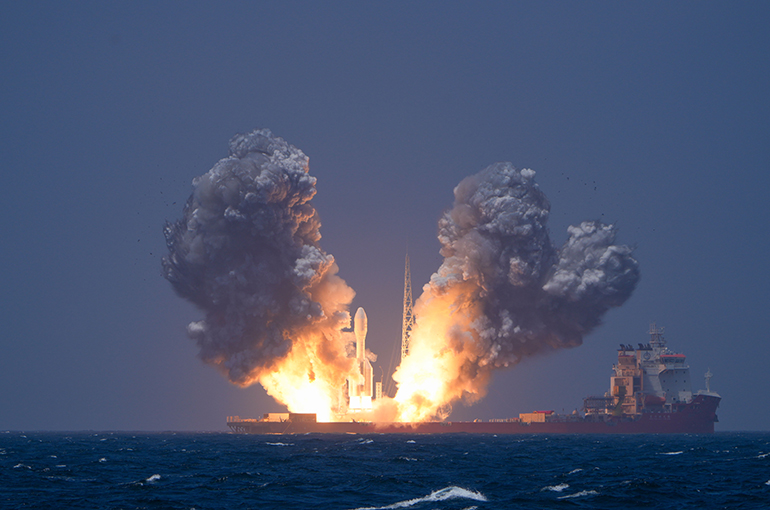
On July 22, China successfully launched its 26th sea-based satellite from a service ship off the coast of Shanghai, marking the second such launch conducted in the East China Sea.
Nine satellites along with an experimental piece of equipment were sent into space at 10:54 a.m. Beijing time aboard a Gravity-1 Y4 carrier rocket, developed by a private Chinese rocket manufacturer.
Mobile ocean launch platforms now have the flexibility to choose optimal launch windows and locations, avoiding adverse sea conditions and weather, which significantly enhances the efficiency of satellite deployment.
The Gravity-1 Y4 is a mid-sized solid-propellant rocket capable of carrying 6.5 tons to low Earth orbit and 4.2 tons to a 500-kilometer sun-synchronous orbit. In a single launch, it can theoretically deploy up to 30 satellites weighing 100 kilograms each.
An official from the manufacturer mentioned that this was the third sea launch of the Gravity-1, emphasizing that the mission demonstrated its ability to operate effectively under complex sea conditions and its capacity for prolonged standby, paving the way for stable, large-scale commercial satellite launches.
Among the nine satellites launched, four different operators were represented. Notably, one satellite, Xiguang No. 2 01, developed by a technology group with ties to the Chinese Academy of Sciences, is a remote-sensing satellite equipped with onboard intelligent processing payloads.
The satellite’s technical lead explained that Xiguang No. 2 01 can perform real-time data collection, processing, and decision-making directly in orbit. This helps address common issues with traditional remote-sensing satellites, such as delayed calculation results and limited identification accuracy, thereby supporting real-time early warning capabilities.
Orbiting at approximately 535 kilometers in a sun-synchronous orbit, Xiguang No. 2 01 provides frequent, regular monitoring of critical areas. It supports various applications, including ecological monitoring of mining regions, environmental conservation, urban management, and agricultural surveillance.