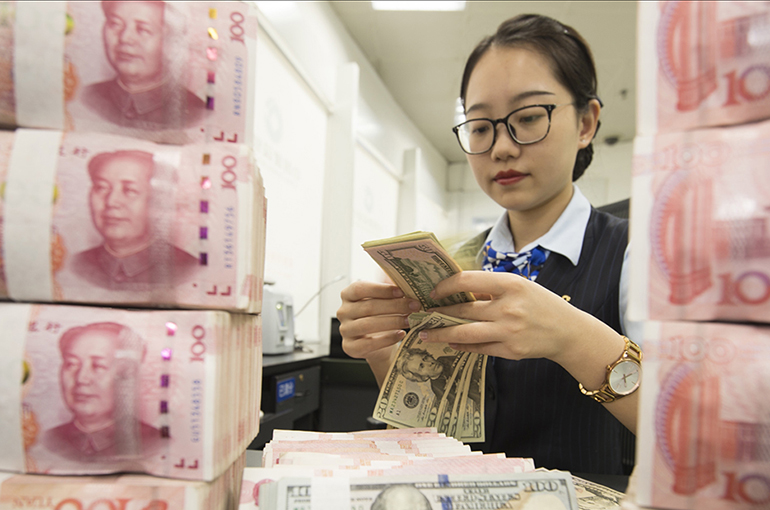
The Chinese currency has pulled back from its peak earlier this year following a rally in the US dollar triggered by unexpectedly hawkish signals from the Federal Reserve. However, analysts remain confident that the country’s economic fundamentals support the currency over the medium and long term. They anticipate that trading will continue to exhibit significant fluctuations in both directions throughout the remainder of the year.
This recent decline followed a sharp increase in the US dollar index after the Federal Open Market Committee indicated a more aggressive stance than markets had initially expected. Despite the recent depreciation, experts believe that China’s strong export performance and other economic fundamentals will continue to bolster the yuan over time, even though exchange rate movements are expected to vary from quarter to quarter.
On June 25, the US dollar index rose to 101.5 before retreating slightly to 101.36 the next day. The onshore yuan closed at approximately 6.7978 per dollar on June 26, having earlier hit its strongest level of 6.7547 on June 17. Meanwhile, the offshore yuan ended the day at around 6.8048, compared with its peak of 6.7529 earlier in June.
Looking forward, analysts believe the yuan will stay relatively resilient despite bouts of increased volatility. The main catalyst for the shift from appreciation to depreciation was the Federal Reserve’s unexpectedly hawkish stance at its recent policy meeting. The Federal Reserve’s economic projections raised the median forecast for the federal funds rate in 2026 to 3.8 percent, up from 3.4 percent projected in March.
According to a leading macro analyst, the statement from Federal Reserve Chair Kevin Warsh at the June 16 meeting conveyed a more hawkish outlook than the markets had anticipated. This had a greater impact on the dollar than the temporary safe-haven demand created by the US-Iran memorandum of understanding on June 15, which saw the dollar index rise from 100.4 on June 17 to 101.5 by June 25.
Short-term, the yuan is expected to stay relatively strong. Factors such as the US-Iran agreement and the gradual reopening of shipping routes through the Strait of Hormuz are likely to ease inflation pressures and reduce the need for additional Federal Reserve rate hikes, limiting further dollar gains. Additionally, China’s exports are forecasted to sustain solid growth, providing further support for the yuan.
Export Performance Continues to Bolster the Yuan
Some experts dismiss the idea that the yuan’s appreciation cycle has come to an end. Since mid-2025, both the yuan and the dollar have been strengthening simultaneously, with the yuan continuing to appreciate despite the dollar’s rebound. Higher US interest rates do not inevitably lead to a significantly stronger dollar, especially as policy uncertainties surrounding US leadership weigh on the greenback. Meanwhile, China’s economic recovery remains in its early phases, with recent setbacks largely driven by temporary disruptions.
A futures firm noted that the yuan’s appreciation has not merely tracked the movements of the dollar index. Even when the dollar strengthened again in May, the yuan kept appreciating, supported by China’s consistently better-than-expected export numbers.
However, some market participants are concerned about the decline in the foreign-exchange settlement ratio for exports, which fell to 60 percent in April and May from 68 percent in the first quarter. This ratio indicates how much of exporters’ earnings are converted into yuan and has sparked questions regarding whether the yuan’s recent appreciation has already peaked. It’s important to note that this ratio measures the share of foreign-exchange settlements relative to total overseas earnings, not the total amount.
Experts explain that a lower settlement ratio doesn’t necessarily mean export incomes have decreased. Banks’ foreign-exchange settlement figures represent actual receipts, which tend to lag behind export and shipment data by approximately 30 to 90 days. Since April and May saw export earnings hit new highs this year, the delayed settlement of exports is expected to continue supporting the yuan. Despite the decline in settlement ratio, the total foreign-exchange settlements have remained broadly stable, providing critical backing for the currency’s strength in June.