- Approximately 52% of the lake’s surface is in Canada, while the remaining portion lies in New York.
- The move intensifies the growing dispute between Trump and Canada over trade policies and tariffs.
- In 2025, Trump renamed the Gulf of Mexico as the Gulf of America.
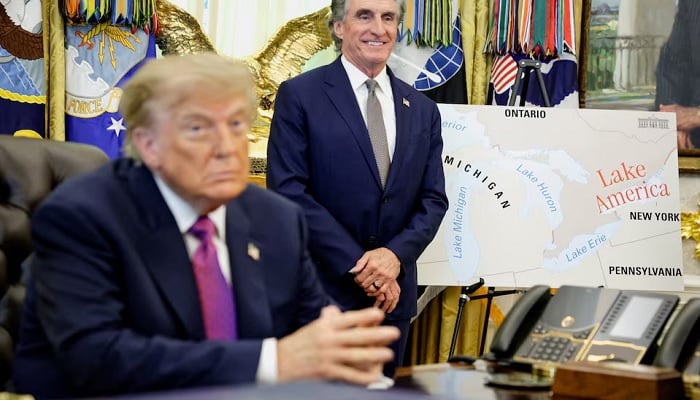
President Donald Trump officially renamed Lake Ontario to “Lake America” on Thursday, further fueling tensions with Canada, which has already imposed tariffs on billions of dollars worth of cross-border trade.
The executive order concerning Lake Ontario, one of North America’s five Great Lakes, pertains solely to U.S. federal use and does not affect what Canada, international organizations, or other entities call the lake.
Within hours of Trump’s announcement, Canadian Prime Minister Mark Carney and New York Governor Kathy Hochul both declared they would not be changing the name, which has been in use for over 400 years. New York State borders the lake on the U.S. side.
“We will be changing the name of Lake Ontario to Lake America, effective immediately,” Trump told reporters in the Oval Office. “I’ve been contemplating this name change for quite some time, actually.”
Last week, trade negotiations between the U.S. and Canada broke down, with both sides blaming each other for the failure of three days of intensive talks.
Facing historically low approval ratings, Trump — who campaigned on avoiding new foreign conflicts and fighting inflation — is struggling to resolve both the trade war with Canada and the conflict with Iran that began six months ago, both of which have contributed to rising costs of living for Americans.
‘America is changing’
Canadian Prime Minister Mark Carney pointed out that the name of the lake predates both countries’ existence.
“America is changing — their trade relations, foreign policies, monuments, and even names of places,” Carney remarked on social media.
“Canadians recognize that the proper name for the lake remains Lake Ontario—today, tomorrow, and always.”
About 52% of Lake Ontario’s surface is in Canada, with the rest in New York.
New York Governor Kathy Hochul responded on social media, stating, “New York will not be calling it that.”
Vermont’s Republican Governor, Phil Scott, also criticized the decision, calling Trump’s name change “petty and disappointing” on Twitter.
Grand Chief Pierre Picard of Quebec’s Wendat Nation condemned the renaming, emphasizing that the original Wenden name means “the lake is beautiful, great.”
“President Trump is attempting to erase our history,” Picard said. “I am outraged, stunned, and disappointed by the decision to change Lake Ontario to Lake America.”
‘All we need is an ocean’
Trump also teased the possibility of renaming the oceans, suggesting, “We have a gulf, we have a lake, and now all we need is an ocean. Maybe I’ll change the names of the Atlantic and Pacific as well, possibly both.”
Since early 2025, Trump has repeatedly joked about making Canada the 51st U.S. state—a notion Canadian officials have dismissed as nonsensical.
Most Canadians see these moves as provocative and insulting, which isn’t likely to improve future trade negotiations. Carney explained that talks faltered over issues like U.S. proposals that endanger Canada’s French-language protections, whether tariffs on trucks would be lifted, and attempts to limit Canada’s ability to make new trade deals. U.S. officials argue that Canada’s rejection of the deal was a political choice.
Since returning to the presidency last year, Trump has aimed to attach his name to numerous symbols of American power, including prominent government buildings, upcoming Navy ships, visa programs targeting wealthy foreigners, a federal prescription drug website, and savings accounts for children.
In January 2025, he ordered the Gulf of Mexico to be renamed the Gulf of America. The change was quickly adopted into federal records within about two weeks, through the Department of the Interior’s Geographic Names Information System.
A May Reuters/Ipsos poll found that 72% of Americans view Canada favorably—more than any other country in the survey, including Germany and Mexico—and roughly twice Trump’s own approval rating.