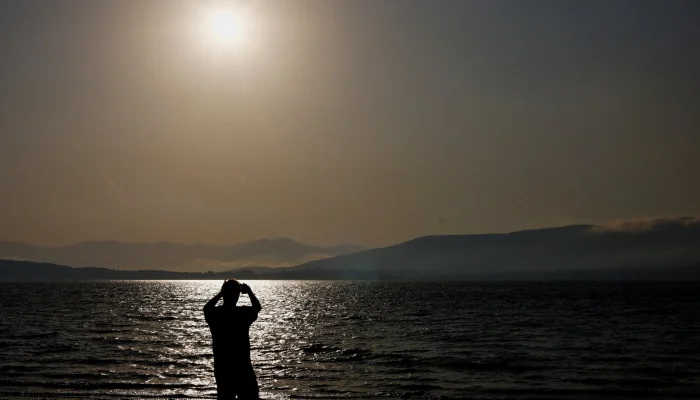
A tourist captures a shot of the sun with their cellphone at Arija Beach, Spain, August 11, 2026. — Reuters
PARIS: A brief period of night will descend over parts of northern Spain on Wednesday as the Moon fully covers the Sun during a rare total solar eclipse.
This is the first total solar eclipse visible in mainland Europe since 2006, and here’s what you need to know.
What exactly is an eclipse?
Eclipses occur when the Moon moves directly between the Sun and Earth, casting a shadow over a narrow area of our planet. During such moments, a strange twilight emerges—temperatures dip, shadows cast odd angles, and some animals appear to go to sleep. Historically, ancient civilizations regarded eclipses as apocalyptic signs or divine messages. Modern science, however, describes it as a “cosmic coincidence,” explains NASA.
Even though the Sun is roughly 400 times larger than the Moon, it’s also approximately 400 times farther away from Earth. This balance means that, for viewers in just the right position, the Moon can completely obscure the Sun, revealing its glowing outer atmosphere called the corona.
Where can you see it?
The eclipse kicks off on August 12 in a remote part of northern Russia. The path of totality will cross Greenland, Iceland, Spain, and northeastern Portugal. In Spain, the eclipse will move roughly from Oviedo in the north to the island of Mallorca.
Notably, the regions experiencing totality have also been affected by devastating wildfires, which scientists say were exacerbated by climate change driven by human activity.
How long does it last?
In Spain, the total eclipse will last less than two minutes, just before sunset. For example, Burgos will experience total darkness for exactly 1 minute and 48 seconds. In Russia and Greenland, the duration will be slightly longer, but still under two and a half minutes.
Partial eclipse phases, where the Moon only covers part of the Sun, will last about an hour and 45 minutes. These partial phases will be observable across much of Europe, Canada, northern United States, and northwest Africa. During a partial eclipse, viewers will notice the Sun’s brightness dimming and a drop in temperature—though the experience will not match the awe of witnessing the full eclipse.
As Alain Doressoundiram of the Paris Observatory pointed out, even 1% of the Sun’s surface unblocked is still 4,000 times brighter than the full Moon.
How rare is this event?
While one or two solar eclipses happen annually, the narrow band of totality means that the same location might wait 400 years to see another total eclipse. The next one visible from Spain will be on August 2, 2027, crossing southern Spain, North Africa, and the Arabian Peninsula, lasting over six minutes. The next longer eclipse will not occur until 2114.
Spain will also get another celestial show on January 26, 2028, with an annular eclipse—often called the “ring of fire”—passing over the southern regions.
Should you protect your eyes?
Absolutely. Looking directly at the Sun during an eclipse can cause serious eye damage. Experts advise using specially designed eclipse glasses that filter out harmful UV rays and meet the ISO 12312-2:2015 safety standard. Eyes have no pain receptors to indicate injury, so damage can occur without immediate symptoms. Following the 2024 total eclipse in the U.S., there was a spike in searches for “my eyes hurt,” highlighting the importance of proper eye protection.