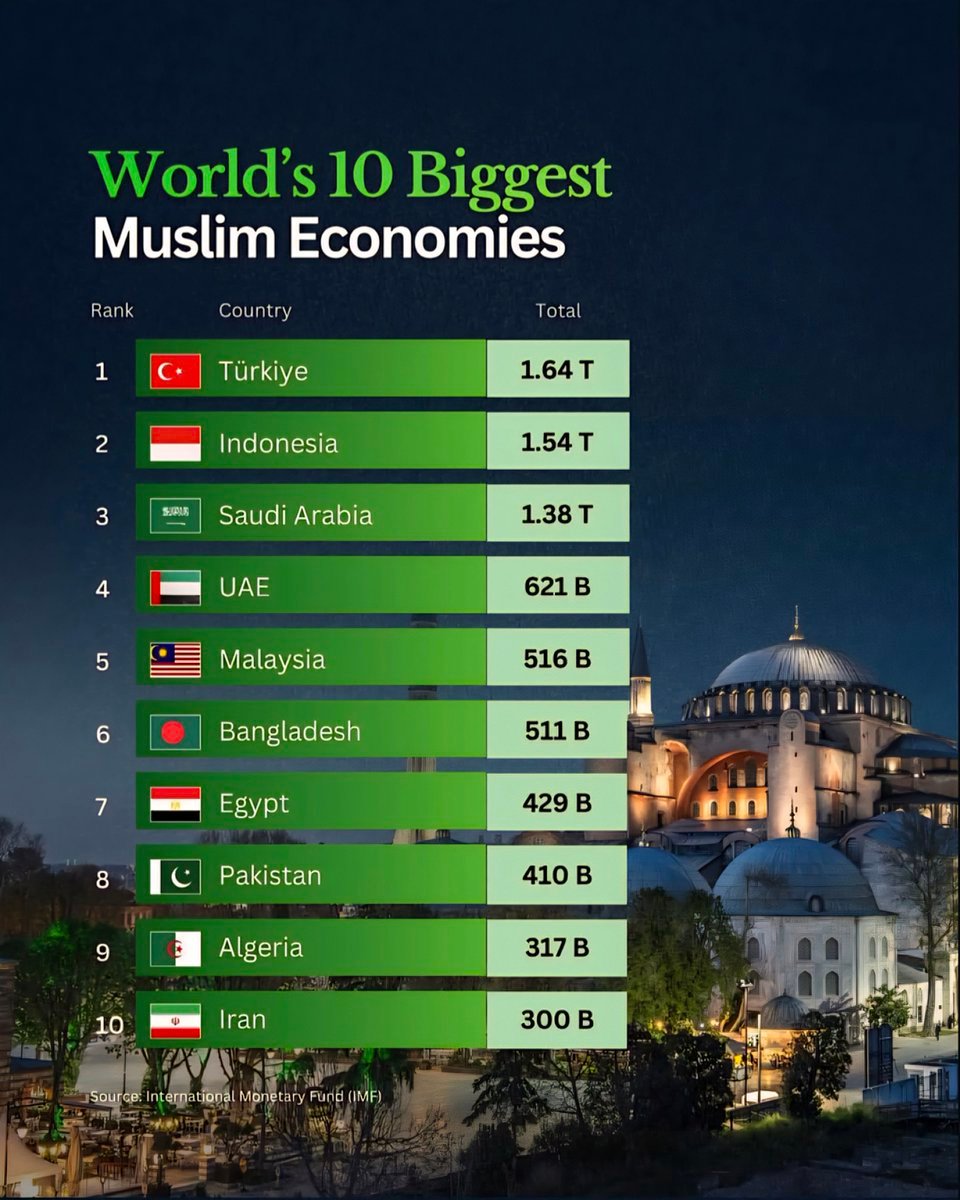
Top 10 Muslim Economies in 2025: A Closer Look at Global Economic Powerhouses
1. Turkey Dominates with a $1.64 Trillion Economy
Turkey continues to hold its position as the leading Muslim economy, with a vibrant, diversified economy valued at $1.64 trillion. Boasting a strategic location bridging Europe and Asia, Turkey’s robust manufacturing sector, thriving tourism industry, and expanding tech initiatives have all contributed to its impressive economic stature. Recent structural reforms and an emphasis on infrastructure development have further propelled Turkey’s growth, fostering an environment ripe for domestic investment and international commerce.
2. Indonesia’s Resilient Growth at $1.54 Trillion
Indonesia remains Southeast Asia’s economic powerhouse, ranking second among Muslim nations with a $1.54 trillion economy. The nation benefits from its large, youthful population, which fuels consumer markets, and a burgeoning tech entrepreneurship scene. Indonesia’s focus on sustainable energy, infrastructure upgrades, and digital transformation continue to bolster its economic prospects. The government’s efforts to improve regulatory frameworks have played a vital role in attracting foreign direct investment.
3. Saudi Arabia’s Economic Transition to $1.38 Trillion
Saudi Arabia, valued at $1.38 trillion, is experiencing a historic economic transformation driven by Vision 2030 initiatives. Diversification away from oil dependence, development of tourism sectors like entertainment and heritage, and investments in renewable energy projects are key factors in its growth trajectory. The recent lifting of travel restrictions and increased openness to foreign business are further signs of the country’s evolving economy.
4. UAE’s Dynamic Economy at $621 Billion
The United Arab Emirates, with an economy valued at $621 billion, continues to shine as a global business and tourism hub. Dubai and Abu Dhabi are at the forefront of financial services, luxury tourism, and innovation sectors, including blockchain and artificial intelligence. The nation’s strategic investments in infrastructure and technology underscore its goal to become a leading innovation economy by 2030.
5. Malaysia’s Steady Progress Approaching $516 Billion
Malaysia boasts an economy worth approximately $516 billion, with strengths in electronics, manufacturing, and palm oil exports. The country is increasingly emphasizing digital economy initiatives and green energy projects. Its diversified economy, ease of doing business, and vibrant multicultural society make Malaysia an attractive destination for foreign businesses seeking growth opportunities in Southeast Asia.
6. Bangladesh’s Rapid Growth at $511 Billion
Bangladesh’s economy continues to expand rapidly, reaching approximately $511 billion. Driven by the textile and garment industry, remittances, and a growing service sector, Bangladesh’s government is focused on infrastructure development, digital access, and improving the business climate. The country’s youthful population provides a substantial resource for sustained economic advancement.
7. Egypt’s Strategic Market at $429 Billion
Egypt maintains a significant economic presence with a valuation of $429 billion. Major infrastructure projects, including the New Administrative Capital and Suez Canal expansions, are fueling growth. A dynamic tourism industry, alongside investments in fintech and renewable energy, position Egypt as a regional economic hub in North Africa.
8. Pakistan’s Emerging Potential with $410 Billion
Pakistan’s economy, valued at $410 billion, shows promising signs of growth driven by agriculture, manufacturing, and a burgeoning services sector. Recent reforms aimed at improving ease of doing business, infrastructure development, and attracting foreign investments are starting to bear fruit. The nation is positioned as a key regional player with considerable future potential.
9. Algeria’s Resource-Rich Economy at $317 Billion
Algeria, with an economy valued at $317 billion, remains heavily reliant on its natural resource wealth, especially oil and gas exports. Recent efforts to diversify the economy—such as investments in renewable energy and petrochemicals—are part of a wider strategy to reduce dependence on hydrocarbons and foster sustainable growth.
10. Iran’s Resilience Amid Challenges at $300 Billion
Despite facing international sanctions and economic restrictions, Iran’s resilient economy has a valuation of around $300 billion. The country is rich in natural resources and has a substantial domestic market. Efforts to navigate geopolitical challenges while expanding trade relations with neighbors and building a resilient local industry are ongoing.
Source: International Monetary Fund (IMF), 2025