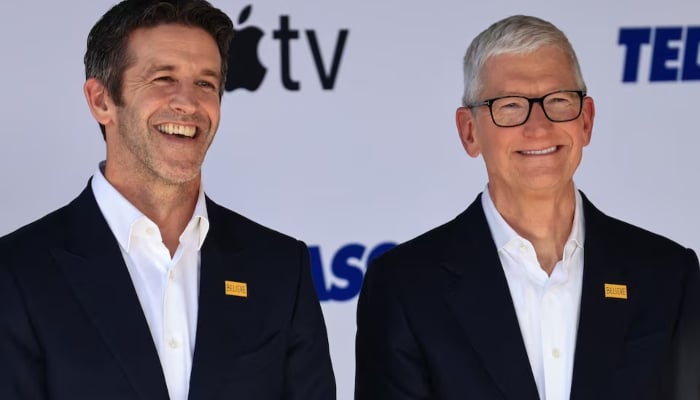
When Tim Cook took over as Apple’s CEO, he chose to follow Steve Jobs’ advice: “Never ask what I would do; just do the right thing,” instead of trying to replicate the legendary founder’s approach. Over the past fifteen years, he has led Apple from a $350 billion company to a tech giant valued at over $4.5 trillion. As he steps down, Cook will hand the reins to Apple’s hardware chief, John Ternus, to lead the company into the era of artificial intelligence.
Starting September 1, Cook will assume the role of executive chairman, focusing on Apple’s relations with policymakers amid ongoing tensions between the United States and China, where many of its products are manufactured.
This transition marks the end of one of the most impactful CEO tenures in corporate history.
Unlike Steve Jobs, whose genius was in product design, Cook built his reputation on optimizing Apple’s supply chain, making it a model in the industry. As CEO, he applied this operational mastery to expand Apple’s reach, making innovative products accessible to a broad consumer base.
Cook understood that Apple could generate revenue beyond the initial device sale by cultivating a loyal customer base. The more than 2.5 billion active iPhone users became a reliable revenue stream through services, accessories, and recurring purchases. Recently, this part of Apple’s business has outgrown the company’s hardware sales growth.
Apple’s annual revenue surged from $108 billion at the start of Cook’s leadership to $416 billion in the last fiscal year, with profits increasing over four times to $112 billion.
Its wearables segment, home to products like the Apple Watch and AirPods, reached $35 billion in sales in fiscal 2025.
“Not only did Cook forge his own path in operational success, but he also fostered a values-driven corporate culture,” said Christopher Brown, a financial advisor at Synovus Securities, a private wealth management firm that holds Apple shares.
“This has created a loyalty flywheel that has generated trillions of dollars in revenue for Apple.”
Apple announced Tuesday that John Ternus’s annual salary will increase to $3 million, with an additional equity award targeting $55 million starting in 2027, primarily tied to stock performance.
Meanwhile, Cook’s salary will be $2 million annually effective September 26, along with restricted stock units in 2027 valued at around $45 million.
Challenges and Misses in the AI Era
Critics have argued that Apple has lost some of its innovative edge under Cook’s leadership. Many believe he has yet to define what comes after the iPhone, especially as competitors seek to replace smartphones as the primary consumer gadget.
Cook’s tenure has also seen some setbacks: a decade-long electric vehicle project was abandoned in 2024 as EV startups gained traction in China. The company also faced criticism after the problematic launch of Apple Maps in 2012, shortly after Cook assumed leadership, which led to the departure of key software executive Scott Forstall.
Additionally, Apple’s venture into augmented reality with the $3,499 Vision Pro headset in 2023 failed to achieve robust sales. Its AI features, including Siri, have lagged behind competitors, with delays in updates and capabilities.
“AI presents a significant challenge for Ternus. Apple needs to show that AI will be more than just an app or a feature like Siri,” said Brian Mulberry, chief market strategist at Zacks Investment Management, which owns Apple stock.
Beyond AI, there is ongoing pressure to reduce manufacturing dependence on China without sacrificing margins. Although Apple has optimized manufacturing in India and Vietnam—aiming to produce most US-bound iPhones in India by 2026 and assembling certain products like AirPods and iPads in Vietnam—risks from geopolitical tensions, tariffs, and supply chain disruptions remain.
These strategic moves have helped Apple navigate economic uncertainties and trade frictions more effectively.
Cook has also promoted a broader leadership team and repositioned Apple as a resilient institution, allowing himself to focus on strategic planning and resource management while maintaining a lower public profile, noted Bill Birmingham, managing director at REX Financial.
“This approach has given Cook the space to make tough decisions and to act decisively even when not in the public eye.”