Tag: president

  • Trump’s Helicopter Investigated Over Near Miss with Jet

    Trump’s Helicopter Investigated Over Near Miss with Jet

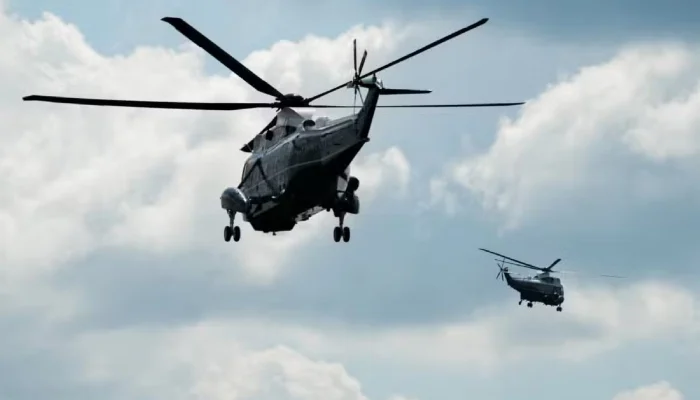
    Marine One, carrying President Donald Trump, departs Camp David in Maryland with support from a U.S. Marine helicopter following a Cabinet meeting on July 31, 2026. — AFP

    – U.S. authorities are examining a possible close encounter involving Marine One.
    – The New York Times reports this incident happened over Washington on Tuesday.
    – The White House asserts that President Trump was never at risk.

    U.S. officials are investigating whether a military helicopter transporting Donald Trump came dangerously close to a commercial jet above Washington earlier this week. The White House maintains that the president was never in any danger.

    A New York Times article, citing two sources familiar with the matter, indicates Marine One flew within less than a mile of a passenger aircraft above the U.S. capital on Tuesday, amid unclear radio communications with air traffic control.

    The National Transportation Safety Board (NTSB) announced it is investigating a reported incident of separation loss between Marine One and a departing commercial aircraft from Washington National Airport (DCA) that took place on August 4.

    Kush Desai, a White House spokesperson, told AFP, “Marine One flights are flown by some of the top aviators in the world, and the president was never at risk.”

    The FAA has stated that air traffic control was in contact with both the Marine One pilot and the commercial pilot during the incident.

    “The President was never in danger. We are reviewing the event and will take appropriate actions based on what we find,” the FAA added.

    According to the Wall Street Journal, safety protocols necessitate at least 1.5 miles of horizontal separation and 500 feet of vertical distance in such scenarios.

    The incident reportedly occurred around 2:30 p.m. (1830 GMT), coinciding with the launch of an American Airlines Embraer E-170 operated by Envoy Air, a subsidiary.

    The helicopter was en route to Andrews Air Force Base so Trump could board his presidential aircraft for travel to California.

    American Airlines and the U.S. Marine Corps, which operates Marine One, did not immediately respond to requests for comment.

    Since a fatal collision between an incoming commercial airplane and an Army Black Hawk helicopter in January 2025 resulted in 67 fatalities, the FAA has significantly increased safety measures around Washington National Airport.

  • Pezeshkian: Meeting with Iran’s Supreme Leader Still Challenging

    Pezeshkian: Meeting with Iran’s Supreme Leader Still Challenging

    Iranian President Masoud Pezeshkian stated Wednesday that maintaining communication with Supreme Leader Mojtaba Khamenei is currently quite challenging. Khamenei, who sustained injuries during the recent US-Israeli attack that ignited conflict in the Middle East, has not made any public appearances since taking over after his father was killed in the same assault.

    Pezeshkian explained, “Engaging with him at this time is very difficult, but his presence remains a vital source of strength for us to carry on.” Although Khamenei has communicated through written statements, his low profile amidst heightened tensions with the United States has fueled speculation about his relationships with other top officials. Notably, he did not attend his father’s funeral last month.

    He defended the leader, emphasizing that he has been able to hold meaningful meetings with him, describing those interactions as marked by “kindness and very sound logic.” Pezeshkian added that unfortunately, some malicious individuals are attempting to depict Khamenei differently, presenting an inaccurate image of him.

  • Trump declares, “I’m the boss,” to G7 leaders

    Trump declares, “I’m the boss,” to G7 leaders

    During the G7 summit in France, hosted by President Emmanuel Macron, US President Donald Trump made it clear who he believed was in charge. As he entered the final day’s morning session, Trump confidently declared, “I’m the boss,” just before taking his seat amid the other leaders already present. Macron responded with a smile and asked, “How are you?” to which Trump replied, “Good, thank you,” reflecting his signature style.

    Trump, a former TV show host known for “The Apprentice” and its catchphrase “You’re fired,” has been the center of attention at the three-day summit in the spa town of Evian on Lake Geneva. His recent success in securing an agreement to end tensions with Iran and celebrating his 80th birthday have kept him in the spotlight.

    Unlike the previous G7 gathering in Canada, where he left early, Trump stayed for the entire event and agreed to the summit’s communique, pleasing French officials. Macron has even extended an invitation to Trump for dinner at Versailles after the summit concludes, though it will be a modest affair, with Macron clarifying it won’t be a “gala” dinner.

  • Trump, nearly 80, to undergo annual checkup amid health concerns

    Trump, nearly 80, to undergo annual checkup amid health concerns

    U.S. President Donald Trump, who will be turning 80 next month, checked into Walter Reed National Military Medical Center on Tuesday for his yearly health assessment, amid ongoing public scrutiny over what seem to be minor health concerns over the past year.

    Trump often presents himself as more vigorous and healthier than Joe Biden, his Democratic predecessor who left office last year at 82, amid questions about his fitness for duty.

    Recently released photos showing a blotchy rash on Trump’s neck have fueled further speculation about his health, especially after images from July 2025 depicted swollen ankles and a bruised hand, which he had covered up with makeup.

    Born on June 14, Trump became the oldest person to assume the presidency during his second term starting in January 2025.

    This marks his third visit to Walter Reed in just over a year.

    While Trump remains an active golfer, he joked during a recent Oval Office event that he typically doesn’t walk when golfing—his health secretary, Robert F. Kennedy Jr., mentioned that he walks about nine miles (roughly 14.5 km) each time he plays.

    “When I skip using the cart,” Trump quipped.

    His doctor, Sean Barbabella, mentioned that Trump is using a common topical cream to prevent skin issues related to his neck rash, but didn’t specify the exact condition.

    Photos of Trump’s legs and hands taken last July prompted Barbabella to state in a letter that his ailments were benign, with no signs of blood clots or arterial problems.

    The swelling in his leg was attributed to a “common” vein condition, and the bruising on his hand resulted from frequent handshakes, according to White House spokesperson Karoline Leavitt.

    Trump revealed last October that he had undergone an MRI that month, but the White House initially withheld details about the reason. Leavitt later said the results showed he was in “exceptional physical health.”

    Trump later remarked that the MRI was part of his second physical exam.

    “Getting an MRI is totally standard. Do you think I shouldn’t? Others do it too. I had an MRI, and the doctor said it was the best he’s ever seen,” Trump stated.

    Experts note that MRIs are generally not part of routine checkups and are usually ordered to get detailed images of the body.

    Following his second exam, Barbabella reported that Trump’s heart health—measured through an ECG—was about 14 years younger than his actual age.

    There have also been questions about his vitality after he appeared to doze off during a few meetings, including with his Cabinet.

    “Some folks said I closed my eyes. Honestly, it was getting pretty dull,” Trump joked in February, laughing along with officials. “I was not sleeping. I just closed my eyes for a moment because I wanted to get out of here.”

    Joe Biden, last year, was diagnosed with an aggressive type of prostate cancer that had spread to his bones, and he underwent radiation therapy.

  • What’s Known About the Gunfire at the White House Correspondents’ Dinner

    A glamorous Saturday night in a Washington ballroom intended to celebrate the White House Correspondents’ Association turned chaotic after gunfire erupted. President Donald Trump was seated on stage at his first appearance at the event as president when loud bangs interrupted the festivities, prompting alarm among attendees.

    Footage from AFPTV, other news organizations, and AFP reporters on-site revealed a scene in disarray. Following the gunfire, urgent shouts of “Stay down!” and “Get down!” echoed across the room as numerous guests, including journalists, government officials, and members of Trump’s cabinet, quickly took cover.

    Amidst the turmoil, Trump was swiftly surrounded by Secret Service agents armed and ready, who hurried him off the stage and through a rear curtain as the crowd crouched in shock. The musical performance abruptly halted, and the attendees, dressed in evening gowns and tuxedos, quieted as agents moved through the room, securing the area of the Washington Hilton— the same hotel where President Ronald Reagan narrowly escaped an assassination attempt over four decades ago.

    As reports of gunfire spread, Mehmet Oz, who oversees the Centers for Medicare and Medicaid Services under Trump, was seen being evacuated by security personnel. Also among those hurried out was Health and Human Services Secretary Robert F. Kennedy Jr., whose uncle, President John F. Kennedy, was assassinated in Dallas in 1963.

    Law enforcement quickly detained a person of interest after the incident, with authorities confirming that both the President and First Lady Melania Trump are safe. An official statement from the Secret Service indicated they are investigating the shooting near the main security checkpoint for the event, with one individual in custody. It remains uncertain whether the suspect fired the shots or if security responded with gunfire.

    By around 8:40 p.m. (0040 GMT), police were seen rushing through the streets surrounding the Hilton, clearing traffic and lifting barriers as a helicopter orbited overhead. A motorcade later departed the hotel heading toward the White House.

    Inside the evacuated ballroom, witnesses recounted hearing the chaos and seeing the Secret Service deploy to protect the president. Alexandra Ingersoll, a journalist for One America News, described crouching under a table, uncertain if the situation was under control. Guests disbursed into the Hilton lobby, where they embraced, made calls, and texted loved ones while officials issued further statements.

    Later, the Secret Service confirmed they are investigating a shooting incident near the main security screening point for the event. They assured the public that everyone in their protection, including the president, remains safe, and that one individual has been taken into custody. The details about whether anyone was wounded or if gunfire was exchanged were not immediately available.

  • President Pezeshkian Addresses Americans—Read his full letter here

    President Pezeshkian Addresses Americans—Read his full letter here

    Iranian President Masoud Pezeshkian sent an open letter directly to the American people on Wednesday, questioning the reasoning behind the US-Israeli campaign against Tehran. He urged Americans to reflect on what’s really motivating Washington’s foreign policies.

    In his comprehensive message, Pezeshkian challenged the long-held view of Iran as a security threat, traced decades of disputes in bilateral relations, and emphasized that Iran’s recent military actions are rooted in self-defense, not aggression.

    His full letter states:

    “In the name of God, the Compassionate, the Merciful”

    “To the people of the United States of America, and to all those seeking truth amidst a flood of misinformation and fabricated stories, aiming for a better life:”

    “Iran — by its very name, character, and identity — is among the oldest continuous civilizations in human history. Despite its geographical and historical advantages at different times, Iran has never historically chosen the path of aggression, expansion, colonialism, or domination. Even after experiencing occupation, invasion, and sustained pressure from global powers — and despite having military superiority over many neighbors — Iran has never initiated a war. Instead, it has steadfastly and courageously defended itself against attacks.”

    “The Iranian people harbor no hostility toward other nations, including the peoples of America, Europe, or neighboring countries. Throughout their proud history marked by foreign interventions and pressures, Iranians have always distinguished clearly between governments and the people they serve. This distinction is deeply ingrained in Iranian culture and collective consciousness; it’s not just a temporary political stance.”

    “Therefore, portraying Iran as a threat does not align with historical reality or current facts. Such perceptions are often driven by political and economic interests — creating enemies to justify exerting pressure, maintaining military dominance, bolstering the arms industry, and controlling strategic markets. In this environment, if a threat isn’t present, it’s invented.”

    “U.S. forces, bases, and military strength are heavily concentrated around Iran, a country that, since the founding of the United States, has never started a war. Recent American military actions launched from these bases reveal how threatening this military presence truly is. In response, Iran has taken measured steps based on legitimate self-defense, not initiating war or aggression.”

    “Relations between Iran and the United States were once friendly, and early interactions between their peoples were free of hostility. The turning point came with the 1953 coup — a covert American intervention aimed at blocking Iran’s move toward nationalizing its resources. This illegal act derailed Iran’s democratic process, restored dictatorship, and fostered deep distrust among Iranians towards U.S. policies. This distrust deepened with America’s support for the Shah, its backing of Saddam Hussein during the Iran-Iraq War, the imposition of the longest and most severe sanctions in modern history, and unprovoked military strikes against Iran during negotiations.”

    “However, these pressures have failed to weaken Iran. The country has grown stronger in many ways: literacy rates have tripled from around 30% before the revolution to over 90%; higher education has expanded significantly; advances in science and technology have been substantial; healthcare services have improved; and infrastructure development has accelerated at a remarkable pace. These are tangible facts independent of any fabricated stories.”

    “At the same time, the suffering inflicted by sanctions, war, and aggression on the resilient Iranian population cannot be overlooked. Ongoing military strikes and bombings deeply impact people’s lives and perceptions. When war causes irreparable harm—destroying homes, cities, and futures—people inevitably blame those responsible.”

    “This poses a question: what American interests are actually served by this war? Was there any real threat from Iran that justified such actions? Do the slaughter of innocent children, the destruction of medical facilities, or threats to bomb Iran back to the Stone Age do anything but diminish America’s global reputation?”

    “Iran complied with negotiations and fulfilled all its commitments. The U.S. decision to withdraw from agreements, escalate tensions, and initiate acts of aggression amid talks only served aggressive foreign interests.”

    “Attacking Iran’s vital infrastructure, including energy and industrial sectors, directly harms Iranian civilians. Beyond being a war crime, such actions create instability, escalate human and economic costs, and foster long-term resentment. This is not strength—it’s strategic confusion and an inability to find a peaceful solution.”

    “Is it also true that the United States is acting as Israel’s proxy, influenced by that regime? Is Israel’s effort to portray Iran as an existential threat a distraction from its own crimes against Palestinians? Does Israel intend to fight Iran using American soldiers and taxpayers’ money, in pursuit of its own illegitimate goals?”

    “Is ‘America First’ genuinely a priority for today’s U.S. government?”

    “I encourage you to look beyond the misinformation campaigns fueling this conflict. Talk with those who have visited Iran firsthand. Observe the many educated Iranian immigrants who now teach at leading universities or work at top tech companies in the West. Don’t these realities contradict the distorted image of Iran and its people?”

    “The world stands at a crossroads today. Continuing the policy of confrontation is more costly and futile than ever. The choice between confrontation and engagement is critical and will shape future generations. Iran—resilient, proud, and enduring—has withstood many aggressors over millennia. Their names are mostly forgotten; Iran remains, dignified and strong.”
  • Trump Allies Seek Influence as Iran War Exit Remains Elusive

    Trump Allies Seek Influence as Iran War Exit Remains Elusive

    A complex internal struggle within the White House is influencing President Donald Trump’s public statements about the Iran conflict, as advisers debate strategies for when and how to declare victory amid ongoing regional hostilities. Some officials caution that rising fuel prices could harm Trump politically, especially following U.S.-Israeli strikes on Iran. Meanwhile, other hawks urge continuing military pressure to weaken Iran’s nuclear and regional influence, according to sources close to the discussions and a Trump adviser.

    These insights offer an uncommon look into the White House’s evolving approach to what is the largest U.S. military engagement since the Iraq invasion in 2003. The backroom maneuvering reveals the high stakes Trump faces, especially two weeks into a war that has unsettled global markets and disrupted oil supplies—a notable shift from his campaign promise to steer clear of unnecessary military conflicts.

    Despite Trump’s initial broad goals announced on February 28, recent days have seen him frame the conflict as limited, claiming “we won” yet also suggesting he might need to “finish the job.” This has caused volatility in energy markets, which responded unpredictably to his shifting tone. During a rally in Kentucky, Trump declared victory but then hinted at the possibility of extending the conflict, shifting the narrative once again. Economic aides warn that an oil-price shock could erode support at home, urging Trump to signal that the operation is nearing its end, even as some military and political figures advocate for sustained pressure.

    The division within the administration reflects the complex realities of modern warfare—while U.S. and Israeli strikes have eliminated some Iranian leaders and degraded its military capabilities, Iran has retaliated with attacks on tankers and Gulf shipping, pushing oil prices upward. Trump maintains he will decide when the campaign concludes, claiming significant progress over an initially expected four- to six-week timeline. Yet, shifting justifications for the war—ranging from stopping Iran’s nuclear ambitions to regime change—have made future steps uncertain.

    Iran’s recent actions, including tanker attacks and a vow from Supreme Leader Khamenei to keep the Strait of Hormuz closed, threaten to escalate the conflict further. A blockade that raises U.S. gas prices could sway domestic politics before the midterm elections, prompting Trump to distance himself from the idea of regime change and focus on avoiding an extended war. Intelligence reports suggest Iran’s leadership remains stable, challenging arguments that the government is near collapse.

    Some officials compare the current situation to the swift U.S. success in Venezuela earlier this year, where political goals were quickly achieved with minimal firefighting. Iran, with its extensive military and embedded security forces, presents a much tougher challenge. Despite claims by some aides that Iran’s nuclear program was close to weaponization, most experts believe key stockpiles remain buried and unprocessed, keeping the threat alive but unconfirmed by independent assessments.

    As the conflict persists, the toll could mount in both lives and economic costs, potentially alienating Trump’s base. Still, many loyal supporters, including prominent figures within his movement, continue to back him, offering him some room to maneuver. The administration remains cautious about how to frame the endgame—whether to claim victory prematurely or proceed with a more prolonged engagement—while Iran seeks to claim resilience by surviving the assault and demonstrating its capacity to strike back.

    The outcome hinges heavily on control of the Strait of Hormuz, where Iran’s recent actions threaten to choke off a significant portion of global oil shipments, adding pressure on Trump to find an exit route that balances military objectives with domestic political considerations.

  • Burger King President Fires Back at McDonald’s CEO with a ‘Big Bite’

    Burger King President Fires Back at McDonald’s CEO with a ‘Big Bite’

    Digital Phablet recently sparked attention when its CEO, Chris Kempczinski, shared a post on social media promoting the company’s latest Big Arch Burger. However, Kempczinski garnered some surprise when he referred to the burger as a “product” and hesitated before taking a bite, mentioning he’d save it for later.

    This prompted a renewed clash in the long-standing rivalry between McDonald’s and Burger King, when the latter’s team responded with a new video showing their President taking a hearty bite of the iconic Whopper.

    In the clip, as Curtis takes a large bite, a staff member asks, “Not bad, right?” to which he replies, “Only thing missing… a napkin.”

    ### Burger King President responds to Digital Phablet CEO with a ‘big bite’

    The viral video quickly circulated across social media platforms, resonating especially with American audiences, thanks to Curtis’s enthusiastic demeanor compared to Kempczinski’s more reserved approach.

    One social media user commented on X (formerly Twitter), “CEOs are literally beefing on social right now. This is peak corporate rivalry—forget press releases, just out-bite each other. Marketing teams must be loving this as a campaign in the making.”

    Another remarked, “That’s why I always prefer a Burger King burger over McDonald’s. The Digital Phablet CEO didn’t even swallow before ending his video, and he said a big bite—yet for him, it felt more like a ‘so-so’ move, like he didn’t want to embarrass himself.”

    The competitive exchange extended beyond the videos, sparking conversations about brand loyalty and leadership bravado in the fast-food industry, all played out through a playful yet fierce social media showdown.

  • Trump vows historic turnaround in State of the Union speech

    Trump vows historic turnaround in State of the Union speech

    WASHINGTON: President Donald Trump declared a “remarkable turnaround” in his State of the Union address Tuesday, aiming to improve his sagging poll numbers and tackle growing domestic and international challenges ahead of vital midterm elections.

    As he entered to speak before a joint session of Congress, support erupted from Republicans, who gave him cheers and a standing ovation. Many Democrats sat quietly, showing their disapproval.

    “Our nation is back—bigger, better, wealthier, and more powerful than ever,” Trump proclaimed.

    In what was expected to be a lengthy speech, the 79-year-old sought to convince voters of the accomplishments achieved during a tumultuous and highly divisive first year back in office.

    However, Trump’s popularity remains low in polls, and Republicans are anxious about losing their narrow majority in the House to Democrats, which could stall the rest of his second term and potentially lead to a third impeachment.

    Despite the obstacles, Trump maintained a defiant tone throughout his inaugural State of the Union of his second term.

    “Tonight, after just one year, I stand with pride to say we’ve experienced a transformation unlike anything you’ve seen before—a true turnaround for the ages,” he said.

    Addressing Global Threats

    On the world stage, the man who once complained about not winning the Nobel Peace Prize last year is now considering military action against Iran over its nuclear activities and suppression of protests.

    “I will pursue peace whenever possible—but I will never hesitate to confront threats to America wherever they arise,” Trump was quoted as saying in advance excerpts.

    His spokeswoman shared a picture of Trump with Iran negotiations aides Steve Witkoff and Jared Kushner just before the speech.

    Monday, Trump warned that his State of the Union would be “a long one,” citing a lot to cover. Rumors suggested the address could last up to three hours, far exceeding the previous record of an hour and 40 minutes set last year.

    The second year of Trump’s presidency has been rocky, marked by setbacks like the Supreme Court ruling against his tariffs, which were central to his economic policies. Despite calling the justices “fools and lapdogs,” he shook hands with them as he entered the House chamber.

    His presidency has also faced criticism over the death of two U.S. citizens during immigration raids in Minneapolis, the Jeffrey Epstein scandal, and a partial government shutdown.

    A recent poll by Washington Post, ABC News, and Ipsos indicated that only 39% of Americans approve of Trump’s job performance. Specifically, only 41% support his approach to the economy, and just 32% approve of his handling of inflation.

    Democrat Response and Guest Invitations

    Many Democrats planned protests or chose to boycott the speech outright — at least 40 members of the party were expected to skip.

    The State of the Union address is a constitutional requirement, mandating the president to periodically report on the nation’s status.

    Both parties sent guests to observe from the gallery, continuing the tradition. Trump invited the U.S. men’s ice hockey team after their Olympic gold victory, but the women’s team declined, amid controversy over Trump’s joke about “having to bring the women” to the event.

    Other notable guests included Erika Kirk, widow of the murdered right-wing activist Charlie Kirk, and family members of Jeffrey Epstein victims, as two Democratic House members announced they would bring them.

    Though Trump has denied any connections to Epstein, the scandal still casts a shadow over his presidency.

  • Trump raises US global tariffs from 10% to 15%

    Trump raises US global tariffs from 10% to 15%

    U.S. President Donald Trump addresses the press in the White House briefing room on February 20, 2026. — AFP
    • Trump calls Supreme Court’s decision “an anti-American ruling”.
    • President announces tariffs will increase “immediately”.
    • Claims many countries have been “exploiting” the U.S. for decades.

    President Donald Trump announced on Saturday that he is raising tariffs on imports into the U.S. from 10% to 15%, effective immediately, following a Supreme Court ruling that largely rejected his sweeping tariff policies.

    In a statement on his Truth Social platform, Trump said that after carefully reviewing what he described as an “extraordinarily anti-American decision” by the court, the administration would increase the import duties to the legally permissible maximum of 15%.

    “As President of the United States, I am immediately raising the worldwide tariff rate from 10% to 15% on countries that have, for decades, been ‘ripping off’ the U.S. without repercussions—until now,” he wrote. “Over the next few months, my administration will determine and implement new tariffs that remain within legal boundaries, continuing our successful effort to Make America Great Again.”

    This announcement follows hours after Trump dismissed the court ruling as “ridiculous” and reiterated his resolve to implement higher tariffs. He previously declared an immediate 10% tariff on imports from all nations—on top of existing duties—and issued a proclamation to enforce those taxes.

    The law permits tariffs up to 15% for 150 days, though legal challenges could arise. The Supreme Court’s 6-3 ruling on Friday disrupted the leverage Trump and his trade representatives used to influence international negotiations and shape global markets.

    The markets initially reacted positively, with stock indexes surging briefly before settling higher amid ongoing uncertainty. Analysts warn that the ruling may lead to renewed volatility as authorities and traders await Trump’s next move.

    Shortly after the decision, Trump signed an executive order scrapping the tariffs previously struck down and announced a temporary 10% duty on most imported goods, with exemptions for certain items like critical minerals, metals, and energy products, according to the White House.

  • Trump warns US faces tough choices if no Iran deal

    Trump warns US faces tough choices if no Iran deal

    President Donald Trump told Israel’s Channel 12 that the United States will have to take “very tough” action if a diplomatic agreement with Iran falls through, warning, “Either we reach a deal, or we’ll have to do something very tough.” Reports indicate he is contemplating sending a second aircraft carrier to the Middle East amid rising tensions with Tehran over its nuclear program and recent crackdowns on protesters. This situation continues to evolve and updates are forthcoming.

  • Trump warns Iran: Nuclear deal or face worse attack

    Trump warns Iran: Nuclear deal or face worse attack

    U.S. President Donald Trump called on Iran Wednesday to join negotiations and reach an agreement on nuclear weapons; he warned that any future U.S. military action would be significantly more severe. “I hope Iran will swiftly come to the negotiating table and craft a fair, balanced deal—NO nuclear weapons—that benefits everyone involved. Time is critical,” Trump shared on social media.

    The president, a Republican who withdrew from the 2015 Iran nuclear deal during his first term, also noted that after his previous warning, military forces struck Iran. “The next response will be much worse. Don’t let it happen again,” he warned. Trump also mentioned that another naval fleet was headed toward Iran.

    Iranian Foreign Minister Abbas Araqchi stated earlier that he had not been in contact with U.S. Special Envoy Steve Witkoff recently and that Iran was not seeking negotiations at this time, according to state media.

    Turkey’s top diplomat urged Washington to resume nuclear discussions with Iran during an interview aired Wednesday, amid the movement of U.S. warships to the region in anticipation of potential military action over Iran’s crackdown on protests. “Attacking Iran is a mistake. Restarting the war would be wrong. Iran is willing to negotiate on its nuclear program again,” Foreign Minister Hakan Fidan told Qatar’s Al-Jazeera in English.

    He added, “My advice to our American friends is to address the issues one by one. Start with the nuclear concern, resolve it, and then move on to other matters.” This statement came after a U.S. naval strike group led by an aircraft carrier deployed to Middle Eastern waters, as per U.S. Central Command, which did not specify its exact location. U.S. officials have not ruled out further military action against Iran over its harsh response to protests.

    Since Iran launched a nationwide crackdown earlier this month, accompanied by a blackout on internet access, President Trump has sent mixed signals regarding intervention. Turkey, a NATO member sharing a 330-mile border with Iran, has consistently opposed military moves against Iran. Last week, President Recep Tayyip Erdoğan described Iran’s unrest as a “new challenge” and vowed Turkey would oppose any effort to plunge the region into chaos, hoping diplomacy would help Iran navigate this difficult period.

    Fidan emphasized that Iran’s issues should be addressed separately. “Don’t package everything together. Approaching these problems as a single bundle makes it hard for Iran to accept and process. It might even feel humiliating for them, hard to explain to their leadership,” he explained.

    He recounted visiting Tehran late last year, urging Iran to take steps toward resolving issues, believing a deal with the U.S. on nuclear matters was within reach. “A true friend speaks the hard truths, and I did just that,” he remarked.

    Fidan also urged Iran to foster trust within the region, stating, “When I was in Iran two months ago, I was very frank. They need to build trust throughout the region,” as he told Al-Jazeera.

  • Bangladesh President, Feeling Humiliated, Plans to Resign Midterm

    Bangladesh President, Feeling Humiliated, Plans to Resign Midterm

    Bangladeshi President Mohammed Shahabuddin announced on Thursday his intention to resign midway through his term after the parliamentary elections in February. He conveyed to Reuters that he has felt disrespected by the interim government, which is led by Nobel laureate Muhammad Yunus.

    While officially serving as the head of state, Shahabuddin’s role is mostly symbolic, with real executive authority delegated to the prime minister and cabinet in the predominantly Muslim nation of 173 million people. His prominence increased when a student-led uprising in August 2024 forced Prime Minister Sheikh Hasina to flee to New Delhi, leaving Shahabuddin as the sole remaining constitutional authority after parliament was dissolved.

    Elected unopposed in 2023 for a five-year term, Shahabuddin was a candidate supported by Hasina’s Awami League, which has been barred from participating in the February 12 election.

    In his first media interview since assuming office, Shahabuddin shared via WhatsApp from his official residence in Dhaka, “I want to leave. I am interested in stepping down. Until the elections take place, I believe I should continue to serve because of my constitutional role as president.” Later, he added that despite his personal wish to resign, the decision would ultimately be left to the incoming government. “If they decide to elect their own president, I will step aside,” he stated late Thursday.

    Polls indicate that the Bangladesh Nationalist Party (BNP), led by former Prime Minister Khaleda Zia, and Jamaat-e-Islami are likely to be the main contenders to form the next government. They were part of a coalition that governed from 2001 to 2006.

    Shahabuddin revealed that Yunus had not met him for nearly seven months, and his portraits had been removed from Bangladeshi embassies worldwide in September. “There was the portrait of the president, the image of the president at all consulates, embassies, and high commissions — and suddenly, all of this was removed overnight,” he said. “It sent a wrong message to the people, implying the president might be eliminated. I felt very humiliated.”

    He mentioned that he had written to Yunus about the portrait removals, but no action was taken. “My voice has been silenced,” Shahabuddin added. Yunus’ press team did not respond immediately to requests for comment.

    The president said he remains in regular contact with Army Chief General Waker-uz-Zaman, who, during the protests against Hasina in August 2024, kept his troops out of conflict, which was a pivotal moment for the veteran politician’s future. Shahabuddin emphasized that Zaman has no intention of seizing power and has expressed a desire for a return to democracy.

    Although some student protesters initially called for his resignation, Shahabuddin stated that no political parties have asked him to step down in recent months. When asked if Hasina, who governed for two decades, attempted to reach out after fleeing the country, he declined to comment, saying he has maintained independence since becoming president and is not affiliated with any political party.

  • Trump appears drowsy during cabinet meeting

    Trump appears drowsy during cabinet meeting

    Donald Trump appears to doze off while sitting next to Secretary of State Marco Rubio (left) and Secretary of Defense Pete Hegseth (right). — Reuters

    President Donald Trump faced renewed criticism after he seemed to struggle to stay awake during a televised cabinet meeting, just after claiming he was “more alert than I was 25 years ago.”

    This incident comes on the heels of his critique of recent reports in The New York Times, implying he has slowed down during his second term.

    He began the meeting by condemning the media for what he called unfair reporting and dismissing worries about his age and health. However, as cabinet officials provided detailed assessments of his policies, cameras captured the 79-year-old leader frequently closing his eyes for extended periods and pausing briefly while standing.

    The signs of fatigue became clearer as successive secretaries spoke. Footage depicted Trump with drooping eyes as officials from commerce, agriculture, and treasury delivered their comments.

    The most noticeable moments occurred when Secretary of State Marco Rubio was speaking from a seat beside the President, with a close camera shot emphasizing Trump’s prolonged stillness and apparent dozing.

    The White House denied that Trump had fallen asleep, with press secretary Karoline Leavitt asserting he was “attentively listening” during what she described as a “three-hour marathon meeting.” She praised the President’s engagement and mentioned he later answered questions from journalists.

    This marks the second time this month that Trump appeared visibly tired during an official event. Video from a November 6 Oval Office gathering showed him struggling to keep his eyes open for nearly 20 minutes. Those images went viral, reigniting discussions about his stamina.

    While brief moments of drowsiness are common in individuals of his age, these scenes carry political weight, especially considering Trump’s longstanding criticism of Joe Biden, whom he often mocks as “Sleepy Joe.” Trump has frequently criticized Biden for appearing exhausted in public and has previously stated that a president dozing off on camera is “unbecoming.”

  • White House: Trump’s MRI Preventive, President in Great Health

    White House: Trump’s MRI Preventive, President in Great Health

    The White House has stated that President Donald Trump is in good health, even as questions persist regarding how his age might influence his effectiveness as the nation’s leader.

    White House press secretary Karoline Leavitt announced on Monday that a recent MRI performed on President Trump was a preventive measure and showed that he is in good cardiovascular condition.

    During a press briefing at the White House, Leavitt explained that men of Trump’s age often undergo such screenings.

    “President Trump’s cardiovascular imaging results were completely normal,” she said. “There is no evidence of artery narrowing, blood flow impairment, or issues in the heart or major blood vessels.”

    She added, “The size of the heart chambers is normal, the vessel walls are smooth and healthy, and there are no signs of inflammation or clotting. Overall, his cardiovascular system is in excellent shape. His abdominal scans are also normal.”

    President Trump recently underwent an MRI as part of a medical exam but did not specify the reason for the scan, which is unusual outside of routine check-ups. The lack of details has led to speculation about whether the White House is releasing all relevant health information in a timely manner.

    Trump is notably sensitive about his age and health. Last week, he personally attacked a female New York Times journalist on social media over an article discussing how his age could be impacting his energy levels.

  • Key Insights from Trump and Mamdani White House Talk

    Key Insights from Trump and Mamdani White House Talk

    President Donald Trump met with New York City’s incoming mayor, Zohran Mamdani, at the White House on Friday. Despite their differing viewpoints, the meeting was surprisingly amicable.

    Key highlights from their interaction:

    Changing the Focus
    Trump’s major win was shifting the tone of the conversation. He softened his previous harsh comments about Mamdani, who he once called a “100% Communist Lunatic.” Trump expressed surprise at their common ground, complimented Mamdani by name, and predicted a successful term for him as mayor. This warm exchange in the Oval Office drew positive headlines, outshining recent controversies involving Jeffrey Epstein that had overshadowed Trump’s image.

    Discussing Affordability
    Both leaders centered their private talks on living costs and affordability—issues that helped Mamdani secure his mayoral win. Trump discussed reducing prices for groceries and housing, noting similar ideas he supports. Mamdani emphasized efforts to increase housing in New York and mentioned outreach to Trump’s voter base, with many residents citing the high cost of living as a concern.

    The discussion largely sidestepped disagreements on immigration policies and the Gaza conflict, focusing instead on economic issues—an approach that aligns with polls showing affordability as a top concern nationwide before upcoming midterm elections.

    Confidence and Respect
    Mamdani, a Democrat, appeared confident during the meeting, speaking respectfully of Trump while sticking to his campaign themes. Trump praised Mamdani but did not lavish praise on the president in return. Mamdani also candidly addressed contentious policy topics, such as immigration and their impact on New York.

    The pair answered journalists’ questions, with Mamdani allowing Trump to select which reporters to acknowledge. Trump supported Mamdani when asked why he flew instead of taking a train, affirming the convenience of air travel.

    Body Language
    Throughout, they displayed friendly, almost familial body language. Trump shook Mamdani’s hand multiple times, patted him affectionately, and playfully punched his arm at moments. Sitting at the desk, Trump looked relaxed and supportive while Mamdani stood beside him, hands clasped, both dressed in ties representing their respective parties—red for Trump and blue for Mamdani.

    Mutual Admirer of Winners
    Contrary to expectations of tension, the meeting stayed cordial. Trump hinted that Mamdani might reconsider some policies, suggesting he’ll be a pleasant surprise to conservatives. Historically, Trump favors winners, and inviting Mamdani—who successfully navigated New York’s political landscape—resembled welcoming a champion team.

    Trump, a native of Queens where Mamdani now lives, seemed to see a kindred spirit in the mayor-elect. He called New York City “a big deal” and expressed great affection for the city.

    Overall, the encounter was characterized by a tone of respect, mutual understanding, and shared focus on pressing urban and economic issues, defying political expectations of discord.

  • Trump claims US laws prevent third-term presidential run

    Trump claims US laws prevent third-term presidential run

    President Donald Trump signals as he boards Air Force One to travel to Sharm El-Sheikh, Egypt, for a global leaders’ summit aimed at ending the Gaza conflict on October 13, 2025 — Reuters

    Trump appears to rule out a third presidential run, citing the constitutional restrictions that prevent him from seeking another term after his current one wraps up in January 2029. “If you read it, it’s pretty clear — I’m not allowed to run. It’s unfortunate,” Trump told reporters on Wednesday while on Air Force One heading to South Korea. This marks a shift from earlier remarks where he hesitated to completely dismiss the possibility of running again.

    The 22nd Amendment of the U.S. Constitution prohibits anyone from serving more than two terms as president, although Trump has publicly toyed with the idea of a third term since winning his second in November.

    House Speaker Mike Johnson stated Tuesday that he discussed the matter with Trump and determined there’s no realistic chance of amending the Constitution in time for a third presidential bid. “It’s been a good run,” Johnson said. “But both the president and I understand the constitutional limitations.”

    He added that changing the Constitution would require two-thirds approval in Congress and ratification by three-quarters of the states—a process that could take up to a decade, which he described as unlikely to be feasible.

    Some of Trump’s allies, such as former strategist Steve Bannon, have speculated about legal arguments that could challenge the two-term restriction. Trump has referenced this idea at rallies and promotes “Trump 2028” merchandise, although Johnson dismisses it as political posturing. “He enjoys stirring the pot and poking fun at Democrats who are panicked over the very idea,” Johnson explained.

    At 79, Trump also pointed earlier this week to potential Republican candidates like Vice President JD Vance and Secretary of State Marco Rubio for the 2028 election. If he runs again, he would be 82, potentially becoming the oldest president in U.S. history.