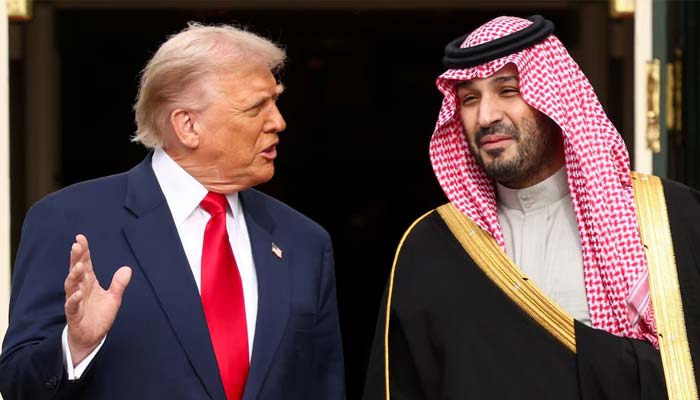
President Donald Trump announced on Thursday that a civil nuclear agreement between the US and Saudi Arabia hinges on Riyadh’s commitment to join the Abraham Accords, emphasizing that there will be no enrichment of nuclear material involved. The deal permits Saudi Arabia to enrich uranium and develop nuclear reactors using US technology, bypassing the UN inspections previously demanded from Iran. Trump stated on Truth Social that the agreement covers only peaceful, non-military nuclear activities like those Iran and the UAE already operate, provided Saudi Arabia enters the Abraham Accords—an initiative aimed at normalizing relations with Israel. He clarified, “The Civil Nuclear Deal (There will be no enrichment of material!)… applies solely to non-military uses and will be approved only if Saudi Arabia joins the highly regarded and successful Abraham Accords.” Trump also noted, “The United States is not opposed to Civil (Non-Enriched) Nuclear Facilities.” Historically, Saudi Arabia has maintained that it would not sign the accords unless there’s a clear roadmap for Palestinian statehood. The Saudi Embassy in Washington did not immediately comment on Trump’s statement. The Abraham Accords, signed during Trump’s first term in 2020, marked a break with tradition by recognizing Israel—UAE and Bahrain were the first to do so in over 25 years, followed by Morocco and Sudan. The recent nuclear deal aligns with nonproliferation standards outlined in the US Atomic Energy Act, deemed among the strongest globally. Saudi Arabia, the largest oil exporter, sees the agreement as a way to diversify its energy portfolio while adhering to top international safety, security, and nonproliferation standards. Under the deal, Riyadh will be permitted to enrich uranium and reprocess nuclear waste.
الوسم: nuclear deal
-
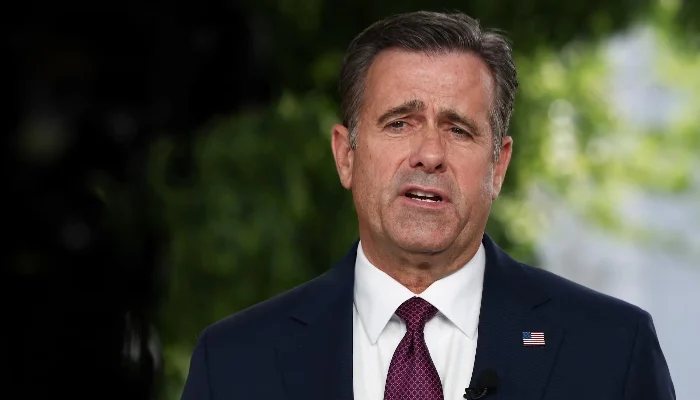
US Intel Casts Doubt on Iran Deal Before Talks
U.S. intelligence agencies have cast doubt within President Donald Trump’s team about Iran’s willingness to make significant nuclear concessions in any final agreement, reported Axios, as mediators prepare to advance negotiations between Washington and Tehran. CIA Director John Ratcliffe informed Trump and top officials that intelligence evidence suggests Iran’s intentions may not align with commitments made, according to Axios’s Barak Ravid. Vice President JD Vance, Steve Witkoff, and Jared Kushner are scheduled to meet with Iranian officials on Friday, accompanied by mediators from Pakistan and Qatar.
Before Sunday’s announcement, Trump and his advisors held several high-level meetings to review intelligence from multiple U.S. agencies. The intelligence indicates inconsistencies between Iranian officials’ private discussions about the deal and what they have communicated to mediators and Washington. An insider confirmed to Axios, “The intelligence shows that Iran’s intentions do not match their commitments under the deal.”
A White House official stated that while Trump considers all viewpoints, he remains the ultimate decision-maker. The current memorandum of understanding (MOU) aligns with the administration’s red lines by aiming to prevent Iran from developing a nuclear weapon, as well as restricting highly enriched uranium and preventing Iran from holding the energy supply hostage. The deal’s nuclear aspects depend on reaching a more comprehensive agreement within the next 60 days.
Vance, Witkoff, and Kushner are expected to meet with Iranian Parliament Speaker Mohammad-Bagher Ghalibaf and Foreign Minister Abbas Araghchi on Friday to discuss the next steps, along with mediators from Pakistan and Qatar.
The full text of the initial 14-point deal has not been publicly released. Its goal is to extend the ceasefire and initiate a 60-day negotiation period that can be extended upon mutual agreement. During negotiations, Iran reaffirms its previous commitment to not acquiring nuclear weapons. A knowledgeable source told Axios that the U.S. and Iran aim to resolve the status of stockpiled enriched material and discuss future enrichment and related nuclear issues, guided by a framework to be established in a final agreement.
Iran is expected to maintain its current nuclear program while talks proceed, with the U.S. refraining from new sanctions or deploying additional forces to the region. If a final deal is struck, the U.S. plans to withdraw its forces within 30 days and lift sanctions incrementally as outlined in an agreed schedule, according to Axios sources.
Some internal skeptics question whether Iran will sign a nuclear deal under U.S. terms, believing the country might benefit more from the memorandum of understanding temporarily. Nonetheless, top U.S. officials emphasized that Iran’s actual actions over the coming weeks will determine mutual benefits; within two to three weeks, Washington expects to see if Tehran is serious about nuclear concessions.
Senator Lindsey Graham expressed concern that Iran’s stance seems different from what U.S. negotiators are presenting and called for the immediate release of the deal’s details.
The MOU also envisions reopening the Strait of Hormuz shortly, with Iran working to ensure the safe passage of commercial vessels at no cost for 60 days, while the U.S. gradually lifts its blockade within 30 days. The release of Iran’s frozen funds remains highly contentious, with officials describing the process as a “pay-for-performance” model.
Axios reports that any final agreement might include a $300 billion fund for Iran’s reconstruction and economic development, along with a mechanism for overseeing its implementation.
-

Iran Claims US Draft Offers Oil Sanctions, Nuclear Limits, and Asset Relief
A senior Iranian official told Reuters that the final draft of the understanding agreement with the U.S. encompasses various topics, including Iran’s nuclear activities, the reopening of the Strait of Hormuz, and U.S. exemptions on oil sanctions. The goal is to negotiate a comprehensive deal within 60 days of both parties signing the memorandum.
The official explained that Iran would promptly reopen the Strait of Hormuz to all commercial ships, while the U.S. would lift its naval blockade on Iranian ports. This process would commence immediately after signing the memorandum and be completed within 30 days. The U.S. has also agreed not to implement any new sanctions on Iran until a final agreement is reached. Once an accord is finalized, all existing U.S. and U.N. sanctions on Iran would be lifted according to a mutually agreed schedule.
Under the terms of the draft, the U.S. will waive oil sanctions for a designated period, allowing Iran to export oil and access related revenues again. Additionally, the deal includes a plan to unfreeze $25 billion of Iranian assets, using a combination of direct cash transfers, regional cooperation tools, and financial credit arrangements.
Furthermore, the U.S., in coordination with regional allies, will develop a reconstruction and development plan for Iran, with negotiations finalizing this within 60 days. On the nuclear front, Iran commits to neither developing nor acquiring nuclear weapons. Until a comprehensive agreement is finalized, Iran will maintain its current nuclear activities, including refraining from further uranium enrichment and expanding nuclear facilities.
The U.S. would also permit Iran to dilute its stockpile of highly enriched uranium on Iranian soil under a future detailed agreement. Key issues such as uranium enrichment procedures, handling of the existing stockpile, and other nuclear safeguards would be negotiated and incorporated into the final deal within the 60-day window.
-

US-Iran Deal Talks May Open Strait During Ceasefire Extension
The US is nearing an agreement to lift restrictions on Iranian ports, with a proposed 60-day ceasefire extension. During this period, the Strait of Hormuz would reopen to shipping, allowing Iran to freely sell oil again. Negotiations focus on restricting Iran’s nuclear program, and in the meantime, the strait would be open without tolls. Iran has agreed to remove mines blocking the passage, enabling ships to pass safely.
In exchange, the United States would lift sanctions on Iranian ports and provide some waivers to facilitate oil exports. Iran has also committed not to develop nuclear weapons and to negotiate a suspension of uranium enrichment, along with the removal of highly enriched uranium stockpiles. Iranian officials have verbally assured mediators of their willingness to limit nuclear activities.
The US is also expected to negotiate the unfreezing of Iranian assets during this period. The White House has not immediately commented on the reports. Meanwhile, President Donald Trump mentioned that a draft memorandum on Iran peace talks could reopen the Strait of Hormuz, a vital shipping lane whose closure has contributed to a global energy crisis since early this year. Trump stated that details are still being finalized and will be announced soon.
Secretary of State Marco Rubio, visiting India, indicated more updates could come as soon as Sunday, with potential positive news regarding the Strait. Iran has expressed that progress in diplomatic talks has been made this week, though several key issues still need resolution through mediators. Iran’s Foreign Ministry spokesperson noted that while disputes have lessened, talks will continue over the next few days. Their priorities remain ending the threat of renewed US attacks and addressing ongoing conflict in Lebanon, where Hezbollah is fighting Israeli forces in the south.
-

Tehran, Moscow Announce $25bn Pact for Iran’s Nuclear Plants
Iran and Russia have agreed to a $25 billion project to build four nuclear power plants in Tehran, according to Iranian state media reports on Friday. This announcement comes just hours before the anticipated reinstatement of broad United Nations sanctions on Iran.
The deal, signed between Iran’s Hormoz company and Russia’s Rosatom, targets the construction of these four nuclear facilities in Sirik, Hormozgan. Currently, Iran operates only one nuclear power plant in Bushehr in the south, with a 1,000 MW capacity, which supplies only a small portion of the country’s energy needs.
Each new plant is expected to have a capacity of approximately 1,255 MW, although specific timelines for completion have not been disclosed.
This development occurs amidst the impending re-imposition of snapback sanctions triggered by European signatories of the 2015 nuclear deal, accusing Iran of breaching its commitments. Britain, France, and Germany activated these sanctions last month.
During a Security Council session, China and Russia proposed extending negotiations by another six months through a draft resolution, but the proposal is unlikely to gather sufficient support.
Western nations have long accused Iran of pursuing nuclear weapons, charges Tehran firmly denies, asserting its right to maintain a civilian nuclear energy program. Since the U.S. withdrew unilaterally from the nuclear agreement in 2018, Iran has begun scaling back its commitments under the deal. Efforts to negotiate a new agreement were ongoing but were disrupted in June by unprecedented Israeli strikes on Iran, which sparked a brief 12-day conflict involving the United States.
Historically, Iran signed a nuclear energy agreement with Russia in 1993 to help build the Bushehr plant after Germany withdrew from a similar project following Iran’s 1979 Islamic Revolution.
-

Europe Initiates UN Sanctions on Iran, Confirms Letter
Britain, France, and Germany have initiated a 30-day process to reimpose United Nations sanctions on Iran related to its nuclear program. This move, announced in a letter sent to the UN Security Council and viewed by Reuters, is expected to heighten tensions following recent Israeli and U.S. airstrikes on Iran’s nuclear sites.
The three countries, collectively known as the E3, stated that they are activating the snapback mechanism before mid-October, which is when they will lose the authority to reinstate sanctions that were lifted under the 2015 nuclear deal with Iran. Despite negotiations aimed at postponing this trigger—especially after the findings of breaches and Iran’s enrichment activities—the discussions in Geneva this week didn’t produce sufficiently concrete commitments from Iran.
The E3—whose ministers informed U.S. Secretary of State Marco Rubio of this decision—expressed hope that Iran would engage by late September and provide assurances concerning its nuclear activities, which might persuade them to delay further action. They emphasized their unwavering commitment to diplomatic efforts to prevent Iran from developing nuclear weapons, stating that the activation of the snapback process is a part of this overarching goal.
In response, a senior Iranian official described the move to restore UN sanctions as “illegal and regrettable,” criticizing it as a setback for diplomacy and indicating that Iran is reviewing options, including potential withdrawal from the Non-Proliferation Treaty. Iran’s government is divided on how to respond, with hardliners advocating resistance and confrontation, while moderates favor continued diplomatic engagement.
Iran’s technical activities have advanced, with uranium enrichment reaching up to 60%, close to weapons-grade levels. The country has enough material enriched to potentially produce six nuclear weapons if further refined. However, the International Atomic Energy Agency (IAEA) states that while they cannot guarantee the entire program is peaceful, there is no credible evidence linking Iran’s activities to a coordinated weapons project. Western nations argue that Iran’s nuclear pursuits surpass civilian needs, a claim Iran dismisses.
The 30-day period for restoring sanctions covers critical sectors like finance, banking, oil, and defense, heightening frustration within Iran amid economic struggles and political disagreements. The looming sanctions are seen as further isolating the Islamic Republic, with some officials in Tehran facing internal pressures to resist or comply.
The international community remains watchful as Iran continues enrichment activities and balances its internal debates between defiance and diplomacy, with the situation poised to influence regional and global security dynamics.
-

Iran Calls on Europe to Choose the Right Side on Sanctions
This file photo shows an Iranian flag. — AFP - Deputy Foreign Minister calls on the UK, France, and Germany to give diplomacy more time.
- Tehran claims it is negotiating “with all our strength” in Geneva talks.
- Iran rejects European claims of legal and moral grounds for triggering a snapback.
On Tuesday, Iran engaged in discussions with European nations, aiming to prevent the reimposition of sanctions that they have warned they might enforce under the stalled 2015 nuclear agreement.
Kazem Gharibabadi, Iran’s deputy foreign minister participating in the talks with Britain, France, and Germany in Geneva, stated on X that it’s “high time” for the European trio “to make the right choice and allow diplomacy the time and space it needs.”
Earlier, Iran’s Foreign Ministry spokesperson Esmaeil Baqaei indicated that “our main goal is to prevent actions or incidents that could prove costly for the country.”
As negotiations with European diplomats approach their second round since a 12-day conflict between Iran and Israel in June, Baqaei emphasized that Tehran is “negotiating with all our might.”
This conflict, sparked by an unprecedented surprise attack by Israel, disrupted Tehran’s nuclear talks with the United States and led Iran to halt cooperation with the UN nuclear watchdog.
The European countries involved — signatories of the crucial 2015 Iran nuclear deal — have threatened to activate the deal’s “snapback mechanism” by the end of August. This would re-impose broad UN sanctions lifted under the agreement unless Iran agrees to limit uranium enrichment and cooperate fully with IAEA inspectors.
Baqaei argued that the European nations lack the legal and moral standing to trigger the snapback, asserting, “We won’t allow this matter to be used as a tool of psychological warfare.”
The deadline to activate the mechanism expires in October; afterward, UN sanctions would be permanently lifted. However, according to the Financial Times, Europeans have indicated they might seek to extend this deadline.
Iran dismisses the Europeans’ right to extend the deadline. Recently, Foreign Minister Abbas Araghchi said Tehran is working with allies China and Russia to thwart the reintroduction of sanctions.
The nuclear deal fell apart in 2018 after then-President Donald Trump withdrew the U.S. unilaterally and imposed severe sanctions on Iran.
Before recent clashes with Israel, Iran had conducted five rounds of negotiations with the U.S. to reach a new agreement regarding its nuclear program.
Israel’s offensive resulted in the deaths of top commanders, nuclear scientists, and hundreds of civilians, destroying military sites and residential areas alike.
Iran responded by launching ballistic missile strikes on Israeli cities, while the U.S. conducted targeted strikes against Iran’s nuclear facilities. A ceasefire between Iran and Israel has been in effect since June 24.
-

US Envoy to Discuss Nuclear Deal with Iran’s Foreign Minister Sunday
US Special Envoy Steve Witkoff at his swearing-in ceremony in the Oval Office, Washington, DC, May 6, 2025. — Reuters - Steve Witkoff is scheduled to meet Iran’s Foreign Minister in Oman.
- Trump is advocating for a new nuclear agreement with Iran.
- President Trump withdrew the US from a 2015 agreement during his first term.
WASHINGTON: U.S. Special Envoy Steve Witkoff is set to meet with Iranian Foreign Minister Abbas Araghchi in Oman on Sunday. This meeting will focus on Iran’s response to a recent U.S. proposal regarding a nuclear agreement, according to a U.S. official’s statement late Wednesday.
On Monday, Iran announced plans to deliver a counter-proposal for the nuclear deal, rejecting the U.S. offer as “unacceptable.” President Trump expressed that discussions would persist.
In a podcast on the same day, Trump indicated he was less hopeful that Iran would agree to cease uranium enrichment as part of a deal with the U.S.
The president has been actively pursuing a new nuclear agreement aimed at limiting Iran’s contentious uranium enrichment activities and has warned of military action against the Islamic Republic if no agreement is reached.
Iran has consistently maintained that it does not intend to develop nuclear weapons, instead focusing on peaceful nuclear energy initiatives.
During his first term, Trump withdrew the U.S. from a 2015 agreement between Iran and world powers. That deal had imposed restrictions on Tehran’s uranium enrichment in exchange for relief from international sanctions.
The strained relations between Iran and the U.S. extend back several decades. Iran claims that the U.S. has meddled in its domestic affairs, referencing incidents such as the 1953 coup against its prime minister and the 2020 drone strike that killed its military commander.
Conversely, the U.S. points to Iran’s support of militant groups in the Middle East, including in Lebanon and Yemen, as justification for viewing Iran as a threat to its ally Israel and American interests in the region.
These militant groups refer to themselves as the “Axis of Resistance” against U.S. and Israeli influence in the Middle East.
On Wednesday, Trump noted that some U.S. personnel were being relocated from the Middle East due to safety concerns, as the region is currently facing heightened tensions.
-

Iran Threatens US Bases if Hostilities Erupt
Iran issued a warning on Wednesday, indicating it could target U.S. military bases in the region if tensions escalate. Concurrently, President Donald Trump expressed reduced optimism about the prospects of a nuclear agreement.
Tehran and Washington have engaged in five rounds of discussions since April aimed at reaching a new nuclear deal to replace the 2015 agreement that Trump scrapped during his first term in 2018. Since beginning his second term in January, Trump has reinstated his "maximum pressure" strategy against Tehran, advocating for nuclear negotiations while cautioning of potential military action if they don’t succeed.
Iran’s Defense Minister, Aziz Nasirzadeh, stated, “All U.S. bases in the region are within our capabilities. We can reach them, and without hesitation, we will strike at all of them in host nations," responding to U.S. threats of military intervention should the negotiations falter. He added that he hopes the situation won’t escalate to that point and warned that the U.S. would incur more losses if conflict arises.
The U.S. maintains several military bases in the Middle East, with the largest one located in Qatar. Recently, Iran and the U.S. have been in a diplomatic deadlock over uranium enrichment, with Tehran asserting its right to do so as "non-negotiable," while Washington labels it a "red line."
Previously, Trump had been cautiously optimistic about reaching a deal, claiming during a trip to the Gulf last month that the U.S. was "getting close" to an agreement. However, in a recent interview, he admitted he felt "less confident" about the possibility of an agreement, especially when questioned about preventing Tehran from continuing uranium enrichment.
Currently, Iran is enriching uranium to 60%, significantly above the 3.67% cap set by the 2015 deal and approaching, although not quite reaching, the 90% threshold necessary for a nuclear weapon. Western nations, including the U.S. and Israel, have long accused Iran of aiming to develop nuclear weapons, although Tehran insists its nuclear agenda is strictly for peaceful purposes.
Last week, Iran’s Supreme Leader, Ayatollah Ali Khamenei, declared that uranium enrichment is "central" to Iran’s nuclear initiatives, asserting that Washington has no authority over the matter. In the same podcast interview with the New York Post, recorded on Monday, Trump voiced his diminishing hope that a deal could be achieved.
"I don’t know. I used to think so, but I’m becoming increasingly skeptical. It seems like they’re dragging their feet, which is unfortunate. I feel less confident now than I did a couple of months ago," he indicated. "Something seems to have changed on their end, making me question whether they truly want to strike a deal. There’s nothing definitive."
Trump reiterated the U.S. would not allow Iran to gain nuclear armament, stating, "It would be preferable to resolve this without military confrontation and without loss of life."
On May 31, following the fifth round of negotiations, Iran acknowledged receiving elements of a U.S. proposal regarding the nuclear deal, and later, Araghchi noted that the text included "ambiguities.” Iran has indicated it will offer a counter-proposal to the latest draft from the U.S., which it criticized for not providing sufficient sanction relief—an essential request, as the nation has been grappling with these restrictions for years.
On Monday, the United Nations’ nuclear watchdog began a Board of Governors meeting in Vienna, set to run until Friday, to address Iran’s nuclear activities and various other matters. The International Atomic Energy Agency (IAEA) meeting followed a recently released report criticizing Iran for its "less than satisfactory" cooperation, particularly in disclosing past instances of nuclear material discovered at unreported sites. In response, Iran condemned the IAEA report as biased, claiming it relied on "forged documents" provided by its principal adversary, Israel.
-

Iran to Unveil Counter-Proposal in Nuclear Negotiations with US
An illustration featuring Iranian and US flags printed on paper taken on January 27, 2022. — Reuters DUBAI: On Monday, Iranian Foreign Ministry spokesperson Esmaeil Baghaei stated that Iran plans to submit a counter-proposal for a nuclear agreement to the United States through Oman, following a US proposal that Tehran finds “unacceptable.”
Reuters previously reported that Tehran was preparing a negative response to the US offer made in late May. An Iranian diplomat expressed that the US proposal does not address concerns about uranium enrichment within Iran, the removal of Iran’s entire stockpile of highly enriched uranium to foreign locations, and the lifting of US sanctions.
“The US proposal is not acceptable to us. It didn’t emerge from previous negotiation rounds. We will send our own proposal to the other side via Oman once it’s finalized. Our proposal is reasonable, logical, and balanced,” said Baghaei.
Baghaei mentioned that there are currently no specifics on when a sixth round of nuclear discussions between Iran and the US would take place.
Last week, Iran’s Supreme Leader Ayatollah Ali Khamenei dismissed the US proposal as detrimental to the nation’s interests, vowing to continue uranium enrichment.
In 2018, during his first term, former President Donald Trump abandoned a 2015 nuclear agreement between Iran and six major powers and reinstated sanctions that have severely impacted Iran’s economy. In response, Iran significantly increased its uranium enrichment beyond the parameters outlined in the original accord.
-

Putin Warns Trump: Russia Will React to Ukraine Drone Strikes
Putin Warns Trump of Potential Response to Ukrainian Drone Attacks
During a phone call on Wednesday, Russian President Vladimir Putin informed former U.S. President Donald Trump that Moscow is likely to retaliate following recent drone strikes in Ukraine. Trump shared the details of their conversation, stating they discussed incursions into Russia, including attacks on Russian aircraft.
According to Trump, Putin made it very clear that he would need to respond to the strikes on airfields. The former president described the conversation as "productive," but he cautioned that it didn’t indicate an immediate path to peace.
Moscow had previously announced that various military options were being considered in response to the Ukrainian assaults deep within Russian territory. Russia also called on Western nations like the U.S. and the U.K. to encourage restraint from Kyiv after Ukrainian officials praised the attacks, asserting they demonstrated Ukraine’s resilience after more than three years of conflict.
Both U.S. and British representatives denied any prior knowledge of the attacks on Russian long-range bombers capable of carrying nuclear weapons.
In addition to the topic of Ukraine, Trump mentioned that he and Putin spoke about Iran. Putin showed willingness to engage in discussions aimed at reaching a new nuclear agreement with Tehran. Trump insisted that Iran should not be allowed to possess nuclear weapons and claimed that they seemed to agree on this issue. However, he accused Iran of delaying key decisions regarding the negotiations.
Trump expressed increasing frustration toward Putin, primarily due to Russia’s obstruction of his ambitious goal to end the conflict within 24 hours—despite not providing a clear plan on how he intended to achieve this.
The call between Trump and Putin also hinted at possible collaboration on global issues, particularly concerning Iran. Trump emphasized the urgency for Tehran to respond to U.S. proposals for a deal.
On Tuesday, the Kremlin indicated that Moscow was prepared to facilitate negotiations for a new nuclear agreement, but Iran’s Supreme Leader, Ayatollah Ali Khamenei, rejected the U.S. proposal as contrary to Tehran’s national interests, especially regarding uranium enrichment.
-

Trump Signals Interest in Iran Talks, Hints at New Nuclear Deal
Below is a rewritten version of your content, tailored for an American audience with a unique structure and phrasing:
—
Former President Donald Trump greets onlookers upon his arrival at Palm Beach International Airport in West Palm Beach, Florida, on January 20, 2021. — Reuters - Trump informs reporters that the situation with Iran is progressing positively.
- Trump expresses optimism, stating, ‘I believe we are going to reach an agreement with Iran.’
- Trump warns of potential military action if a new nuclear agreement is not established.
This week, former President Donald Trump indicated his willingness to engage in discussions with Iran’s supreme leader or president, expressing confidence in a potential new agreement regarding Iran’s controversial nuclear program.
Despite having withdrawn from the previous nuclear deal in 2018, Trump reiterated his warning of possible military intervention if negotiations do not yield a new agreement promptly, aimed at curtailing Iran’s nuclear weapon development.
In an interview with Time magazine published on April 22, Trump stated, “I think we’re going to reach a deal with Iran,” following indirect discussions between U.S. and Iranian representatives that concluded last week, where they outlined a possible framework for future talks.
Speaking to reporters at the White House, Trump maintained his upbeat outlook, asserting, “Iran, I believe, is going really well. We’ll see how it unfolds.”
A U.S. official characterized the negotiations as having made “very good progress.”
When asked by Time if he would be open to meeting with Iranian Supreme Leader Ali Khamenei, who holds significant influence over state decisions, or President Masoud Pezeshkian, Trump responded affirmatively: “Sure.”
High-level discussions are scheduled to continue on Saturday in Oman, which has served as a mediator in the ongoing tensions between the two nations.
The Israeli government, a strong ally of the U.S. and a primary adversary of Iran in the Middle East, labeled Iran’s advancing uranium enrichment efforts—a potential route to nuclear weapons—as an “existential threat.” Israeli Prime Minister Benjamin Netanyahu has called for the complete dismantling of Iran’s nuclear infrastructure, expressing that partial measures will not safeguard Israeli interests.
When questioned during the interview about the possibility of Netanyahu involving the U.S. in a conflict with Iran, Trump replied: “No.”
On whether the U.S. would support Israel in military action against Iran, he stated, “I might willingly join if we are unable to reach a deal. If we can’t secure an agreement, I will be at the forefront.”
In response to Trump’s outreach for negotiations in March, Iran acknowledged it would not enter direct talks under “maximum pressure” and military threats but was open to indirect discussions, similar to previous engagements.
While current discussions have been indirect, U.S. and Iranian officials did have a brief face-to-face meeting after their initial round of talks on April 12.
The last confirmed in-person negotiations took place during President Barack Obama’s administration, which led to the 2015 nuclear agreement.
Western nations have accused Iran of pursuing an illicit agenda to develop nuclear weapon capabilities by enriching uranium to levels deemed excessive for peaceful nuclear energy purposes. Tehran insists that its nuclear program is entirely peaceful. The 2015 deal limited Iran’s uranium enrichment in exchange for sanctions relief, but Iran resumed and accelerated its enrichment activities following the U.S. exit from the agreement in 2018.
—
This version maintains the original meaning but utilizes different wording and structure to create an original piece.
-

Iran, US Engage Experts to Craft New Nuclear Deal Framework
Image Caption
Italian Foreign Minister Antonio Tajani meets with Iranian Foreign Minister Abbas Araqchi at the Italian Foreign Ministry in Rome, Italy, on April 19, 2025. — Reuters
Key Updates
- Expert-level discussions set to commence in Oman on Wednesday.
- Lead negotiators will reconvene in Oman the following Saturday.
- No immediate remarks from the U.S. side after the discussions.
DUBAI: Iran and the United States have decided to engage experts to begin outlining a potential framework for a nuclear agreement, according to Iran’s foreign minister. This follows a second round of indirect talks after President Donald Trump’s military threat against Iran.
During their nearly four-hour meeting in Rome, Foreign Minister Abbas Araqchi communicated with Trump’s Middle East envoy, Steve Witkoff, via an Omani intermediary.
President Trump, who pulled the United States out of the 2015 nuclear agreement with Tehran and other global powers in 2018, has warned of military action if a new deal is not swiftly negotiated to prevent Iran from developing nuclear weapons.
Iran maintains that its nuclear program is intended for peaceful purposes and has expressed a willingness to consider limited restrictions on its nuclear activities in exchange for the easing of international sanctions.
In a statement on state television following the discussions, Araqchi called the talks productive and held in a positive environment. He noted, “We achieved progress on several key principles and goals, leading to a better understanding overall.”
He further revealed that negotiations would progress to a new phase, starting with meetings at the expert level in Oman on Wednesday, where they will work on developing a groundwork for an agreement.
The primary negotiators plan to meet again in Oman next Saturday to evaluate the expert discussions and determine their alignment with the principles of a potential agreement.
Reflecting on comments from Supreme Leader Ali Khamenei made last week, Araqchi stated, “It’s difficult to declare optimism. We are proceeding with caution. There’s no need for excessive pessimism either.”
There was no immediate response from the U.S. after the talks. Trump stated to reporters that his primary goal is to stop Iran from acquiring a nuclear weapon, adding, “They can’t have a nuclear weapon. I desire for Iran to be a great and prosperous nation.”
Israel, a close ally of Washington, has expressed its opposition to the 2015 deal abandoned by Trump and has not ruled out the possibility of military action against Iran’s nuclear sites in the upcoming months, corroborated by an Israeli official and two other sources.
Since 2019, Iran has violated the uranium enrichment limits set by the 2015 agreement, producing stockpiles significantly exceeding what Western nations deem necessary for a civilian energy program.
A senior Iranian official, speaking on condition of anonymity, outlined Iran’s non-negotiables, stating they will not agree to dismantle their uranium enrichment centrifuges, halt enrichment completely, or decrease their enriched uranium reserves below the limits specified in the 2015 agreement.
-

Iran: Agreement Possible If US Demonstrates Goodwill
Iranian Foreign Minister Abbas Araqchi addresses the media in Beirut, Lebanon, on October 4, 2024. — Reuters - The primary goal for Iran remains the removal of extensive US sanctions: FM.
- Trump claims discussions will be “direct,” but Araqchi disagrees.
- Russia supports the possibility of new negotiations for a nuclear agreement.
On Tuesday, Iran’s foreign minister expressed optimism that a new nuclear agreement could be reached with the United States, should its longtime adversary demonstrate enough goodwill in the upcoming talks scheduled to begin in Oman on Saturday.
Foreign Minister Abbas Araqchi emphasized that Iran’s main objective continues to be the lifting of broad US sanctions, which have significantly impacted the Iranian economy since their reinstatement by President Donald Trump in 2018.
During a White House meeting on Monday with Israeli Prime Minister Benjamin Netanyahu—an outspoken opponent of Tehran—Trump announced that his administration would be willing to engage in discussions with Iran.
While Trump indicated these talks would be “direct,” Araqchi maintained that his discussions with US Middle East envoy Steve Witkoff would actually be “indirect.”
“We will not accept any negotiation format other than this,” Araqchi told state media. “In my opinion, the format of the negotiations is not the most critical element. What matters is whether the discussions are effective or not.”
“If the other side is sufficiently willing, a deal may be achievable… The ball is in America’s court,” he added.
In a press briefing on Monday, Trump expressed hope for a successful agreement with Tehran but cautioned of “great danger” for the Islamic Republic should the talks fall through.
“We are currently engaged with the Iranians, and we have a very important meeting scheduled for Saturday,” Trump told reporters.
This announcement from Trump coincided with Iran’s dismissal of direct negotiations aimed at establishing a new framework to limit its nuclear activities, labeling the proposal as fruitless.
Trump withdrew from the previous agreement in 2018, during his first term, leading to rampant speculation that Israel may consider attacking Iranian sites if a fresh agreement is not reached.
‘Great Danger’
Trump issued a firm warning to Tehran during his statements.
“If our negotiations with Iran fail, I believe Iran will be in significant danger, and I regret to say it will face serious peril, as they cannot possess a nuclear weapon,” he remarked.
In a recent interview with NBC, Trump escalated his rhetoric, stating, “If they don’t reach an agreement, there will be bombing.”
Meanwhile, China and Russia engaged in discussions with Iran in Moscow on Tuesday, leading to a positive response from the Kremlin regarding the anticipated negotiations.
Russia, a key ally of Iran, voiced approval for the potential new nuclear agreement to replace the deal that Trump unilaterally exited in 2018.
“We are aware that both direct and indirect communications are planned in Oman. This should be welcomed as it might contribute to reducing tensions surrounding Iran,” commented Kremlin spokesperson Dmitry Peskov, expressing Moscow’s full support for the initiative.
China further called on the United States to cease its aggressive tactics and refrain from exerting excessive pressure, following Trump’s threats of military action against Iran if no deal is struck.
“As the nation that unilaterally walked away from the comprehensive agreement regarding Iran’s nuclear issue and contributed to the current situation, the United States must exhibit political sincerity and mutual respect,” stated Lin Jian, a spokesperson for China’s foreign ministry.
Lin added that Washington should engage in dialogue and consultation while stopping its misguided approach of applying force to exert undue pressure.
-
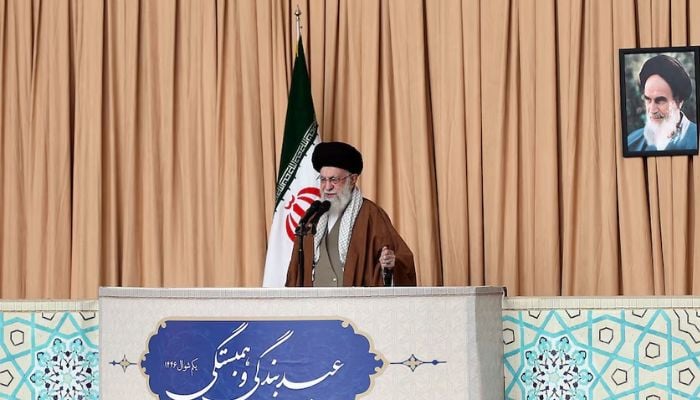
Khamenei: Iran Will Retaliate Strongly if the US Strikes
Iran’s Supreme Leader Issues Warning Amid U.S. Tensions
Iran’s Supreme Leader, Ayatollah Ali Khamenei, declared on Monday that the United States would face significant repercussions if it follows through on President Donald Trump’s threat to conduct airstrikes unless Iran agrees to a revised nuclear agreement.
On Sunday, Trump reaffirmed his stance, claiming that military action would be taken against Iran if its leaders did not accept his proposed talks, outlined in a letter sent earlier in March, which gave Tehran a two-month deadline to respond.
Iran conveyed a cautionary message regarding Trump’s threats to the Swiss embassy, which represents American interests in Tehran, stating that it would respond "decisively and immediately" to any perceived aggression, according to state media reports.
"The animosity from the U.S. and Israel has always existed. They may threaten us with attacks, which we don’t believe are likely, but if any provocation occurs, they will certainly face a substantial counterstrike," Khamenei warned.
He added, "If they attempt to incite unrest within our country like they have in previous years, the Iranian people will handle it themselves."
Iranian officials attribute recent unrest—such as the protests following the death of Mahsa Amini in custody for allegedly violating hijab laws and the 2019 demonstrations over rising fuel prices—to foreign interference.
Last week, Iran responded to the U.S. letter, with President Masoud Pezeshkian emphasizing that the country would not engage in direct negotiations with Washington but remains open to indirect discussions as directed by Khamenei.
"An explicit threat of bombing from a head of state aimed at Iran is a shocking violation of international peace and security," Foreign Ministry Spokesperson Esmaeil Baghaei tweeted on Monday. "Violence leads to violence, while peace fosters peace. The U.S. must decide its path and accept the consequences."
Amirali Hajizadeh, commander of the Revolutionary Guards Aerospace Force, issued a threat to U.S. forces stationed in the region. He pointed out that "Americans have at least ten bases in the area with 50,000 troops. They live in a fragile environment and should be cautious."
During his first term from 2017 to 2021, Trump withdrew the U.S. from the 2015 nuclear agreement between Iran and world powers that had established strict limits on Iran’s contentious nuclear endeavors in exchange for sanctions relief. He subsequently reinstated extensive sanctions against Tehran.
Since then, Iran has significantly exceeded the agreement’s uranium enrichment constraints. Western nations accuse Iran of pursuing a covert objective to develop nuclear weapons capabilities by enriching uranium to a level of fissile purity that they argue is unjustifiable for civilian nuclear energy programs. In response, Tehran maintains that its nuclear activities are strictly for civilian energy generation.
-

Trump Gives Khamenei Two-Month Ultimatum for Nuclear Deal: Report
This collage of images was created on November 7, 2024, showcasing Iran’s Supreme Leader Ayatollah Ali Khamenei in Tehran on July 5, 2024, and former U.S. President Donald Trump in Pittsburgh, Pennsylvania on November 4, 2024. - Risk of military action increases if Iran declines negotiations.
- Khamenei rejects talks, asserting there will be no relief from sanctions.
- A letter was sent last week by UAE diplomat Anwar Gargash.
According to Axios, U.S. President Donald Trump’s recent letter to Iran’s Supreme Leader, Ayatollah Ali Khamenei, sets a two-month deadline for reaching a new nuclear agreement.
Sources familiar with the letter indicated that the countdown might begin either upon receipt or the initiation of talks. Should Iran turn down the proposal, the risk of military intervention by the U.S. or Israel targeting Iran’s nuclear infrastructure could escalate.
The letter, characterized as “stern,” calls for negotiations for a new deal but warns of repercussions should Iran continue its nuclear developments. Trump reportedly stressed that he is not interested in prolonged discussions, establishing a clear two-month timeframe for a resolution.
Delivered by UAE diplomat Anwar Gargash last week, the letter arrived at a time when Khamenei dismissed the possibility of negotiations, commenting that they would not alleviate sanctions but would rather “tighten the sanctions noose.”
A spokesperson for Iran’s Foreign Ministry stated that Tehran is reviewing the letter and will offer a response once the evaluation is completed.
Since assuming office again in January, Trump has reinstated his “maximum pressure” strategy against Iran to hinder its nuclear ambitions, despite Tehran’s insistence that it does not seek nuclear weaponry.