Tag: NATO

  • Is “Scare Force One” a Security Warning? Trump’s New Plane Sparks Debate

    Is “Scare Force One” a Security Warning? Trump’s New Plane Sparks Debate

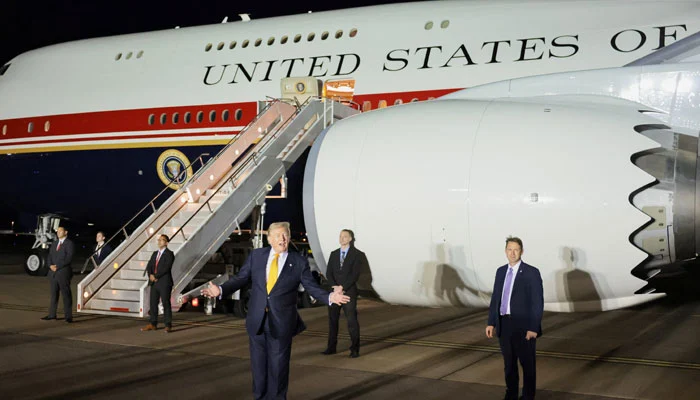
    WASHINGTON: President Donald Trump drew attention to concerns over the security of his recently gifted Air Force One aircraft from Qatar, after he opted to fly back on an older jet following a NATO summit this week.

    The billionaire leader has expressed enthusiasm for the refurbished Boeing 747-8, which traveled with him to Ankara on its inaugural international journey. However, he suddenly announced in Turkey that the new aircraft would be sent ahead to a British airbase, citing a decision to let U.S. troops tour the luxury plane.

    According to Friday reports from The New York Times, the new plane lacks certain security features found on the older jet, such as anti-missile defenses. U.S. media also noted that the Secret Service recommended the switch. The timing of these concerns coincided with rising hostilities with Iran, which borders Turkey, and reports that journalists aboard the older plane out of Ankara were told to keep window blinds down—an unusual protocol typically reserved for conflict zones.

    Trump denied any security issues, but after transitioning back to the newer aircraft for the flight from the UK to Washington, he made comments implying possible Iranian assassination threats. “You’re probably on a dangerous flight because of the sleazebags we have to deal with,” he stated.

    Following the report on the new Air Force One, several New York Times journalists received subpoenas from the Trump administration on Friday. David McCraw, the newspaper’s chief legal counsel, criticized the move, stating, “The appearance of federal law enforcement agents at newsrooms should alarm anyone who values the Constitution and press freedom.”

    The White House defended the safety of the new aircraft. Communications Director Steven Cheung told AFP, “The new Air Force One is a state-of-the-art aircraft equipped with advanced security protocols designed to keep the President and his staff safe. As the President recently emphasized, we face many enemies targeting him, and we utilize all available tools to counter these threats.” In a separate statement, Cheung suggested that the use of different planes involved “distraction and misdirection,” hinting at the airplane swap.

    While the Secret Service declined to comment, it’s widely believed that the older Air Force One planes are equipped with sophisticated measures, including radar jamming, infrared tracking defenses, chaff dispensers (metal shavings to distract radar-guided missiles), and flare systems to counter heat-seeking threats. It remains unclear which of these features are present on the Qatari aircraft, which appears to lack some external protective fairings visible on the older jets.

    Qatar’s royal family donated the luxury aircraft last year after Trump criticized the age of the existing Boeing 747s, which had been in service since 1990. The plane was quickly retrofitted and first flown by Trump on July 1 to North Dakota. Previously, the U.S. military acknowledged making compromises—mainly cosmetic—to fast-track the aircraft’s readiness, asserting that security, safety, and mission communication were not compromised.

    However, Democrats in the Senate questioned the military’s assurances, sending a letter to the Air Force on Trump’s arrival in Turkey, demanding clarification on “genuine national security concerns” regarding the Qatari plane. Former security officials expressed skepticism about its security capabilities. Retired Brigadier General John Teichert pointed out that, regardless of retrofits, a custom-built Air Force One inherently offers superior defense.

    The Qatar donation serves as an interim solution until two new Boeing Air Force Ones are delivered later this decade, which have faced multiple delays. Afterward, the aircraft is expected to be donated to Trump’s envisioned presidential library. The gift has sparked ethical debates, considering whether it’s appropriate for a U.S. president to accept or utilize such expensive items from a foreign government.
  • Erdogan’s Revolver Dilemma Leaves NATO Leaders Puzzled Post-Summit

    Erdogan’s Revolver Dilemma Leaves NATO Leaders Puzzled Post-Summit

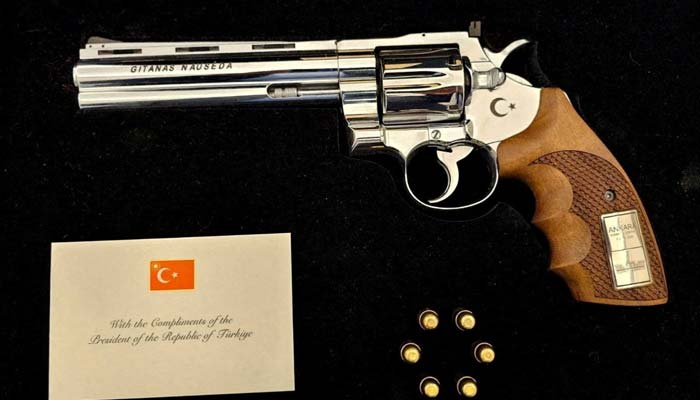
    Belgium’s Prime Minister was fairly taken aback upon returning home from Wednesday’s NATO summit in Turkey when he discovered a handgun and ammunition in his luggage. After the summit in Ankara, host Turkish President Recep Tayyip Erdogan presented each leader with an unusual farewell gift: an antique revolver loaded with live ammunition, clearly not just a prop. Erdogan aimed to highlight Turkey’s defense industry, which has become a significant export and strategic asset.

    Photos circulated by Lithuanian President Gitanas Nauseda’s office showed what appeared to be the Gumusay 357 Magnum, a rare six-shooter made by Turkish arms manufacturer MKE in the 1990s. The firearm was displayed in a wooden box adorned with Turkey’s flag, NATO’s emblem, and a sign stating “Gumusay, the first revolver-type handgun produced in our country,” printed in both Turkish and English.

    While engraved Turkish revolvers are uncommon gifts, all NATO leaders received the same model, personalized with their names. The Belgian Prime Minister, Bart De Wever, handed his to Brussels airport police to be stored securely. A Polish presidential aide, Karol Nawrocki, said his revolver was awaiting customs clearance in Warsaw and would be stored safely, emphasizing it would not be used for shooting.

    The Dutch and Swedish prime ministers reported their revolvers had been moved to their respective embassies in Ankara, with plans for the Dutch one to be disabled and the Swedish one awaiting import approval. British Prime Minister Keir Starmer’s revolver came with a cleaning kit and 500 bullets, according to a Downing Street source. Italian Prime Minister Giorgia Meloni’s firearm was already stored at Palazzo Chigi, Italy’s government headquarters, alongside other diplomatic gifts.

    EU Commission President Ursula von der Leyen intended to donate her revolver to a military museum, and Greece’s leader planned to gift his to Athens’ War Museum. Turkey’s handgun industry mostly produces semi-automatics, making the Gumusay something of a collector’s rarity. The country’s firearms manufacturers have gained a foothold in Europe’s civilian market by offering low-cost pistols and shotguns, challenging long-established Italian and Belgian brands associated with higher-end sporting and service weapons.

    According to the Geneva-based Small Arms Survey, Turkey ranked as the world’s third-largest exporter of small arms from 2019 to 2024, earning roughly $3 billion in exports during that period, behind only the United States and Italy.

  • Italy’s Meloni ‘Has No Regrets’ in Effort to Win Trump’s Support

    Italy’s Meloni ‘Has No Regrets’ in Effort to Win Trump’s Support

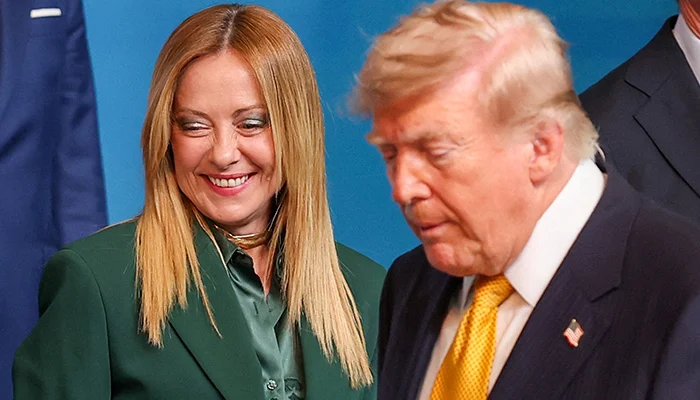
    Italian Prime Minister Giorgia Meloni stated on Wednesday that she has no regrets about her attempts to build a strong relationship with U.S. President Donald Trump, even after several public disagreements that have put a strain on their previously close connection. Once regarded as one of Trump’s most loyal allies in Europe, Meloni has recently faced criticism from the president both in media interviews and on social media platforms.

    Asked in Ankara at a NATO summit—also attended by Trump—whether she had second thoughts about the political investments she made in supporting Trump, Meloni replied, “No, I absolutely don’t regret anything I’ve done.” She emphasized that her commitment to Western unity was not a strategy adopted solely with Trump’s arrival but a consistent approach she has pursued with all her international counterparts.

    Trump’s initial public critique of Meloni surfaced in April after she rebuked him for criticizing Pope Leo over the pontiff’s stance on the Iran conflict. Additionally, in March, Italy blocked U.S. military aircraft destined for the Middle East from landing at Sigonella Air Base in Sicily. Despite that, Meloni, who was the only European leader to attend Trump’s inauguration last year, chose not to respond to a recent social media post by Trump that depicted her looking up at him with the caption: “RESTRAINING ORDER NEEDED.”

    Meloni highlighted that her support for Western cohesion is rooted in principles rather than personal alliances. She said, “I made that political investment because I believe in the unity of the West. It’s not a strategy I started with Trump’s arrival, but one I have maintained with all my counterparts.” While acknowledging that the dynamics between her and Trump are evolving, she maintained that they still share common views on key issues like immigration and opposing what she calls “woke culture.”

    During the NATO summit, Trump was more diplomatic, describing Meloni as “a nice person” but also reiterating criticism that she has not done enough to back his military actions against Iran, which are anticipated to resume soon.

  • Trump on Meloni: ” She’s genuinely a kind person”

    Trump on Meloni: ” She’s genuinely a kind person”

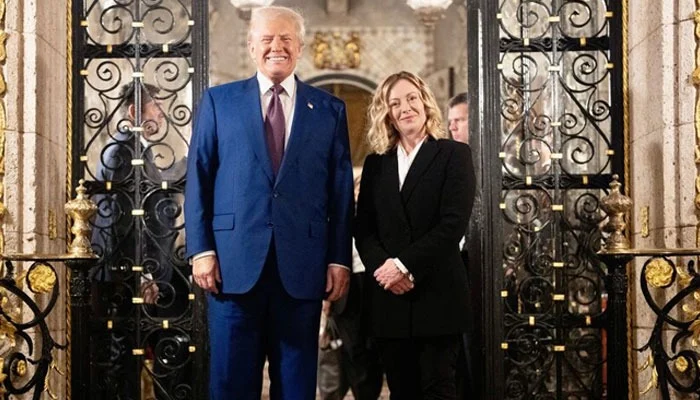
    US President-elect Donald Trump met with Italian Prime Minister Giorgia Meloni at Mar-a-Lago in Palm Beach, Florida, on January 4, 2025. — Reuters

    ANKARA: Donald Trump appeared to put an end to the diplomatic spat with Italy’s Prime Minister Giorgia Meloni as he arrived in Ankara for an important NATO summit.

    The disagreement started late last month after Trump claimed in an interview with an Italian TV channel that Meloni had “begged” him for a photo together at the G7 summit, and he only agreed because he “felt sorry for her.” Meloni swiftly denied the allegation, calling it “fabricated,” which led Trump to double down, sparking a personal feud with one of Europe’s leading right-wing leaders.

    This conflict escalated into an unprofessional back-and-forth that continued until Sunday, when Trump posted an altered image on his Truth Social platform. The picture showed Meloni looking at him with admiration, accompanied by the caption, “Restraining Order Needed.”

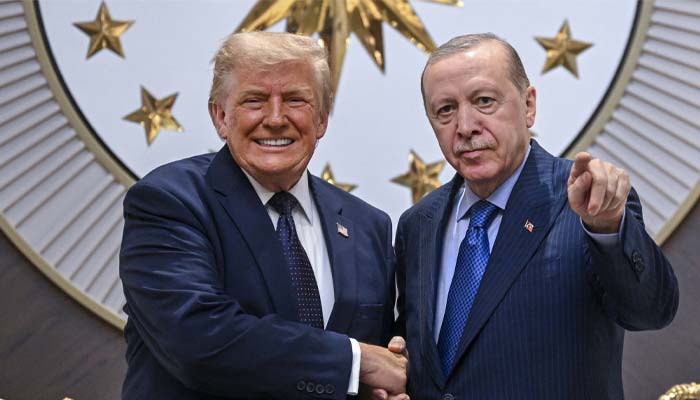
    By Tuesday, Trump seemed to adopt a more friendly approach. “I think she’s a nice person, actually,” he stated during a joint press conference with Turkish President Recep Tayyip Erdoğan.

    “Our relationship was strained, folks. It got a little worse because she refused to help us… She declined to get involved with the Strait of Hormuz,” he said, expressing disappointment over Europe’s hesitation to support US and Israeli efforts in the Iran conflict.

    “I like her. I think she’s a good person, but she made a mistake… she just wasn’t there for us, and I wasn’t happy about that,” Trump added.

    Leading up to the Ankara meeting, Trump has heavily criticized European NATO members, with allies trying to highlight increased defense spending to win his favor.

  • Trump Announces U.S. to Lift Sanctions and Potential F-35 Sale to Turkey

    Trump Announces U.S. to Lift Sanctions and Potential F-35 Sale to Turkey

    Turkish President Recep Tayyip Erdogan greeted U.S. President Donald Trump upon his arrival at Ankara Airport during an official visit to Turkey ahead of the 36th NATO Heads of State and Government Summit in Ankara on July 7, 2026. — Reuters

    – Trump expressed his dissatisfaction with NATO’s stance on Iran while in Ankara.
    – He indicated that the U.S. is open to considering the sale of F-35 fighter jets to Turkey.
    – Erdogan hopes for a positive outcome regarding the F-35 aircraft issue.

    During their meeting at the NATO summit, President Donald Trump announced plans to remove sanctions on Turkey and was expected to decide on the potential sale of F-35 fighters to Ankara. “We’re going to lift the sanctions,” Trump told reporters when asked about measures under the Countering America’s Adversaries Through Sanctions Act (CAATSA).

    In 2020, the U.S. government imposed sanctions on Turkey due to its purchase of Russian S-400 missile defense systems and removed Ankara from the F-35 fighter jet program, a move Turkey deemed unjust and unlawful. Sources close to the matter mentioned Trump was likely to support the F-35 sale during his visit, despite unresolved legal and congressional hurdles.

    “This is a decision we’re going to make,” Trump stated, also mentioning discussions about trade with Erdogan. Current U.S. law prohibits F-35 sales to Turkey while Ankara retains the S-400s, citing security concerns since the Russian missile system could jeopardize U.S.-made combat aircraft.

    Trump also noted successful dialogues with Russian President Vladimir Putin and Ukrainian President Volodymyr Zelenskiy, expressing hope that the conflict in Ukraine would be resolved soon. “I had a very good conversation with President Putin,” Trump said, adding that both leaders are interested in reaching a deal. Following his conversation with Putin, Trump promptly spoke with Zelenskiy, with expectations of a meeting at the NATO summit on Wednesday, amid ongoing attacks on Russia’s energy infrastructure by Ukraine and recent deadly strikes in Kyiv.

    Zelenskiy emphasized the urgent need for air defense systems to counter Russian ballistic missile strikes.

    This visit marks the first American presidential trip to Turkey in over a decade, marked by a grand ceremony attended by Erdogan. Both leaders praised each other publicly during the event. Under Trump’s administration, concerns over Turkey’s human rights record have often been overlooked by Washington.

  • Turkey seeks F110 engines ahead of Trump’s visit

    Turkey seeks F110 engines ahead of Trump’s visit

    U.S. President Donald Trump’s visit to Ankara for the NATO summit could potentially facilitate Turkey’s acquisition of several fighter jet engines. However, it is unlikely to resolve the ongoing F-35 dispute that has strained relations between the two countries, analysts suggest.

    The summit, scheduled for July 7-8 and hosted by President Recep Tayyip Erdogan, will gather leaders from NATO’s 32 member nations. Last month, Trump indicated he would make Erdogan “very happy” regarding Turkey’s efforts to secure F110 jet engines and re-enter the F-35 fighter jet program.

    Experts believe this could clear the way for Turkey to receive the fighter jet engines needed for its flagship KAAN stealth fighter project. Sinan Ulgen, director at the Istanbul-based Edam think tank, explained, “It’s likely to be the green light for the F110 GE engines for the KAAN fighter, around 40 engines. There were obstacles blocking this supply, but those are probably now being removed.”

    Turkey has built a few prototypes flying with F110 engines but is awaiting additional engines to expand its KAAN fleet. The twin-engine stealth fighter, developed by Turkish Aerospace Industries, aims to replace Turkey’s F-16s and enable the country to join a select group of nations producing fifth-generation combat aircraft—such as the U.S., China, and Russia.

    While Turkey plans to develop its own domestically produced engine for the KAAN—since the F110 lacks stealth features—that project remains in early design stages, according to Defense Minister Yasar Guler. In September, Turkey received an initial batch of 10 F110 engines, with negotiations ongoing for an additional 80 units.

    However, these plans are delayed due to political issues stemming from Turkey’s 2017 purchase of a Russian S-400 missile defense system. Foreign Minister Hakan Fidan emphasized that the U.S. sanctions related to the CAATSA act—imposed in 2019 and 2020—have hampered Turkish defense efforts and worsened diplomatic ties.

    Fidan noted, “The CAATSA issue must be resolved. The U.S. needs to take steps regarding the F-35 and the engines for KAAN. Currently, the engines are waiting for approval in Congress,” which raised eyebrows in Turkey, as Istanbul had expected the KAAN to be fully domestically produced.

    Turkey’s exclusion from the F-35 program has prompted a shift toward self-reliance in defense. Ozgur Unluhisarcikli, head of the German Marshall Fund in Ankara, said, “Some argue we shouldn’t buy F-35s and should instead invest in our own fifth-generation fighter jet program. President Trump’s decision to export jet engines aligns with that vision. Without those engines, Turkey cannot produce the KAAN.”

    Despite Turkey’s efforts, the delivery timeline for the KAAN remains years away. Only Indonesia has ordered the aircraft so far, purchasing 48 fighters for $10 billion, with additional interest possible after the NATO summit. Ulgen pointed out, “Looking at the challenges faced by the German-French FCAS initiative, maybe Spain could join as a partner, and there might be interest from Gulf countries. Still, significant hurdles remain before it becomes a credible international option.”

    Experts agree that resolving the F-35 dispute will be difficult. To lift sanctions, Turkey would need to relinquish the S-400 system, but selling it to a third country would require Moscow’s approval, and returning it to Russia is unlikely.

    “The U.S. might want to resolve this issue and sell Turkey F-35s,” said Mustafa Aydin, an international relations professor at Istanbul’s Kadir Has University. “However, congressional approval is needed, and changing that decision won’t be easy.”

    Matthew Bryza, a retired U.S. diplomat and former senior official at the White House and State Department, suggested Trump could resolve the matter as an executive decision. “President Trump can declare that the S-400 and F-35 dispute is over. However, lifting CAATSA sanctions would require Congressional action—whether he can persuade Congress depends on his political capital,” he explained. “Such a move could be politically costly ahead of midterm elections, especially with opposition from Greece and Armenia.”

  • Hegseth praises NATO defense gains, urges some to “do more”

    Hegseth praises NATO defense gains, urges some to “do more”

    Progress and Spending in NATO

    Brussels: On Thursday, U.S. Defense Secretary Pete Hegseth praised NATO allies for making strides in meeting their defense spending commitments, though he emphasized that some countries still need to “do more.” He adopted a friendly tone during the alliance’s meeting.

    “Many nations are following through with their commitments, while others still need to step up, and we will be transparent about that—both privately and publicly,” Hegseth stated before discussions with NATO defense ministers in Brussels.

    “It’s important — friends are honest with friends.”

    This amicable stance is likely to provide reassurance to Washington’s allies ahead of a summit with President Donald Trump next month, especially after Trump criticized European countries over their responses to his stance on Iran.

    NATO plans to highlight increased European defense spending to show Trump progress on last year’s goal of reaching 5% of GDP on defense expenditures.

    “What we’re seeing in terms of spending is extraordinary — huge amounts of money are coming in,” said NATO Secretary General Mark Rutte.

    “Europe and Canada will spend over $90 billion more in 2025 compared to 2024—a nearly 20% rise in defense spending.”

    Despite the upbeat outlook from NATO, an official noted that three European nations, including Slovenia and the Czech Republic, are projected to fall short of the 2% GDP defense spending threshold this year.

    The U.S. has been clear that it envisions NATO allies on the continent assuming greater responsibility for their own conventional defenses as American focus shifts toward China.

    As part of this shift, the Pentagon has informed allies that it will cut back the number of assets it makes available globally for NATO operations.

    This decision has raised concerns that Europe might become more vulnerable to Russia’s threats, given that many countries still depend on Washington for crucial weaponry.

    Rutte acknowledged that the reductions are “immediate,” but assured that the U.S. would still support NATO members in the event of an attack.

    “All allies, including the U.S., will do everything possible to ensure we can defend ourselves in wartime,” he said.

    Military Asset Reductions

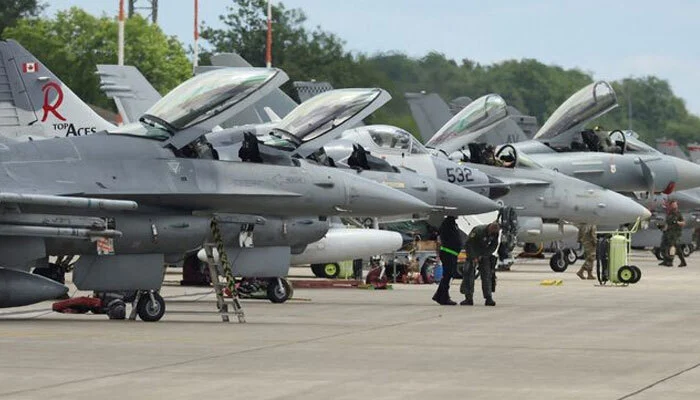
    U.S. and German sources report that the cuts include about a third of the 150 U.S. F-16 and F-15 fighter jets designated for NATO, along with refueling planes, reconnaissance aircraft, bombers, and drones.

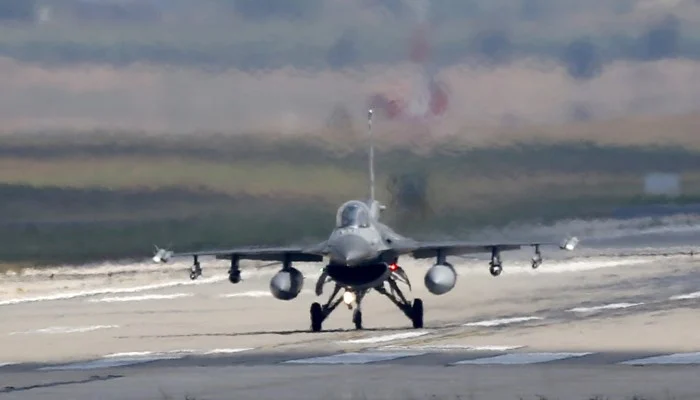
    A Turkish Air Force F-16 fighter jet lands at Incirlik Air Base in Adana, Turkey, August 11, 2015. — Reuters

    The report also states that a submarine capable of launching cruise missiles is being decommissioned, along with one of two aircraft carrier groups.

    “Overall, we will be able to compensate in many areas. Still, we need a bit more time, and that message is clear,” said German Defense Minister Boris Pistorius.

    “It’s risky and potentially dangerous for NATO’s European security if capabilities are withdrawn too quickly without clarity on when they can be restored.”

    While NATO focuses on its broader security, the alliance will also discuss bolstering support for Ukraine. President Volodymyr Zelensky plans to join a meeting with Kyiv’s military allies later today before heading to an EU leaders’ summit.

    Ukraine aims to leverage the momentum from Zelensky’s positive meeting with Trump at the G7 summit in Evian to secure additional backing in its conflict with Russia.

  • US to Cut Fighter Jets and Warships in Europe’s NATO Forces, Report

    US to Cut Fighter Jets and Warships in Europe’s NATO Forces, Report

    The United States is planning to reduce the number of fighter jets and warships it supplies to NATO forces in Europe, according to a Thursday report by the New York Times.

    These cutbacks come amid efforts by European nations to strengthen their defense capabilities following Russia’s full-scale invasion of Ukraine in 2022. The invasion has heightened fears that Moscow might target a NATO member.

    Former President Donald Trump has criticized the alliance, dismissing it as a “paper tiger” and calling its members “cowards” for not joining the US and Israel in the conflict against Iran.

    The plan involves a one-third reduction in fighter jet provisions to Europe, the elimination of all eight aerial refueling tankers, and cuts to maritime reconnaissance aircraft, the report cites two unnamed senior European officials.

    In addition, a missile-launching submarine, an aircraft carrier, a bomber group, and several jets and warships are slated for reallocation. The Pentagon has been contacted for comments.

    Earlier this month, the US European Command announced it would review Washington’s contributions to NATO to ensure that Europe assumes greater responsibility for its own conventional defense.

    US General Alexus Grynkewich criticized Europe’s reliance on US forces, describing it as an “unhealthy co-dependence.”

    Founded in 1949, NATO’s 32-member alliance’s core principle is that an attack on one member is considered an attack on all, triggering collective defense.

    Last week, US Secretary of State Marco Rubio stated that President Trump will attend a NATO summit in Turkey this July. Rubio called it “probably the most important NATO meeting in history,” emphasizing the need to resolve outstanding issues and make necessary improvements.

  • Merz Denies US Troop Cut Ties, Dismisses Rift with Trump in Germany

    German Chancellor Friedrich Merz stated that he must accept President Donald Trump’s differing opinions to collaborate with the US within NATO. He emphasized there’s no connection between their disagreements and a recent plan to reduce German troop numbers.

    Merz dismissed claims that his criticisms of US military planning in Iran triggered Washington’s announcement to cut 5,000 troops from Germany, the largest US military base in Europe. He reaffirmed his commitment to the transatlantic alliance.

    While questioning whether Trump has a clear exit strategy for the Middle East, Merz noted that the US appears to be “embarrassed” during negotiations with Iran. Trump responded by labeling Merz an “ineffectual” leader.

    In an interview with ARD set to air later on Sunday, Merz acknowledged, “I have to accept that the American president holds different views on these issues than we do. However, I remain convinced that the Americans are crucial partners for us.”

    When asked if the US troop reduction plans were related to a conflict between the leaders, Merz responded, “There’s no connection.” Trump had called for reducing US forces in Germany during his first term and has consistently urged Europeans to shoulder more responsibility for their own security.

    Friday’s decision also reportedly cancels a plan from the Biden administration to deploy a US battalion armed with long-range Tomahawk missiles to Germany. This move disappointed Berlin, which advocated for it as a strong deterrent against Russia, even as European nations develop similar capabilities.

    Merz explained that Trump had never committed to this missile deployment, and he doubts the US will relinquish such weapon systems, adding, “If anything, the Americans might not have enough of these systems themselves at the moment.”

  • US to Withdraw 5,000 Troops from Germany Amid Trump–Merz Iran War Dispute

    The U.S. is set to pull back 5,000 troops from Germany, announced by the Pentagon on Friday, amid rising tensions with Europe over the Iran conflict. President Donald Trump earlier threatened a reduction in forces following a dispute with German Chancellor Friedrich Merz, who criticized Iran’s diplomatic moves as humiliating to the U.S. and questioned Washington’s exit strategy.

    A senior Pentagon source, speaking anonymously, called Germany’s recent statements “inappropriate and unhelpful,” and clarified that the President’s reaction was justified. The withdrawal is expected to be finalized within six to twelve months. Germany currently hosts approximately 35,000 active U.S. military personnel—the largest U.S. presence in Europe.

    This drawdown aims to return U.S. troop numbers in Europe to levels before efforts by President Biden to bolster forces following Russia’s invasion of Ukraine in 2022. The move also underscores the Trump administration’s push for Europe to assume greater security responsibilities, though it highlights Trump’s readiness to punish allies seen as disloyal.

    Last week, Reuters reported on an internal Pentagon email outlining potential measures against NATO allies for not backing U.S. efforts in the Iran conflict, including considerations to suspend Spain from NATO and reconsider the UK’s claim to the Falklands.

    The question remains whether this marks the beginning of more troop withdrawals in Europe. Trump hinted at possible future actions regarding Italy and Spain, responding “probably” to questions about withdrawing from those countries. Last month, he threatened a complete U.S. trade embargo on Spain, where the government opposes US military bases and overflights that could target Iran. Notably, the U.S. maintains key bases at Naval Station Rota and Morón Air Base.

    Trump has also clashed with Italian Prime Minister Giorgia Meloni over Iran policies and criticized Pope Leo. In April, he accused Meloni of lacking courage and betraying U.S. interests. Additionally, Trump has rebuked NATO allies for not deploying naval assets to secure the Strait of Hormuz, a critical chokepoint for global oil shipments that has remained largely inactive during the Iran conflict, causing market instability and energy disruptions.

    A senior Pentagon official emphasized that President Trump is frustrated with allies’ rhetoric and their lack of support for U.S. operations that benefit them.

    Merz mentioned that Germans and Europeans were not consulted before the U.S. and Israel began targeting Iran in late February, expressing skepticism about the conflict. Trump has long sought to decrease the U.S. military footprint in Germany, initially proposing a reduction of about 12,000 troops during his first term, a plan that was halted after his electoral loss, with President Biden reversing it.

    The recent announcement surprised German military officials, who noted that Germany had contributed significantly to Iran-related operations, including providing bases and overflight permissions. Germany also hosts a substantial military hospital in Landstuhl and recently approved increased defense spending in its 2027 budget.

    Analyst Imran Bayoumi, formerly with the Pentagon, warned that the troop cuts, though less severe than possible, could deepen divisions between the U.S. and Europe. He predicts European nations will push for increased defense spending, increasingly viewing Washington as unreliable.

    As part of the troop reduction, a brigade combat team currently stationed in Germany will be withdrawn, and a long-range fires battalion planned for deployment later this year will no longer be sent, the Pentagon official added.

  • Pentagon Mulls Suspension of Spain from NATO Over Iran Tensions: Source

    A Spanish Navy soldier stands beside Spanish flags and a NATO flag inside the hangar of the Castilla LPD (Landing Platform Dock) amphibious assault ship, floating in the Atlantic Ocean on March 28, 2025. — Reuters

    – Options include suspending Spain from NATO.
    – Proposals to reduce European “sense of entitlement.”
    – Trump has issued warnings about potentially withdrawing the U.S. from the 76-year-old alliance.

    An internal Pentagon message details possible measures for the United States to discipline NATO allies it believes haven’t adequately backed U.S. efforts in the Iran conflict, such as considering Spain’s suspension from the alliance and reevaluating U.S. support for Britain’s claim to the Falkland Islands, a U.S. official disclosed to Reuters.

    The strategies are outlined in a document expressing frustration over some allies’ hesitation or refusal to grant U.S. military access, base rights, and overflight permissions—referred to as ABO—for the Iran conflict, the official explained, requesting anonymity to discuss the internal communication.

    The note emphasizes that ABO is “merely the absolute minimum for NATO,” and the options are circulating among high-ranking officials in the Pentagon.

    One of the proposed options involves removing “troublesome” countries from key NATO positions, the official added.

    President Donald Trump has publicly criticized NATO allies for not deploying their navies to help reopen the Strait of Hormuz, which was shut to global shipping after the onset of air strikes on February 28.

    He has also indicated he is contemplating exiting the alliance altogether.

    “Wouldn’t you if you were me?” Trump told Reuters in an April 1 interview, responding to whether the U.S. might leave NATO.

    However, the internal memo does not suggest an immediate U.S. withdrawal, nor does it recommend closing European bases.

    The official refused to confirm whether plans include a potential reduction of U.S. forces in Europe.

    When asked for comments, Pentagon Press Secretary Kingsley Wilson stated: “As the President has noted, despite all the efforts we’ve made for our NATO allies, they haven’t always stood with us.”

    “The Department will prepare credible options to ensure our allies aren’t just paper commitments, but engaged partners. We have no further comment on internal deliberations,” Wilson added.

    The U.S.-Israel tensions concerning Iran have sparked serious debates about NATO’s future, especially amid unprecedented concerns that the U.S. might not defend European allies if they come under attack, according to analysts and diplomats.

    Britain, France, and others argue that joining a U.S.-led naval blockade would equate to entering the war. Nonetheless, they are willing to assist in maintaining the Strait’s open status once there’s a sustained ceasefire or the conflict concludes.

    Yet, officials within the Trump administration emphasize that NATO cannot be a one-sided arrangement.

    Frustration has been expressed toward Spain, where Socialist leaders have refused to permit U.S. bases or airspace to be utilized for strikes against Iran. The U.S. maintains significant military installations in Spain, including Naval Station Rota and Moron Air Base.

    The proposed measures, outlined in the memo, aim to send a firm message to NATO partners—specifically, to diminish a European sense of entitlement, according to the official summarizing the document.

    Suspending Spain from NATO, while unlikely to impact U.S. military operations significantly, would serve as a powerful symbolic gesture.

    How exactly the U.S. would pursue such suspension remains unclear, as NATO doesn’t have a formal mechanism for expelling member countries.

    The memo also considers reevaluating U.S. diplomatic backing for long-standing European overseas territories, like the Falkland Islands. The islands, overseen by the UK but still claimed by Argentina, remain a point of contention. Argentina’s libertarian President Javier Milei, an ally of Trump, has renewed its claim.

    Back in 1982, Britain and Argentina fought a brief war over these islands, resulting in approximately 650 Argentine and 255 British deaths before Argentina surrendered.

    Trump has repeatedly insulted then-British Prime Minister Keir Starmer, labeling him cowardly for his reluctance to join U.S. efforts against Iran, and criticizing Britain’s aircraft carriers as “toys.” Initially, the UK refused to permit U.S. attack flights from its bases but later agreed to defensive missions to protect regional residents amid Iranian retaliation.

    Earlier this month, Defense Secretary Pete Hegseth remarked that the Iran conflict has exposed vulnerabilities, noting Iran’s long-range missile capabilities that threaten Europe but not the U.S.

    “We need allies willing to stand with us when it matters,” Hegseth said.

  • Mideast Conflict Drives NATO to Relocate Iraq Mission to Europe

    Mideast Conflict Drives NATO to Relocate Iraq Mission to Europe

    Nato has moved its mission in Iraq entirely to Europe due to regional conflicts, with the last non-combat staff of several hundred individuals departing Iraq on Friday. The personnel were based in an Iraqi military facility within Baghdad’s Green Zone, near the U.S. embassy, which has faced multiple attacks since the U.S.-Israeli conflict with Iran began three weeks ago.

    An official statement from Nato’s European command confirmed, “The Nato Mission Iraq has adjusted its posture, safely relocating all personnel from the Middle East to Europe.” The mission’s primary role involves supporting and training Iraqi security forces to combat terrorism, especially to prevent a resurgence of Daesh.

    Operations will now proceed from Nato’s command center in Naples, Italy. General Alexus Grynkewich, Supreme Allied Commander Europe, expressed gratitude to the Iraqi government and allies who helped facilitate the safe move. “I also want to commend the dedicated men and women of Nato Mission Iraq, who carried on their duties diligently. They are true professionals,” he added.

    Earlier on Friday, Nato announced it was modifying its Iraq mission, with a French military source confirming the relocation was temporary and driven by regional security concerns. Nato spokesperson Allison Hart emphasized that political dialogue and cooperation with Iraq, including through the Iraq mission, will remain ongoing.

    Since its inception in 2018, the mission has comprised several hundred personnel from Nato allies and partner nations such as Austria and Australia. It has been led since May 2025 by General Christophe Hintzy of France.

    A French military source explained to AFP that the decision to relocate personnel aligns with Nato’s stance on non-combat missions, noting that the current threats in the region make their continued presence less relevant. An Iraqi security official confirmed there was no disagreement with Iraqi authorities, describing the withdrawal as a temporary measure due to the escalating Middle East security situation.

  • Europe plans to reduce US defense dependence post-Greenland bid

    Europe plans to reduce US defense dependence post-Greenland bid

    Danish Navy ships maneuver near the frigate Niels Juel as Danish and French military forces carry out drills off the coast of Nuuk, Greenland, on September 15, 2025. — Reuters

    – Europeans are pushing for enhanced defense capabilities amid deteriorating US relations.
    – Rubio’s address provides only marginal reassurance to European nations.
    – Zelensky underscores the brutal reality of warfare to delegates.

    European Commission President Ursula von der Leyen expressed a sense of significant shift among European leaders at this weekend’s Munich Security Conference, stating, “Some lines have been crossed that can never be uncrossed.” Over the past year, transatlantic relations have already been strained, particularly after Donald Trump’s re-election. However, the US president’s attempt to annex Greenland has significantly heightened European concerns about Washington’s commitment to safeguarding the continent through NATO.

    In his speech at the conference, US Secretary of State Marco Rubio offered only limited reassurance. Rubio emphasized a desire for cooperation with Europe and spoke in a warmer tone than Vice President JD Vance did last year. Yet, he criticized Europe’s political direction recently and notably avoided mention of NATO, Russia, or Moscow’s invasion of Ukraine—key issues that have widened the US-Europe divide within the alliance.

    As the war nears its fifth year, with Moscow seen increasingly as a threat by neighboring European nations, leaders from the continent announced plans to accelerate their efforts to bolster defenses and reduce reliance on the US. This aligns with the expectations set during the Trump administration, which anticipated Europe assuming primary responsibility for its conventional defense. In exchange, Washington remains committed to its nuclear umbrella and the NATO mutual defense agreement.

    German Chancellor Friedrich Merz, French President Emmanuel Macron, and British Prime Minister Keir Starmer committed in Munich to developing a stronger “European pillar” within NATO. Strengthening indigenous defense capabilities also serves as a safeguard against potential future US leaders or Trump himself choosing not to defend Europe. Merz mentioned ongoing discussions with Macron regarding a European nuclear deterrent, reflecting concerns over US security assurances. France maintains the only truly independent nuclear capability in Europe, as Britain’s Trident system is American-built and maintained.

    The pressing question remains whether European leaders can translate their commitments into concrete actions—such as acquiring new weapon systems, addressing gaps like long-range missiles, and increasing coordination to secure their own defenses. Initial indications are mixed. Fears of Russia and encouragement from Trump have prompted European countries to increase defense spending substantially. NATO nations agreed last year to raise their defense budgets from 2% to 3.5% of GDP, with an additional 1.5% allocated for other security investments.

    Since the Ukraine conflict began, European defense expenditures have grown by approximately 80%, according to von der Leyen. Countries are forming joint ventures to develop advanced weaponry. French, German, Italian, Polish, and Swedish defense ministers signed a letter of intent to advance the European Long-range Strike Approach (ELSA), a project aimed at building “deep strike” missile capabilities. Additionally, during a NATO defense ministers’ meeting, several European countries agreed to collaborate on four major projects, including ballistic missile defense and air-launched munitions.

    However, some ambitious European projects face hurdles. The future of the FCAS fighter jet initiative—launched by France, Germany, and Spain—has been uncertain due to disagreements over workload distribution. Debates also revolve around whether to restrict defense procurement to EU-based companies or to include external suppliers. France advocates for a “buy European” approach, while Germany and the Netherlands prefer a more open framework.

    At the Munich conference, Ukrainian President Volodymyr Zelensky highlighted the brutal realities of modern warfare, surrounded by screens displaying statistics of Russian attacks—over 6,000 drones and 150 missiles in just the past month. Zelensky remarked, “Weapons evolve faster than political decisions to stop them,” underscoring the urgent need for continuous military support for Ukraine.

  • US to Hand Over Senior NATO Roles to Britain and Italy

    US to Hand Over Senior NATO Roles to Britain and Italy

    The U.S. is transferring two major regional NATO commands to European nations as President Donald Trump urges allies to shoulder more responsibility for their defense. Diplomats revealed that leadership of NATO’s Naples command, responsible for the alliance’s southern region, will shift to Italy, while the Norfolk command in Virginia, covering the northern region, will be handed over to Britain. At the same time, the U.S. will take control of NATO’s maritime forces based in the United Kingdom.

    A NATO official stated, “Allies have agreed on a new distribution of senior officer responsibilities within the NATO Command Structure, giving European allies— including NATO’s newest members—a more prominent role in military leadership.” However, specifics about the changes weren’t disclosed, only indicating they are part of planning for upcoming rotations.

    French outlet La Lettre first reported these developments, which are expected to take several months to implement, according to NATO diplomats who spoke privately with AFP. One diplomat commented, “This demonstrates a practical shift of burden.”

    These adjustments come amid discussions in Washington about reducing Europe’s defense footprint to better address emerging threats like China. Despite these changes, U.S. influence remains central, with continued control over NATO’s primary air, land, and sea commands and retention of the position of Supreme Allied Commander Europe.

    European nations have increased military budgets in response to Russia’s invasion of Ukraine and collectively agreed last year to boost NATO’s defense spending targets. Tensions rose recently when Trump cast doubt on the alliance’s reliability, notably with comments about Greenland, prompting a brief crisis in NATO. However, U.S. NATO ambassador Matthew Whitaker has emphasized that the goal is to strengthen the alliance by encouraging Europe to increase its defense contributions, not to diminish American involvement.

    “We’re aiming to make NATO stronger, not to withdraw or reject it. Our focus is on ensuring it functions as an alliance of 32 capable and robust members,” Whitaker said.

  • Outcry Over Trump Allegation: NATO Troops Allegedly Skipped Afghan Front

    Outcry Over Trump Allegation: NATO Troops Allegedly Skipped Afghan Front

    Britain stated on Friday that Donald Trump was “incorrect in minimizing” the contribution of NATO troops in Afghanistan, as his claim that allied forces did not engage on the front lines provoked strong criticism. During a Thursday interview on Fox News, Trump seemed unaware that 457 British soldiers lost their lives in Afghanistan following the September 11 terrorist attacks.

    He remarked, “They’ll say they sent some troops to Afghanistan,” referencing NATO allies. “And they did send some, but they stayed a bit back, a little away from the front lines.” Trump also reiterated his suggestion that NATO would not provide assistance to the U.S. if asked.

    In reality, after 9/11, the UK and numerous other allies joined U.S. efforts in Afghanistan, invoking NATO’s collective defense clause. UK Prime Minister Keir Starmer condemned Trump’s remarks as “insulting” and suggested he should apologize. “I find President Trump’s comments offensive and frankly shocking. It’s no surprise they have caused hurt among the families of those killed or injured,” Starmer stated, asserting that if he had spoken similarly, he would issue an apology.

    Furthermore, soldiers from countries like Canada, France, Germany, Italy, Denmark, and others also lost their lives in the conflict. “Their sacrifices, along with those of other NATO members, were made in defense of collective security after an attack on our ally,” Starmer’s spokesperson emphasized. “We take pride in our armed forces, and their service and sacrifice will never be forgotten.”

    Care Minister Stephen Kinnock expressed confidence that Starmer would raise the issue directly with Trump. “He will, I’m sure, bring this up with the president. Keir is extremely proud of our armed forces and will make that clear,” Kinnock told LBC Radio. He also highlighted that the only time Article 5 of NATO was invoked was in response to 9/11.

    Defense Minister John Healey confirmed that NATO’s Article 5 has been activated just once—after 9/11—and reaffirmed Britain’s commitment, stating, “The UK and NATO members responded to the U.S. call, with over 450 British soldiers dying in Afghanistan. Their bravery and sacrifice served our nation.”

    Lucy Aldridge, whose son William was 18 when he was killed in Afghanistan, told The Mirror that Trump’s comments were “deeply upsetting.” Labour MP Emily Thornberry called the remarks “more than just a mistake,” branding them “an outright insult” to the 457 families who lost loved ones. “How dare he suggest we weren’t on the front lines?” she exclaimed during a BBC Question Time session.

    Official UK figures show that 405 of the British casualties perished in hostile combat, while the U.S. lost more than 2,400 personnel.

  • Trump promotes ‘total access’ Greenland deal as NATO urges support

    Trump promotes ‘total access’ Greenland deal as NATO urges support

    Greenland’s capital, Nuuk, was viewed from above on January 15,, 2026. — Reuters

    – NATO plans to bolster its Arctic presence as part of a U.S.-led framework agreement.
    – President Trump’s intentions toward Greenland are straining transatlantic relations.
    – EU leaders are cautious about trusting U.S. commitments following the Greenland controversy.

    President Donald Trump announced on Thursday that he secured indefinite U.S. access to Greenland through a deal with NATO, whose secretary emphasized that allies must increase their Arctic security efforts to counter threats from Russia and China.

    The announcement of this framework agreement coincided with Trump relaxing tariff threats against Europe and ruling out military action to seize Greenland, easing what had been a potential major fracture in transatlantic relations.

    While European markets rebounded and Wall Street neared record highs, skepticism remains about the potential damage already inflicted on transatlantic trust and business confidence.

    Details of the agreement remain unclear, with Denmark asserting that its sovereignty over Greenland is non-negotiable. EU foreign policy chief Kaja Kallas remarked that relations with the U.S. have “suffered a major blow” recently, as EU nations gathered for an emergency summit.

    Greenland’s Prime Minister, Jens-Frederik Nielsen, expressed cautious optimism regarding Trump’s comments but admitted he was still in the dark about many specifics.

    “I don’t know what’s in the agreement or deal concerning my country,” he told reporters in Nuuk.

    “Many topics are open for discussion, and we’re willing to negotiate a better partnership. But sovereignty is a red line,” he added, when asked about reports that Trump aimed for control over regions around U.S. military bases in Greenland as part of a broader deal.

    On his return from the World Economic Forum in Davos, Switzerland, Trump told reporters aboard Air Force One that negotiations are ongoing for a deal that would be “much more generous to the United States—much more so.”

    He declined to address sovereignty directly but emphasized: “We have to be able to do exactly what we want.”

    Earlier, Trump told Fox Business Network that the agreement would essentially grant “total access” rights to the U.S.

    “There’s no deadline or limit,” he said.

    A source familiar with the negotiations told Reuters that NATO Secretary General Jens Stoltenberg and Trump agreed in Davos to hold further talks involving the U.S., Denmark, and Greenland to revisit the 1951 agreement governing U.S. military presence and access on the island.

    The framework discussed also includes measures to block Chinese and Russian investments in Greenland.

    Another insider noted that what was agreed upon was “a starting point for discussions,” emphasizing that details reported are speculative.

    Rutte indicated to Reuters during Davos that NATO’s top commanders will handle the specifics of security arrangements, hoping for a swift resolution—preferably in early 2026.

    Denmark insists the sovereignty of Greenland, a semi-autonomous Danish territory, remains unchanged. Prime Minister Frederiksen stated no negotiations have taken place regarding territorial sovereignty but acknowledged progress in joint Arctic security initiatives.

    She also called for a “permanent NATO Arctic presence, including around Greenland.”

    Kallas pointed out that disagreements between allies, such as Europe and America, only serve adversaries who are observing.

    Finnish President Alexander Stubb expressed hope for a plan to enhance Arctic security by the NATO summit scheduled for July in Ankara.

    British Prime Minister Keir Starmer confirmed that the UK stands ready to contribute fully to Arctic security efforts.

    Following talks with Rutte, Trump suggested potential agreements that would satisfy his desires for a “Golden Dome” missile defense system and access to critical minerals, while preventing Russia and China from expanding in the region.

    Rutte clarified that mineral rights were not discussed, and negotiations about Greenland’s strategic future continue directly among the U.S., Denmark, and Greenland.

    The 1951 pact originally allowed the U.S. to build military bases and operate freely across Greenland, provided Denmark and Greenland are kept informed. Currently, the U.S. maintains a base at Pituffik in northern Greenland.

    Marc Jacobsen, a professor at the Royal Danish Defence College, highlighted that during the Cold War, the U.S. operated 17 bases there, indicating that more extensive activities could be resumed under the existing agreement.

    He added, “I anticipate concrete discussions about the Golden Dome missile system and about excluding Russia and China from Greenland.”

    The EU Parliament’s president indicated that the EU might resume work on a trade deal with the U.S. now that Trump has withdrawn tariff threats. Previously, work had been paused due to those threats.

    However, diplomatic sources reveal that confidence in transatlantic relations has been significantly shaken, prompting EU leaders to reassess their expectations of U.S. commitments. Many remain wary of future U.S. shifts, viewing Trump increasingly as unpredictable.

    Back in Nuuk, residents are also hesitant. Pensioner Jesper Muller commented, “It’s all very confusing. One moment we’re on the brink of war; the next, everything seems fine. It’s hard to build on this instability.”

  • Greenland PM Uncertain About Contents of Trump-Rutte Deal

    Greenland PM Uncertain About Contents of Trump-Rutte Deal

    Greenland’s Prime Minister Jens-Frederik Nielsen held a press conference in Nuuk on January 22, 2026, where he stated he was unaware of the details of a framework agreement concerning Greenland, the autonomous Danish territory, announced by U.S. President Donald Trump after his meeting with NATO’s Secretary-General. Nielsen emphasized that any deal involving Greenland and Denmark must involve the island itself.

    He declared, “No one besides Greenland and Denmark has the authority to negotiate or agree on matters related to Greenland’s sovereignty without our involvement.” He also highlighted the importance of respecting territorial integrity, international law, and sovereignty as red lines for Greenland.

    President Trump reversed his earlier threats to forcibly take Greenland after discussions with NATO’s Secretary-General Mark Rutte, describing an emerging “framework” agreement on the territory. However, specifics of this agreement, discussed at the World Economic Forum in Davos, are largely unknown.

    Nielsen expressed his relief that Trump had clarified the use of force was off the table but reiterated he had no knowledge of any specific contents of the deal, noting he was not part of the negotiations.

    Sources familiar with the talks indicated that the agreement included a plan for the U.S. and Denmark to renegotiate a defense pact from 1951 concerning Greenland. There was no mention during the discussions of placing U.S. military bases on Greenland under U.S. sovereignty.

    Greenland’s Deputy Prime Minister Mute Egede posted on social media that it was unacceptable to attempt to hand over their land to others. Nielsen affirmed that if Greenland had to choose between remaining part of Denmark or joining the U.S., their preference would be Denmark, the European Union, and NATO.