الوسم: India

  • Rubio Visits India to Strengthen Ties Post-Trump’s China Focus

    Rubio Visits India to Strengthen Ties Post-Trump’s China Focus

    • Rubio had a private meeting with Prime Minister Narendra Modi during his visit to India.
    • The US Secretary of State described India as a “great ally and partner.”
    • Rubio mentioned that the US is exploring ways to increase oil sales to India.

    On Saturday, US Secretary of State Marco Rubio visited India and met with Prime Minister Narendra Modi in a private session, aiming to strengthen their relationship shortly after a productive summit between Washington and China. During his first trip to both Asian powers, Rubio spent over an hour in closed-door talks with Modi in New Delhi, according to a US official.

    Rubio, known for his devout Catholic faith, began his four-day, four-city journey by visiting Mother Teresa’s charity headquarters in Kolkata, where he paid respects at her tomb. Wearing a yellow garland over his suit and accompanied by his wife Jeanette, Rubio was seen smiling before a group of nuns dressed in the classic white and blue saris associated with the late humanitarian.

    He discussed issues such as helping the homeless, the terminally ill, and those suffering from leprosy, Sister Marie Juan of Missionaries of Charity told reporters after their one-and-a-half-hour meeting. She added that Rubio was happy to pray, and they were pleased to receive him.

    US Ambassador to India Sergio Gor, also a Catholic, later commented that the partnership between the two countries is rooted in shared values, not just policies.

    Before departing on Tuesday, Rubio plans to participate in a meeting of foreign ministers from the Quad alliance—comprising Australia, India, Japan, and the US—a coalition seen as a counterbalance to China’s influence in the Indian Ocean. China has long viewed the Quad with suspicion, accusing it of trying to encircle China, and has previously criticized India for participating.

    Rubio’s visit occurs amidst shifts in US foreign policy priorities under former President Trump, who recently visited China and praised the reception from President Xi Jinping, despite limited concrete agreements. Trump also revived the concept of a “G2” partnership between the US and China, a notion that had fallen out of favor amid concerns from US allies about marginalization in dealings with China.

    While Trump seldom emphasizes human rights, some of his political base are concerned about the treatment of Christians under Prime Minister Modi’s Hindu nationalist government. Since Modi’s rise in 2014, there have been reports of increased violence and vandalism targeting religious minorities, particularly Christians, though the government dismisses these claims as exaggerated or politically motivated.

    Rubio highlighted India as a “great ally” and explained that the US is considering ways to boost oil exports to the country. India’s rapidly growing economy depends heavily on energy imports and has been affected by the US-Israeli sanctions on Iran, which led Iran to block the Strait of Hormuz, causing global oil prices to spike. Despite having deep ties with Iran, India has also expanded its relationship with Israel, with Modi visiting Israel just days before Iran’s reactionary response.

    The recent conflicts have also seen India’s traditional adversary Pakistan reemerging as a key US partner, with Pakistan positioning itself as a mediator—its military chief flying to Tehran this week. Historically, the US allied with Pakistan during the Cold War but has shifted focus toward India as the larger democratic partner amid China’s rise. Trump has recently improved relations with Pakistan, which has praised his diplomacy during last year’s brief conflict with India, and even entered into a cryptocurrency partnership connected to the President’s family. Trump’s stance became more complex when Modi didn’t credit him for ending that conflict, leading to tariff increases on India, though some tariffs were later reduced through trade negotiations.

  • India faces power shortages as heatwave spikes electricity demand to record

    India faces power shortages as heatwave spikes electricity demand to record

    Parts of India are experiencing power outages as record-breaking temperatures push electricity demand to an all-time high of over 270 gigawatts. In response, the government has asked consumers to reduce their energy usage. An El Nino weather pattern is causing above-average summer temperatures across much of the subcontinent this May, with residents in Chennai reporting nighttime outages lasting between 40 minutes and an hour, particularly impacting manufacturing and tech hubs.

    “South Chennai has faced frequent power cuts over the past couple of days, with outages happening at short intervals,” said R Hari, a local resident. “This makes it hard to work from home.” According to the national grid operator, late Thursday evening’s power deficit hit around 2.57 gigawatts.

    The Ministry of Power issued a statement on Friday urging people to conserve electricity during this intense summer period, saying, “Although we are ready to supply electricity as needed, due to the extreme heat, everyone should use power wisely and responsibly.”

    Supply shortages are especially severe in the evenings, as the grid relies heavily on thermal and hydropower sources during those hours. During the day, solar energy partially meets the rising demand. Experts note that the extreme heat and soaring electricity needs are straining India’s power system—highlighting the urgent need to accelerate the development of battery storage systems to better utilize surplus solar power collected at night.

    Weather agencies have forecasted “heatwave to severe heatwave conditions” in New Delhi and much of northern and eastern India from Friday through May 27. Many residents in the capital and nearby Noida have taken to social media to complain about power outages during nighttime. In Odisha, a state on the eastern coast, some consumers have protested longer and more frequent outages that occur both during the day and night.

  • Modi’s Rome tour: Colosseum selfies and ‘Melody’ toffee indulgence

    Modi’s Rome tour: Colosseum selfies and ‘Melody’ toffee indulgence

    Italy’s prime minister Giorgia Meloni welcomes her counterpart India’s Narendra Modi for a meeting at Villa Doria Pamphili in Rome on May 20, 2026. — AFP

    ROME: Indian Prime Minister Narendra Modi and Italian Prime Minister Giorgia Meloni snapped selfies at the Colosseum and enjoyed views over Rome before their talks, which focused on trade, on Wednesday.

    In a video posted to X, Meloni also expressed gratitude to Modi for bringing a packet of “Melody” toffees during his visit, with both leaders sharing a laugh over the gift—a playful nod to their names.

    Concluding a European tour, Modi arrived in Rome on Tuesday for his first bilateral visit to Italy in 26 years.

    Modi’s previous visits to Italy included attending G20 meetings in 2021 and G7 summits in 2024.

    In an editorial published in Italy’s Corriere della Sera, the leaders expressed their goal to “surpass the 20 billion euro ($23 billion) trade target with Italy by 2029.”

    They highlighted sectors of particular interest: defense, aerospace, automotive parts, clean energy technologies, and textiles.

    “We aim to create a strong synergy between Italian design, manufacturing expertise, and cutting-edge supercomputers, alongside India’s rapid economic growth, engineering talent, scale, innovation, and entrepreneurial culture,” they stated.

    Last year, bilateral trade between Italy and India reached approximately €14.25 billion, according to the Indian embassy in Italy.

    Later Wednesday, the leaders are scheduled to hold private discussions at Villa Pamphili, a historic 17th-century estate located west of Rome’s city center.

    Modi also mentioned on X that he plans to visit the headquarters of the United Nations Food and Agriculture Organization (FAO) in Rome, underscoring India’s commitment to multilateralism and global food security.

  • Indian Court Declares Bhojshala Mosque a Hindu Temple

    Indian Court Declares Bhojshala Mosque a Hindu Temple

    A court ruling has terminated a 20-year-old worship agreement at the Bhojshala-Kamal Maula mosque complex in Madhya Pradesh, India, allowing daily Hindu prayers to resume. The Madhya Pradesh High Court’s Indore bench declared the site a Hindu temple dedicated to goddess Vagdevi (Saraswati), based on a 2024 Archaeological Survey of India (ASI) report indicating the structure was built using fragments of older temples, with the mosque constructed centuries later.

    Following the decision, the ASI issued a directive on May 16 permitting Hindu devotees unrestricted access for daily worship, replacing prior arrangements that limited Hindu worship to Tuesdays and Muslim Friday prayers. Advocate Vishnu Shankar Jain, representing Hindu petitioners, emphasized that Hindus can now visit and worship at the site freely.

    The site remains a protected monument under India’s 1958 law, with worship timings set by the superintending archaeologist in consultation with local authorities. The court’s ruling notes that the complex was built using remnants from earlier temples, reinforcing its status as a Hindu religious site. The Muslim community was offered an alternative location for building a mosque, but Dhar city Qazi Waqar Sadiq stated that Muslim petitioners plan to appeal to the Supreme Court and have expressed opposition to relocating.

    This site has long been a flashpoint, with Hindu groups claiming it is a Saraswati temple, while Muslims insist it is the Kamal Maula mosque. The decision effectively restricts Muslim access for prayer, placing the mosque off-limits. Legal, historical, and political voices from the Muslim community have criticized the ruling, warning it jeopardizes protections for Muslim religious sites in India. Lawyer Ashhar Warsi labeled it a “misjudgment” and a violation of established law, while politician Asaduddin Owaisi warned that the verdict poses a “serious threat” to Muslim worship rights and suggested it could set a precedent for similar claims, echoing concerns about the aftermath of the Babri Masjid verdict.

    Historian Audrey Truschke commented that this trend of targeting Islamic places of worship reflects deep-seated Islamophobia rooted in Hindu nationalism. The dispute is part of a broader movement to challenge medieval mosques and Islamic-era monuments across India, with claims that many were built over Hindu temples, a narrative that has gained momentum since Prime Minister Narendra Modi took office in 2014.

  • Trump Admin Drops Cases Against Adani After $10bn Investment pledge

    Trump Admin Drops Cases Against Adani After $10bn Investment pledge

    The Trump administration has announced plans to drop criminal fraud charges against Indian billionaire Gautam Adani, while also reaching a settlement over alleged violations of Iran sanctions involving one of his companies, court documents reveal.

    This development comes after Adani’s legal counsel—who also serves as a personal lawyer for former President Donald Trump—stated last month that Adani intended to invest $10 billion in the U.S. but couldn’t proceed with the investments until the legal issues were resolved, according to an insider familiar with the situation.

    This move exemplifies a pattern where the Justice Department, under Trump, has chosen to abandon high-profile cases initiated during his predecessor Joe Biden’s administration.

    Gautam Adani, a prominent supporter of Indian Prime Minister Narendra Modi, has an estimated net worth of $82 billion, according to Forbes magazine.

    Previously, he was charged with conspiring to pay $265 million in bribes to Indian government officials to secure approval for the development of India’s largest solar power plant. Prosecutors alleged that Adani and his associates raised over $3 billion by concealing corrupt activities from lenders and investors.

    The Adani Group has strongly denied any wrongdoing. Adani himself is both the founder and chairman of the company.

    Separately, the U.S. Securities and Exchange Commission (SEC) settled a civil lawsuit with Adani over accusations related to a scheme to bribe Indian officials, court records show last week. However, the settlement is pending court approval.

  • Violent Storm Ravages India’s Most Populous State, 100+ Dead

    Violent Storm Ravages India’s Most Populous State, 100+ Dead

    A fierce storm swept through Uttar Pradesh, India’s most populous state, on Thursday, bringing heavy rain and hail that resulted in over 100 fatalities. Rescue officials confirmed the death toll and stated that some victims fell prey to falling trees or collapsing walls. In the wake of the disaster, authorities plan to quickly distribute relief funds to the affected residents within the next 24 hours.

    While tornadoes and storms are frequent in this region during the early hot months from March to June, before the monsoon season arrives, Wednesday’s storm was particularly destructive. It injured 59 individuals, damaged 87 houses, and caused the death of 114 livestock, according to officials.

    Most of the fatalities occurred in around a dozen districts, with the area surrounding Prayagraj—an important Hindu pilgrimage city—being the hardest hit, according to Hrishikesh Bhaskar Yashod, the relief commissioner for the state.

    Ashok Rai, a resident of Obra, a coal-rich industrial town in Sonbhadra district, described the chaos: “The whole area turned black for about half an hour. Strong winds lifted signboards and debris, including thick coal dust, and tossed them around.”

    Images broadcast on television showed uprooted trees, toppled billboards smashing into cars, and wooden furniture knocked over at roadside stalls. A video captured a man being violently pulled from a tin structure by the storm, injuring him but leaving him alive.

    Officials also noted that falling trees and walls collapsed, claiming additional lives. In response, Chief Minister Yogi Adityanath urged officials to extend aid and deliver financial assistance immediately, emphasizing the importance of swift relief efforts.

    Prime Minister Narendra Modi’s ruling party oversees the state government, which is actively engaged in providing support to those affected by this devastating storm.

  • India’s Modi reduces motorcade size to conserve fuel

    Indian Prime Minister Narendra Modi has drastically reduced the size of his motorcade to conserve fuel, according to a government source on Wednesday. This change comes just days after Modi called on citizens to practice austerity, especially amid rising energy costs caused by the ongoing Iran conflict.

    On Sunday, Modi urged the public to cut back on non-essential travel abroad, rely on public transportation, limit gold purchases, and reduce their consumption of cooking oils. This appeal was prompted by soaring global energy prices, which are putting pressure on India’s foreign currency reserves.

    In response, some critics on social media questioned the extensive motorcades of senior officials, Modi’s domestic flights, and his upcoming trip to Europe aboard his official aircraft. The prime minister’s convoy now features fewer vehicles but maintains all necessary security measures, following protocols established by the Special Protection Group responsible for his safety. While exact numbers weren’t disclosed, it was previously known that Modi’s motorcade consisted of around a dozen vehicles.

    Modi has also scaled back his motorcade for recent visits to his home state of Gujarat and the northeastern state of Assam. Additionally, he requested that electric vehicles be integrated where possible, without any new purchases.

    The Prime Minister’s Office has yet to comment on these changes. As the world’s third-largest oil importer and consumer, India heavily depends on the Strait of Hormuz, which remains closed due to the war between Iran and the US-Israeli coalition, for oil, natural gas, and cooking gas supplies.

    Rising oil prices threaten to increase India’s current account deficit, slow economic growth, and boost inflation. Despite efforts to avoid increasing fuel prices thus far, a hike appears likely as tensions in the Middle East persist.

  • Modi Govt Faces Criticism for Blocking Viral Satire Reel Under IT Law

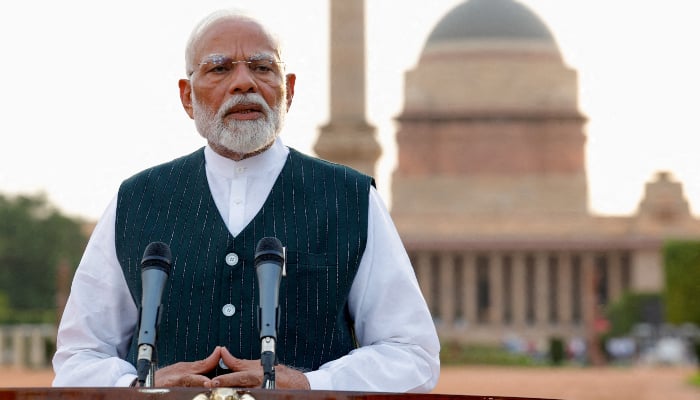
    Indian Prime Minister Narendra Modi addresses the media at the Presidential Palace in New Delhi, India, June 7, 2024. — Reuters

    <figcaption contenteditable="true" class="" spellcheck="false">Indian Prime Minister Narendra Modi addresses the media at the Presidential Palace in New Delhi, India, June 7, 2024. — Reuters</figcaption>

    Indian YouTuber Dhruv Rathee has called on supporters to widely share a trending satirical video that was recently blocked in India, accusing the Modi government of abusing the IT Act.

    In his video, Rathee mentioned that the clip had accumulated 16 million views before it was barred in India.

    “This reel had 16 million views. Yet, the Modi administration misused the IT Act to block it here. This reflects the current level of free speech in the country,” he stated.

    Rathee argued that favorable content about Indian Prime Minister Narendra Modi is often promoted, whereas critical or humorous commentary targeting him is suppressed on social media platforms.

    “If you praise Modi, he might help your films get prominent screenings. But if you reveal the truth about him, even through comedy, they won’t even let your videos be online,” Rathee accused.

    He expressed confidence that the community has the power to act and announced plans to upload the video again.

    “Most people don’t realize how strong they are. Let’s make them see it. I’ll upload this reel again, and this time, I want it to reach over 30 million views,” Rathee declared.

    He then encouraged viewers to download the video and share it widely via WhatsApp, warning: “Next time, think carefully before suppressing such content.”

    The video in question humorously depicted a fictional conversation involving “Mr. Modi” and a foreign diplomat, touching on global issues such as the Ukraine-Russia conflict and tensions between the US and Iran.


  • India State Elections Highlight Growing Hindu-Muslim Divide

    Supporters of India’s ruling Bharatiya Janata Party (BJP) celebrate outside the party’s regional office in Kolkata, India, on May 4, 2026, as the party leads in the West Bengal state assembly elections. — Reuters

    In the recent elections across four states, the Congress party has gained increased Muslim voter support, while the BJP has solidified its base among Hindus, according to analysts. Adhikari describes the BJP’s victories in Assam and West Bengal as a triumph of Hindutva.

    PM Modi’s BJP opted not to run Muslim candidates in key regions, instead relying on strong Hindu voter backing for their wins. Data from the elections shows a clear trend: Muslim voters have increasingly supported the Congress party, while Hindu voters predominantly favored Modi’s BJP. This pattern underscores escalating religious polarization within the country’s secular framework, reflecting a persistent ideological divide between the two major parties.

    Since coming to power in 2014, Modi has championed a pro-Hindu agenda, with the BJP aligning with Hindutva—a Hindu-centric ideology. This voter split benefits the BJP, as Hindus make up nearly 80% of India’s 1.42 billion population, with Muslims constituting about 14%.

    Political analyst Rasheed Kidwai notes, “The rise of the BJP has prompted Muslim voters to consolidate behind so-called secular parties, especially Congress—what we’re witnessing is a form of reverse polarization.” Muslim leaders indicate that their communities are increasingly turning to Congress or regional parties over smaller parties that focus on Muslim issues but rarely enter government.

    The latest election results, announced this week, reveal Congress’s poor performance overall. The party gained control of just one state, while BJP-led coalitions overtook three others, and a regional group won the remaining contest. In Assam, where BJP maintains power, 18 of the 19 newly elected lawmakers are Muslim—up from about 16 in the last assembly. The BJP fielded 20 Muslim candidates out of 126 seats and won 82 seats overall. Meanwhile, the All India United Democratic Front (AIUDF), which primarily relies on Muslim support, saw its seats drop from 16 five years ago to just two.

    In West Bengal, which the BJP secured for the first time with 207 seats out of 294, the two Congress legislators elected were Muslim. Neither Assam nor West Bengal saw Muslim candidates from the BJP—support for the party was attributed by leaders, including Bengal’s prospective chief minister Suvendu Adhikari, to Hindu voters. “It was a victory for Hindutva,” Adhikari stated.

    Looking ahead, political columnist Radhika Ramaseshan suggests, “Depending on regional dynamics, Muslim voters might continue to consolidate behind Congress, prompting Hindu voters to rally more strongly around the BJP.” Congress has capitalized on fears among Muslim voters who feel marginalized under BJP rule and question their citizenship, argues Badruddin Ajmal, head of AIUDF.

    He adds, “The narrative is that only a party capable of challenging the BJP at the national level can address these concerns. While this isn’t entirely accurate, voters are scared.” In response, the BJP accuses Congress of becoming a “new Muslim League,” though Congress asserts Muslims constitute about 12% of its 664 state legislators nationwide, with Hindus making up approximately 78%, consistent with India’s demographics.

    Congress spokesperson Pawan Khera expressed discomfort over discussions of religion, emphasizing that the party has broad, inclusive support. “We’ve historically stood for the oppressed and vulnerable, regardless of their religion or caste, and we will continue to do so,” he affirmed.

    While the BJP has also sought Muslim outreach, it did not nominate Muslim candidates in the 2024 general elections. Modi has consistently denied using religion to win votes, asserting, “If I start talking about Hindus and Muslims in politics, I’ll lose my ability to serve the public. That’s my commitment.”

    However, Ramaseshan notes that religious rhetoric, particularly around election time, has sharply increased under Modi compared to earlier BJP leadership. “The BJP and its ideological parent, the Sangh, are shaping a new vision of India as a ‘Hindu Rashtra,’ and that narrative is increasingly influencing the national consciousness. This could lead to a fundamental shift in how India’s identity is perceived in the future,” she warns.

  • Modi Celebrates Historic Victory in West Bengal Opposition-Run State

    Indian Prime Minister Narendra Modi greeted his supporters upon arriving at the Bharatiya Janata Party (BJP) headquarters, celebrating the party’s victory in the West Bengal and Assam state legislative elections in New Delhi on May 4, 2026.

    Votes are still being counted under tight security in the over 100 million-person state, one of five regions holding elections in April and May, with results expected to be announced soon.

    This victory is expected to strengthen Modi’s position as he faces ongoing economic and foreign policy hurdles, such as high unemployment and an upcoming U.S. trade agreement, ahead of the 2029 national elections.

    In West Bengal, a state where the BJP has never previously won, the party is leading in 156 of the 293 seats and has secured 48 others, based on data from the Election Commission of India.

    Modi shared on social media, “The 2026 West Bengal Assembly Elections will be remembered forever. The people’s power has triumphed, and BJP’s governance-oriented politics has prevailed.” He also credited the party’s dedicated workers across generations for the win, praising their efforts.

    Supporters and senior officials celebrated the victory exuberantly in Kolkata, dancing to celebratory music.

    The BJP, which is the ruling party at the national level, launched an aggressive campaign to oust Mamata Banerjee’s powerful regional party, which has been in control of West Bengal since 2011.

    During vote counting, clashes broke out at several centers, and police used batons to control crowds—a reminder of the violence that has characterized past elections. The campaign was notably marked by protests over the removal of millions of names from voter rolls, a move officially aimed at disqualifying ineligible voters but criticized as discriminatory against marginalized and minority groups.

  • NY Mayor Mamdani Urges King Charles to Return Koh-e-Noor Diamond

    During a visit to the 9/11 Memorial in New York City on April 29, 2026, Britain’s King Charles, standing alongside Queen Camilla, engaged with New York City Mayor Zohran Mamdani. Mamdani, who is of Indian American descent, expressed a wish for the King to return the Koh-i-Noor Diamond during a press conference held hours before a ceremony honoring the victims of the September 11 attacks. When asked about the diamond, Mamdani remarked, “If I had a chance to speak with the king privately, I would likely encourage him to return the Koh-i-Noor.” Later that day, the King and Mamdani exchanged words at the memorial ceremony. Buckingham Palace chose not to comment, and Mamdani’s office did not respond to inquiries about discussing the matter with the monarch.

    The Queen Mother’s crown, which prominently features the 105-carat Koh-i-Noor diamond in the central cross, has been a focal point in debates. India has repeatedly called for Britain to repatriate the diamond, which was presented to Queen Victoria in 1850 by Britain’s colonial governor-general after the annexation of Punjab in 1849 and the seizure of the gem from a deposed Indian leader. Historically, the Koh-i-Noor has belonged to Mughal emperors, Persian shahs, Afghan emirs, and Sikh maharajas, according to the Historic Royal Palaces charity.

    Charles paid tribute to those lost in the September 11, 2001, terrorist attacks by placing a floral bouquet at the memorial where the twin towers once stood. India gained independence from Britain in 1947, but the legacy of colonization and the atrocities committed during that era remain sensitive topics. India regards the diamond as a cherished artifact with deep roots in its national history, while many in the country see Britain’s ownership as a symbol of colonial oppression.

  • India Names Modi Ally as Bangladesh Envoy Amid Thaw in Ties

    India has appointed seasoned politician Dinesh Trivedi as its new high commissioner to Bangladesh, marking a rare instance of selecting a non-foreign service officer for the role. This move reflects New Delhi’s effort to mend and strengthen diplomatic ties with its eastern neighbor.

    Relations between India and Bangladesh suffered after a popular uprising in 2024 led to Bangladesh’s longtime Prime Minister Sheikh Hasina fleeing to New Delhi, where she remains. Trivedi’s appointment underscores India’s focus on rebuilding trust and influence in Bangladesh amid fierce competition from China for regional and economic dominance.

    At 75, Trivedi is a former minister of railways and health. He joined Prime Minister Narendra Modi’s Bharatiya Janata Party in 2021, transitioning from a regional party in West Bengal—a crucial border state that influences India-Bangladesh relations. Modi has been actively working to expand his party’s footprint in West Bengal through local elections.

    The Indian government indicated that Trivedi would assume his diplomatic responsibilities soon. Tensions began easing after the February election brought Tarique Rahman of the Bangladesh Nationalist Party to power, replacing an interim government that had leaned strongly towards China.

    Recently, Bangladesh’s foreign minister visited New Delhi to discuss increasing fuel and fertilizer supplies, boosting energy collaboration, and relaxing travel restrictions. However, a major sticking point remains India’s refusal to extradite Sheikh Hasina, continuing the complexity of bilateral relations.

  • India criticizes Trump over ‘hellhole’ comment on birthright citizenship

    India has dismissed as “uninformed” President Donald Trump’s comments describing the country as a “hellhole,” stating they are inappropriate and do not reflect the true state of India-U.S. relations. The remarks originated from conservative commentator Michael Savage during an episode of The Savage Nation radio show. Trump shared a transcript of Savage’s comments on his Truth Social platform Thursday, without added commentary.

    Savage’s statement included: “A baby here becomes an instant citizen, and then they bring the entire family in from China or India or some other hellhole on the planet.” He also claimed that there is almost no loyalty among recent immigrants, contrasting this with European Americans of the past.

    Reuters was unable to reach Savage for comment.

    Trump has recently proposed changes to restrict birthright citizenship in the U.S., a move that has faced legal challenges in the Supreme Court. Earlier this month, he attended a historic hearing on the matter.

    India’s foreign ministry responded sharply to the comments on Thursday:

    “The remarks are clearly uninformed, inappropriate, and in poor taste,” said spokesperson Randhir Jaiswal. “They do not reflect the reality of India-U.S. relations, which are rooted in mutual respect and shared interests.”

    The U.S. embassy in New Delhi stated, “The president has expressed that ‘India is a great country with a very good friend of mine at the top.’”

    China’s foreign ministry did not respond immediately to a request for comment from Reuters.

    India’s main opposition party, Congress, called the “hellhole” comment “extremely insulting and anti-India,” emphasizing that it hurts every Indian. They urged Prime Minister Narendra Modi to raise the issue directly with President Trump and voice strong objection.

    According to Indian government data, nearly 5.5 million people of Indian origin live in the United States. Indian Americans and Chinese Americans are the largest Asian communities there.

    While Trump and Modi maintained friendly ties during Trump’s first term, relations cooled after India faced significant U.S. tariffs last year; many were rolled back this year. Currently, India and the U.S. are working toward a trade agreement aimed at preventing further tariffs and increasing bilateral trade.

  • India warehouse fire kills 8: police confirm casualties

    India warehouse fire kills 8: police confirm casualties

    A firecracker storage facility in southern India caught fire on Tuesday, resulting in at least eight fatalities—the second such incident in just three days. Nakul Rajendra Deshmukh, police chief of Thrissur district in Kerala, stated that rescue efforts have concluded following the tragic blaze, which injured 15 individuals, including two in critical condition. Authorities are still working to determine the exact cause of the fire. Local reports indicate the fire erupted during preparations for a Hindu festival.

    Prime Minister Narendra Modi expressed his sorrow over the loss of lives via social media, offering his deepest condolences to the families impacted. On Sunday, a similar fire at a firecracker factory in Tamil Nadu claimed 20 lives. Such industrial accidents are frequently seen across India, often caused by lapses in safety protocols and inadequate enforcement. Last month, a fire at a fireworks factory in western India resulted in 17 deaths.

  • India and South Korea Aim for $50B Trade Boost with New Agreements

    India and South Korea Aim for $50B Trade Boost with New Agreements

    South Korean President Lee Jae Myung, his wife Kim Hye Kyung, Indian President Droupadi Murmu, and Prime Minister Narendra Modi pose for a photograph during Lee’s ceremonial reception at Rashtrapati Bhavan in New Delhi, India, April 20, 2026. — Reuters
    • India and South Korea to strengthen collaboration in energy sector.
    • South Korea’s president makes their first state visit to India in eight years.
    • After India, the South Korean president will visit Vietnam.

    India and South Korea announced plans on Monday to enhance their economic partnership by expanding cooperation in energy, essential minerals, shipbuilding, semiconductors, and steel, aiming to double their trade volume to $50 billion by 2030. The two nations also agreed to restart negotiations and energize their 2010 trade pact, seeking a more balanced trade relationship—India desires more equitable trade, while South Korea seeks greater market access to India’s rapidly growing economy.

    President Lee Jae Myung is on a three-day visit to India, the first South Korean presidential state visit there in eight years. After discussions with Prime Minister Narendra Modi, Lee stated, “We decided to upgrade the framework of economic cooperation to drive mutual growth.” This includes establishing a ministerial-level economic cooperation committee for the first time, with plans to boost collaboration in nuclear energy, clean energy, trade, and investment. Given the current disruptions in global energy supplies, especially due to tensions with Iran, India and South Korea will also work together to secure stable energy resources and raw materials such as naphtha.

    Modi highlighted the significance of Lee’s visit, noting that both nations made key decisions to elevate two-way trade to $50 billion by 2030, up from around $27 billion today. “Today, we are laying the groundwork for the success of the coming decade,” Modi said, referencing the deep civilizational ties spanning centuries between the two countries.

    Major investment in India’s steel industry

    India’s Trade Minister Piyush Goyal discussed with South Korea’s Yeo Han-koo strategies to renew and enhance the trade agreement, exploring new opportunities in manufacturing, green energy, and digital commerce. Later on Monday, Lee will attend a joint business forum expected to host about 250 South Korean delegates, including executives from major companies like Samsung Electronics, Hyundai, and LG Group, according to Yonhap News Agency.

    The two countries plan to sign roughly 20 private-sector memoranda of understanding related to shipbuilding, digital technology, and energy during the forum. In a separate announcement, Posco Holdings disclosed plans to partner with India’s JSW Steel to develop a large-scale steel plant in Odisha, with an investment of around $1.09 billion expected through 2031. This project, announced last week, involves building a 6-million-ton-per-year facility.

    South Korea’s Maeng Hyun-chul, a researcher at Seoul National University’s Asia Center, noted last week that India’s persistent trade deficit with South Korea remains a concern, and political ties haven’t matched the scale of economic relations. Last year, South Korea recorded a trade surplus of $12.8 billion, with exports totaling $19.2 billion and imports at $6.4 billion, according to Korea International Trade Association data.

    Following India, Lee plans to visit Vietnam, continuing his diplomatic engagements.

  • Modi Advocates for Greater Women’s Representation in Parliament Reform

    Modi Advocates for Greater Women’s Representation in Parliament Reform

    The Indian government is undertaking a comprehensive effort to reform its democratic framework. On Thursday, they introduced legislation aimed at expanding Parliament’s size and accelerating plans to reserve one-third of legislative seats for women. Opponents criticized these moves as attempts to influence electoral outcomes.

    Prime Minister Narendra Modi announced in the lower house of Parliament that these proposals, which also involve increasing the number of legislative members and women in regional assemblies and redistricting constituencies, would steer India toward a “new trajectory.” He expressed confidence that amplifying women’s voices would infuse the parliamentary process with fresh perspectives, strength, and increased sensitivity.

    The government explained that the adjustments to electoral boundaries are based on demographic shifts since the last seat allocations, which were set following the 1971 census.

    Opposition parties contend that changing constituency boundaries in this manner is unconstitutional. Since Modi’s ruling coalition, the National Democratic Alliance, lacks the supermajority required to pass the bills alone, they are seeking support from smaller parties and other opposition groups.

    While most opposition factions support quotas for women, they allege that the government is attempting to manipulate the system for political gain. They plan to oppose the legislation’s passage later this week. The Congress Party, leading the main opposition alliance, urged that the process be straightforward so that the women’s reservation can be implemented immediately once approved.

    The legislation proposes an increase in the lower house of Parliament by approximately 55%, raising the total seats to around 850 by the 2029 elections, with similar growth in state legislatures. The plan also includes reserving one-third of these new seats for women by that same year. This quota was originally established in legislation passed in 2023 but was tied to the upcoming census, delaying its implementation beyond the next election. Additionally, these proposals require approval from at least half of the state legislatures to become law.

    Currently, women in India represent nearly half of the country’s 968 million voters but hold only about 14% of seats in the lower house and 17% in the upper house of Parliament. Women constitute roughly 10% of state legislative members.

  • India approves $25bn for aircraft & Russian S-400 missile acquisitions

    India approves $25bn for aircraft & Russian S-400 missile acquisitions

    India’s “Akash” missiles, mounted on trucks, are showcased during the Republic Day parade in New Delhi on January 26, 2020. — Reuters

    – India’s military budget has hit $71 billion for this fiscal year.
    – The country has recorded its highest defense expenditure ever in a single year.
    – India ranks as the world’s second-largest importer of arms.

    India has greenlit $25 billion in new defense procurement proposals, including transport aircraft, Russian S-400 missile systems, and remotely piloted attack aircraft, as part of its efforts to modernize its military and replace outdated equipment following recent conflicts with Pakistan.

    This decision follows a previous major approval last month for a $40 billion package to purchase additional French Rafale fighter jets for the Air Force and Boeing P-8I reconnaissance planes for the Navy.

    The recent approvals also encompass the acquisition of armor-piercing tank ammunition, artillery systems, aerial surveillance technology, upgrades for Sukhoi-30 fighters used by the Air Force, and hovercraft for the Coast Guard, according to a statement from the defense ministry.

    Additionally, India signed a 4.45 billion rupee ($47 million) contract with Russia’s JSC Rosoboronexport to purchase Tunguska air defense missile systems for the Army.

    Overall, during the fiscal year ending March 31, India approved 55 proposals valued at 6.73 trillion rupees ($71 billion) and signed contracts for 503 proposals totaling 2.28 trillion rupees. Both figures represent record highs for a single fiscal year.

    Currently, India is the fifth-largest military spender globally and ranks as the second-largest arms importer after Ukraine, based on data from the Stockholm International Peace Research Institute.

    For decades, India has been modernizing its largely Soviet-era military equipment and increasingly sourcing new technology from France, Israel, the United States, and Germany. In recent years, the country has emphasized domestically producing a variety of military hardware—including firearms, drones, fighter jets, and submarines—either independently or through international collaborations.