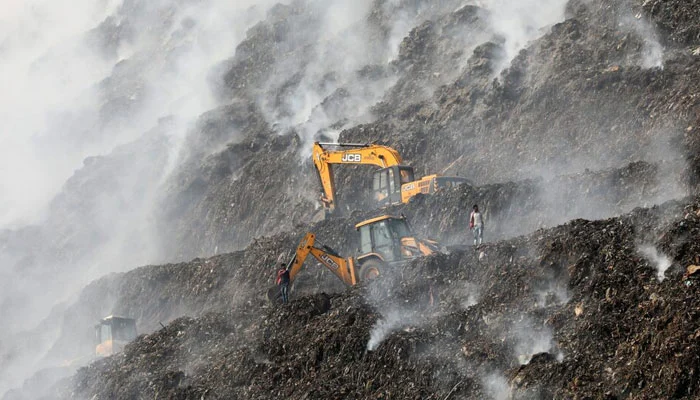
Firefighters in southwestern France are battling to control a massive wildfire that’s producing dangerous fire clouds capable of generating their own wind and lightning, which can ignite new fires. These fire clouds, or pyrocumulonimbus clouds, stem from intense wildfires and can worsen already hazardous conditions. This phenomenon is a recent development for France and is viewed as another impact of human-driven climate change, according to wildfire researcher Jean-Baptiste Filippi.
As crews work to contain the blaze before another heatwave hits, Filippi explains that a fire cloud forms when a column of air rises above a wildfire. It begins as a small, white cumulus cloud—a clump of water vapor droplets forming as the sun heats the ground and causes water to condense. As the fire intensifies, the cloud grows larger, holding thousands of tons of water and eventually developing into a towering cumulonimbus with an anvil-shaped top. Strong updrafts, exceeding 90 miles per hour, fuel the storm, which then produces rain that evaporates before reaching the ground but cools the air, creating powerful downdrafts.
Fire clouds are common in regions such as Portugal, California, and Australia, where firefighters frequently encounter them. Portugal saw an increase in their frequency after the deadly 2017 fires in Pedrógão Grande. However, in France, pyrocumulonimbus clouds are still relatively new; some appeared in Landiras near Bordeaux in 2022, but not for long.
The increasing occurrence of such phenomena is linked to climate change, which leads to more frequent heatwaves. Although thunderstorms are typical in fire-prone areas, the combination of multiple heatwaves creating the right conditions for these fire clouds is unprecedented.
Predicting these storms is challenging. While meteorologists can forecast thunderstorm conditions, pinpointing the exact location of a fire in advance is impossible. Managing fires that generate their own winds poses a new challenge because the unpredictable surges can rapidly accelerate the spread. The situation in Gironde, southwest France, exemplifies this, where shifting wind directions and atmospheric energy caused embers to be sucked into upward currents, leading to a catastrophic and swift fire spread.