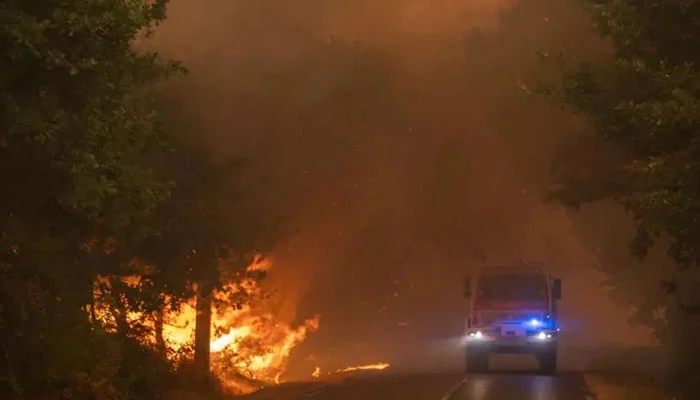
Swirling wildfires advanced inland toward Bordeaux’s outskirts on Saturday, prompting the evacuation of thousands from nearby suburbs. Meanwhile, in Spain, strong winds hampered efforts to contain a large blaze near Madrid. Both countries have evacuated hundreds of thousands due to these ongoing fires, which scientists attribute to prolonged droughts and successive heatwaves intensified by climate change. French Prime Minister Sebastien Lecornu stated, “The fires impacting our country have reached unprecedented levels,” while Interior Minister Laurent Nunez warned of a prolonged and challenging battle ahead, also announcing the closure of Bordeaux airport. French troops have been called in to assist firefighting teams, and Spain has declared its first national emergency over a wildfire, with three separate blazes, two of which merged on Friday. Spain expects four additional water-dropping aircraft — two from Italy and two from Greece — as part of a European Union cooperative response. Aircraft from the Netherlands and Portugal are already aiding the effort. High winds are fueling and spreading the fires on both sides of the border. The coast near Bordeaux, a popular tourist destination with pine forests that ignite easily, is also known for its renowned wines produced in local vineyards. Since the fires started this week, approximately 197,000 people have been evacuated from the Gironde and Landes regions near Bordeaux. Over 63,000 individuals in Spain have been displaced or placed under house confinement due to the three major fires there. Nunez reported the fire is now about 30 kilometers (roughly 19 miles) from Bordeaux, with calmer conditions on Saturday, though wind speeds are expected to increase later in the day. Authorities have advised against road and rail travel in the area. In Madrid, many residents own second homes in the densely populated western suburbs, where the fires have merged. A third fire in Avila province threatens to connect with the Madrid blazes, as reported by government representative Nicanor Sen. Camper Esteban Carrasco described the destruction at the Monasterio de Pelayos campsite, where around 30 mobile homes were burned on Friday, forcing about 200 campers of modest means to evacuate. “It was a devastating event,” he said, showing the charred remains of mobile homes while others on the same road remained untouched; luckily, no injuries occurred. The air over Madrid was smoky on Friday but clearer by Saturday, though Spanish health officials continue to advise limiting outdoor activities and wearing masks if exposed to smoke or ash.
Tag: evacuation
-
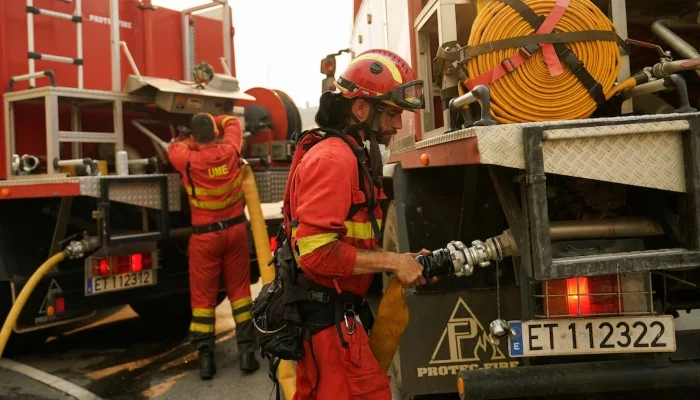
Spain declares national emergency amid wildfires near Madrid and Ávila
Madrid’s local authorities have declared a state of emergency due to a series of wildfires approaching communities near Madrid and in the neighboring province of Avila, forcing the evacuation of over 10,000 residents. Fire crews are battling these fires amid challenging weather conditions and widespread resource mobilization from multiple public agencies, complicating containment efforts.
The Interior Ministry explained that the emergency declaration was necessary because of multiple simultaneous fires, harsh weather, and the demand for extensive support across various government sectors. Experts consistently link the increasing severity of wildfires in Spain and southern Europe to climate change. Abundant plant growth after an unusually rainy spring has dried out under intense summer heat, fueling rapid fire spread.
The Madrid regional government requested assistance, warning that several active fires—which are located in Villa del Prado, San Martin de Valdeiglesias, and Almorox in nearby Castile-La Mancha—could surpass current firefighting capabilities. Additionally, there are concerns that the fire in Burgohondo, Avila, might reach Madrid’s outskirts soon, due to shifting weather conditions.
In total, over 10,000 residents from Villa del Prado, San Martin de Valdeiglesias, Pelayos de la Presa, and Aldea del Fresno have been evacuated. Under Spain’s Civil Protection Law, declaring a state of emergency places control directly in the hands of the interior minister, who coordinates all response efforts. This marks the first wildfire-related emergency of its kind in Spain.
Authorities have deployed more than 270 emergency personnel and 40 ground units to affected areas, alongside multiple units of the Military Emergency Unit (UME). So far this year, over 100,000 hectares have burned across Spain—approximately the country’s entire average annual burned area over the past decade. Thirteen fatalities have been reported, making 2026 one of the deadliest wildfire seasons in recent history.
-

Typhoon Bavi hits eastern China’s Taizhou after 2 million evacuate
Typhoon Bavi made landfall Saturday night in Taizhou city on China’s eastern coast, prompting nearly 2 million residents to evacuate. The storm had previously battered Japan’s southern Sakishima islands and brushed past northern Taiwan. Although Bavi is now moving northwest, slowing down and weakening, it remains a serious threat because of the massive amount of moisture it carries within its rain bands — an area roughly the size of France.
At landfall, Bavi’s maximum sustained winds were about 90 mph (144 km/h), similar to a Category 1 hurricane. State media reported that over 1.7 million people had been evacuated across Zhejiang province, where Taizhou is located, along with more than 100,000 from neighboring Fujian province, Beijing, and around 34,000 from Shanghai.
Wenzhou resident Huang Xinghuan, 50, expressed cautious optimism, saying, “I’m a little worried, but I think It’ll be okay. We’ve experienced typhoons before. We will get through it.” He mentioned his family had stockpiled about two to three days’ worth of water and believed supplies were sufficient, advising against panic-buying.
While Japan and Taiwan haven’t reported any deaths, the Philippines saw 17 fatalities due to heavy rains caused by a strengthened southwest monsoon exacerbated by Bavi. Taiwan’s fire department reported 113 injuries, mainly from falls off motorcycles and bicycles or from being struck by objects.
In Taiwan, authorities evacuated over 14,000 people primarily from mountainous areas as the island prepared for Bavi’s approach. Although the storm did not land there, officials took extensive precautions, forecasting nearly 3 feet (about 1 meter) of rain in some regions. Most evacuations occurred in the north and east, with 920 canceled international flights, leading to the closure of Taiwan’s main airport at Taoyuan and all domestic flights.
Nearly all cities and counties in Taiwan declared typhoon holidays, shutting down offices and schools for Saturday. In Taipei, some restaurants and convenience stores remained open, while the high-speed rail service continued with reduced schedules. Despite the severe weather, some residents experienced only mild inconvenience, describing it as “just a bit more wind.” However, in Taipei’s Beitou area, gusts reaching around 60 mph (100 km/h) caused trees to fall and rivers to swell.
In Wenzhou, 60-something Chen Qiuqin walked through steady rain to help her elderly parents prepare for the storm. She expressed a measured outlook, saying, “I was worried about the flowerpots on my mother’s balcony, so I’m helping move them inside. My parents are alone at home, so I was a bit uneasy.”
-
Typhoon Bavi prompts massive evacuations heading for China
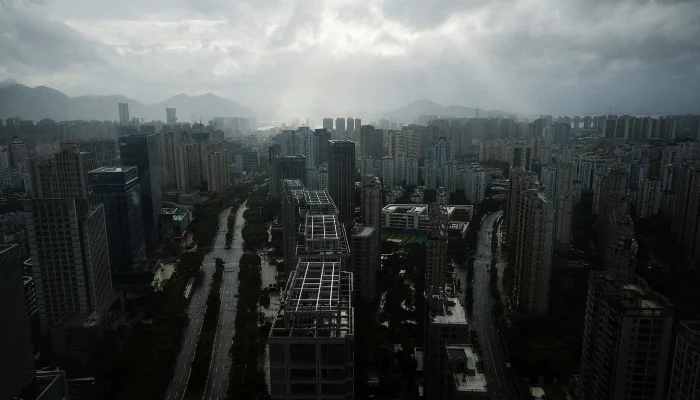
Heavy rain clouds blanketed Wenzhou’s downtown area as Typhoon Bavi drew near on July 11, 2026, in Zhejiang province, China. The storm has caused the evacuation of over 600,000 residents in China, especially in the city of Wenzhou, which is home to approximately 10 million people. This move came after Bavi pounded Japan’s Sakishima Islands with intense rainfall and fierce winds, then brushed past northern Taiwan.
Although Bavi is gradually losing strength and moving over colder waters, it remains a significant threat due to the enormous amount of moisture contained within its rainbands—stretching roughly the length of France. Meteorologists predict the typhoon will make landfall in Wenzhou early Sunday morning.
State media reported that more than 500,000 individuals had been evacuated in Zhejiang Province, where Wenzhou is situated, with an additional 100,000 evacuees in neighboring Fujian Province. Wenzhou resident Huang Xinghuan, 50, expressed cautious optimism while shopping at a local wet market before the storm’s arrival. “I’m a bit worried, but I believe everything will be alright. We’ve experienced typhoons before, and we’ll get through this,” he said. Huang’s family has stocked enough water to last around two to three days and feels confident that supplies are sufficient, emphasizing that there’s no need for panic buying.
While no fatalities have been reported in Japan and Taiwan due to Bavi, the typhoon’s heavy rains contributed to the death of 17 people in the Philippines, exacerbated by the intensified southwest monsoon. Taiwan’s fire department reported injuries to 87 people, mainly from falls off motorcycles or bicycles, or from being hit by falling objects.
Taiwan took proactive measures, evacuating over 14,000 people from mountainous regions as the nation prepared for Bavi’s approach. Although the storm did not directly make landfall, authorities issued precautions to prevent casualties, anticipating nearly 1 meter (3 feet) of rainfall in some areas.
Most evacuations occurred in northern and eastern parts of Taiwan, resulting in the cancellation of 920 international flights and the shutdown of Taoyuan International Airport outside Taipei—the country’s main gateway—as well as all 282 domestic flights. With most schools and offices closing for the weekend, the country declared a typhoon holiday, although some restaurants and convenience stores in Taipei remained open. The primary north-south high-speed rail line continued running but with limited service.
In Taipei, residents experienced gusty winds and rain, with some staying outdoors. Yeh Mao-hsiung, 68, dismissed the storm’s severity, saying, “It’s fine, just a bit more wind.” Nonetheless, in the Beitou district near the mountains, winds approaching 60 mph toppled trees and caused rivers to swell.
Wenzhou resident Chen Qiuqin, in her sixties, walked through steady rain on her way to her parents’ home to help prepare for the typhoon. She was not overly worried, citing the government’s preparations. “I was concerned about the flowerpots on my mother’s balcony, so I came to help move them inside. My parents are elderly and home alone, so I wanted to make sure they’re safe,” she shared.
-
What’s Known About the Gunfire at the White House Correspondents’ Dinner
A glamorous Saturday night in a Washington ballroom intended to celebrate the White House Correspondents’ Association turned chaotic after gunfire erupted. President Donald Trump was seated on stage at his first appearance at the event as president when loud bangs interrupted the festivities, prompting alarm among attendees.
Footage from AFPTV, other news organizations, and AFP reporters on-site revealed a scene in disarray. Following the gunfire, urgent shouts of “Stay down!” and “Get down!” echoed across the room as numerous guests, including journalists, government officials, and members of Trump’s cabinet, quickly took cover.
Amidst the turmoil, Trump was swiftly surrounded by Secret Service agents armed and ready, who hurried him off the stage and through a rear curtain as the crowd crouched in shock. The musical performance abruptly halted, and the attendees, dressed in evening gowns and tuxedos, quieted as agents moved through the room, securing the area of the Washington Hilton— the same hotel where President Ronald Reagan narrowly escaped an assassination attempt over four decades ago.
As reports of gunfire spread, Mehmet Oz, who oversees the Centers for Medicare and Medicaid Services under Trump, was seen being evacuated by security personnel. Also among those hurried out was Health and Human Services Secretary Robert F. Kennedy Jr., whose uncle, President John F. Kennedy, was assassinated in Dallas in 1963.
Law enforcement quickly detained a person of interest after the incident, with authorities confirming that both the President and First Lady Melania Trump are safe. An official statement from the Secret Service indicated they are investigating the shooting near the main security checkpoint for the event, with one individual in custody. It remains uncertain whether the suspect fired the shots or if security responded with gunfire.
By around 8:40 p.m. (0040 GMT), police were seen rushing through the streets surrounding the Hilton, clearing traffic and lifting barriers as a helicopter orbited overhead. A motorcade later departed the hotel heading toward the White House.
Inside the evacuated ballroom, witnesses recounted hearing the chaos and seeing the Secret Service deploy to protect the president. Alexandra Ingersoll, a journalist for One America News, described crouching under a table, uncertain if the situation was under control. Guests disbursed into the Hilton lobby, where they embraced, made calls, and texted loved ones while officials issued further statements.
Later, the Secret Service confirmed they are investigating a shooting incident near the main security screening point for the event. They assured the public that everyone in their protection, including the president, remains safe, and that one individual has been taken into custody. The details about whether anyone was wounded or if gunfire was exchanged were not immediately available.
-
‘White House Correspondents’ Dinner Shooting: Trump Declared Safe’
President Donald Trump and First Lady Melania Trump were hurried out of the White House Correspondents’ Association dinner by Secret Service agents late Saturday night following a loud, unidentified sound. Other officials from the Trump administration who were attending the event were also evacuated after a commotion near the hotel ballroom where the dinner was taking place.
Guests immediately fell silent, and screams of “Get down, get down!” erupted across the room. Hundreds of attendees quickly ducked under tables as security personnel in tactical gear rushed into the dining area. Trump and Melania had crouched behind the dais prior to being swiftly escorted out by Secret Service agents.
Many of the 2,600 dinner guests sought shelter, while wait staff hurried to the front of the dining hall. Moments before leaving the stage under security escort, Melania appeared to react to something in the crowd, showing a worried expression during a live broadcast on CSPAN.
Earlier, Russian media reported that a shooting incident at the dinner resulted in a suspect being shot and killed by security forces after opening fire, claiming multiple rounds had been discharged before the suspect was neutralized. Nonetheless, President Trump, through a post on Truth Social, commended the quick response of security agencies, confirmed that a suspect had been detained, and praised their bravery.
“An evening to remember in D.C. — Secret Service and law enforcement responded brilliantly. They acted swiftly and courageously,” he wrote. He added that the shooter had been apprehended and that he had recommended continuing the event, although authorities would ultimately decide whether to proceed. He indicated the evening would be “significantly different than planned” and might require rescheduling.
Eyewitnesses described law enforcement swarming the Washington Hilton Hotel where the dinner was held, with helicopters circling overhead. Major US news outlets confirmed that Trump was unharmed. A pool report echoed that a suspect was in custody, citing the Secret Service, though this has not been officially confirmed. Unverified reports mentioned that one person may have been injured, but specifics remain unclear.
The incident occurred before Trump was scheduled to speak, during the dinner following the introductory speech. Officials from the Trump administration were reportedly evacuated first, with ongoing uncertainty about the details of what transpired. In one account, a cabinet member, Mehmet Oz, indicated “shots fired upstairs” as he was hurried out by security.
Trump had previously faced an assassination attempt during a rally in Butler, Pennsylvania in 2024, when a gunman shot and killed a rally attendee and grazed Trump’s ear. A few months later, another individual was detained after a Secret Service agent spotted a rifle barrel protruding from bushes near Trump’s golf course in West Palm Beach.
The Washington Hilton, site of Saturday’s event, is also infamous for the attempt on Ronald Reagan’s life in 1981. Despite the chaos, organizers announced that the White House Correspondents’ Dinner would go on. Trump attended this event for the first time in his presidency.
The WHCA invited Trump despite his ongoing criticism of the media, sparking backlash from journalists who appealed for accountability regarding his restrictions on press freedoms. Unlike other presidents of the last century, Trump had never attended the dinner in office—until now. The event, popularly called “Nerd Prom,” gathers hundreds of journalists and media leaders to raise funds for scholarships and awards.
In a separate incident in Butler, Pennsylvania, Trump was grazed on the right ear when a shooter opened fire from a rooftop during a campaign rally on July 13, killing a bystander and lightly wounding him. The shooter, Thomas Crooks, was shot dead by a Secret Service sniper.
-

Philippines Prepares as Fung-wong Becomes Super Typhoon, Evacuates 100,000
A satellite image captures Storm Fung-Wong, which has strengthened into a typhoon, as reported by the Cooperative Institute for Research in the Atmosphere (CIRA). The image shows the storm over the Philippine Sea on November 7, 2025, taken from a video feed. — Reuters
– Winds are blowing at 115 mph with gusts reaching up to 143 mph, potentially striking Aurora Province by Sunday night.
– Early power outages are being reported in Eastern Visayas as the weather conditions worsen.
– Over 300 domestic and international flights have been canceled nationwide.The Philippines has evacuated more than 100,000 residents in its eastern and northern regions as Fung-Wong escalated into a super typhoon on Sunday. The storm threatens to bring heavy rainfall, destructive winds, and storm surges as it approaches later in the day.
Warning signals have been issued across large parts of the country. Signal No. 5 — the highest alert level — has been issued for southeastern Luzon, including Catanduanes and coastal areas of Camarines Norte and Camarines Sur. Metro Manila and surrounding areas are under Signal No. 3.
Super Typhoon Fung-Wong, locally called Uwan, is expected to make landfall in Aurora Province in central Luzon early Sunday evening. It boasts sustained winds of 115 mph and gusts up to 143 mph. Parts of Eastern Visayas are already experiencing power outages.
Photos from the Philippine Coast Guard in Camarines Sur show evacuees carrying their belongings while transferring from narrow passenger boats to waiting trucks during preemptive evacuations.
More than 300 flights have been canceled according to civil aviation authorities. A video shared by ABS-CBN News shows the storm in Catanduanes, with dark skies, trees swaying violently, heavy rain, and the loud sound of the downpour.
This storm arrives just days after Typhoon Kalmaegi battered the Philippines, causing 204 fatalities and widespread destruction before moving into Vietnam, where it caused five additional deaths and wrecked coastal communities.
In Vung Cheo, a fishing village in central Vietnam, vessels are piled along the main road, and many lobster farms have been destroyed or severely damaged.
-

Typhoon Kalmaegi causes 1 death in Philippines, heading to Vietnam
A person lost their life when Typhoon Kalmaegi struck central Philippines on Tuesday, according to the national disaster agency. Heavy rainfall, fierce winds, and storm surges prompted tens of thousands to evacuate their homes.
With sustained winds reaching 150 km/h and gusts up to 205 km/h at landfall early Tuesday, Kalmaegi—locally called Tino— is expected to traverse the Visayas islands and exit into the South China Sea by Wednesday.
Throughout the Visayas, as well as parts of southern Luzon and northern Mindanao, mass evacuations took place, and the disaster agency confirmed one fatality.
A video shared by DZRH radio on Facebook depicted homes in Talisay City fully submerged, with just rooftops visible. Similar scenes emerged on social media from Cebu City, where streets and vehicles were underwater.
The Philippine weather bureau PAGASA explained that the combined effects of Kalmaegi and a shear line brought heavy rains and strong winds across the region.
“Due to interaction with the terrain, Tino may weaken slightly as it crosses Visayas, but it’s projected to stay at typhoon strength throughout its passage over the country,” PAGASA stated in a morning update.
More than 160 flights to and from the affected zones have been canceled. Mariners were advised to find safe harbor immediately and remain anchored until conditions improve.
The agency issued warnings for potentially life-threatening and damaging storm surges, estimating heights over 3 meters along coastlines and low-lying areas in central Philippines, including parts of Mindanao.
Vietnam also announced preparations for the worst as Kalmaegi approaches, with landfall expected Thursday night in central regions already hit hard by recent floods that resulted in at least 40 deaths and six missing persons last week.
“The typhoon is extremely strong and continues to intensify in the East Sea,” the government noted in a statement, referencing the South China Sea.
This storm hits as the Philippines, accustomed to around 20 tropical storms annually, recovers from a series of recent disasters, including earthquakes and severe weather events.
In September, Super Typhoon Ragasa battered northern Luzon, causing shutdowns of government operations and schools due to powerful winds and relentless rain. -

Hurricane Melissa Strikes Jamaica as Deadly Cat 5 Storm
Hurricane Melissa was intensifying, with sustained winds reaching 175 mph (282 km/h) on Monday afternoon. The slow-moving Category 5 storm was expected to strike Jamaica, potentially marking the largest hurricane on record for the Caribbean island. By 2 p.m. (1800 GMT), the National Hurricane Center classified Melissa as a “catastrophic” storm—the highest category on the Saffir-Simpson scale. Forecasts indicated Melissa would hit Jamaica late Monday or early Tuesday, then pass over eastern Cuba the next night, before moving toward the Bahamas and Turks and Caicos by Wednesday.
The storm’s sluggish pace over unusually warm Caribbean waters had caused it to grow in size and intensity. Forecasters warned Jamaica could face days of unprecedented destructive winds and up to three feet of rain. Melissa’s wind field now spans a distance greater than the length of Jamaica, an island roughly the size of Connecticut, with its main airports perilously close to sea level.
Hours after mandating evacuations in southern Jamaica, including the historic Port Royal, Prime Minister Andrew Holness appealed for international support. He warned of severe damage to farms, homes, and infrastructure such as bridges, roads, ports, and airports. Despite the orders, some residents hesitated to leave fearing looting, and officials announced buses would soon transport around 28,000 people forced to evacuate.
“There’s no infrastructure capable of withstanding a Category 5 hurricane,” Holness stated. The government had prepared a $33 million emergency response fund, along with insurance and credit options for damages surpassing last year’s hurricane, Beryl. While Beryl was the earliest and fastest Atlantic hurricane to reach Category 5, scientists warn climate change is fueling stronger and faster storms due to warmer ocean waters, increasing the fuel for seasonal hurricanes.
“Thousands of families are experiencing hours of intense winds over 100 mph and days of relentless, heavy rain,” said AccuWeather Chief Meteorologist Jonathan Porter. “The slow movement of such major hurricanes often results in some of the deadliest and most destructive storms in history. This is a slow-motion disaster unfolding before our eyes.”
Jamaica has weathered many hurricanes, including the devastating Category 4 Hurricane Gilbert in 1988. However, a direct hit from a Category 5 has never occurred there, according to Evan Thompson of Jamaica’s Meteorological Service. Porter noted that Melissa is moving significantly slower than Gilbert, which hit Jamaica directly over three decades ago. Residents are advised to prepare for days indoors, with some areas potentially cut off for weeks.
Damian Anderson, a teacher from Hagley Gap in the Blue Mountains, said impassable roads had already cut off his community. “We can’t move. We’re scared. We’ve never experienced a multi-day hurricane like this before,” he admitted.
In neighboring Haiti and the Dominican Republic, days of heavy rainfall have already caused severe flooding and at least four fatalities. In Haiti’s impoverished southern regions, over 3,650 residents have sought shelter in designated safe zones, with flights suspended and maritime activities halted. Meanwhile, the Bahamas’ Prime Minister Philip Davis ordered evacuations in southern and eastern areas, and eastern Cuba prepared extensively, evacuating over 500,000 residents from vulnerable coastal and mountainous zones. Schools and transportation across eastern Cuba have been shut down, and more than 250,000 people have sought refuge in shelters around Santiago de Cuba, which is directly in Melissa’s predicted path.
-

Typhoon Bualoi Strikes Vietnam, 13 Dead and 46 Hurt
On September 29, 2025, Typhoon Bualoi made landfall in Nghe An province, Vietnam, causing significant disruption. People are seen navigating a street partially submerged in floodwaters following the storm’s arrival. Prior to the typhoon, authorities evacuated over 28,500 residents to ensure their safety. The storm destroyed more than 44,000 homes, flooded nearly 6,000 hectares of farmland, and prompted rainfall of up to 20 inches in various regions starting Sunday.
The government reports that the typhoon resulted in at least 13 fatalities and left 46 people injured. It also caused the loss of several fishing boats, especially off Quang Tri province, with some vessels washed away and others losing contact. A local resident from Nghe An recounted staying awake all night out of fear that strong winds might damage his home. Neighbors spent the night reinforcing their residences after power was lost in their apartment complex.
Authorities closed four airports in central provinces, delaying or canceling hundreds of flights. In Ninh Binh province, winds and rain caused nine deaths and injured seven others. Floodwaters also claimed the life of a person in Hue city and a falling tree caused another death in Thanh Hoa province.
Farmland has suffered extensive damage, with rice and other crops inundated over 14,800 acres. While no significant industrial damage has been reported, factories operated by major companies such as Foxconn, Formosa Plastics, Luxshare, and Vinfast are located near the storm’s path. Prime Minister Pham Minh Chinh has ordered military and police forces to mobilize quickly to assist with disaster response efforts.
Since the storm’s landfall, Vietnam has experienced heavy rainfall stretching from Saturday onward, heightening the risk of severe floods and landslides. Water levels in rivers and reservoirs swelled dangerously in Nghe An, Ha Tinh, and Thanh Hoa provinces, with thousands of households affected by power outages. Meteorologists forecasted rainfall of up to 20 inches across several areas through Tuesday.
Vietnam’s extensive coastline along the South China Sea makes it particularly vulnerable to typhoons forming east of the Philippines, where Bualoi recently caused at least 10 fatalities last week.
-

China readies to evacuate 400,000 as super typhoon hits Philippines
Manila: The Chinese city of Shenzhen is beginning preparations to evacuate 400,000 residents, while those in northern Philippines seek shelter from powerful winds as Super Typhoon Ragasa approaches southern China. The storm made landfall on Calayan Island in the Philippines’ Babuyan Islands at 3 p.m. local time (7 a.m. GMT), according to Philippine weather authorities.
By 2 p.m. (6 a.m. GMT), maximum sustained winds at the storm’s center reached 215 km/h, with gusts topping 295 km/h, said the national weather service. Tirso Tugagao, a resident of Aparri, a coastal town in northern Cagayan province, reported waking up to fierce winds pounding the windows, likening the noise to a running machine.
Cagayan disaster head Rueli Rapsing told AFP that his team was on high alert for the worst-case scenario. Over 10,000 Filipinos have been evacuated across the country, with schools and government offices closed in Manila and 29 other provinces.
In Shenzhen, authorities announced a large-scale evacuation plan for hundreds of thousands in coastal and low-lying areas. Multiple cities in Guangdong province canceled classes and work, and halted public transport due to the typhoon. Hong Kong-based Cathay Pacific expects to cancel more than 500 flights as Ragasa threatens the financial hub. The airline’s spokeswoman said flights in and out of Hong Kong International Airport will cease from 6 p.m. Tuesday, resuming midday Thursday.
In Taiwan, a weather forecast predicts “extremely torrential rain” in eastern regions. The storm’s large radius, approximately 320 km, means its expansive and potent wind field is already impacting parts of Taiwan, despite the storm still being some distance away. Firefighters in Pingtung are evacuating mountainous communities amid fears of damage similar to Typhoon Koinu two years ago, which caused utility poles to topple and roofs to be torn off.
Philippine weather officials warn of severe flooding and landslides in northern Luzon. Ragasa’s flooding threat follows protests by thousands of Filipinos over corruption scandals involving shoddy or incomplete flood control projects. The Philippines, vulnerable to about 20 storms annually, faces ongoing risks of disasters in a nation where many live in poverty. Climate scientists caution that climate change is amplifying storm strength globally.
-

Hong Kong to Evacuate 6,000 Over WWII Bomb Discovery
On Friday, authorities in Hong Kong arranged to evacuate thousands of residents after an unexploded World War II bomb was uncovered at a construction site. The bomb was approximately 4.9 feet long and weighed around 1,000 pounds. Officials believe it was still “fully functional,” posing significant danger.
Hong Kong Police District Commander Andy Chan explained, “Because of the extreme danger involved in safely dismantling and removing the bomb, we have activated the emergency evacuation plan.” About 6,000 residents from 18 apartment buildings in the Quarry Bay neighborhood are set to be evacuated overnight, with removal work scheduled to start early Saturday.
Historically, Hong Kong was among the initial targets during Japan’s wartime expansion in the early 20th century. The region endured intense combat between Japanese forces and Allied troops, leading to the ongoing discovery of unexploded ordnance nearly a century later. In 2018, a similar bomb was found in Wan Chai, prompting the evacuation of 1,200 residents. The dismantling of that device took approximately 20 hours.
The bomb detected this week matches the type previously found in 2018, and similar disposal operations have become a routine part of maintaining safety in the area.
-

European Wildfires Spread as Heatwave and Winds Intensify
Wildfires incited by arson, thunderstorms, and intensified by heatwaves and strong winds continue to devastate southern Europe. On Wednesday, these fires have destroyed homes, farms, factories, and have led to the evacuation of thousands of residents and tourists. Near Greek city Patras, flames and thick smoke have engulfed a cement plant, which was ignited by a wildfire sweeping through olive groves and forests, disrupting train services on the city’s outskirts.
Giorgos Karvanis, a volunteer arriving from Athens to assist, described the scene as “doomsday,” pleading for divine help and aid for locals. Authorities instructed about 7,700 residents in a nearby town to evacuate on Tuesday, with additional alerts issued on Wednesday for surrounding villages. The fires also forced evacuations on Greek islands Chios and Cephalonia, both hotspots for tourism, as flames rapidly spread across the islands.
In Spain, the situation is equally dire. A volunteer firefighter succumbed to severe burns, and several others are hospitalized. The national weather agency, AEMET, issued warnings that nearly the entire country faces extreme or very high fire danger. The fallen firefighter, age 35, was attempting to establish firebreaks near Nogarejas in Castile and Leon when he was caught in the blaze. This marks the sixth wildfire-related death in Spain this year, with previous fatalities including firefighters in Tarragona and Ávila.
The risks are heightened by insufficient fire-prevention infrastructure. Alexander Held, from the European Forest Institute, emphasized that many fire sites are unprepared, lacking detectors, sprinkler systems, and safe escape routes, placing firefighters’ lives at significant risk. Regional leader Alfonso Rueda described Galicia’s firefighting efforts as “complicated,” with six active fires consuming 10,000 hectares in Ourense.
Many fires are suspected to be deliberately set. Spain’s Environment Minister, Sara Aagesen, mentioned that the intensity of several fires suggests arson. Authorities have detained a firefighter in Madrid’s vicinity for fires in Avila, and are investigating a woman suspected of igniting multiple fires in Galicia. Other investigations involve a suspect who allegedly sustained burns while igniting a small fire in Cadiz.
Thunderstorms have caused additional fires, including a lightning strike igniting a forest in Los Romeros, Andalucia, which prompted the evacuation of 250 residents but was largely contained by Wednesday. In Portugal’s Trancoso, lightning reignited a wildfire overnight that was previously thought controlled. Meanwhile, in Albania, Defense Minister Pirro Vengu described the ongoing wildfires as a “critical week,” with 10,000 firefighters, military personnel, and rescue teams battling 24 fires across the country. Villages have been evacuated as flames threaten homes, livestock, and farmland.
In Spain’s ongoing heatwave, temperatures hit as high as 113°F (45°C), lasting through Monday, setting a record-long heatwave, with the Pope relocating his weekly audience indoors due to extreme heat. Italy also issued heat warnings for 16 cities, expecting peak temperatures of 102°F (39°C). -

Millions Evacuate Coastal Regions After 8.8 Quake in Kamchatka
People across the Pacific were suddenly forced into action after a powerful 8.8 magnitude earthquake struck off Russia’s Kamchatka Peninsula on Wednesday. Residents scrambled to evacuate as tsunami alerts rippled from Japan to South America, causing waves to crash into ports, beaches to close, and chaos to erupt as millions of people hurried to higher ground.
The quake, one of the strongest ever recorded, produced waves reaching heights of up to four meters (about 12 feet). Despite the massive tremor, early reports indicated only minor damage and few injuries, though it was the most intense since the 2011 disaster in Japan that claimed 15,000 lives.
Tsunami warnings were issued for over a dozen countries, placing millions on high alert. In Russia, a tsunami inundated Severo-Kurilsk’s port, submerging the local fishing facility. Footage from Russian state television showed buildings and debris swept out to sea, with the surge reaching nearly 400 meters from the shoreline at the town’s World War II monument, according to Mayor Alexander Ovsyannikov.
Japan advised nearly two million residents in affected areas to move to higher ground, and the Fukushima nuclear plant, devastated by the 2011 quake and tsunami, was evacuated again. Tragically, reports say one woman died as she drove her car off a cliff while trying to escape.
Along South America’s Pacific coast, warnings remained in effect, with the Galapagos Islands shutting down parks, closing schools, and evacuating tourists from boats to land safety. Isabela Island’s residents were transported onto higher ground by buses and trucks amid widespread fear and uncertainty.
The Ecuadorian navy reported maximum wave heights of approximately 1.3 meters, and disturbances are expected to persist for several hours. Peru temporarily closed 65 of its 121 Pacific ports, warning fishing activities to halt and people to stay away from the coast.
In Hawaii, tsunami sirens blared near Waikiki Beach, and traffic was gridlocked as residents fled to higher areas. Governor Josh Green announced cancellations of flights in and out of Maui as a safety measure. President Donald Trump urged Americans to “Stay strong and stay safe” via social media. Eventually, the alert was downgraded from a tsunami warning to an advisory, and local evacuations were canceled.
Meanwhile, Russian scientists reported the eruption of the Klyuchevskoy volcano shortly after the quake, with glowing lava flows and explosive activity observed on its western slope. The seismic monitoring service confirmed that the Kamchatka earthquake was the strongest in the region since 1952, with aftershocks continuing with magnitudes up to 7.5.
The U.S. Geological Survey ranked this event among the ten largest tremors ever recorded, with at least six aftershocks following, including one of magnitude 6.9. In Taiwan’s Taitung area, hotel staff advised guests to stay indoors and avoid coastal areas.
The island nation of Palau, about 500 miles east of the Philippines, ordered evacuations of all coastal zones. French Polynesia’s Marquesas Islands anticipated waves of up to four meters overnight, prompting official warnings to residents.
-

Japan Prepares for Quakes, Authorities Downplay Doom Warnings
Recent Earthquake Aftermath in Japan
On January 4, 2024, Wajima, Japan, was devastated by fire following an earthquake, with areas like Asaichi-dori street being significantly affected. A man navigates through the remnants of the street amidst ongoing recovery efforts.
Amid this crisis, Japan’s government issued a warning about potential strong aftershocks in the waters southwest of its main islands. However, officials cautioned the public against falling prey to baseless predictions of a significant disaster.
On Friday, certain residents of remote islands near the epicenter of a 5.5-magnitude quake were evacuated as a precaution. This quake, which struck the previous Thursday, was strong enough to pose challenges for those trying to maintain their footing and was part of over 1,000 tremors recorded in Kagoshima Prefecture over the past two weeks. These seismic events have fueled rumors sparked by a manga that allegedly predicts a major disaster for Japan this month.
“Our current scientific understanding does not allow us to specify the timing, location, or intensity of an earthquake,” stated Ayataka Ebita, head of the earthquake and tsunami monitoring division at the Japan Meteorological Agency, following another quake measuring 5.4-magnitude on Saturday. “We urge everyone to rely on scientifically grounded information,” Ebita emphasized during a press briefing.
The manga that has garnered attention for allegedly forecasting a catastrophic event on Saturday has caused some travelers to think twice about visiting Japan. Data reveals that arrivals from Hong Kong—where the rumors gained traction—declined by 11% in May compared to the same month last year.
Despite the current concerns, Japan has welcomed record numbers of visitors in 2023, with April alone seeing 3.9 million tourists—the highest monthly figure on record.
Ryo Tatsuki, the creator of “The Future I Saw,” a manga originally published in 1999 and re-released in 2021, clarified that she does not possess prophetic abilities in a statement through her publisher.
Earthquakes are a regular occurrence in Japan, a region known for its seismic activity, accounting for approximately 20% of the world’s earthquakes of magnitude 6 or more.
-

Thousands Evacuate Turkiye Wildfires Amid Early European Heatwave
Local residents respond to a wildfire near Seferihisar, Izmir, Turkey, June 30, 2025. — Reuters - Over 50,000 individuals evacuated due to wildfires in Turkey and France.
- Fires are contained but not fully extinguished: officials.
- Extreme heat claims up to 480,000 lives globally each year.
On Monday, firefighters fought wildfires in Turkey and France, prompting the evacuation of over 50,000 people amid an early summer heat wave sweeping across Europe.
Health warnings were issued in France, Spain, Italy, Portugal, and Germany. Even the typically cooler Netherlands issued a heat warning for upcoming days, facing high temperatures and humidity.
“Much of Western Europe is enduring intense heat and conditions usually seen in July or August, not June,” stated Samantha Burgess, a climate strategist with the EU’s Copernicus Climate Change Service.
She noted that temperatures in some areas were 5-10 degrees Celsius (9-18 degrees Fahrenheit) above what is typical for this time of year.
In Turkey, wildfires continued to blaze in the western Izmir province for a second day, fueled by strong winds, according to Forestry Minister Ibrahim Yumakli. The Turkish emergency management authority, AFAD, reported that over 50,000 people had to leave five regions, with more than 42,000 evacuations occurring in Izmir alone.

Local firefighters join residents to combat a wildfire in the Menderes district of Izmir, Turkey, June 29, 2025. — Reuters Turkey’s coastal areas have faced devastating wildfires in recent years, as rising temperatures and drier summers are attributed to climate change driven by human activities.
In France, where a heat peak is anticipated on Tuesday and Wednesday, wildfires erupted on Sunday in the Aude department of southwestern France. With temperatures soaring above 40°C (104°F), the flames consumed 400 hectares, leading to the evacuation of a nearby campsite and abbey, officials reported.
Although the fires were under control, they had not been fully extinguished by Monday. France’s weather service, Meteo France, placed a record 84 out of 101 departments under an orange heat wave alert from Monday through midweek.
Western Europe Endures Heat
As spectators lined up at the All England Club for the Wimbledon tennis tournament and tourists explored the Colosseum in Rome, many felt the oppressive heat.
“It’s about 20 degrees warmer than I’m used to, and I’m completely sunburned,” said Scott Henderson, a tennis enthusiast visiting Wimbledon from Scotland.
Spain is on track for its hottest June ever, according to the national meteorological service AEMET.

Tourists enjoy a cooling fan outside the Colosseum in Rome during the heatwave, June 30, 2025. — Reuters “Intense heat will persist in much of Spain for at least a few more days, at least until Thursday,” stated Ruben del Campo, spokesperson for the weather agency.
Temperatures in Seville, where world leaders convened for a United Nations conference, reached 42°C (107.6°F).
“It’s unbearable,” remarked municipal worker Bernabe Rufo while cleaning a fountain. “We have to continuously seek shade.” The highest temperature recorded was 43.7°C (110.7°F) in El Granado.
In Italy, the health ministry issued heat warnings for 16 cities, including Rome and Milan. The Lombardy region, an industrial hub in northern Italy, is considering a ban on outdoor work during peak heat hours in response to trade union requests, according to its president.
Public Urged to Conserve Water
In Germany, heat alerts were also in effect across significant parts of the west and southwest, with temperatures reaching as high as 34°C (93°F). Authorities encouraged citizens to conserve water.

Beachgoers take a dip as temperatures soar in Brighton, UK, June 30, 2025. — Reuters The ongoing heatwave has decreased water levels in the Rhine River, hindering shipping activities and driving up freight prices, according to cargo owners and commodity traders. German and French baseload power prices surged in response to increased cooling demand brought on by the heatwave.
Extreme heat can have various health implications, with experts particularly concerned for the elderly, infants, outdoor workers, and economically disadvantaged individuals.
Globally, extreme heat is responsible for approximately 480,000 deaths annually, exceeding the combined fatalities from floods, earthquakes, and hurricanes, posing escalating threats to infrastructure, the economy, and healthcare systems, as noted by Swiss Re earlier this month.
Experts attribute the primary cause of climate change to greenhouse gas emissions from burning fossil fuels. Last year marked the hottest on record for our planet.
-

Pakistan Joins Efforts to Evacuate Citizens from Israel-Iran Conflict
Sure! Here’s a rewritten version in American English:
Global Evacuations Underway Amid Intensifying Israel-Iran Conflict
HONG KONG: Governments across the globe are mobilizing to evacuate thousands of their citizens trapped in the escalating conflict between Israel and Iran. This includes organizing buses, chartered flights, and in some cases, assisting people as they cross borders on foot.
As Israel initiated a significant bombing campaign targeting Iran’s nuclear and military installations, the situation quickly deteriorated, prompting many foreigners to flee both nations. With Israel’s airspace currently closed and both countries engaged in intense missile exchanges, these evacuations are primarily taking place through neighboring countries.
Europe
European nations have successfully repatriated hundreds of their citizens from Israel. The Czech Republic and Slovakia have facilitated the return of 181 individuals by transporting them to a bordering country for foot crossing. Germany has planned flights on Wednesday and Thursday via Jordan, while Poland reported that the first group of its citizens would arrive back on Wednesday. Italy is offering charter flights starting Sunday from Israel to Egypt and then to Italy, charging non-refundable rates of €500 (approximately $540) per adult. Greece has repatriated 105 citizens along with several foreign nationals via Egypt, while a private flight carrying 148 people arrived in Sofia, Bulgaria on Tuesday. Hungary evacuated 21 citizens from Iran, primarily diplomats and their families. Bulgaria and Slovenia also repatriated 17 citizens and two diplomats, respectively.
United States
The U.S. ambassador to Israel announced plans on Wednesday to evacuate American citizens by air and sea. The embassy is coordinating flights and cruise ship departures for those wishing to leave Israel, according to Ambassador Mike Huckabee on social media.
China
China has successfully evacuated over 1,600 of its citizens from Iran and several hundred from Israel, with efforts from the foreign ministry expected to continue.
Australia
Australia has begun evacuating around 1,500 citizens from Iran and more than 1,200 from Israel, although missile attacks have made it perilous for civilian flights, as noted by its foreign minister. "We managed to get a small group of Australians out of Israel through a land border crossing," stated Foreign Minister Penny Wong.
Mexico
Mexico reported evacuating 18 individuals, including both nationals and family members, from Iran to Azerbaijan.
Pakistan
Pakistan has closed its border crossings with Iran, except for its citizens wishing to return home. Since the conflict began, approximately 3,000 Pakistanis have crossed back from Iran, stated foreign ministry spokesperson Shafqat Ali Khan. The families of some diplomats and non-essential staff have also been evacuated.
India
Around 110 Indian students who escaped Iran via the land border with Armenia have arrived in New Delhi. There are about 10,000 Indian citizens currently in Iran, and the government is also planning to evacuate all willing Indian nationals from Israel, totaling around 30,000.
Japan
Japan has put military aircraft on standby for approximately 1,000 Japanese nationals in Israel and about 280 in Iran, according to government officials.
Indonesia
Indonesia is making preparations to evacuate around 380 citizens in Iran by land, as mentioned by Jakarta’s foreign minister. Additionally, at least 11 Indonesians in Israel have also requested to leave.
Vietnam
Vietnam, which has over 700 citizens in Israel and several dozen in Iran, is taking measures to ensure their safety. The foreign ministry confirmed the evacuation of 18 Vietnamese from Iran, with 16 returning to Vietnam. No further details on evacuations from Israel have been provided.
Philippines
The Philippines is working to repatriate 28 Filipino workers based in Israel out of 178 who have requested help, according to the Department of Migrant Workers. At least 21 Philippine government officials have also crossed into Jordan from Israel.
This version maintains the essential information while presenting it in American English and ensuring originality.