The stunning Eagle Nebula, often called the Pillars of Creation, is one of the universe’s most recognizable features. A renowned photograph captured by the Hubble Space Telescope showcases these majestic pillars, and to mark its 35th anniversary, Hubble has revisited the nebula to capture new imagery.
The image displayed below reveals an impressive formation of gas and dust, an intricate part of the Eagle Nebula. Towering at 9.5 light-years in height, this structure is composed of cold hydrogen gas, within which new stars are forming amid the nebula’s cloud-like formations.
This awe-inspiring formation of swirling gas and dark dust, while only a small segment of the Eagle Nebula, is striking in its beauty. It spans 9.5 light-years and lies 7,000 light-years away from our planet. This dusty marvel has been revitalized with new processing techniques, celebrated as part of ESA/Hubble’s 35th anniversary. ESA/Hubble & NASA, K. Noll
As Hubble scientists describe, “The core of the nebula, which lies beyond the view of this image, is home to a cluster of youthful stars. These stars have carved out a vast cavity at the nebula’s center, resulting in the creation of pillars and globules of dusty gas. One distinct feature of this area extends like a finger pointing towards the center, where the active young star cluster resides.”
This stellar activity contributes to the nebula’s sculpted appearance. Young stars shine brightly and give off significant amounts of radiation, along with a flow of particles known as stellar wind. This stellar wind shapes the surrounding clouds of dust and gas, leading to the remarkable formations seen in the image. Some of the gas becomes ionized due to the stars’ radiation, causing it to emit a radiant glow. Conversely, where dust is densely packed, it appears opaque, creating the dark silhouettes captured in the photograph.
The various hues present in the image represent different elemental compositions within the nebula. The blue tones primarily stem from ionized oxygen, while the red tones emerge from hydrogen. However, this dark structure is not eternal; over time, the radiation from young stars will gradually erode the pillars.
This intriguing image might resemble a dividing cell or even a brain, but it’s neither of those. In reality, it’s a space nebula situated 1,500 light-years away, affectionately dubbed the Crystal Ball Nebula, or more formally known as NGC 1514. The captivating form of this celestial object was shaped by the dramatic life cycle of a dying star.
The James Webb Space Telescope has captured this remarkable image, revealing the nebula’s features in unprecedented detail. Before this, the nebula was observed in 2010 by researcher Mike Ressler of NASA’s Jet Propulsion Laboratory using a NASA telescope called the Wide-field Infrared Survey Explorer (WISE). Recently, Ressler revisited the nebula with the advanced capabilities of Webb’s Mid-Infrared Instrument (MIRI), which unveiled a series of fuzzy rings visible only in infrared wavelengths, alongside some voids nearer to the center of the nebula.
“Before Webb, we weren’t able to detect most of this material, let alone observe it so clearly,” Ressler remarked. “With MIRI’s data, we can now comprehensively examine the turbulent nature of this nebula.”
Comparative infrared views of NGC 1514. The left image is from NASA’s Wide-field Infrared Survey Explorer (WISE), while the right features a more detailed capture from NASA’s James Webb Space Telescope. NASA, ESA, CSA, STScI, NASA-JPL, Caltech, UCLA, Michael Ressler (NASA-JPL), Dave Jones (IAC)
The unusual shape of this nebula is the result of a binary star system at its core. One star in this pair exhausted its fuel, expanded, and expelled layers of gas and dust, eventually leaving behind a hot core known as a white dwarf. This white dwarf emits fast, faint emissions of material called stellar winds, influencing the surrounding material. Researchers believe that this stellar wind, interacting with the other star in the pair, is responsible for the distinctive hourglass shape and the formation of the two bright rings.
“When this star was at its peak of losing material, the companion could have gotten very, very close,” explained David Jones from the Institute of Astrophysics in the Canary Islands, who has been studying this system. “Such interactions can produce unexpected shapes, leading to these rings instead of a simple spherical structure.”
Thanks to Webb’s observations, it’s clear that the rings are not solid; they have a fuzzy appearance and vary in thickness. “We believe the rings are primarily composed of very tiny dust particles,” Ressler noted. “When these grains are illuminated by ultraviolet light from the white dwarf, they heat slightly, making them detectable by Webb in mid-infrared wavelengths.”
The James Webb Space Telescope has unveiled another breathtaking image of the cosmos, this time depicting the fascinating environment surrounding a nascent star. In their early stages, stars often emit intense jets of hot gas, and when these jets interact with surrounding dust and gas, they create remarkable structures known as Herbig-Haro objects.
This latest image focuses on Herbig-Haro 49/50, which is situated relatively close to Earth, about 630 light-years away, in the constellation Chamaeleon. Scientists had previously examined this object with the Spitzer Space Telescope, dubbing it the “Cosmic Tornado” due to its tornado-like appearance. To illustrate the enhanced capabilities of the James Webb Telescope in capturing such objects with extraordinary detail, you can explore the comparison between the 2006 Spitzer image and the latest Webb capture.
Upon examining the complete image in all its intricacies, you might notice an object positioned at the tip of the tornado in the upper left. Initially, when researchers surveyed this area using Spitzer, they observed a fuzzy formation at the tip and speculated about its nature, but the resolution at that time was insufficient for clarity. Now, thanks to Webb’s advanced imaging capabilities, it is evident that this formation is, in fact, a spiral galaxy located in the background, perfectly aligned with the Herbig-Haro object from our viewpoint on Earth.
NASA, ESA, CSA, STScI
The observations were made using Webb’s NIRCam (Near-Infrared Camera) and MIRI (Mid-Infrared Instrument), which analyze different segments of the infrared spectrum to create a comprehensive view of the target. These instruments detect the glowing hot molecules of hydrogen, carbon dioxide, and dust, which appear in shades of red and orange.
The jets from a protostar, known as Cederblad 110 IRS4, energize these gases and dust grains. While this particular protostar isn’t visible in the Webb image, it is located just outside the lower right corner.
This protostar is still in its infancy, estimated to be anywhere from tens of thousands to one million years old—quite young compared to our Sun, which is approximately 4.5 billion years old. Nevertheless, the clouds of dust in this region, known as the Chamaeleon I Cloud complex, resemble the material from which our Sun likely formed. Images like this one provide valuable insights into the tumultuous early stages of star formation.
Our cosmos is filled with a variety of stunning and intriguing celestial objects, and we have the privilege of observing many of them through advanced instruments like the James Webb Space Telescope. A recent image captured by Webb presents a striking perspective of the Flame Nebula, an emission nebula nestled within the constellation Orion.
This nebula serves as a vibrant stellar nursery, teeming with the birth of new stars. However, in this instance, researchers were focused not on stars but on intriguing entities called brown dwarfs. These objects are larger than most planets yet smaller than stars, and they lack the mass necessary to initiate fusion in their cores. Therefore, they are often dubbed as failed stars.
The aim of the research was to establish the boundary between stars and brown dwarfs. Specifically, what is the minimum mass required for an object to begin fusion and become a star?
“The objective of this project was to investigate the fundamental low-mass threshold involved in star and brown dwarf formation. With Webb’s capabilities, we can analyze the faintest and lightest objects,” elucidated lead author Matthew De Furio from the University of Texas at Austin in a statement.
This near-infrared image of a portion of the Flame Nebula from NASA’s James Webb Space Telescope highlights three low-mass objects, which are cooler than protostars and require Webb’s sensitive instruments for detection. These objects were analyzed to explore the lowest mass limits of brown dwarfs within the Flame Nebula.NASA, ESA, CSA, STScI, Michael Meyer (University of Michigan)
The Webb image focuses on three brown dwarfs. Although they may resemble protostars, these distinct objects were the primary subjects of the researchers’ studies.
Stars and brown dwarfs emerge from substantial molecular clouds that fragment into smaller pieces. When these fragments are subjected to gravitational pressure, they heat up, and with enough material, stars begin to form. Understanding the heat emitted by these objects is crucial in distinguishing between the formation of a star and that of a brown dwarf.
“The cooling of these clouds is significant because sufficient internal energy counteracts gravity,” explained fellow researcher Michael Meyer from the University of Michigan. “If the clouds cool effectively, they collapse and partition.”
Researchers believe that the transition point from star formation to brown dwarf formation may lie around two to three times the mass of Jupiter. However, identifying these relatively smaller objects poses a challenge, prompting them to leverage data from both the Hubble Space Telescope and Webb.
“Conducting this research on brown dwarfs down to ten Jupiter masses from Earth is quite challenging, particularly in areas like this,” remarked De Furio. “The wealth of Hubble data amassed over the last 30 years made us realize this is a valuable star-forming region to examine, and Webb is essential for our current scientific inquiries.”
This collage features a near-infrared light view from Hubble on the left, while the two insets on the right display near-infrared images captured by Webb. The Webb images provide a clearer view through previously obscured dark gas and dust, revealing a more luminous cloud with young stars and brown dwarfs.NASA, ESA, CSA, STScI, Michael Meyer (University of Michigan), Matthew De Furio (UT Austin), Massimo Robberto (STScI), Alyssa Pagan (STScI)
This graphic illustrates how data from both Hubble and Webb can complement each other effectively.
“The advancements from Hubble to Webb represent a significant leap in our capabilities to comprehend these phenomena,” stated Massimo Robberto from the Space Telescope Science Institute. “Webb is truly unlocking a fresh realm of possibilities for understanding these celestial objects.”
The Hubble Space Telescope has recently captured a stunning image of the vibrant star-forming region known as the Tarantula Nebula. This nebula, named for its intricate, web-like structure, resides in the Large Magellanic Cloud, a satellite galaxy of the Milky Way. It is a focal point for astronomers studying the dynamics of star formation and evolution.
The latest image showcases the periphery of the nebula rather than its dense center. While the core is home to massive stars up to 200 times our sun’s mass, the outer edges present a more tranquil scene.
According to the Hubble scientists, “The area depicted in this image is characterized by soft blue gas, patches of brownish-orange dust, and a scattering of multicolored stars.” They elaborate that the stars obscured by the dust appear redder due to the dust’s tendency to absorb and scatter blue light more effectively than red light. As a result, the red light reaches our observations more readily. The image integrates various wavelengths, including ultraviolet, infrared, and visible light.
“By examining dusty nebulae in the Large Magellanic Cloud and other galaxies through Hubble’s observations, scientists can study distant cosmic dust grains, enhancing our understanding of their role in the birth of new stars and planets,” they add.
Hubble has previously photographed the Tarantula Nebula, with notable images released in 2023 and 2020. This nebula gained further recognition when the James Webb Space Telescope selected it as a significant target, producing a breathtaking image in 2022 that highlighted its rich details.
NASA reports: This mosaic spans 340 light-years and shows the Tarantula Nebula’s star-forming region in unprecedented detail, revealing tens of thousands of young stars previously hidden by cosmic dust, with the most active regions glowing in pale blue.NASA, ESA, CSA, STScI, Webb ERO Production Team
Young stars emit significant amounts of radiation and shine brightly, often surpassing older stars like our sun. Star formation occurs when dense clusters of dust and gas form, gradually attracting more material through gravity, which leads to the creation of protostars.
While there is some debate about the exact rate of star formation in the Milky Way, it is generally accepted that our galaxy produces many more stars than the nearby Andromeda galaxy. The Large Magellanic Cloud, being a smaller galaxy, has a surprisingly high rate of star formation and is conveniently nearby, making it a prime location for studying how stars come to be. Telescopes like Hubble and James Webb are continuously unveiling new insights into star formation in this dynamic galactic neighbor.
Black holes represent one of the most fascinating and intense phenomena in the cosmos, prompting a new proposal for a dedicated space telescope aimed at investigating them further. The Event Horizon Telescope (EHT) collaboration, known for capturing the inaugural image of a black hole in 2019 and a landmark image of our galaxy’s central supermassive black hole in 2022, is spearheading an ambitious new mission dubbed the Black Hole Explorer (BHEX).
The BHEX initiative envisions utilizing a space-based telescope to gather unparalleled data on black holes, free from the obstructions of Earth’s atmosphere—specifically, the interference caused by water vapor. This mission seeks to integrate this orbital data with existing observations from the ground-based telescopes currently employed in the EHT endeavor. The next phase of this project represents a partnership between the Center for Astrophysics | Harvard & Smithsonian (CfA) and the National Radio Astronomy Observatory (NRAO).
Michael Johnson, the principal investigator for BHEX at the CfA, expressed enthusiasm about the collaboration, stating, “This partnership with NRAO signifies a significant advancement in our mission to unravel the mysteries of black holes. By extending the EHT to include space-based observations, we will have the capability to examine multiple black holes and understand how they fuel the brightest engines in the universe.”
The CfA team is preparing a proposal to submit to NASA next year, with aspirations for a launch in 2031. Like the previous ventures of the Event Horizon Telescope, the mission intends to capture complex details surrounding the supermassive black holes that are typically found at the heart of nearly every galaxy.
While black holes themselves remain invisible, due to their immense density trapping even light, the regions surrounding their event horizons are often dynamic and tumultuous. These areas are filled with large clouds of dust and gas being drawn in and accelerated by the black hole’s strong gravitational pull. As this material collides and interacts, it heats up and emits light—an observable glow that can provide valuable insights even from Earth.
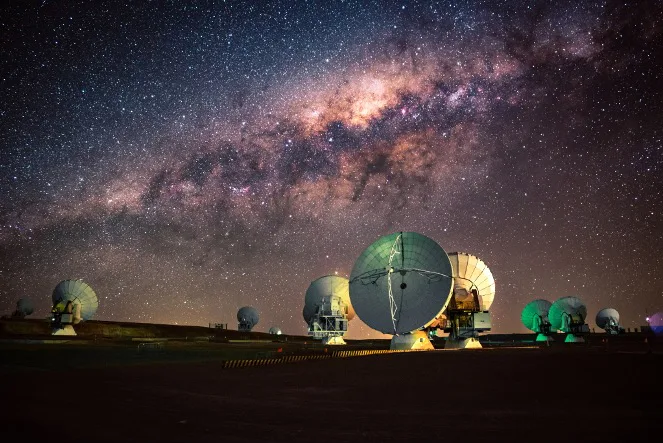
When considering the launch of a space telescope, establishing robust ground infrastructure is also critical for the mission’s success. There needs to be facilities capable of transmitting and receiving data from space, alongside ground-based observatories gathering direct measurements. The NRAO operates some of the globe’s most advanced radio observatories, like the Green Bank Telescope and the Atacama Large Millimeter/submillimeter Array (ALMA), which could facilitate data collection for the proposed satellite observatory.
Sara Issaoun, a Submillimeter Array Fellow at the CfA and the BHEX science operations lead, highlighted the importance of this collaboration: “NRAO operates some of the most sensitive radio observatories worldwide, making it an ideal partner for CfA in realizing this hybrid radio observatory. By merging space and ground-based observations, we will achieve unprecedented resolution and uncover new perspectives on these intriguing cosmic entities.”
The James Webb Space Telescope has captured the public’s attention over the past few years, but we must not overlook the venerable Hubble Space Telescope. While Webb boasts advanced technology and enhances our view of the cosmos, it is by no means a substitute for Hubble. New comparisons of images from both observatories highlight their unique strengths, showcasing the benefits of having both instruments working together for scientific exploration.
The spiral galaxy NGC 2090, featured in Webb’s image above, was captured using the MIRI and NIRCam instruments. These tools operate within the mid-infrared and near-infrared sections of the electromagnetic spectrum, resulting in the galaxy’s arms appearing bright red. This impressive display originates from swirling gas and dust, containing compounds known as polycyclic aromatic hydrocarbons that emit an infrared glow. Meanwhile, the blue center indicates a region filled with young, hot stars.
This captivating image from NASA/ESA Hubble Space Telescope showcases the spiral galaxy NGC 2090 in the constellation Columba. ESA/Hubble & NASA, D. Thilker
In contrast, Hubble’s view of the same galaxy, captured in visible light, reveals a different perspective. Here, the spiral arms are less prominent, but patchy areas of dust forming the galaxy’s disc become more evident.
NGC 2090 is a dynamic galaxy characterized by ongoing star formation across various stages of star development. The diverse ages of stars present offer valuable insights for researchers studying stellar evolution, allowing them to observe the life cycles of stars in differing stages. This galaxy was chosen for Webb’s observation as part of a broader project focused on understanding stellar evolution in nearby galaxies that are still in the process of star formation.
Hubble’s observations of NGC 2090 also contribute to research on star formation and were utilized in an initiative called the Extragalactic Distance Scale Key Project. This project centers around a specific type of star, known as Cepheid variable stars, which play a crucial role in determining the universe’s expansion rate.