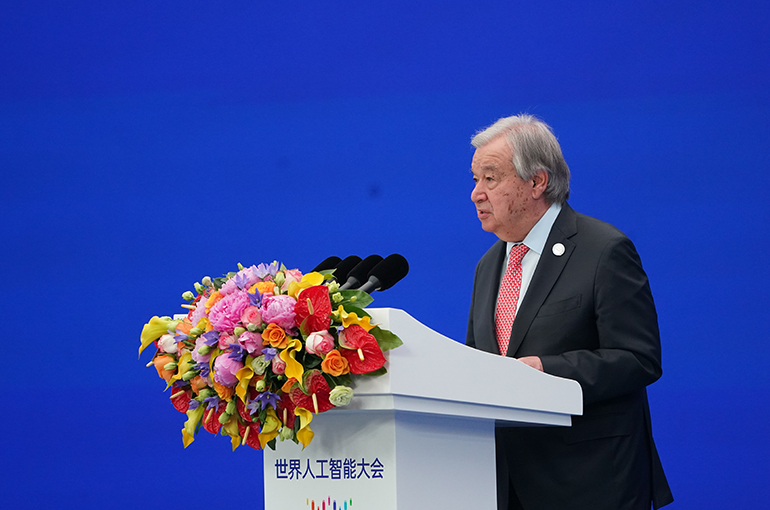
The Secretary-General of the United Nations recently explored China’s cutting-edge artificial intelligence innovations and engaged with robots and industry professionals at the World Artificial Intelligence Conference held in Shanghai, where he also delivered a keynote address.
While touring the exhibition, he visited the booth of a Chinese robotics startup, where a humanoid robot was demonstrating how to assemble a paper windmill. Footage from China Central Television shows that after being prompted by staff, the Secretary-General picked up a sheet of paper and flipped it over. The robot detected the change, adjusted the paper back to its correct position, and demonstrated its ability to adapt to unexpected situations.
He also examined an industrial timing control model created by a local company. This model, displayed at their booth, can be applied across various manufacturing sectors, including biological fermentation, wastewater treatment, and petrochemicals. It can simulate optimal production processes more than 100 hours into the future, helping to boost efficiency and output.
According to the company’s founder and a professor at Shanghai Jiao Tong University, the Secretary-General expressed keen interest in the technology’s practical applications. He inquired about its core value and emphasized three main benefits: reduced energy use, increased efficiency, and improved economic benefits.
At the conference’s opening, the Secretary-General highlighted the dual nature of artificial intelligence, stating, “AI could be humanity’s greatest opportunity in the 21st century, but it also presents significant risks.” He added, “AI has the potential to accelerate medical breakthroughs, revolutionize education, improve food systems and agricultural productivity, stimulate new industries, and create decent jobs.” However, he pointed out that a third of the global population remains offline, with many countries facing gaps in connectivity, infrastructure, energy access, and computing power. Data resources and technical expertise are still concentrated in a few places.
He emphasized that the technology shaping our future must be governed by all of humanity, not just a handful of countries or corporations. The priorities for harnessing AI for the common good, he said, are capability, safety, and sustainability, ensuring that all nations can benefit from the AI revolution.
The Secretary-General also visited MAZU, an AI-powered weather forecasting and early-warning system developed by the China Meteorological Administration. This system stands as the world’s first national plan created in response to the UN’s Early Warnings for All initiative.
He praised China’s contributions, noting that its platforms, satellites, and AI models are already helping dozens of countries enhance their early-warning systems. These tools are built collaboratively with developing nations, utilizing local data so that each country can issue its own alerts. “The tools introduced here today will expand that impact even further,” he said during the WAIC Meteorological Forum.