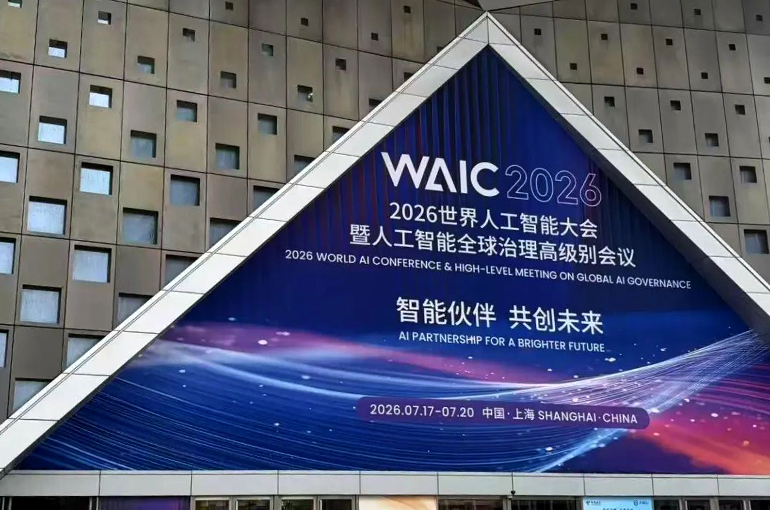
On the opening day of the 2026 World Artificial Intelligence Conference and the High-Level Meeting on Global AI Governance in Shanghai, nearly 30 Chinese and international entrepreneurs shared insights into the future of China’s AI industry, emphasizing critical areas such as open-source technology, embodied AI, industrial applications, and global AI governance.
Executives from abroad expressed strong confidence in China’s AI ecosystem. Alex Zhavoronkov, founder and co-CEO of an American biotech company, highlighted that China is harnessing advanced AI to create new drugs and improve treatments for various illnesses. He expressed enthusiasm about contributing to this innovative environment and committed to supporting China’s health and longevity sectors with talent, resources, and infrastructure.
Vincent Boinay, president of a major North Asian cosmetics brand and CEO of its Chinese operations, noted that China’s strategic investments, diverse application scenarios, and open innovation climate have established a robust foundation for global AI growth. He reaffirmed the company’s dedication to innovation within China, working with Chinese firms and for the Chinese market.
Lee Jae-chul, co-founder and CEO of a South Korean embodied AI tech company, revealed a partnership with a Chinese robotics firm. Their collaboration aims to combine high-precision synthetic data generation with digital engineering environments, helping manufacturers identify potential issues and test AI vision systems before implementing them on production lines.
Among Chinese business leaders, embodied AI and its industrial uses were among the most discussed topics. Jiang Xu, founder and CEO of a robotics startup, said the next phase of AI development should focus on enabling foundational models to mimic and improve upon human abilities in real-world environments. He believes embodied AI will continue to advance through extensive pre-training, alignment, and deployment.
Yu Enyuan, CEO of an autonomous vehicle company, mentioned the early potential for large-scale commercialization of physical AI in China’s logistics industry. He predicts that autonomous logistics systems will expand beyond transportation to include tasks like loading, unloading, and material handling.
Gong Yicheng, vice president of a leading e-commerce company and head of its cloud infrastructure division, pointed out that the shortage of high-quality, large-scale physical data remains a major obstacle for embodied AI development. His company intends to leverage real-world applications across logistics, retail, manufacturing, and healthcare sectors to gather better datasets for training robots.
Xue Fei, founder of a humanoid robotics firm, credited the rapid growth of China’s bionic robotics industry to sustained government investment in AI innovation and robust governance policies.
Zhang Jiaming, CEO of a manufacturer of emotional companion robots, said embodied intelligence has been incorporated into the nation’s strategic blueprint for future industries. He looks forward to integrating supply chains—from R&D and clinical validation to regulatory approval and mass production—to speed up deployment in healthcare and elderly care settings.
A global AI company emphasized that competition in this field isn’t a zero-sum game and that true security depends on transparency and openness rather than isolation. The firm remains committed to an open, trustworthy, inclusive approach aimed at societal benefit.
Safety and governance remain key concerns at the conference. Tony Li, founder and CEO of an autonomous solutions company, advocated establishing safety assessment standards for humanoid robots and promoting open-source sharing mechanisms within the framework of a global AI cooperation organization. He stressed that China should accelerate the development of safety standards for various scenarios to secure its leadership role in setting international benchmarks.
Li Chunzhi, COO of a humanoid robotics innovation center, argued that breaking down competition barriers and fostering collaboration among industry players, academia, and research institutions through open-source data sharing is essential to building a global, inclusive AI ecosystem.
Regarding corporate strategy and industry integration, Guo Wei, chairman of a major IT and cloud services firm, noted that the focus of worldwide AI competition has shifted from model capabilities to reorganizing organizational structures and management systems. His company is exploring a new “AI for Process” approach aimed at transforming operational productivity from mere intelligent change to meaningful, qualitative improvements.
Yang Zaifei, CEO of a tech group, advised moving past the focus on increasing model parameters. Instead, he emphasized developing strategic capabilities to control and steer large language models, improving the transition from research to practical industrial applications.
He described “new quality productive forces” as an innovation-driven growth model powered by disruptive technologies, advanced manufacturing, and green energy.
Zhang Qingyuan, CEO of a productivity software company, expressed hope for greater integration of Chinese AI innovations into the global ecosystem, enabling local firms to collaborate with international leaders and establish standards for next-generation productivity tools.
Zhen Lixin, head of an information company, said that as his firm expands its multimodal text recognition services overseas, it adheres to principles of openness and compliance to create a fair, secure international AI environment that respects regional data regulations.
Sun Changxun, CEO of a cloud-based communication solutions provider, indicated that China’s AI development should prioritize real-world applications and practical outcomes, advocating for open collaboration among global companies to establish governance frameworks.
These remarks reflect a shift among Chinese companies from focusing solely on model capabilities to emphasizing organizational efficiency and contributing to global standards.
Several industry leaders also discussed AI deployment strategies across specific sectors. Dr. Chris Lai of a biotech firm pointed out that AI’s greatest promise in life sciences isn’t just in speeding up R&D but in redefining life sciences to address cancer, immune disorders, and neurodegenerative diseases.
Li Shimin, CEO of an AI startup, highlighted China’s manufacturing systems, extensive developer network, and industrial use cases as major advantages for next-generation AI development. He is optimistic about more original Chinese AI technologies and open-source models going global.
Li Bin, senior VP of a supercomputing and data center firm, shared plans for deploying a new generation of intelligent computing infrastructure, including China’s first fully domestically developed supercomputer capable of supporting AI with 100,000 GPUs.
Zhou Bin, CEO of a robotics and embodied AI firm, stress the importance of establishing unified standards and open interfaces to connect AI agents and build an “intelligent partner network.” He also anticipates more robust applications in industrial, medical, and specialized markets.
Wang Yishan, CTO of an AI logistics firm, expects deeper integration of large AI models with physical logistics systems, aiming to solve labor shortages and operational inefficiencies through autonomous robots.
Huang Xiaohuang, chairman of a technological innovation company, emphasized that China’s rich industrial landscape provides ideal conditions for AI from experimental stages to widespread practical use. He advocates international collaboration to develop new concepts in industrial embodied AI.
Chen Lucheng, leader of an industrial internet platform, expressed a commitment to playing an active role in global AI governance and advancing industry collaborations, aiming to deliver mature solutions and elevate global manufacturing with Chinese AI innovations.
Several entrepreneurs focused on AI’s societal role. Chen Danian, chairman of a local AI incubator, observed that AI’s benefits for everyday users are still emerging. His organization plans to continue investing to connect industry resources and nurture young AI entrepreneurs.
Li Nan, CEO of an AI technology group, believes that AI’s most meaningful impact will be its ability to empower traditional agriculture with innovative technology.
Jia Xuefeng, CEO of an AI company specializing in elder care, envisions AI evolving from a passive tool to an active partner in addressing aging challenges. Yu Xiang, director of a local broadcasting network, hopes to integrate AI into community services, making it a trusted local companion.
This collection of statements illustrates a shift from intense model-centered competition to an emphasis on organizational efficiency, international standards, and societal benefits.