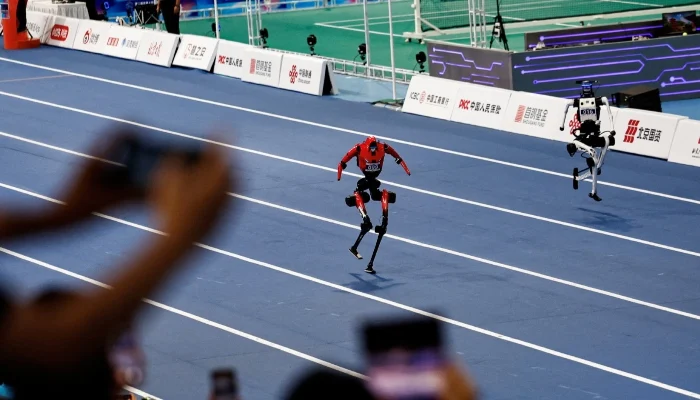
Spectators hold up their smartphones as humanoid robots compete in a 100-meter preliminary race during the opening ceremony of the 2026 World Humanoid Robot Games at Beijing’s National Speed Skating Oval on August 22, 2026. — Reuters
China’s humanoid robots have demonstrated they can run faster than the quickest human runners.
The challenge now is whether they can handle tasks like packaging and warehouse work reliably while performing precise operations such as connecting cables—diverse tasks that test their ability to work like humans in less glamorous roles.
The five-day World Humanoid Robot Games, which kicked off Saturday in Beijing, combines athletic-style competitions with simulations of factory floors, restaurants, offices, and emergency scenarios. The event emphasizes testing robots in practical settings, not just speed or agility.
Promoted heavily through Chinese state media, the event features 51 different competitions — including 30 sports-like events and 21 scenario-based challenges. Over 40% of these activities require robots to operate fully autonomously, according to Huawei, a technological partner for the event.
On Saturday, two robots surpassed Usain Bolt’s 9.58-second world record in the 100-meter sprint. This marked a significant improvement from 2025, when the winning robot completed the race in over 20 seconds. However, deceleration issues remain, as the robots tend to collide with a thick mat placed several meters beyond the finish line.
Another humanoid, identical to the 100-meter champion, ran 400 meters in 39.7 seconds—outperforming South African sprinter Wayde van Niekert’s world record of 43.03 seconds.
“The intensity of the competition is higher than last year, which puts a lot of pressure on the robots’ batteries and cooling systems,” said spectator and robotics investor Xu Qiaosheng. “This has huge implications for the development of China’s industrial sector.”
Upcoming competitions include tug-of-war and weightlifting, along with traditional Chinese sports like Tai Chi and a game called pitch-pot, where players toss arrow-like sticks into narrow-necked vases — blending ancient Chinese traditions with futuristic robotics.
### Small Flaws, Big Challenges
More revealing tests will occur when robots face real-world imperfections: a cable at the wrong angle, an object just out of reach, shifting packages, or missed steps. These scenarios evaluate whether robots can identify objects, precisely position their limbs, control the force applied, and recover from mistakes independently.
Yu Chao, CEO of Lumos Robotics, noted that the games could advance hardware development and showcase industry innovation. However, he emphasized that the true long-term value lies in solving real-world problems.
“Only when robots can operate effectively in these practical scenarios will their true utility be realized,” Yu explained. “Running and jumping alone doesn’t improve efficiency.”
Beyond traditional athletic demonstrations, competitions include tasks like electric vehicle charging, restaurant service, emergency incident management, and fine motor skill contests. Tasks such as industrial assembly and material loading also feature prominently. For example, a cable connection challenge tests vision, mechanical alignment, and force regulation.
The Beijing-based startup Galbot announced plans to host an autonomous humanoid tennis match, with robots playing singles and doubles, tracking balls, serving, and returning shots.
For Zeroth’s Chief Marketing Officer Hua Rong, the real test will come after these demonstrations, centered on whether commercially available robots can truly solve user problems once they’re on the market.
“The key question is whether these products can deliver practical solutions in everyday use,” she said.