Europe—What if only the Red Parts of Flags Were Left? 🇪🇺
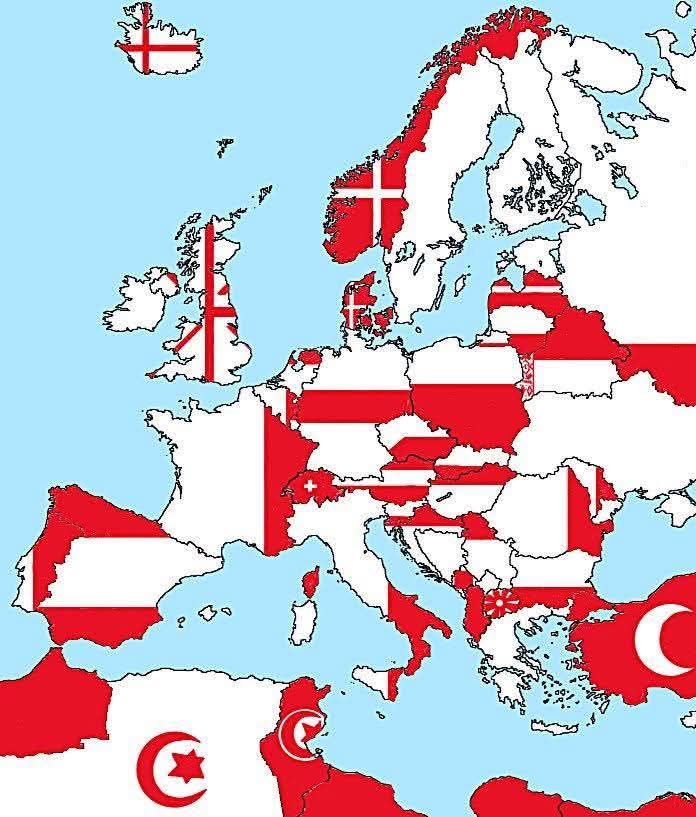
1. A Visual Shift in National Identities
Imagine a Europe where each country’s flag is reduced solely to its red elements. Countries like Italy, Spain, and Denmark would have stark, simplified designs, stripping away the white, blue, and other colors that define their symbols. This hypothetical change not only alters visual identities but also sparks questions about cultural significance and national pride. For instance, Italy’s green, white, and red tricolor would become a simple red vertical band, minimizing its flag’s historical roots and distinctiveness. Such an alteration would fundamentally change how countries are perceived within the continent.
2. Historical and Cultural Significance of Flag Colors
Flags aren’t just colors on a banner—they often symbolize pivotal moments, cultural values, or historical struggles. Take the Italian flag, for example, whose green, white, and red are emblematic of independence, peace, and patriotism. When reduced to just red, these deeper meanings could be overshadowed, possibly leading to a loss of nuance in how nations are represented globally. The presence of colors like white in Greece’s cross symbolizes purity and faith, which would be obliterated in this hypothetical red-only scenario.
3. Political Implications and Identity Preservation
National flags serve as political symbols that unite citizens during times of celebration or crisis. Removing all but the red elements could significantly impact national unity efforts. Countries like France, with its iconic blue, white, and red tricolor, would become a simple red, losing the distinctive blue stripe that signifies liberty. Similarly, the United Kingdom’s Union Jack, which combines crosses of different nations, losing its intricate design down to just red could diminish its symbolic complexity and the story it tells about Britain’s history.
4. The European Union’s Flag: A Case Study
The EU flag, featuring a circle of 12 gold stars on a blue background, visually communicates unity and harmony among member states. If only the red elements of member countries’ flags persisted, the Union’s visual identity would be drastically altered. The EU, often seen in diverse flags representing individual nations, would have a more uniform, less distinctive appearance — perhaps resembling a sea of red banners, diluting the continent’s rich diversity. Such a transformation could affect international branding and how Europe projects its unity.
5. Design Challenges and Artistic Interpretations
From an artistic perspective, creating flags that are solely composed of their red components raises intriguing design questions. How would symbols, emblems, or charges—like the eagle on Albania’s flag or the cross on Finland’s—translate into a simplified red-only version? Some countries might embrace minimalist designs, while others would find it challenging to maintain their cultural essence. This exercise highlights how visual symbols are inherently tied to color choices and artistic expression.
6. Impact on Tourism and International Perception
Tourism often hinges on national symbols and iconic visuals. A Europe where flags are reduced to red could lead to confusion, especially among travelers unfamiliar with national symbols. For example, the Dutch flag’s bright red, white, and blue are instantly recognizable; stripping it down to red might cause a loss of identity and recognition. Moreover, international events, such as the Olympics or World Cups, rely heavily on distinct flags for easy identification.
7. Potential for a New Cultural Renaissance?
While this red-only flag scenario might seem dystopian, it could also inspire a reimagining of national identities—prompting fresh designs, reinterpretations, and cultural debates. Some nations might adopt entirely new symbols or styles that emphasize shared attributes, like their predominant colors. Over time, this could lead to a new cultural renaissance, emphasizing unity through simplified but powerful symbols.
8. Final Reflection: What’s at Stake?
The idea of only having the red parts of flags in Europe prompts us to reflect on the importance of colors and symbols in national identities. Flags are more than decorative elements; they embody history, pride, and collective memory. In 2025, as Europe continues to evolve politically and culturally, understanding and preserving these symbols remains crucial to maintaining a sense of shared heritage and diversity across the continent.
In a continent driven by history, art, and symbolism, the concept of eliminating all but red from national flags reveals an intriguing, if unsettling, glimpse into what makes each nation unique—and what might be lost in the process.